

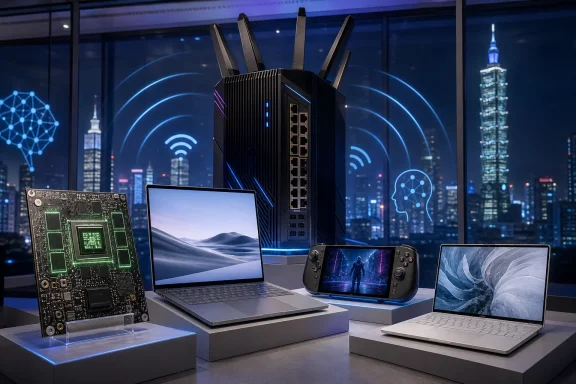
At Computex Taipei 2026, held June 2–5 in Taiwan, How-To Geek’s standout picks centered on NVIDIA’s RTX Spark Arm platform, Microsoft’s Surface Laptop Ultra, Intel Arc G3 handheld chips, Dell’s cheaper XPS 13, revived AMD X3D CPUs, and early Wi-Fi 8 routers. The common thread was not novelty for novelty’s sake. It was the industry’s search for a new PC bargain: more local AI, more efficient silicon, more repairable premium machines, and faster networking, preferably without asking buyers to accept another generation of incremental refreshes. Computex has always been where component strategy leaks into finished products, and this year the strategy was unusually plain.
CES sells vibes. MWC sells mobility. Computex sells the supply chain’s idea of the next five years, often before the consumer market has the vocabulary to ask for it.
That is why a show that can look painfully business-to-business from a distance often matters more to Windows users than flashier consumer events. The hinge design, the memory configuration, the router chipset, the cooling module, the NPU story, and the board partner lineup all appear here before they become back-to-school laptops, gaming handhelds, NAS boxes, and the next sysadmin headache.
The How-To Geek roundup correctly identifies the energy of Computex 2026 as unusually broad. This was not merely another year of thinner laptops and more RGB. The show’s center of gravity moved toward platforms: NVIDIA trying to make Arm PCs a serious Windows category, Intel trying to claw into handheld gaming, Dell and Apple’s shadows reshaping the midrange laptop market, AMD reselling an old CPU because the economics of upgrades have changed, and ASUS showing a Wi-Fi 8 router before Wi-Fi 8 has even fully settled into final form.
That mix sounds chaotic, but the argument underneath is coherent. The PC industry is no longer betting that one architectural answer will satisfy everyone. It is fragmenting into local AI workstations, efficient Arm laptops, gaming-first handhelds, bargain premium notebooks, long-tail upgrade platforms, and home networks that look suspiciously like small-business infrastructure.
RTX Spark is not just another AI accelerator being stapled onto an otherwise familiar Windows laptop. It is an Arm-based PC platform from the company that already owns much of the software gravity around AI development, GPU compute, creator acceleration, and high-end workstation credibility. That makes it a direct challenge to the assumption that Windows on Arm must live or die according to Qualcomm’s roadmap.
For years, Windows on Arm has been trapped between two truths. The first is that the idea makes obvious sense: better battery life, tighter integration, fanless or low-noise designs, and Apple-style efficiency are all things Windows laptop buyers plainly want. The second is that the ecosystem has lacked the ruthless coordination that made Apple Silicon work. Apple controlled the hardware, the operating system, the developer tools, the app distribution story, and the customer expectations. Microsoft and Qualcomm had to persuade an entire Windows ecosystem to move in sync.
NVIDIA changes that equation because it brings not only silicon but leverage. Developers already optimize for NVIDIA. AI tooling already assumes NVIDIA. Many creator and engineering workloads already orbit CUDA, TensorRT, RTX acceleration, and the broader NVIDIA stack. If RTX Spark becomes more than a boutique workstation platform, Windows on Arm finally gets a second anchor tenant.
That does not guarantee success. It may even sharpen the fragmentation problem if Microsoft, Qualcomm, NVIDIA, Intel, AMD, and OEMs all pursue partially overlapping definitions of an “AI PC.” But for Windows users who have watched Arm devices alternate between impressive demos and app-compatibility caveats, NVIDIA’s entrance is a real event. The company is not asking the market to believe in Arm because Arm is elegant. It is asking the market to believe in Arm because the AI workstation has become personal.
The reported specifications are deliberately provocative: a 20-core CPU, up to 128GB of unified memory, and the same maximum one-petaflop AI-performance framing attached to RTX Spark. The display story is equally premium, with a 15-inch mini-LED PixelSense Ultra touchscreen, a 3:2 aspect ratio, and a claimed 2000-nit peak HDR brightness. The ports and chassis sound like Microsoft is aiming squarely at buyers who might otherwise default to a MacBook Pro.
The interesting part is not whether the Surface Laptop Ultra beats a MacBook Pro in a synthetic benchmark. It is whether Microsoft can make Windows on Arm feel boring in the best possible way. Enterprise buyers do not want architectural romance. They want their VPN clients, EDR agents, browser extensions, device-management stack, printers, docks, accessibility tools, and obscure line-of-business applications to work.
That is where the Surface Laptop Ultra could matter beyond its likely high price. If Microsoft ships a flagship Arm laptop with visible repairability, accessible SSD and battery components, and QR-coded internal parts, it is sending a signal that this is not a sealed science project. It is trying to make the exotic look administrable.
Still, the risk is obvious. A late-2026 launch window leaves plenty of room for expectations to outrun software reality. Unified memory may be technically elegant, but buyers will still ask what happens when they need more, what configurations cost, how long firmware support lasts, and whether the machine behaves like a reliable Windows fleet device rather than a developer conference trophy.
Running large models locally changes the privacy, latency, and cost discussion. It lets developers test agents without round-tripping everything to the cloud. It gives companies a plausible reason to evaluate on-device inference for sensitive workflows. It also gives enthusiasts the chance to treat AI the way they once treated GPU rendering, virtualization, and home labs: as a workload worth building around.
But local AI is not free magic. A machine with 128GB of unified memory and serious accelerator hardware is not going to land in the same price band as a basic productivity laptop. The earliest RTX Spark systems may be aspirational devices for developers, creators, researchers, and corporate teams that can justify local experimentation. That is how many platform shifts begin: not as mass-market necessities, but as expensive proofs that eventually become cheaper and less weird.
The Windows angle is crucial. Microsoft wants Windows to be the operating system for agentic computing, but that requires more than Copilot branding. It requires hardware that can run meaningful local models, APIs that developers trust, battery behavior that users can tolerate, and security boundaries that administrators can explain. RTX Spark is not the whole answer, but it makes the question harder to ignore.
If the first generation works, it could reset expectations for premium Windows machines. A high-end PC may no longer be defined primarily by CPU cores, gaming frame rates, or screen quality. It may be defined by how much serious computation it can do privately, locally, and continuously.
Arc G3 is an attempt to correct that. Built around Panther Lake-era technology and aimed at handhelds, the platform is positioned against AMD’s Ryzen Z-series chips, with G3 Extreme using stronger integrated graphics than the standard version. Confirmed or expected devices from brands such as OneXPlayer, Acer, and MSI suggest Intel is not treating this as a paper launch.
The challenge is that handheld gaming is not won on silicon alone. It is won on drivers, frame pacing, standby behavior, thermals, battery profiles, firmware updates, storefront compatibility, and whether a device resumes from sleep without ruining someone’s train ride. AMD’s advantage has not been perfection; it has been that developers, Valve, OEMs, and users increasingly understand the shape of the platform.
Intel must therefore win twice. It needs to show that Arc G3 can deliver better performance per watt than AMD alternatives, and it needs to prove that the software stack will not make early adopters feel like unpaid QA. Arc graphics has improved dramatically since its rougher beginnings, but handheld buyers are less forgiving than desktop tinkerers. A GPU driver problem on a tower PC is annoying. On a handheld, it can make the whole device feel compromised.
The Linux question matters too. AMD’s position in handhelds has benefited from the Steam Deck ecosystem and the broader momentum around Linux gaming. If Arc G3 wants credibility beyond Windows handhelds, Intel needs cooperation from Valve and the open-source graphics community at the level where fixes arrive before YouTube reviewers declare the platform flaky.
The XPS line has long functioned as Windows’ answer to the MacBook: polished, compact, and sometimes too clever with its own design choices. This new XPS 13 appears to be Dell’s recognition that the middle of the market is worth fighting over again. A 13.4-inch 1600p 120Hz display, a thin and light chassis, 512GB of base storage, and promised long battery life are all strong signals for students and mainstream professionals who want a good laptop without entering workstation pricing.
The compromises matter. A mechanical touchpad instead of a haptic one, a more conventional keyboard, and 8GB of RAM in the base model are all reminders that the midrange premium category is built by subtraction. In 2026, 8GB on a Windows laptop is especially hard to love. Browser workloads, Teams, security software, background updaters, and AI-adjacent features have not exactly become lighter.
Still, Dell’s move is rational. If Apple presses downward with a cheaper MacBook, Windows OEMs cannot leave that price band to plastic bargain machines and last year’s clearance stock. The PC market needs machines that feel modern without demanding workstation money. The XPS 13 may not be the most exciting device at Computex, but it points to a healthier competitive pressure than another $3,000 flagship.
For IT departments, the question will be configuration discipline. A slim, affordable XPS with insufficient memory may be a false economy. A slightly more expensive configuration with enough RAM and storage could become exactly the sort of standard-issue laptop many organizations need.
The 5800X3D earned its reputation because 3D V-Cache made it unusually strong in games, and because AM4 became one of the rare modern desktop platforms with a genuinely long upgrade runway. Bringing it back at $350, reportedly with a thermal pad rather than a major silicon change, is less a technological triumph than a market confession. AMD is acknowledging that platform longevity is now a feature people will pay for.
That has consequences. The traditional desktop upgrade cycle pushed users toward new sockets, new motherboards, new memory standards, and often new cooling considerations. The AM4 story taught buyers to value continuity. If a board bought years ago can still host a meaningful gaming upgrade, that platform earns a kind of loyalty that benchmark charts alone cannot buy.
There is also a broader affordability angle. The AI boom has made advanced packaging, high-bandwidth memory, datacenter GPUs, and leading-edge capacity more strategically important and more expensive. Consumers feel that indirectly through pricing, availability, and product segmentation. Reintroducing a known-good gaming CPU is not glamorous, but it is a practical answer to a market where many buyers would rather extend a system than rebuild it.
The danger for AMD is that nostalgia can become a crutch. A revived 5800X3D is useful because AM4 was unusually successful, not because old products are inherently virtuous. The company still has to make newer platforms feel similarly durable. Otherwise, the anniversary chip becomes a reminder of a promise users fear may not be repeated.
That size is not just gamer theater. Multi-gig ports, high-end radio chains, early silicon, and heat dissipation all take space and power. Enthusiast routers have been drifting toward small-server territory for years, and Wi-Fi 8 appears likely to accelerate that trend at the top end. The home network is no longer just a broadband-sharing appliance. It is where cloud gaming, local NAS traffic, security cameras, smart-home devices, remote work, and increasingly AI-adjacent edge workloads collide.
The problem is timing. Buying into a pre-standard Wi-Fi generation is always a gamble. Vendors may promise firmware updates, but final certification can expose gaps between early hardware and the eventual standard. Wi-Fi 6E and Wi-Fi 7 already taught enthusiasts that headline throughput is only part of the story; client support, regional spectrum rules, firmware maturity, and mesh behavior matter just as much.
For most homes, a giant early Wi-Fi 8 router will be unnecessary. For enthusiasts and small offices, it may be a preview of where the network is headed: more wired backhaul, more 2.5GbE and 10GbE ports, more heat, more software complexity, and more pressure to treat the router as critical infrastructure rather than a box to reboot when Netflix stutters.
ASUS deserves credit for showing where the bleeding edge is going, but early adopters should remember the first rule of networking hardware: standards finalize slowly, and routers age in public. The best Wi-Fi 8 router for most people may not be the first one they see.
That fragmentation is exciting, but it pushes risk downstream. Users and IT departments will be asked to make bets on architectures, standards, memory models, and software ecosystems that are still settling. The buying decision is no longer simply “which laptop is faster?” It is “which platform will still make sense in three years?”
Windows users know this problem well. The Windows ecosystem’s greatest strength is variety, and its greatest weakness is also variety. A Mac buyer chooses between a narrow set of Apple-controlled machines. A Windows buyer chooses between x86 and Arm, Intel and AMD and NVIDIA, NPUs and GPUs, local AI and cloud AI, OLED and mini-LED, Wi-Fi 7 and early Wi-Fi 8, repairable designs and sealed slabs, gaming handhelds with Windows and handhelds that would rather be SteamOS devices.
For enthusiasts, that variety is the hobby. For administrators, it is a validation matrix. Every new architecture means driver questions. Every new accelerator means management questions. Every new wireless standard means support calls from someone who bought a router before the clients caught up.
The optimistic reading is that Computex 2026 shows the PC escaping stagnation. The pessimistic reading is that the industry is rebuilding the compatibility maze just as users were beginning to understand what an AI PC even means. Both readings can be true.
The devices How-To Geek singled out from Computex 2026 are exciting because they point beyond the usual annual refresh, but they also demand patience. RTX Spark could help Windows on Arm grow up, Surface Laptop Ultra could make local AI feel practical, Arc G3 could turn Intel into a real handheld contender, and Wi-Fi 8 could make home networks faster and stranger than ever. The winners will not be decided by keynote numbers in Taipei; they will be decided months later, in driver updates, firmware fixes, benchmark databases, enterprise pilots, repair guides, and the quiet moment when a new kind of PC stops feeling new.
 Computex Stopped Pretending the PC Is Just a PC
CES sells vibes. MWC sells mobility. Computex sells the supply chain’s idea of the next five years, often before the consumer market has the vocabulary to ask for it.That is why a show that can look painfully business-to-business from a distance often matters more to Windows users than flashier consumer events. The hinge design, the memory configuration, the router chipset, the cooling module, the NPU story, and the board partner lineup all appear here before they become back-to-school laptops, gaming handhelds, NAS boxes, and the next sysadmin headache.
The How-To Geek roundup correctly identifies the energy of Computex 2026 as unusually broad. This was not merely another year of thinner laptops and more RGB. The show’s center of gravity moved toward platforms: NVIDIA trying to make Arm PCs a serious Windows category, Intel trying to claw into handheld gaming, Dell and Apple’s shadows reshaping the midrange laptop market, AMD reselling an old CPU because the economics of upgrades have changed, and ASUS showing a Wi-Fi 8 router before Wi-Fi 8 has even fully settled into final form.
That mix sounds chaotic, but the argument underneath is coherent. The PC industry is no longer betting that one architectural answer will satisfy everyone. It is fragmenting into local AI workstations, efficient Arm laptops, gaming-first handhelds, bargain premium notebooks, long-tail upgrade platforms, and home networks that look suspiciously like small-business infrastructure.
NVIDIA’s RTX Spark Is the Arm PC Moment Qualcomm Wanted to Own
The most important Computex 2026 story is NVIDIA’s RTX Spark, also referred to around the show as the n1x platform. The headline number is the kind NVIDIA loves: up to a petaflop of AI compute and as much as 128GB of unified memory, enough to run very large local models by laptop standards. But the architecture matters more than the marketing figure.RTX Spark is not just another AI accelerator being stapled onto an otherwise familiar Windows laptop. It is an Arm-based PC platform from the company that already owns much of the software gravity around AI development, GPU compute, creator acceleration, and high-end workstation credibility. That makes it a direct challenge to the assumption that Windows on Arm must live or die according to Qualcomm’s roadmap.
For years, Windows on Arm has been trapped between two truths. The first is that the idea makes obvious sense: better battery life, tighter integration, fanless or low-noise designs, and Apple-style efficiency are all things Windows laptop buyers plainly want. The second is that the ecosystem has lacked the ruthless coordination that made Apple Silicon work. Apple controlled the hardware, the operating system, the developer tools, the app distribution story, and the customer expectations. Microsoft and Qualcomm had to persuade an entire Windows ecosystem to move in sync.
NVIDIA changes that equation because it brings not only silicon but leverage. Developers already optimize for NVIDIA. AI tooling already assumes NVIDIA. Many creator and engineering workloads already orbit CUDA, TensorRT, RTX acceleration, and the broader NVIDIA stack. If RTX Spark becomes more than a boutique workstation platform, Windows on Arm finally gets a second anchor tenant.
That does not guarantee success. It may even sharpen the fragmentation problem if Microsoft, Qualcomm, NVIDIA, Intel, AMD, and OEMs all pursue partially overlapping definitions of an “AI PC.” But for Windows users who have watched Arm devices alternate between impressive demos and app-compatibility caveats, NVIDIA’s entrance is a real event. The company is not asking the market to believe in Arm because Arm is elegant. It is asking the market to believe in Arm because the AI workstation has become personal.
Surface Laptop Ultra Turns Microsoft’s Hardware Line Into a Platform Statement
Microsoft’s Surface Laptop Ultra is the natural companion to RTX Spark because Surface has always been Microsoft’s way of arguing with its own OEM ecosystem. Sometimes that argument is about tablets. Sometimes it is about touchscreens, pen input, repairability, or premium materials. This time, the argument is that a Windows laptop can be a local AI workstation without looking like a mobile server.The reported specifications are deliberately provocative: a 20-core CPU, up to 128GB of unified memory, and the same maximum one-petaflop AI-performance framing attached to RTX Spark. The display story is equally premium, with a 15-inch mini-LED PixelSense Ultra touchscreen, a 3:2 aspect ratio, and a claimed 2000-nit peak HDR brightness. The ports and chassis sound like Microsoft is aiming squarely at buyers who might otherwise default to a MacBook Pro.
The interesting part is not whether the Surface Laptop Ultra beats a MacBook Pro in a synthetic benchmark. It is whether Microsoft can make Windows on Arm feel boring in the best possible way. Enterprise buyers do not want architectural romance. They want their VPN clients, EDR agents, browser extensions, device-management stack, printers, docks, accessibility tools, and obscure line-of-business applications to work.
That is where the Surface Laptop Ultra could matter beyond its likely high price. If Microsoft ships a flagship Arm laptop with visible repairability, accessible SSD and battery components, and QR-coded internal parts, it is sending a signal that this is not a sealed science project. It is trying to make the exotic look administrable.
Still, the risk is obvious. A late-2026 launch window leaves plenty of room for expectations to outrun software reality. Unified memory may be technically elegant, but buyers will still ask what happens when they need more, what configurations cost, how long firmware support lasts, and whether the machine behaves like a reliable Windows fleet device rather than a developer conference trophy.
The AI PC Finally Becomes Local, Expensive, and Hard to Ignore
The industry’s AI PC pitch has been muddy for two years because too much of it sounded like a branding exercise. Add an NPU, redraw a taskbar icon, run a few camera effects, and declare the machine ready for the future. RTX Spark pushes the conversation into a different register because local model capacity is no longer a decorative feature.Running large models locally changes the privacy, latency, and cost discussion. It lets developers test agents without round-tripping everything to the cloud. It gives companies a plausible reason to evaluate on-device inference for sensitive workflows. It also gives enthusiasts the chance to treat AI the way they once treated GPU rendering, virtualization, and home labs: as a workload worth building around.
But local AI is not free magic. A machine with 128GB of unified memory and serious accelerator hardware is not going to land in the same price band as a basic productivity laptop. The earliest RTX Spark systems may be aspirational devices for developers, creators, researchers, and corporate teams that can justify local experimentation. That is how many platform shifts begin: not as mass-market necessities, but as expensive proofs that eventually become cheaper and less weird.
The Windows angle is crucial. Microsoft wants Windows to be the operating system for agentic computing, but that requires more than Copilot branding. It requires hardware that can run meaningful local models, APIs that developers trust, battery behavior that users can tolerate, and security boundaries that administrators can explain. RTX Spark is not the whole answer, but it makes the question harder to ignore.
If the first generation works, it could reset expectations for premium Windows machines. A high-end PC may no longer be defined primarily by CPU cores, gaming frame rates, or screen quality. It may be defined by how much serious computation it can do privately, locally, and continuously.
Intel’s Arc G3 Handheld Play Is Late, but Not Necessarily Too Late
Intel’s Arc G3 and G3 Extreme announcement reads like a company finally noticing that AMD had been allowed to build a handheld gaming franchise almost by default. The Steam Deck, ROG Ally, Legion Go, and their many cousins made AMD’s integrated graphics and semi-custom instincts feel like the natural center of portable PC gaming. Intel, despite years of talking up graphics ambition, often seemed more interested in proving Arc belonged in desktop cards than in owning a fast-growing mobile niche.Arc G3 is an attempt to correct that. Built around Panther Lake-era technology and aimed at handhelds, the platform is positioned against AMD’s Ryzen Z-series chips, with G3 Extreme using stronger integrated graphics than the standard version. Confirmed or expected devices from brands such as OneXPlayer, Acer, and MSI suggest Intel is not treating this as a paper launch.
The challenge is that handheld gaming is not won on silicon alone. It is won on drivers, frame pacing, standby behavior, thermals, battery profiles, firmware updates, storefront compatibility, and whether a device resumes from sleep without ruining someone’s train ride. AMD’s advantage has not been perfection; it has been that developers, Valve, OEMs, and users increasingly understand the shape of the platform.
Intel must therefore win twice. It needs to show that Arc G3 can deliver better performance per watt than AMD alternatives, and it needs to prove that the software stack will not make early adopters feel like unpaid QA. Arc graphics has improved dramatically since its rougher beginnings, but handheld buyers are less forgiving than desktop tinkerers. A GPU driver problem on a tower PC is annoying. On a handheld, it can make the whole device feel compromised.
The Linux question matters too. AMD’s position in handhelds has benefited from the Steam Deck ecosystem and the broader momentum around Linux gaming. If Arc G3 wants credibility beyond Windows handhelds, Intel needs cooperation from Valve and the open-source graphics community at the level where fixes arrive before YouTube reviewers declare the platform flaky.
Dell’s Cheaper XPS 13 Shows the Premium Laptop Market Getting Squeezed From Below
The refreshed Dell XPS 13 is not as dramatic as RTX Spark, but it may matter to more buyers. A $700 premium-adjacent Windows laptop, or $600 with a student discount, is a direct response to a market that has become uncomfortably polarized. At one end are expensive AI workstations and creator laptops. At the other are cheap machines that too often feel like punishment.The XPS line has long functioned as Windows’ answer to the MacBook: polished, compact, and sometimes too clever with its own design choices. This new XPS 13 appears to be Dell’s recognition that the middle of the market is worth fighting over again. A 13.4-inch 1600p 120Hz display, a thin and light chassis, 512GB of base storage, and promised long battery life are all strong signals for students and mainstream professionals who want a good laptop without entering workstation pricing.
The compromises matter. A mechanical touchpad instead of a haptic one, a more conventional keyboard, and 8GB of RAM in the base model are all reminders that the midrange premium category is built by subtraction. In 2026, 8GB on a Windows laptop is especially hard to love. Browser workloads, Teams, security software, background updaters, and AI-adjacent features have not exactly become lighter.
Still, Dell’s move is rational. If Apple presses downward with a cheaper MacBook, Windows OEMs cannot leave that price band to plastic bargain machines and last year’s clearance stock. The PC market needs machines that feel modern without demanding workstation money. The XPS 13 may not be the most exciting device at Computex, but it points to a healthier competitive pressure than another $3,000 flagship.
For IT departments, the question will be configuration discipline. A slim, affordable XPS with insufficient memory may be a false economy. A slightly more expensive configuration with enough RAM and storage could become exactly the sort of standard-issue laptop many organizations need.
AMD’s Ryzen 7 5800X3D Revival Admits the Upgrade Economy Has Changed
AMD’s decision to revive the Ryzen 7 5800X3D in a 10th Anniversary Edition is strange only if one assumes the desktop CPU market still moves in clean generational steps. In practice, millions of users are sitting on perfectly serviceable AM4 systems, watching GPU prices, memory prices, and AI-driven component demand distort upgrade plans. For them, the best new CPU may be an old CPU with a fresh warranty.The 5800X3D earned its reputation because 3D V-Cache made it unusually strong in games, and because AM4 became one of the rare modern desktop platforms with a genuinely long upgrade runway. Bringing it back at $350, reportedly with a thermal pad rather than a major silicon change, is less a technological triumph than a market confession. AMD is acknowledging that platform longevity is now a feature people will pay for.
That has consequences. The traditional desktop upgrade cycle pushed users toward new sockets, new motherboards, new memory standards, and often new cooling considerations. The AM4 story taught buyers to value continuity. If a board bought years ago can still host a meaningful gaming upgrade, that platform earns a kind of loyalty that benchmark charts alone cannot buy.
There is also a broader affordability angle. The AI boom has made advanced packaging, high-bandwidth memory, datacenter GPUs, and leading-edge capacity more strategically important and more expensive. Consumers feel that indirectly through pricing, availability, and product segmentation. Reintroducing a known-good gaming CPU is not glamorous, but it is a practical answer to a market where many buyers would rather extend a system than rebuild it.
The danger for AMD is that nostalgia can become a crutch. A revived 5800X3D is useful because AM4 was unusually successful, not because old products are inherently virtuous. The company still has to make newer platforms feel similarly durable. Otherwise, the anniversary chip becomes a reminder of a promise users fear may not be repeated.
ASUS’ Giant Wi-Fi 8 Router Is a Warning From the Future
The ASUS ROG Rapture GT-BN98 Pro may be the most Computex product in the entire roundup: enormous, aggressive, premature, and probably more revealing than its spec sheet. It is an early Wi-Fi 8 router arriving before the standard is finalized, with multi-gig Ethernet, claims of lower latency and better coverage, and a chassis large enough to become part of the conversation.That size is not just gamer theater. Multi-gig ports, high-end radio chains, early silicon, and heat dissipation all take space and power. Enthusiast routers have been drifting toward small-server territory for years, and Wi-Fi 8 appears likely to accelerate that trend at the top end. The home network is no longer just a broadband-sharing appliance. It is where cloud gaming, local NAS traffic, security cameras, smart-home devices, remote work, and increasingly AI-adjacent edge workloads collide.
The problem is timing. Buying into a pre-standard Wi-Fi generation is always a gamble. Vendors may promise firmware updates, but final certification can expose gaps between early hardware and the eventual standard. Wi-Fi 6E and Wi-Fi 7 already taught enthusiasts that headline throughput is only part of the story; client support, regional spectrum rules, firmware maturity, and mesh behavior matter just as much.
For most homes, a giant early Wi-Fi 8 router will be unnecessary. For enthusiasts and small offices, it may be a preview of where the network is headed: more wired backhaul, more 2.5GbE and 10GbE ports, more heat, more software complexity, and more pressure to treat the router as critical infrastructure rather than a box to reboot when Netflix stutters.
ASUS deserves credit for showing where the bleeding edge is going, but early adopters should remember the first rule of networking hardware: standards finalize slowly, and routers age in public. The best Wi-Fi 8 router for most people may not be the first one they see.
The Real Computex Story Is Platform Risk
Taken together, these announcements show an industry chasing opportunity through fragmentation. NVIDIA wants to make Arm Windows machines serious by attaching them to local AI. Microsoft wants Surface to prove that such machines can look like polished premium PCs. Intel wants handheld gaming to become a second chance for Arc. Dell wants to defend the affordable premium laptop. AMD wants to monetize platform longevity. ASUS wants to sell tomorrow’s network before tomorrow has finished writing its standard.That fragmentation is exciting, but it pushes risk downstream. Users and IT departments will be asked to make bets on architectures, standards, memory models, and software ecosystems that are still settling. The buying decision is no longer simply “which laptop is faster?” It is “which platform will still make sense in three years?”
Windows users know this problem well. The Windows ecosystem’s greatest strength is variety, and its greatest weakness is also variety. A Mac buyer chooses between a narrow set of Apple-controlled machines. A Windows buyer chooses between x86 and Arm, Intel and AMD and NVIDIA, NPUs and GPUs, local AI and cloud AI, OLED and mini-LED, Wi-Fi 7 and early Wi-Fi 8, repairable designs and sealed slabs, gaming handhelds with Windows and handhelds that would rather be SteamOS devices.
For enthusiasts, that variety is the hobby. For administrators, it is a validation matrix. Every new architecture means driver questions. Every new accelerator means management questions. Every new wireless standard means support calls from someone who bought a router before the clients caught up.
The optimistic reading is that Computex 2026 shows the PC escaping stagnation. The pessimistic reading is that the industry is rebuilding the compatibility maze just as users were beginning to understand what an AI PC even means. Both readings can be true.
The Pieces That Will Matter After the Booth Lights Go Dark
The most concrete lesson from this year’s Computex crop is that buyers should pay less attention to launch spectacle and more attention to ecosystem follow-through. The best products in this lineup will be the ones whose software, pricing, thermals, and support policies survive contact with normal users.- NVIDIA’s RTX Spark is important because it gives Windows on Arm a powerful second pole beyond Qualcomm, but its success depends on app compatibility, developer tools, pricing, and OEM execution.
- Microsoft’s Surface Laptop Ultra could become the first truly convincing flagship Arm Windows laptop, but only if it behaves like a dependable Windows machine rather than a showcase for local AI demos.
- Intel’s Arc G3 handheld chips give AMD real competition in portable PC gaming, but drivers, Linux support, and OEM battery tuning will decide whether the hardware advantage matters.
- Dell’s cheaper XPS 13 is a sign that the premium laptop market is moving downward again, though base memory configurations could determine whether it feels like value or compromise.
- AMD’s Ryzen 7 5800X3D revival proves that long-lived platforms can become strategic assets, especially when component prices make full rebuilds harder to justify.
- ASUS’ early Wi-Fi 8 router is a glimpse of the multi-gig home network future, but pre-standard hardware remains a bet for enthusiasts rather than a sensible default for ordinary households.
The devices How-To Geek singled out from Computex 2026 are exciting because they point beyond the usual annual refresh, but they also demand patience. RTX Spark could help Windows on Arm grow up, Surface Laptop Ultra could make local AI feel practical, Arc G3 could turn Intel into a real handheld contender, and Wi-Fi 8 could make home networks faster and stranger than ever. The winners will not be decided by keynote numbers in Taipei; they will be decided months later, in driver updates, firmware fixes, benchmark databases, enterprise pilots, repair guides, and the quiet moment when a new kind of PC stops feeling new.
References
- Primary source: How-To Geek
Published: 2026-06-08T17:56:06.570978
Loading…
www.howtogeek.com - Related coverage: tomshardware.com
Loading…
www.tomshardware.com - Related coverage: techradar.com
Loading…
www.techradar.com - Related coverage: pcgamer.com
Loading…
www.pcgamer.com - Related coverage: windowscentral.com
Microsoft and NVIDIA’s Surface Laptop Ultra pushes Windows on Arm into high‑performance territory
Microsoft and NVIDIA unveil the Surface Laptop Ultra, a 128GB RAM beast with Blackwell graphics and a mini-LED display that redefines performance for Windows on Arm. www.windowscentral.com
- Related coverage: computex-taipei.jp
開催概要 | COMPUTEX TAIPEI
COMPUTEX TAIPEI について台北国際コンピュータ見本市(COMPUTEX TAIPEI)は、世界を代表するAIとスタートアップの展示会として、世界中の起業家の皆様に産業の知識交流のためのプラットフォームを提供し、さらなる技術... computex-taipei.jp
- Related coverage: gigabyte.com
Loading…
www.gigabyte.com - Related coverage: notebookcheck.com
Loading…
www.notebookcheck.com - Related coverage: my.computex.biz
Loading…
my.computex.biz - Related coverage: axios.com

Microsoft debuts Nvidia-powered Microsoft Surface Ultra laptop
Microsoft is trying again to redefine the PC for the AI era.www.axios.com
- Related coverage: lensmor.com
Loading…
www.lensmor.com - Related coverage: laptopmedia.com
Loading…
laptopmedia.com - Related coverage: tomsguide.com
Loading…
www.tomsguide.com - Related coverage: qualcomm.com
Loading…
www.qualcomm.com - Related coverage: computex.co.jp
Loading…
www.computex.co.jp - Related coverage: techxplore.com
Loading…
techxplore.com - Related coverage: computex.biz
Loading…
www.computex.biz - Related coverage: cloudcdn.taiwantradeshows.com.tw
Loading…
cloudcdn.taiwantradeshows.com.tw