

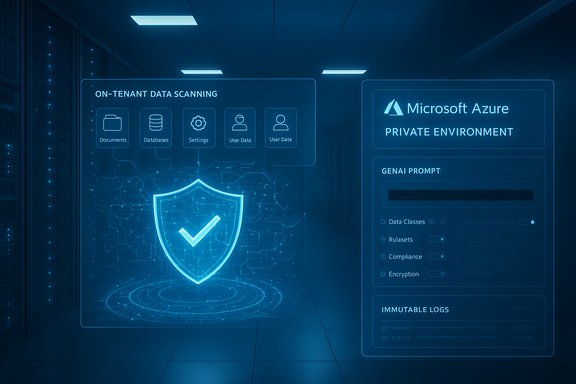
Concentric AI’s new Private Scan Manager for Microsoft Azure expands the company’s Semantic Intelligence™ data security governance platform into private Azure environments, promising on‑tenant scanning, category‑aware DLP for GenAI use, and an option for highly regulated customers that must keep raw data within their own cloud or on‑prem footprint.
Concentric AI’s Semantic Intelligence platform has positioned itself as a hybrid Data Security Posture Management (DSPM) and Data Loss Prevention (DLP) solution that emphasizes semantic, context‑aware classification of both structured and unstructured data. The vendor has pushed the narrative that rule‑based approaches—keywords, regex and static patterns—fail at scale for modern, messy enterprise content; instead, Concentric relies on deep learning and patented semantic classification to detect PII, PCI, PHI, intellectual property, and other business‑critical categories. The company’s December 17, 2025 Business Wire announcement adds a new deployment model: Private Scan Manager for Azure, enabling organizations to deploy Concentric’s scanning and categorization components inside a private Microsoft Azure cloud (including environments aligned with government requirements). Concentric says this option follows earlier work to support private scanning on AWS and gives customers a choice between private cloud deployments on either of the two major hyperscalers. This release arrives against a broader industry backdrop where enterprises are balancing the productivity and scale of SaaS GenAI tools with strict regulatory and data‑sovereignty requirements. Agencies and contractors handling Controlled Unclassified Information (CUI) increasingly rely on Government Community Cloud (GCC) High, Azure Government, or private Azure/Azure Stack variants to meet FedRAMP, DFARS, ITAR and other constraints. Microsoft’s documentation and community guidance make it clear: GCC High and other US‑sovereign offerings are the recommended path for workloads that must protect CUI and other sensitive regulated data. Deployments that claim to “keep data on‑prem” need careful architecture and contractual clarity to meet those obligations.
Source: pharmiweb.com Concentric AI Introduces Private Scan Manager for Azure to Enable Compliance and Comprehensive GenAI
 Background
Concentric AI’s Semantic Intelligence platform has positioned itself as a hybrid Data Security Posture Management (DSPM) and Data Loss Prevention (DLP) solution that emphasizes semantic, context‑aware classification of both structured and unstructured data. The vendor has pushed the narrative that rule‑based approaches—keywords, regex and static patterns—fail at scale for modern, messy enterprise content; instead, Concentric relies on deep learning and patented semantic classification to detect PII, PCI, PHI, intellectual property, and other business‑critical categories. The company’s December 17, 2025 Business Wire announcement adds a new deployment model: Private Scan Manager for Azure, enabling organizations to deploy Concentric’s scanning and categorization components inside a private Microsoft Azure cloud (including environments aligned with government requirements). Concentric says this option follows earlier work to support private scanning on AWS and gives customers a choice between private cloud deployments on either of the two major hyperscalers. This release arrives against a broader industry backdrop where enterprises are balancing the productivity and scale of SaaS GenAI tools with strict regulatory and data‑sovereignty requirements. Agencies and contractors handling Controlled Unclassified Information (CUI) increasingly rely on Government Community Cloud (GCC) High, Azure Government, or private Azure/Azure Stack variants to meet FedRAMP, DFARS, ITAR and other constraints. Microsoft’s documentation and community guidance make it clear: GCC High and other US‑sovereign offerings are the recommended path for workloads that must protect CUI and other sensitive regulated data. Deployments that claim to “keep data on‑prem” need careful architecture and contractual clarity to meet those obligations. What Concentric AI announced (what the product does)
Private Scan Manager for Azure — the vendor description
- All raw data scanning and categorization occurs inside the customer’s private Microsoft Azure cloud. Concentric positions this as enabling compliance while offloading heavy compute and operations: the Private Scan Manager runs in the customer’s tenant or private Azure environment and connects to the vendor’s Semantic Intelligence control plane for policy and remediation orchestration.
- The platform claims to cover data at rest and data in motion and extend protections into GenAI workflows — e.g., identifying sensitive content before it is pasted into or uploaded to ChatGPT, Copilot, or other LLM tools. Concentric highlights its category‑aware DLP, continuous risk monitoring, automated remediation (fixing excessive permissions, quarantining unclassified data, revoking risky shares), and Copilot/GenAI “risk tiles” for visibility into risky prompts.
- Concentric also emphasizes patented semantic categorization and recent patent grants, which the company says underpin its ability to identify nuanced content categories beyond PII/PCI/PHI (for example, IP or “critical business documents”).
Where Private Scan Manager fits into enterprise architectures
Deploying Private Scan Manager for Azure is pitched as a middle ground between:- Running Concentric entirely as a SaaS offering (where raw scanning may occur in Concentric’s cloud), and
- Building and operating an in‑house scanner solution on commodity servers.
Why this matters: compliance, GenAI risk, and operational tradeoffs
Compliance and data residency (GCC High and CUI)
For government contractors and agencies handling CUI, the data residency and contractual guarantees matter. Microsoft’s guidance repeatedly points to GCC High and Azure Government as the appropriate environments for many categories of CUI and export‑controlled data (ITAR/EAR). If an organization’s compliance posture requires contractual FedRAMP High commitments or other government‑grade controls, an on‑tenant Azure deployment or Azure Government tenancy can be the right platform to host scanner infrastructure and retain raw data inside required boundaries. Concentric explicitly calls out GCC High customers and public‑sector entities as a target for this Azure deployment model.GenAI data security: preventing prompt egress and shadow GenAI
Enterprises are wrestling with accidental or intentional leakage of sensitive data into third‑party GenAI tools. Concentric’s platform aims to intervene across the data lifecycle: discover sensitive content, label it semantically, apply category‑aware DLP (block/warn/redact when a user attempts to paste or upload data into a GenAI app), and provide continuous monitoring for risky sharing or anomalous access. These are precisely the controls recommended in industry playbooks for safe GenAI adoption—classify first, then control egress and maintain audit trails. Concentric’s integration claims (for example, with ChatGPT Enterprise’s Compliance API) reinforce that the vendor is targeting this vector.Operational tradeoffs and FinOps
Deploying scanning in a private Azure tenant reduces the risk of moving raw content into a vendor cloud, but it does not eliminate cost or complexity. Running high‑throughput semantic classification at scale requires significant CPU/GPU resources, fast I/O and robust orchestration. Concentric’s pitch is that it handles the heavy lifting (software + managed services) while customers supply Azure compute/storage and retain residency. That tradeoff—vendor managed software, customer provided infrastructure—can be attractive, but organizations must still evaluate compute sizing, network egress, storage costs, and SLAs. Public cloud “private tenancy” may shift but not remove FinOps complexities.Technical analysis: claims, strengths, and what to verify
Claim: “Semantic Intelligence uses patented AI to understand context, not rules”
Strengths:- The semantic approach addresses the bluntness of regex/keyword classifiers and is better suited to unstructured corporate content (contracts, source code, design docs).
- Concentric lists multiple patents and recent grants describing semantic grouping, category assignment at arbitrary granularity, and behavior contextualization — a plausible basis for stronger classification performance.
- Semantic models can outperform rule engines in recall/precision, but vendor claims must be validated with representative datasets. Organizations should request precision/recall numbers on their data types and run pilot scans.
- Patents explain technique but do not guarantee production quality at scale across every language, region, or vertical document set.
Claim: “Category‑aware DLP protects sensitive data from being leaked through email and GenAI”
Strengths:- Concentric’s product materials describe specific integrations (e.g., ChatGPT Enterprise Compliance API) and DLP actions (warn/block/redact) for third‑party GenAI tools; these are practical features for real‑world GenAI governance.
- Latency and UX: synchronous blocking or redaction for every user‑side GenAI prompt can introduce latency or reduce productivity. Test policies for false positives that could frustrate users.
- Coverage: DLP must be enforced across the full range of interaction vectors (browser plugins, API usage, managed vs unmanaged devices). Verify connectors and enforcement points.
Claim: “Private Scan Manager for Azure avoids the need to run software on customer servers”
Strengths:- Running in a private Azure tenant is operationally simpler than deploying a vendor appliance or dedicated on‑prem cluster; it leverages cloud elasticity and Azure managed services. Microsoft’s Azure Stack / Azure Local options give customers choices for private or sovereign operations.
- The “no need to run on‑prem servers” claim depends on the Azure topology (Azure Government vs Azure Local vs on‑prem Azure Stack). For truly air‑gapped or disconnected sites, Azure Local / Azure Stack Hub still requires specific network and support arrangements; confirm compatibility and any offline constraints.
Market context and vendor positioning
Concentric is moving into a competitive landscape where several established DSPM/DLP/PDPM vendors and newer startups are fighting for the same regulatory‑sensitive customers. Two market realities matter:- Many legacy data security vendors are retreating from full on‑prem support and are optimizing for cloud‑native SaaS delivery. Concentric emphasizes its choice for customers—preserving private deployments where required—positioning that as a market differentiator. The vendor’s press materials explicitly call out legacy players “discontinuing” on‑prem options as rationale for their approach.
- Hyperscalers and cloud security ecosystems now offer integrated tooling for DSPM and DLP (Microsoft Purview, Defender for Cloud, and similar offerings from AWS and Google). Enterprises are adopting mixed strategies—using Purview/DSPM for labeling and native DLP where possible and augmenting with third‑party semantic engines where native classifiers miss context. Independent community discussions and vendor writeups emphasize that a hybrid, co‑managed approach often wins for regulated workloads.
- Depth of integrations with Microsoft Purview and Entra, and
- Evidence of supportability in Government cloud environments (audit artifacts, SOC/FedRAMP/TX‑RAMP or equivalent certifications).
Practical concerns and red flags to evaluate before buying
- Data flow and residency: Confirm exactly where raw content is processed, transiently stored, and logged. Request an architecture diagram showing network flows, encryption (in‑flight and at rest), and storage lifetimes.
- Certifications and audit evidence: For GCC High and CUI workloads, demand evidence of compliance posture and contractual commitments (FedRAMP High equivalency, TX‑RAMP, SOC 2, or specific public‑sector attestations).
- Performance and scale: Obtain benchmarked throughput numbers for your document mix (large PDFs, audio/video, source code repos) and ask how Concentric scales classification and vectorization workloads in a private Azure tenant.
- Hidden costs: Clarify who owns Azure compute costs, storage, egress, and third‑party accelerator (GPU) charges in the private model. Confirm operational responsibilities for upgrades, backups, and availability.
- False positives and business impact: Request pilot scans and sample remediation actions. DLP blocks tuned too aggressively create operational friction; too permissive and they miss risk. Validate accuracy on representative datasets.
- Incident response and forensics: Ensure the product provides immutable logs, audit trails, and the ability to capture the provenance of a file (who accessed, where it moved) for legal and forensic needs.
- Integration with existing controls: Verify how Concentric’s labels and policies ingest/expose Microsoft MIP labels, Defender alerts, and SIEM incidents so the platform integrates with your security stack.
Recommended evaluation checklist (practical steps)
- Request an architecture and data‑flow diagram that shows:
- Where scanning occurs (tenant/region)
- Network controls and private endpoints used
- Retention policies for transient files and logs
- Run a scoped pilot:
- Select 3–5 representative repositories (file share, SharePoint, database dump, support tickets)
- Measure classification precision/recall for high‑value categories
- Test DLP blocking, redaction, and user‑experience flows with a controlled user group
- Verify compliance artifacts:
- Obtain copies of SOC / FedRAMP / TX‑RAMP attestations as applicable
- Validate contractual language for CUI handling and breach responsibilities
- Financial and operational modeling:
- Model expected Azure compute/storage costs during index/build and regular scans
- Confirm vendor and customer responsibilities for updates and operational support
- Integration validation:
- Test mapped labels to Microsoft Purview/MIP
- Confirm ingestion into your SIEM and incident workflows
- Legal and procurement:
- Review Data Processing Agreements, Data Residency clauses, and breach notification SLAs
Strengths and strategic positives
- Practical hybrid option: Private Scan Manager for Azure provides a sensible compromise—retaining residency while lowering the burden of building scanning infrastructure in legacy on‑prem modes.
- GenAI‑oriented DLP: The product is explicitly designed to reduce prompt egress to GenAI tools, an urgent enterprise risk that legacy DLP rules often miss. Concentric’s integration focus (ChatGPT Enterprise Compliance API and Copilot risk tiles) shows pragmatic attention to modern attack vectors.
- Patented semantic tech: Recent patents and product claims suggest genuine investment in semantic grouping and behavior‑context modeling; this can materially improve classification quality for business categories.
- Channel and marketplace presence: Listings in cloud marketplaces and a multi‑cloud pitch (AWS Marketplace, private Azure deployments) broaden procurement options, enabling faster proofs of value for customers who buy through existing cloud agreements.
Risks, caveats, and vendor‑neutral concerns
- Vendor claims vs. independent verification: Concentric’s press release claims prior AWS private scanning support; independent public evidence is limited to marketplace presence rather than a clear prior press release describing a fully comparable “private scan” deployment. Due diligence should require direct references to customers and documented architecture.
- False‑positive fatigue: Advanced semantic models reduce noise but are not infallible. The bigger the dataset diversity (foreign languages, legacy binary formats, scanned PDFs), the more scope for classification errors that affect automated remediation.
- Latency and UX tradeoffs: Inline blocking or real‑time redaction in GenAI prompts must be balanced against user productivity. Heavy-handed policies can drive shadow IT if usable alternatives are not provided.
- Supply chain and third‑party risk: Private Azure deployments reduce data egress but still depend on vendor code, managed services, and cloud provider controls. Ensure vendor security review, software bill of materials (SBOM), and penetration test evidence are part of procurement.
- Operational readiness for sovereign environments: Not all private Azure configurations are identical—Azure Government and Azure Local/Azure Stack have differing support, connectivity, and marketplace constraints. Validate the exact Microsoft environment the vendor supports and any additional configuration work required.
Bottom line for WindowsForum readers and IT decision makers
Concentric AI’s Private Scan Manager for Azure is a timely addition for organizations that must keep raw data inside controlled cloud/sovereign environments while still wanting modern, AI‑driven classification and GenAI‑aware DLP. The offering answers an urgent market need: governance for GenAI and high‑value data without forcing enterprises to choose between pure SaaS convenience and expensive, bespoke on‑prem scanners. However, buyers should not rely solely on vendor statements. Prior to procurement, perform measurable pilots, insist on compliance artifacts and clear architectural diagrams, and validate billing and operational responsibilities for Azure resources. Where Concentric asserts prior support for private scanning on AWS, procurement teams should request deployment references or a formal case study—marketplace entries are helpful but are not the same as documented production proofs. Enterprises building GenAI governance programs need three things in concert: accurate discovery, enforceable egress controls, and auditable provenance. Concentric’s semantic approach and private‑tenant deployment model line up with those goals—but practical success will come down to rigorous pilots, integration with native controls (Microsoft Purview, Entra, Defender), and clear contractual guarantees for data handling in government‑grade environments.Quick takeaways (summary list)
- Concentric’s Private Scan Manager for Azure enables scanning and semantic categorization inside a customer‑controlled Azure environment; targeted at regulated sectors and GCC High/CUI workloads.
- The platform focuses on semantic classification, category‑aware DLP for GenAI, automated remediation, and continuous risk monitoring.
- Microsoft’s GCC High/Azure Government pathways remain the recommended cloud targets for many CUI workloads; confirm the customer’s exact compliance needs before choosing the deployment model.
- Concentric touts patents and integrations, but customers must validate accuracy, latency, and cost through pilots and production references.
- Independent confirmation of earlier AWS “private scanning” announcements is limited to marketplace listings; ask the vendor for explicit AWS private‑scan case studies if AWS is required.
Source: pharmiweb.com Concentric AI Introduces Private Scan Manager for Azure to Enable Compliance and Comprehensive GenAI
