Concentric AI’s Semantic Intelligence platform can now run its heavy-duty data scanning and classification entirely inside a customer-controlled Microsoft Azure tenancy — a Private Scan Manager for Azure that promises on‑tenant raw-data scanning while maintaining a central control plane for policy orchestration and remediation.
Concentric AI has positioned Semantic Intelligence as a context‑aware data security governance platform that blends discovery, semantic classification, continuous risk monitoring, category‑aware DLP, and automated remediation. The vendor first publicized Private Scan Manager capabilities earlier in 2025 to let organizations perform scan processing inside customer environments; the Azure announcement expands that on‑tenant model to Microsoft Azure sovereign/tenant topologies and sits alongside previously publicized support for private scanning on AWS. For buyers wrestling with GenAI egress risk, regulatory residency requirements, and the operational tradeoffs between SaaS convenience and on‑prem control, the Private Scan Manager model is pitched as a middle path: raw content processing inside a controlled cloud tenancy, with the vendor running a control plane for policy and remediation orchestration. That hybrid architecture is central to Concentric’s messaging and to why regulated sectors have taken notice.
Industry commentators note the attractiveness of vendor‑managed scanning running inside the customer’s cloud tenancy: it preserves SaaS feature velocity while meeting residency constraints. But commercial success depends on demonstrable accuracy, operational manageability, and tight contractual controls.
Adopt only after pilot validation and contractual hardening:
Source: SecurityBrief New Zealand https://securitybrief.co.nz/story/concentric-ai-brings-private-scan-manager-to-azure/
 Background
Concentric AI has positioned Semantic Intelligence as a context‑aware data security governance platform that blends discovery, semantic classification, continuous risk monitoring, category‑aware DLP, and automated remediation. The vendor first publicized Private Scan Manager capabilities earlier in 2025 to let organizations perform scan processing inside customer environments; the Azure announcement expands that on‑tenant model to Microsoft Azure sovereign/tenant topologies and sits alongside previously publicized support for private scanning on AWS. For buyers wrestling with GenAI egress risk, regulatory residency requirements, and the operational tradeoffs between SaaS convenience and on‑prem control, the Private Scan Manager model is pitched as a middle path: raw content processing inside a controlled cloud tenancy, with the vendor running a control plane for policy and remediation orchestration. That hybrid architecture is central to Concentric’s messaging and to why regulated sectors have taken notice.What Concentric announced (overview)
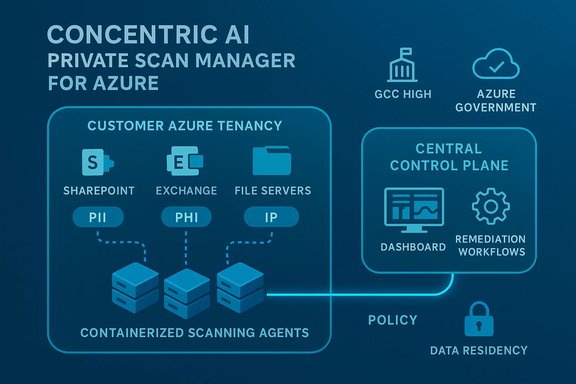
- The new option, Private Scan Manager for Azure, enables Concentric’s scanning and semantic classification components to run inside a customer’s Azure tenancy — including Azure Government and Microsoft 365 GCC High topologies that organizations use to host Controlled Unclassified Information (CUI).
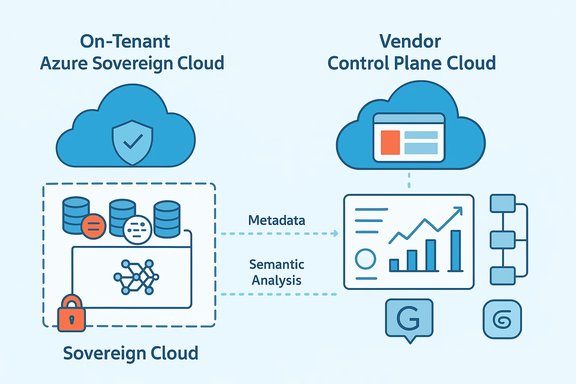
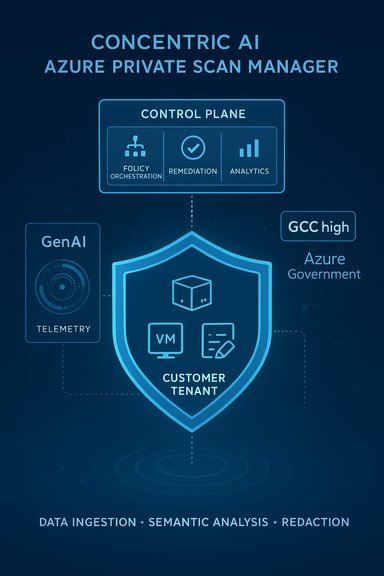
- Concentric states that all raw data scanning and categorization occur inside the customer’s private Azure cloud, while a central control plane manages policies, remediation workflows, and dashboards. This is intended to give customers “on‑prem style” data residency without the operational burden of hosting scanning engines on physical servers.
- The capability is offered as part of the Semantic Intelligence platform and complements Concentric’s earlier Private Scan Manager direction for AWS, giving customers a choice of private‑cloud tenancy for scanning workloads.
Why this matters: compliance, GenAI risk, and procurement dynamics
Concentric’s Azure Private Scan Manager answers several pressing needs that appear across security and compliance teams:- Data residency and contractual assurances — For workloads governed by FedRAMP, DoD SRG, ITAR or HIPAA, hosting scanning inside a known Azure tenancy (GCC High/Azure Government/sovereign instances) can materially reduce contractual and audit friction compared with sending raw content into a vendor cloud.
- GenAI egress prevention — With enterprise GenAI tools now a common channel for accidental prompt leakage, category‑aware DLP that blocks, warns, or redacts sensitive content before it gets pasted into a model is increasingly necessary. Concentric positions Private Scan Manager as part of that layered defense.
- Operational tradeoffs — The hybrid model hands compute and residency to the customer (Azure infrastructure) while the vendor handles software, updates, and remediation orchestration — a compromise that keeps operational overhead lower than a fully self‑operated on‑prem scanner but preserves residency guarantees.
Technical design and claimed architecture
On‑tenant scanning layer + SaaS control plane
Concentric describes a two‑tier architecture:- Local scanning components (containerized or VM‑based) run inside the customer’s Azure tenancy and perform raw ingestion, semantic analysis, categorization, and any local redaction/holding actions.
- A central control plane — hosted by Concentric — manages policies, remediation workflows (permission fixes, quarantines, share revocations), aggregated dashboards, and cross‑tenant analytics. Metadata and classification results are communicated to that control plane while Concentric asserts that raw content never leaves the tenant during scanning.
Claimed capabilities
- Fast discovery across structured and unstructured stores (files, databases, email, cloud repositories).
- Patented semantic models that aim to identify nuanced categories beyond PII/PHI/PCI — such as intellectual property and other “critical business documents.”
- Category‑aware DLP for GenAI flows, continuous risk monitoring, and automated remediation actions tied into downstream security tooling and service tickets.
Points to verify technically
- What exact artifacts (metadata fields, embeddings, classification outputs) are transmitted to the control plane, and under what retention policy?
- Which Azure sovereign topologies are supported in practice (GCC High, Azure Government, Azure Stack/Local) and which require additional engineering or contractual steps?
- Compute and storage sizing guidance for representative scan volumes (cost per TB, expected index build time, throughput).
Strengths and where Concentric’s pitch lands well
- Semantic/context‑aware classification: Replacing brittle regex/keyword approaches with deep semantic models improves recall/precision for messy enterprise documents and for categories such as IP or contract clauses. Concentric’s patents and published materials reinforce that semantic modeling is a core investment area.
- Targeted for government/sovereign needs: Explicit compatibility with GCC High and references to Azure Government make the product relevant to federal contractors and public sector entities that must maintain CUI controls.
- GenAI integration: Concentric highlights integrations with enterprise GenAI compliance APIs (for example, Compliance APIs used by major LLM vendors) and offers category‑aware DLP to prevent prompt‑level leakage — an important capability as organizations expand GenAI use cases.
- Operational compromise: For buyers that want on‑tenant residency without the operational complexity of managing scanning clusters and model inference themselves, the hybrid approach reduces operational burden while preserving control.
Risks, caveats and what procurement teams must insist on
Concentric’s model reduces certain risks but introduces others that procurement and security teams must explicitly address:- Control‑plane telemetry and supply‑chain dependencies: Even with on‑tenant scanning, the central control plane can see metadata and triggers. Buyers must get contractual guarantees on what leaves the tenancy, for how long, and who can access it. Ask for SBOMs, penetration test reports, and third‑party attestations.
- Performance and FinOps: Semantic classification at scale is compute‑intensive. Pilot scans should measure throughput, VM/GPU requirements, I/O and storage cost, and how index builds affect Azure billing. Overrun costs are a common hidden risk.
- False positives and automation risk: Even advanced semantic models produce false positives. If remediation is automated (permission changes, quarantines), test for disruptive false positives and insist on human‑in‑the‑loop options for high‑risk categories.
- Sovereign/air‑gap edge cases: Azure Government, GCC High, and Azure Stack/Azure Local are not identical. Validate the vendor’s support for your specific topology and any restrictions on marketplace images, support staffing, and connectivity.
- Independent proof for AWS private scanning claim: Concentric’s announcements reference prior support for private scanning on AWS, but public independent case studies or widely published production proofs are limited. If AWS private‑tenant deployment is a mandatory requirement, insist on direct references and a documented case study before procurement.
A practical procurement and pilot checklist
Security, compliance, and cloud teams should treat this offering as a measurable hypothesis. A recommended, sequenced checklist:- Request architecture diagrams that show exactly where raw data is processed, what metadata leaves the tenant, and control‑plane endpoints.
- Demand written contractual language that explicitly limits telemetry export, enumerates permitted metadata, and sets maximum retention windows.
- Provide a redacted, representative dataset for a blind pilot and request precision/recall metrics for critical categories (PII, PHI, PCI, IP, contract clauses). Measure false positives and remediation impact.
- Run integration tests with your GenAI stack (ChatGPT Enterprise or other copilots) to validate inline blocking, redaction, or warning flows and to ensure UX latency is acceptable.
- Model FinOps: measure Azure VM/Storage/IOPS costs for index builds and ongoing scans; budget expected monthly costs and set caps for scan operations.
- Require SBOMs, penetration test results, and third‑party audits as part of the procurement package. Negotiate SLAs for incident response and forensic evidence.
How this sits in the market (competitive context)
Concentric’s private‑tenant strategy reflects a wider market split: many vendors are accelerating cloud‑native SaaS models while a set of regulated buyers still require on‑prem or sovereign deployments. Native Microsoft tooling (Purview, Defender for Cloud) remains a competitor for classification and governance inside Azure, and legacy DLP vendors still offer appliance‑based on‑prem options. Concentric’s differentiator is the combination of semantic models and explicit GenAI integrations — however, buyers should weigh that against Microsoft native integrations and incumbent vendor relationships.Industry commentators note the attractiveness of vendor‑managed scanning running inside the customer’s cloud tenancy: it preserves SaaS feature velocity while meeting residency constraints. But commercial success depends on demonstrable accuracy, operational manageability, and tight contractual controls.
Recommendations for Windows and Azure teams (practical steps)
- Map your sensitive data scope first: inventory SharePoint, Exchange, OneDrive, file servers, NetApp ONTAP, MongoDB, and any third‑party repositories. Prioritize by risk and compliance impact.
- Start with a small pilot: pick one high‑value repository and a controlled GenAI use case. Measure classification accuracy and remediation latency before scaling.
- Integrate outputs into Microsoft native controls: ensure Concentric’s labels and categories map to Purview classification tags and Entra conditional access controls to maintain consistent enforcement.
- Insist on runbooks for degraded mode: define how the environment will behave if the vendor control plane becomes unavailable (failover, local enforcement, log retention). Test those runbooks.
- Build FinOps guardrails: set VM quotas and Azure budget alerts for index builds and sustainment scans to avoid unexpected billing spikes.
Critical analysis — strengths versus practical risk
Concentric’s Azure Private Scan Manager is a pragmatic response to a clear market demand: reconcile GenAI productivity with strict residency and compliance requirements. The semantic approach addresses real limitations in legacy DLP, and the hybrid deployment model reduces the operational burden of fully self‑operated scanner fleets. For organizations that must keep raw content inside sovereign clouds (GCC High, Azure Government), this model can materially simplify procurement and audit signoffs. However, the model is not without caveats. The control‑plane telemetry question is central: metadata and classification outputs can themselves be sensitive and must have contractually bound handling. Semantic models require validation against representative corpora — especially in multilingual, legacy format, or OCR‑heavy datasets — and automated remediation must be throttled to prevent business disruption from false positives. Finally, independent proof of scale and production deployments matters: marketing claims about prior AWS private scanning exist, but public, independently verifiable AWS case studies are sparse; buyers should demand references.Final verdict for IT decision makers
Concentric AI’s Private Scan Manager for Azure is a credible and timely option for regulated organisations seeking AI‑driven data governance that keeps raw data inside customer‑controlled Azure tenancies. It aligns with the “classify-first, control-egress, and audit interactions” approach that enterprise GenAI governance requires, and it reduces the heavy lifting of on‑prem model management.Adopt only after pilot validation and contractual hardening:
- Run a scoped pilot with representative data and GenAI scenarios.
- Require clear, written limits on telemetry and retention.
- Validate precision/recall metrics on your data and measure remediation impacts.
- Obtain SBOMs, pen test reports, and production references — particularly if you require AWS private‑tenant parity.
Source: SecurityBrief New Zealand https://securitybrief.co.nz/story/concentric-ai-brings-private-scan-manager-to-azure/