Private Scan Manager for Azure: On-Tenant AI Data Governance for Regulators

  • Thread Author
Concentric AI’s Semantic Intelligence platform can now run its heavy-duty data scanning and classification entirely inside a customer-controlled Microsoft Azure tenancy — a Private Scan Manager for Azure that promises on‑tenant raw-data scanning while maintaining a central control plane for policy orchestration and remediation.

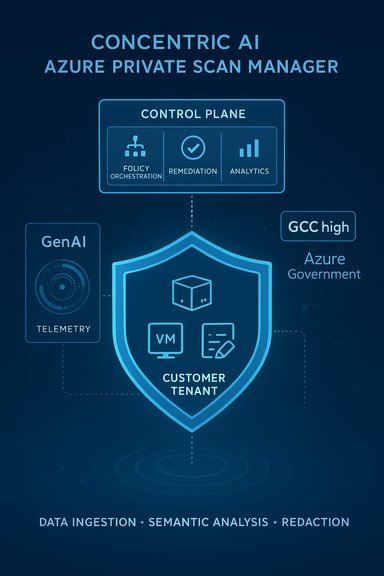
Blue infographic showing Concentric AI Private Scan Manager for Azure with tenancy and central control.Background​

Concentric AI has positioned Semantic Intelligence as a context‑aware data security governance platform that blends discovery, semantic classification, continuous risk monitoring, category‑aware DLP, and automated remediation. The vendor first publicized Private Scan Manager capabilities earlier in 2025 to let organizations perform scan processing inside customer environments; the Azure announcement expands that on‑tenant model to Microsoft Azure sovereign/tenant topologies and sits alongside previously publicized support for private scanning on AWS. For buyers wrestling with GenAI egress risk, regulatory residency requirements, and the operational tradeoffs between SaaS convenience and on‑prem control, the Private Scan Manager model is pitched as a middle path: raw content processing inside a controlled cloud tenancy, with the vendor running a control plane for policy and remediation orchestration. That hybrid architecture is central to Concentric’s messaging and to why regulated sectors have taken notice.

What Concentric announced (overview)​

  • The new option, Private Scan Manager for Azure, enables Concentric’s scanning and semantic classification components to run inside a customer’s Azure tenancy — including Azure Government and Microsoft 365 GCC High topologies that organizations use to host Controlled Unclassified Information (CUI).
  • Concentric states that all raw data scanning and categorization occur inside the customer’s private Azure cloud, while a central control plane manages policies, remediation workflows, and dashboards. This is intended to give customers “on‑prem style” data residency without the operational burden of hosting scanning engines on physical servers.
  • The capability is offered as part of the Semantic Intelligence platform and complements Concentric’s earlier Private Scan Manager direction for AWS, giving customers a choice of private‑cloud tenancy for scanning workloads.
This expansion is explicitly targeted at industries that must keep content inside controlled perimeters — healthcare, finance, federal contractors, pharmaceutical R&D, hedge funds, and telcos — and at organizations using Microsoft’s GCC High/Azure Government environments.

Why this matters: compliance, GenAI risk, and procurement dynamics​

Concentric’s Azure Private Scan Manager answers several pressing needs that appear across security and compliance teams:
  • Data residency and contractual assurances — For workloads governed by FedRAMP, DoD SRG, ITAR or HIPAA, hosting scanning inside a known Azure tenancy (GCC High/Azure Government/sovereign instances) can materially reduce contractual and audit friction compared with sending raw content into a vendor cloud.
  • GenAI egress prevention — With enterprise GenAI tools now a common channel for accidental prompt leakage, category‑aware DLP that blocks, warns, or redacts sensitive content before it gets pasted into a model is increasingly necessary. Concentric positions Private Scan Manager as part of that layered defense.
  • Operational tradeoffs — The hybrid model hands compute and residency to the customer (Azure infrastructure) while the vendor handles software, updates, and remediation orchestration — a compromise that keeps operational overhead lower than a fully self‑operated on‑prem scanner but preserves residency guarantees.
Those benefits are real but conditional: success depends on contractual clarity around telemetry, the exact sovereign topology supported, pilot validation against representative data sets, and careful FinOps planning for the Azure compute/storage footprint required by large‑scale semantic scanning.

Technical design and claimed architecture​

On‑tenant scanning layer + SaaS control plane​

Concentric describes a two‑tier architecture:
  • Local scanning components (containerized or VM‑based) run inside the customer’s Azure tenancy and perform raw ingestion, semantic analysis, categorization, and any local redaction/holding actions.
  • A central control plane — hosted by Concentric — manages policies, remediation workflows (permission fixes, quarantines, share revocations), aggregated dashboards, and cross‑tenant analytics. Metadata and classification results are communicated to that control plane while Concentric asserts that raw content never leaves the tenant during scanning.

Claimed capabilities​

  • Fast discovery across structured and unstructured stores (files, databases, email, cloud repositories).
  • Patented semantic models that aim to identify nuanced categories beyond PII/PHI/PCI — such as intellectual property and other “critical business documents.”
  • Category‑aware DLP for GenAI flows, continuous risk monitoring, and automated remediation actions tied into downstream security tooling and service tickets.

Points to verify technically​

  • What exact artifacts (metadata fields, embeddings, classification outputs) are transmitted to the control plane, and under what retention policy?
  • Which Azure sovereign topologies are supported in practice (GCC High, Azure Government, Azure Stack/Local) and which require additional engineering or contractual steps?
  • Compute and storage sizing guidance for representative scan volumes (cost per TB, expected index build time, throughput).

Strengths and where Concentric’s pitch lands well​

  • Semantic/context‑aware classification: Replacing brittle regex/keyword approaches with deep semantic models improves recall/precision for messy enterprise documents and for categories such as IP or contract clauses. Concentric’s patents and published materials reinforce that semantic modeling is a core investment area.
  • Targeted for government/sovereign needs: Explicit compatibility with GCC High and references to Azure Government make the product relevant to federal contractors and public sector entities that must maintain CUI controls.
  • GenAI integration: Concentric highlights integrations with enterprise GenAI compliance APIs (for example, Compliance APIs used by major LLM vendors) and offers category‑aware DLP to prevent prompt‑level leakage — an important capability as organizations expand GenAI use cases.
  • Operational compromise: For buyers that want on‑tenant residency without the operational complexity of managing scanning clusters and model inference themselves, the hybrid approach reduces operational burden while preserving control.
These strengths make the offering compelling for a narrow but significant buyer set: regulated organizations that want cloud economics and managed services while retaining strict residency and audit controls.

Risks, caveats and what procurement teams must insist on​

Concentric’s model reduces certain risks but introduces others that procurement and security teams must explicitly address:
  • Control‑plane telemetry and supply‑chain dependencies: Even with on‑tenant scanning, the central control plane can see metadata and triggers. Buyers must get contractual guarantees on what leaves the tenancy, for how long, and who can access it. Ask for SBOMs, penetration test reports, and third‑party attestations.
  • Performance and FinOps: Semantic classification at scale is compute‑intensive. Pilot scans should measure throughput, VM/GPU requirements, I/O and storage cost, and how index builds affect Azure billing. Overrun costs are a common hidden risk.
  • False positives and automation risk: Even advanced semantic models produce false positives. If remediation is automated (permission changes, quarantines), test for disruptive false positives and insist on human‑in‑the‑loop options for high‑risk categories.
  • Sovereign/air‑gap edge cases: Azure Government, GCC High, and Azure Stack/Azure Local are not identical. Validate the vendor’s support for your specific topology and any restrictions on marketplace images, support staffing, and connectivity.
  • Independent proof for AWS private scanning claim: Concentric’s announcements reference prior support for private scanning on AWS, but public independent case studies or widely published production proofs are limited. If AWS private‑tenant deployment is a mandatory requirement, insist on direct references and a documented case study before procurement.

A practical procurement and pilot checklist​

Security, compliance, and cloud teams should treat this offering as a measurable hypothesis. A recommended, sequenced checklist:
  • Request architecture diagrams that show exactly where raw data is processed, what metadata leaves the tenant, and control‑plane endpoints.
  • Demand written contractual language that explicitly limits telemetry export, enumerates permitted metadata, and sets maximum retention windows.
  • Provide a redacted, representative dataset for a blind pilot and request precision/recall metrics for critical categories (PII, PHI, PCI, IP, contract clauses). Measure false positives and remediation impact.
  • Run integration tests with your GenAI stack (ChatGPT Enterprise or other copilots) to validate inline blocking, redaction, or warning flows and to ensure UX latency is acceptable.
  • Model FinOps: measure Azure VM/Storage/IOPS costs for index builds and ongoing scans; budget expected monthly costs and set caps for scan operations.
  • Require SBOMs, penetration test results, and third‑party audits as part of the procurement package. Negotiate SLAs for incident response and forensic evidence.

How this sits in the market (competitive context)​

Concentric’s private‑tenant strategy reflects a wider market split: many vendors are accelerating cloud‑native SaaS models while a set of regulated buyers still require on‑prem or sovereign deployments. Native Microsoft tooling (Purview, Defender for Cloud) remains a competitor for classification and governance inside Azure, and legacy DLP vendors still offer appliance‑based on‑prem options. Concentric’s differentiator is the combination of semantic models and explicit GenAI integrations — however, buyers should weigh that against Microsoft native integrations and incumbent vendor relationships.
Industry commentators note the attractiveness of vendor‑managed scanning running inside the customer’s cloud tenancy: it preserves SaaS feature velocity while meeting residency constraints. But commercial success depends on demonstrable accuracy, operational manageability, and tight contractual controls.

Recommendations for Windows and Azure teams (practical steps)​

  • Map your sensitive data scope first: inventory SharePoint, Exchange, OneDrive, file servers, NetApp ONTAP, MongoDB, and any third‑party repositories. Prioritize by risk and compliance impact.
  • Start with a small pilot: pick one high‑value repository and a controlled GenAI use case. Measure classification accuracy and remediation latency before scaling.
  • Integrate outputs into Microsoft native controls: ensure Concentric’s labels and categories map to Purview classification tags and Entra conditional access controls to maintain consistent enforcement.
  • Insist on runbooks for degraded mode: define how the environment will behave if the vendor control plane becomes unavailable (failover, local enforcement, log retention). Test those runbooks.
  • Build FinOps guardrails: set VM quotas and Azure budget alerts for index builds and sustainment scans to avoid unexpected billing spikes.

Critical analysis — strengths versus practical risk​

Concentric’s Azure Private Scan Manager is a pragmatic response to a clear market demand: reconcile GenAI productivity with strict residency and compliance requirements. The semantic approach addresses real limitations in legacy DLP, and the hybrid deployment model reduces the operational burden of fully self‑operated scanner fleets. For organizations that must keep raw content inside sovereign clouds (GCC High, Azure Government), this model can materially simplify procurement and audit signoffs. However, the model is not without caveats. The control‑plane telemetry question is central: metadata and classification outputs can themselves be sensitive and must have contractually bound handling. Semantic models require validation against representative corpora — especially in multilingual, legacy format, or OCR‑heavy datasets — and automated remediation must be throttled to prevent business disruption from false positives. Finally, independent proof of scale and production deployments matters: marketing claims about prior AWS private scanning exist, but public, independently verifiable AWS case studies are sparse; buyers should demand references.

Final verdict for IT decision makers​

Concentric AI’s Private Scan Manager for Azure is a credible and timely option for regulated organisations seeking AI‑driven data governance that keeps raw data inside customer‑controlled Azure tenancies. It aligns with the “classify-first, control-egress, and audit interactions” approach that enterprise GenAI governance requires, and it reduces the heavy lifting of on‑prem model management.
Adopt only after pilot validation and contractual hardening:
  • Run a scoped pilot with representative data and GenAI scenarios.
  • Require clear, written limits on telemetry and retention.
  • Validate precision/recall metrics on your data and measure remediation impacts.
  • Obtain SBOMs, pen test reports, and production references — particularly if you require AWS private‑tenant parity.
When those conditions are met, Private Scan Manager for Azure can close an important gap: giving regulated enterprises the ability to use modern semantic DSPM/DLP capabilities while keeping raw content within the cloud boundaries their compliance programs demand.

Source: SecurityBrief New Zealand https://securitybrief.co.nz/story/concentric-ai-brings-private-scan-manager-to-azure/
 

Concentric AI’s Semantic Intelligence platform can now run its heavy-duty data scanning and classification entirely inside a customer‑controlled Microsoft Azure tenancy, bringing a new on‑tenant deployment option — Private Scan Manager for Azure — to organisations that must keep raw content inside tightly controlled cloud or sovereign environments.

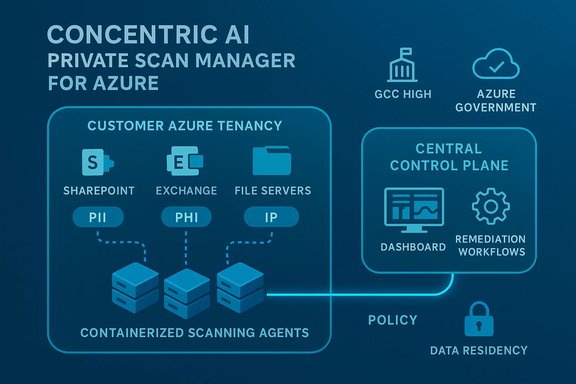
On-Tenant Sovereign Cloud sends metadata and semantic analysis to Vendor Control Plane Cloud for analytics.Background​

Concentric AI has built its product strategy around semantic, context‑aware classification and remediation, positioning Semantic Intelligence as a hybrid Data Security Posture Management (DSPM) and Data Loss Prevention (DLP) platform. The Private Scan Manager model relocates the compute‑intensive, content‑level scanning tasks into a customer‑owned cloud tenancy while preserving a vendor‑hosted control plane for policy orchestration, dashboards and cross‑tenant analytics. This hybrid design is presented as a middle path between full SaaS (where raw scanning occurs in the vendor cloud) and fully self‑operated on‑prem clusters. The Azure announcement expands an earlier private‑scan option Concentric has offered for AWS, giving customers a choice of private cloud tenancy for residency‑sensitive scanning workloads. Concentric’s messaging explicitly targets regulated industries — healthcare, financial services, government contractors, pharmaceutical R&D, telcos and hedge funds — where contractual or regulatory constraints prevent raw data from leaving the customer’s controlled boundary.

What Private Scan Manager for Azure actually is​

Architecture at a glance​

Concentric describes a two‑tier architecture:
  • An on‑tenant scanning layer (containerized or VM‑based) runs inside the customer’s Azure tenancy — including sovereign variants such as Azure Government or Microsoft 365 GCC High where applicable — and performs raw ingestion, semantic analysis, classification, and local redaction or quarantine.
  • A central control plane, hosted by Concentric, manages policies, remediation workflows (for example, permission fixes, quarantine actions, ticket creation) and aggregated dashboards. Metadata and classification outputs are reported to the control plane while the vendor asserts that raw content remains inside the customer tenant during scanning.
This hybrid model is engineered to deliver the operational benefits of a managed service — automated upgrades, vendor‑driven feature velocity, managed remediation workflows — while keeping the sensitive data processing step on infrastructure provided and controlled by the customer. The offering does not require customers to run scanning engines on physical servers; instead, Concentric’s scanning components run within the customer’s Azure tenancy to meet residency requirements without full on‑prem management overhead.

Claimed feature set​

Concentric’s public materials and product briefs present a broad capability set for the Azure private‑tenant deployment:
  • High‑speed discovery across structured and unstructured data stores, including file repositories, email, databases and cloud apps.
  • Patented semantic models intended to identify nuanced categories beyond classic PII/PHI/PCI — for example, intellectual property and critical business documents.
  • Category‑aware DLP that can block, warn or redact content before it is pasted into or uploaded to GenAI tools and other external services.
  • Continuous risk monitoring and automated remediation for excessive permissions, risky sharing, misclassification and anomalous user behaviour.
These claims are set out in the vendor press release and accompanying product pages, and they form the basis of Concentric’s pitch to regulated buyers. Independent verification through pilots and technical review remains essential for procurement teams, especially for vertical‑specific categories such as clinical notes, export‑controlled documents or proprietary algorithm code.

Why this matters: compliance, GenAI risk and procurement dynamics​

Data residency and sovereign cloud alignment​

For organisations that must process Controlled Unclassified Information (CUI) or export‑controlled material, Azure Government and Microsoft 365 GCC High are established options to meet the contractual and audit demands of US federal and defense‑adjacent workloads. Microsoft’s compliance documentation explains the special authorizations and personnel/screening assurances associated with these environments, and many agencies and contractors map CUI workloads to GCC High or Azure Government for that reason. Concentric explicitly positions the Azure Private Scan Manager for customers using these topologies. Running raw scans inside an eligible Azure sovereign tenancy can reduce contractual friction compared with transferring raw content to a vendor cloud — provided the vendor’s architecture, contractual promises and operational practices align with the customer’s compliance requirements. That caveat matters: terms such as “raw data never leaves the tenant” need to be contractually defined and technically demonstrable.

GenAI egress risk and category‑aware DLP​

The rapid adoption of generative AI tools has introduced a new, high‑velocity egress risk: users copying or uploading sensitive content into public or third‑party LLMs. Enterprises now seek controls that can detect and halt risky prompt content at the point of entry, or at least capture auditable telemetry when interactions occur. OpenAI and other vendors have introduced Compliance APIs that allow enterprises to export logs and integrate with DLP and SIEM tooling; Concentric highlights such integrations as part of its GenAI governance playbook. The Private Scan Manager’s role is to label and control sensitive content before it reaches LLMs, or to provide forensic visibility for post‑facto investigations.

Procurement dynamics: hybrid over binary​

Concentric markets the Azure deployment as a compromise: customers retain residency and avoid on‑prem hardware while receiving managed software and remediation services from the vendor. That positioning is directly aimed at buyers who are uncomfortable with full SaaS scanning of raw content but who also want to avoid the maintenance and staffing burden of fully self‑operated scanners. The move is part of a broader vendor trend supplying flexible deployment topologies — SaaS, private‑tenant, and appliance — to win regulated customers.

Strengths: where the pitch is convincing​

  • Semantic classification vs. brittle rules: Deep learning‑based semantic models generally outperform regex/keyword approaches on messy, unstructured corpora. For identifying non‑standard sensitive assets such as IP or contract clauses, semantic models can demonstrably reduce false negatives and improve precision when trained and tuned properly. Concentric’s patents and product claims centre this capability as a differentiator.
  • Sovereign tenancy support: Explicit compatibility with GCC High and Azure Government (as stated by Concentric) makes the offering relevant to federal contractors and public‑sector entities that must maintain CUI inside defined boundaries. Microsoft’s own compliance posture for Azure Government supports such use cases.
  • GenAI‑aware controls: Integrations with enterprise compliance and logging APIs (for example, the OpenAI Compliance API) provide a method to link prompt telemetry to data classification outcomes, supporting both prevention and investigation workflows.
  • Operational compromise: By hosting scanning components inside a customer’s tenancy while retaining a vendor control plane, Concentric aims to reduce the operational burden of managing clusters and inference workloads without conceding on residency guarantees. For many buyers this is a pragmatic trade‑off.

Risks, caveats and the verification checklist​

Concentric’s Azure Private Scan Manager reduces certain risks, but it introduces others that procurement and security teams must explicitly address. Below are the practical checks and the reasons you should insist on them.

Key areas buyers must verify​

  • Architecture and telemetry: obtain a full network and data‑flow diagram that shows exactly which artifacts (metadata fields, embeddings, classification outputs) leave the tenant and under what retention/ACL policies. Contractually bind those limitations.
  • Sovereign topology details: confirm support for the precise Azure environment you plan to use (GCC High vs Azure Government vs Azure Stack/Local). These topologies are not identical in capabilities, marketplace availability, or support models.
  • Pilot on representative datasets: run a scoped proof‑of‑value using your data to measure precision/recall, throughput, time‑to‑index and compute costs (FinOps). Ask for precision/recall numbers for key categories and perform blind trials.
  • Telemetry and control‑plane governance: require written guarantees about telemetry types sent to Concentric’s control plane, retention windows, access controls, and incident response processes. Insist on SBOMs, pen‑test results and third‑party attestations.
  • Automation safety: if remediation actions are automated (permission changes, quarantines), verify human‑in‑the‑loop controls for high‑risk categories and run failure‑mode exercises. False positives can be disruptive if applied automatically at scale.
  • FinOps modelling: semantic scanning at scale consumes significant compute and storage. Model index builds, recurring scans and the steady‑state footprint; confirm who is responsible for Azure resource costs and how usage spikes are handled.
  • Legal and contractual clarity: for the strictest regulatory regimes, include explicit contractual clauses that map the vendor’s deployment behaviour to your compliance program (FedRAMP, DFARS, ITAR, HIPAA). Require audit rights and logging provisions.

Why these items matter​

  • Vendors may assert that “raw data never leaves the tenant.” That language is useful but insufficient without a technical demonstration and contractual enforcement. Verify by traffic capture during pilot runs and by reviewing exactly what metadata and classification outputs are transmitted.
  • Sovereign clouds and government‑grade environments have nuanced constraints (e.g., personnel screening, marketplace availability). Validate support early in procurement to avoid surprises later. Microsoft’s Azure Government documentation shows how authorizations and service scoping differ across regions.
  • Semantic models are powerful, but they are not omniscient. Niche legal phrasing, foreign languages, scanned legacy PDFs with poor OCR, or specialised technical formats will reduce accuracy. Proof‑of‑value on representative corpora is non‑negotiable.

Practical evaluation playbook (step‑by‑step)​

  • Request architecture diagrams and an explicit data‑flow statement that lists every artifact leaving the tenant. Require contractual limits on telemetry, retention, and access.
  • Run a small pilot in your target Azure topology (GCC High / Azure Government / commercial) containing redacted but representative samples. Measure precision/recall by category and file type.
  • Validate GenAI flows: test category‑aware DLP blocking/warning/redaction against your enterprise GenAI stack and confirm log ingestion from the GenAI vendor’s Compliance API.
  • Execute FinOps simulations: calculate cost per TB scanned, index build time, expected steady‑state VM/GPU sizing and storage tiers. Confirm billing responsibilities.
  • Test remediation actions at scale with rollback/runbook testing and human‑approval gates for high‑impact changes.
  • Request SOC/FedRAMP/third‑party audit evidence and SBOM; require SLAs and incident‑response playbooks with guaranteed timelines and reporting behavior.

Integrating Private Scan Manager for Azure with Microsoft tooling​

Concentric’s outputs should be treated as a source of truth that maps into existing Microsoft security and governance controls rather than replacing them. Recommended integration touchpoints include:
  • Microsoft Purview for classification mapping and data governance alignment.
  • Microsoft Entra (RBAC/Conditional Access) to enforce access changes suggested by the remediation workflows.
  • Defender for Cloud / Defender for Storage and Azure Policy for cross‑subscription posture checks and monitoring.
Mapping Concentric’s semantic categories to Purview labels and Entra policies will create auditability and consistent enforcement across the estate. Microsoft documentation and community guidance describe how GCC High and Azure Government differ in scope and support, so integration testing must occur within the target sovereign environment.

Operational implications: runbooks, updates and incident response​

  • Clarify who is responsible for patching and upgrades to the scanning components running in your tenancy. Ask for scheduled maintenance windows and rollback mechanisms.
  • Define an incident response SLA that covers detection, notification, forensic access, and remediation responsibilities. Confirm whether Concentric will supply forensic artifacts and what access level is required for post‑incident analysis.
  • Run failure‑mode drills: simulate control‑plane unavailability, scanner outages and network partitioning to ensure your operations team can continue to enforce policies during degraded modes.
  • Maintain defense‑in‑depth: classification and DLP are necessary but not sufficient. Combine technical guardrails with user training, acceptable‑use policies for GenAI and continuous monitoring to address both accidental and deliberate leakage.

Market context and competitive positioning​

Concentric’s announcement positions it as part of a broader market pivot: vendors offering flexible deployment models to accommodate both SaaS‑first and residency‑constrained customers. Native Microsoft tooling (Purview, Defender, Entra) competes in the same space and is the natural integration partner; legacy DLP vendors still pursue on‑prem appliance buyers; and newer DSPM/DLP hybrids offer either cloud‑only or private‑tenant approaches. Concentric’s differentiator is its semantic engine and explicit GenAI integrations, but measurable accuracy, operational cost and contractual clarity will determine commercial success. A note of market caution: vendor framing that “legacy players are discontinuing on‑prem support” is a marketing argument and should be treated as context rather than hard fact; procurement teams should independently assess incumbents’ roadmaps and contractual offers before making replacement decisions.

Final verdict — who should consider Private Scan Manager for Azure, and how to proceed​

Private Scan Manager for Azure is a pragmatic option for organisations that:
  • Must keep raw content inside a specific sovereign or private Azure tenancy for compliance (for example, GCC High / Azure Government).
  • Want semantic, context‑aware classification that reduces false negatives for IP and business‑critical documents.
  • Need to control GenAI egress risk by applying category‑aware DLP before content reaches LLMs, or by linking prompt telemetry to classification results.
However, success depends on three measurable outcomes that buyers must prove during procurement:
  • Residency andTelemetry Guarantees — a contractual and technical demonstration that raw data is processed in‑tenant and that only approved metadata leaves the tenancy.
  • Classification Accuracy on Real Data — pilot metrics (precision, recall) on the organisation’s representative datasets, across languages and legacy formats.
  • Manageable Operational and Financial Overhead — validated FinOps modelling for scanning, indexing and steady‑state operations.
For Windows administrators, security architects and procurement teams evaluating Concentric’s offering, the recommended path is straightforward: demand the architecture and compliance artifacts up front; run a scoped pilot in the exact Azure topology you will operate in; measure accuracy, latency and cost; validate GenAI integrations with your platform’s Compliance API; and negotiate explicit contractual limits on telemetry and incident response.
Concentric’s Private Scan Manager for Azure addresses a clear market need by reconciling on‑tenant residency with managed, AI‑driven data governance. It is not a finished compliance guarantee by itself — it is a tool whose real value depends on the details buyers insist upon and the pilots they run. When evaluated with technical rigor and contractual safeguards, it can be a powerful element in a modern, GenAI‑aware data protection program.
Source: SecurityBrief Asia https://securitybrief.asia/story/concentric-ai-brings-private-scan-manager-to-azure/
 

Concentric AI’s Semantic Intelligence platform can now run its heavy-duty data scanning and classification entirely inside a customer-controlled Microsoft Azure tenancy with the launch of Private Scan Manager for Azure, a deployment option pitched at organisations that must keep raw content inside sovereign or tightly controlled cloud boundaries.

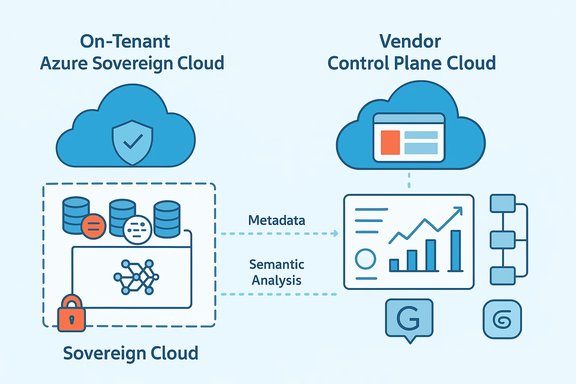
Blue infographic showing Concentric AI Azure Private Scan Manager architecture for the customer tenant.Overview​

Concentric AI’s announcement expands an existing “private scanning” deployment model—previously emphasised for AWS—by enabling the vendor’s scanning and semantic classification components to operate inside customer-owned Azure environments, including government/sovereign topologies such as Microsoft 365 Government Community Cloud High (GCC High) and Azure Government. The vendor says all raw-data scanning and categorisation occur inside the customer’s private Azure tenancy while Concentric retains a central control plane for policy orchestration, remediation workflows, and analytics. This move arrives against a market backdrop where organisations must reconcile the productivity and operational benefits of SaaS with strict regulatory and residency constraints — a tension that has been heightened by rapid GenAI adoption and concerns about prompt-level data leakage. Concentric presents the Azure option as a middle path: customer-hosted content processing with vendor-managed policy and remediation services.

Background​

What Concentric AI already offers​

Concentric AI’s core product, Semantic Intelligence, is a data security governance platform that combines discovery, semantic classification, continuous risk monitoring, automated remediation, and category-aware DLP (data loss prevention). The company has emphasised context‑aware AI models over brittle rule- or regex-based detection, claiming better accuracy for PII, PHI, PCI and harder-to-detect assets such as intellectual property or critical business documents. Recent public materials also highlight integrations with GenAI telemetry and enterprise compliance APIs.

Why a private‑tenant option matters now​

Highly regulated industries — healthcare, financial services, defence contractors, pharma, telcos, and hedge funds — often face contractual or regulatory mandates that raw content remain within specific geographical or operational boundaries. Microsoft’s GCC High and Azure Government are commonly used options for workloads that must handle Controlled Unclassified Information (CUI) and other FedRAMP/DoD-relevant data, and vendors aiming at these sectors must align to those topologies. Concentric’s Azure Private Scan Manager explicitly targets that set of buyers.

What Private Scan Manager for Azure actually is​

High-level architecture​

Concentric describes a two-tier architecture:
  • An on‑tenant scanning layer (containerised or VM-based) runs inside a customer Azure tenancy (including sovereign variants). This component performs raw ingestion, semantic analysis, classification, and any local redaction or quarantine actions.
  • A central control plane hosted by Concentric manages policy articulation, remediation orchestration (permission fixes, quarantines, ticketing), dashboards, and cross-tenant analytics. Metadata and classification outputs are transmitted to that control plane; Concentric asserts that raw content remains inside the tenant during scanning.
This hybrid model is pitched as providing the operational benefits of a managed service (automated upgrades, vendor-driven features, remediation orchestration) while giving customers on‑tenant residency for raw data processing.

Claimed capabilities​

Concentric advertises the following feature set for the Azure private‑tenant deployment:
  • Fast discovery and indexing of both structured and unstructured data across repositories, email, file shares, and databases.
  • Semantic classification models intended to detect nuanced categories beyond PII/PHI/PCI — examples include intellectual property and critical business documents.
  • Category‑aware DLP that can block, warn, or redact sensitive content before it is uploaded to GenAI tools or other external services.
  • Continuous risk monitoring and automated remediation for excessive permissions, risky sharing, misclassified data, and anomalous user behaviour.
  • Integration with GenAI telemetry/compliance APIs (e.g., enterprise compliance endpoints) to correlate prompt logs with classification outcomes.

Why this is important for regulated organisations​

Sovereignty and contractual assurance​

For organisations required to meet FedRAMP High, DFARS/NIST-800-171, ITAR or HIPAA controls, hosting scanning inside a known Azure sovereign tenancy (GCC High/Azure Government) can reduce contractual friction relative to sending raw content into an external vendor cloud. Microsoft documents and public guidance make GCC High and Azure Government the recommended environments for many CUI and export‑controlled workloads; aligning a vendor deployment to these topologies is often a procurement prerequisite.

GenAI egress control​

The rise of generative AI tools has created a new high-velocity egress vector: users can inadvertently paste or upload sensitive content into LLM interfaces. Concentric positions Private Scan Manager as part of a layered defence that labels and controls sensitive content before it reaches models, and that links prompt telemetry to classification results for audit and investigation. Integration with compliance APIs that expose prompt logs or telemetry is a key element of this use case.

Operational compromise​

The private Azure model shifts compute and storage responsibility to the customer (they provide Azure VMs/instances), while the vendor retains software maintenance, feature delivery, and orchestration. This is often attractive to organisations that want on‑tenant residency without the operational cost of a fully self‑operated scanner cluster.

Strengths — where Concentric’s pitch lands well​

  • Semantic classification: Deep semantic models generally outperform rule-based approaches on messy, enterprise document corpora, improving recall and reducing false negatives for non‑standard sensitive items such as contract clauses or proprietary algorithms. Concentric’s patents and recent filings underscore investment in this area.
  • Sovereign‑aware deployment: Explicit support for GCC High/Azure Government topologies addresses a narrow but high‑value buyer segment that frequently encounters procurement roadblocks with pure SaaS vendors.
  • GenAI telemetry integration: The ability to map classification outputs to GenAI prompt logs and compliance APIs helps create an auditable trail when accidental prompt leakage occurs. That capability is increasingly considered essential for regulated GenAI adoption.
  • Managed‑service ergonomics: Customers keep residency control while offloading upgrades, remediation automation, and vendor feature velocity — a pragmatic trade for many security teams.

Risks, caveats and technical questions buyers must insist on​

Concentric’s architecture reduces some risks but introduces others. The value of this model depends heavily on contractual clarity, technical transparency, and pilot performance.

1) Control‑plane telemetry and the “what leaves the tenant” question​

Concentric states that raw data is processed in‑tenant, but the control plane still receives metadata, classification outputs, and orchestration signals. Buyers should explicitly verify:
  • Which exact artifacts are sent to the control plane (fields, embeddings, hashed identifiers, full text excerpts).
  • Retention policies and access controls for transmitted metadata.
  • Who (vendor staff, subcontractors) can access those artifacts and under what conditions.
Marketing claims like “raw data never leaves the tenant” must be contractually defined and technically demonstrable. Insist on architecture diagrams and proof-of-concept traffic captures.

2) Sovereign topology differences​

“Azure Government”, “GCC High”, and “Azure Stack/Azure Local” are distinct in capabilities, support models, and marketplace image availability. Confirm whether the vendor supports your specific Azure variant in production and what additional engineering or contractual steps may be required.

3) Performance and FinOps (cost) implications​

Semantic scanning at scale is compute‑intensive. Buyers must pilot representative datasets and model index builds to understand:
  • VM/CPU/GPU sizing and I/O requirements.
  • Time‑to‑index and steady‑state scan cadence.
  • Storage tiers and egress implications.
  • Who pays for Azure compute/storage during indexing and recurrent scans.
Without accurate FinOps modelling, cost overruns are a real risk.

4) False positives, automated remediation risk​

Even sophisticated models produce false positives. If remediation actions (permission changes, quarantines, share revocations) are automated, they can cause operational disruptions. Insist on human‑in‑the‑loop options for high‑risk categories and clearly scoped automation thresholds.

5) Supply‑chain and legal exposure​

Private‑tenant deployments reduce but do not eliminate third‑party dependencies. Buyers should require:
  • SBOMs (software bill of materials).
  • Third‑party penetration test reports and attestation.
  • Clear incident response and forensic artifact access clauses in contracts.

6) Verification of claimed model accuracy​

The company highlights patented semantic approaches, but patents are not a substitute for operational benchmarks. Buyers must demand precision/recall metrics on redacted, representative datasets and run blind trials across file types, languages, and legacy binary content.

Practical procurement and pilot checklist​

  • Request an explicit architecture and data‑flow diagram that shows what is transmitted to Concentric’s control plane and why.
  • Confirm supported Azure topologies (GCC High, Azure Government, Azure Stack, Azure Local) and obtain written confirmation for the chosen environment.
  • Run a scoped proof‑of‑value with representative datasets to measure precision, recall, throughput, latency, and index build times.
  • Define telemetry retention windows and access controls contractually; require audit and export rights for logs.
  • Simulate remediation automation failure modes; insist on rollback/playbook SLAs and human approval gates for high-risk actions.
  • Ask for SBOMs, recent penetration test results, and third‑party attestations; negotiate incident response SLAs and post‑incident reporting obligations.
  • Model Azure costs for index builds and steady-state scanning; identify cost‑ownership in the contract (who pays for compute spikes?.

Integration points with Microsoft tooling​

For Windows and Azure teams, Concentric’s outputs should augment — not replace — Microsoft native governance tools. Recommended integration touchpoints include:
  • Microsoft Purview for classification mapping and governance alignment.
  • Microsoft Entra (Azure AD) for RBAC and conditional access enforcement following remediation suggestions.
  • Defender for Cloud/Defender for Storage and Azure Policy for posture checks and incident telemetry correlation.
Mapping Concentric’s semantic categories to Purview labels and Entra policies creates a consistent, auditable enforcement chain across the estate.

Market context and competitive positioning​

Concentric’s private‑tenant Azure option reflects a broader vendor strategy: provide flexible deployment topologies (SaaS, private‑tenant, on‑prem appliance) to capture both cloud‑native buyers and residency‑constrained customers. Native Microsoft stacks (Purview + Defender + Entra) remain primary competitors, while legacy DLP vendors and newer DSPM/DLP hybrids also address parts of this market. Concentric’s differentiator is its semantic engine and GenAI awareness; the outcome will hinge on demonstrable accuracy, manageable operational overhead, and procurement‑grade contractual guarantees.

Critical analysis — the real tradeoffs​

  • Benefit: The Azure Private Scan Manager reduces an important compliance and audit friction point by keeping raw content inside a known sovereign tenancy while preserving the operational simplicity of a managed platform. For many buyers this is a practical compromise.
  • Cost: That compromise moves compute and storage costs to the customer, and it still leaves a control‑plane dependency and telemetry transfer that must be contractually limited and technically verifiable.
  • Risk: Model-driven classification improves recall but also risks disruptive false positives when combined with automated remediation. The balance between automation and human review is crucial.
  • Proof: Marketing claims (patents, semantic superiority, “never leaves the tenant”) need to be substantiated by pilot metrics, architecture diagrams, and contractual commitments before the platform becomes the foundation of a regulated data program.

Recommended next steps for IT leaders and architects​

  • Treat Concentric’s Azure Private Scan Manager as a candidate solution for residency‑constrained scanning but require a measured procurement path: architecture review → pilot on representative datasets → legal/controls mapping → phased rollout.
  • Insist on pilot KPIs: precision and recall for key sensitive categories, time‑to‑index, remediation latency, and Azure resource consumption with cost estimates.
  • Demand contractual transparency around telemetry, retention, SBOMs and pen‑test reports, and negotiate incident response obligations with measurable SLAs.
  • Integrate outputs with Microsoft Purview and Entra to preserve consistent labels and access enforcement across platforms.

Conclusion​

Concentric AI’s Private Scan Manager for Azure answers a concrete, growing need: reconcile modern, AI‑driven data governance with the residency, personnel and contractual guarantees required by regulated organisations. The offering’s hybrid architecture — on‑tenant scanning plus a vendor control plane — is a pragmatic compromise that will be attractive to many federal contractors, healthcare providers, financial institutions and other compliance‑sensitive buyers. That said, the value delivered will depend on rigorous procurement discipline. Buyers must demand transparency about exactly what leaves the tenant, measurable classification performance on representative data, tested remediation safety nets, and clear FinOps modelling. With those checks in place, the Private Scan Manager model can materially reduce compliance friction while enabling organisations to adopt GenAI and modern data governance without exposing raw content to uncontrolled external clouds.

Source: SecurityBrief Australia https://securitybrief.com.au/story/concentric-ai-brings-private-scan-manager-to-azure/
 

Back
Top