

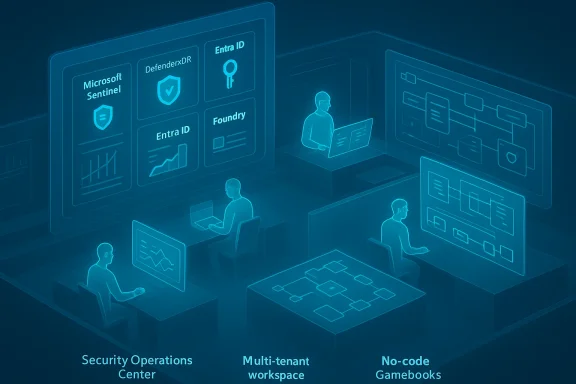
When two seasoned SOC builders set out to fix what they saw as an industry design flaw, the result was not another point product — it was a platform that reframes how managed service providers (MSPs) deliver Microsoft-native security at scale. ContraForce, founded in 2021 by veterans from Intel and McAfee, has packaged Microsoft Sentinel, Defender XDR, Entra ID, and Microsoft Foundry into a multi-tenant Security Delivery Platform that claims to let a single analyst manage an order of magnitude more customers through autonomous AI agents and no-code orchestration. The implications are significant: MSPs gain capacity and new revenue streams, end-customers see faster containment, and the security market gets another example of vendor co‑innovation — but the headline performance claims deserve careful scrutiny and governance before being trusted into production.
For years the security industry’s tooling assumed large, centralized SOCs staffed by teams of analysts and engineers. That model breaks down for MSPs trying to protect dozens or hundreds of small-to-medium customers under tight margins. Building a 24/7 SOC that can ingest telemetry, tune detections, and conduct repeatable incident response has been prohibitively expensive for many service providers. ContraForce’s premise is simple: leverage Microsoft’s cloud-native stack and apply automation and multi-tenancy to convert enterprise-grade tooling into an MSP‑friendly service delivery layer.
Microsoft’s investments matter because the Defender/XDR + Sentinel ecosystem already aggregates cross-signal telemetry across endpoints, identity, email, and cloud workloads. That native cross-signal data fabric is the single biggest operational advantage for any vendor building XDR or MXDR services on Microsoft technology — it reduces integration friction and gives automation higher-fidelity context for investigations. Microsoft’s evolving capabilities around AI-driven detection and agent runtimes further enable partners who can operationalize them responsibly.
Why the numbers can vary:
The partnership model offers clear advantages:
MSPs evaluating ContraForce — or any agentic MXDR solution built on Microsoft’s stack — should prioritize:
Source: Microsoft Microsoft Security at Scale: How ContraForce Delivers AI Powered Microsoft Defender XDR for MSPs | Microsoft Customer Stories
 Background: SOC pain, MSP economics, and why Microsoft matters
For years the security industry’s tooling assumed large, centralized SOCs staffed by teams of analysts and engineers. That model breaks down for MSPs trying to protect dozens or hundreds of small-to-medium customers under tight margins. Building a 24/7 SOC that can ingest telemetry, tune detections, and conduct repeatable incident response has been prohibitively expensive for many service providers. ContraForce’s premise is simple: leverage Microsoft’s cloud-native stack and apply automation and multi-tenancy to convert enterprise-grade tooling into an MSP‑friendly service delivery layer.Microsoft’s investments matter because the Defender/XDR + Sentinel ecosystem already aggregates cross-signal telemetry across endpoints, identity, email, and cloud workloads. That native cross-signal data fabric is the single biggest operational advantage for any vendor building XDR or MXDR services on Microsoft technology — it reduces integration friction and gives automation higher-fidelity context for investigations. Microsoft’s evolving capabilities around AI-driven detection and agent runtimes further enable partners who can operationalize them responsibly.
What ContraForce built: an anatomy of the platform
ContraForce did not reinvent detection engines. Instead, it built a Security Delivery Platform that sits on top of Microsoft primitives and adds three practical layers:- A multi-tenant workspace architecture that provides each MSP customer a dedicated ContraForce workspace, preserving isolation while enabling centralized operations and visibility.
- A no-code orchestration layer (marketed as “Gamebooks”) that codifies playbooks and automations across tenants, letting MSPs design and run standardized response workflows.
- Autonomous Security Delivery Agents — AI-driven agents that handle Level 1 SOC tasks (triage, enrichment, disposition) and can execute supervised or autonomous response actions through integrated Microsoft controls.
Key platform features (at a glance)
- Multi-tenant Sentinel + Defender XDR management with per-customer workspace isolation.
- No-code playbooks ("Gamebooks") to orchestrate response across signals and tenants.
- Autonomous AI agents that triage alerts, enrich telemetry, and apply dispositions or response actions.
- Marketplace distribution and co-sell alignment with Microsoft and cloud distributors to shorten procurement cycles.
The AI claim: automation, capacity, and the evidence
ContraForce’s most attention-grabbing claims are operational metrics: AI agents that automate 90%+ of Level 1 SOC tasks, 10× more customers per analyst, 93% reduction in cost-per-incident, and incident resolution “in minutes or seconds” rather than hours. Those claims, if accurate, represent a material shift in MSP economics and risk posture. However, the available public descriptions show those numbers as vendor and customer-reported outcomes rather than results from independent, third‑party audits. Industry reporting notes the directional plausibility of dramatic MTTR and unit-cost reductions from playbook automation, while cautioning that specific multipliers vary widely by environment and telemetry fidelity. Treat these metrics as promising vendor‑provided results that require validation in each deployment.Why the numbers can vary:
- Telemetry quality and coverage — automation depends on high-fidelity signals across endpoints, identity, email, and cloud. Gaps lower automation confidence.
- Detection fidelity and false positive rates — higher false positive volumes force human review and reduce automation yield.
- Playbook completeness and diversity of customer environments — homogeneous environments are easier to automate than highly customized stacks.
- Governance and response authority — organizations that limit autonomous actions (for safety/compliance) will see lower automation percentages.
Customer outcomes and economics (what MSPs are reporting)
ContraForce and trialing MSPs report clear business impacts:- Rapid onboarding of previously-declined customers, enabling growth without proportionate headcount increases.
- New premium services such as 24/7 MDR and AI-augmented MXDR, which lift average contract values while reusing existing infrastructure.
- Improved SLA performance because automated agents catch and contain suspicious activity faster — often before a human sees it.
How the Microsoft relationship shapes the product and go-to-market
ContraForce’s product trajectory has been tightly aligned with Microsoft programs: co‑build partnerships, participation in Microsoft AI Co‑Innovation Lab efforts, and presence in Microsoft's partner marketplaces. That alignment accelerates product development and market access — Microsoft’s engineering collaboration helps ContraForce leverage Foundry, Agent Services, and Azure OpenAI in secure, enterprise-ready ways. Marketplace listings and co‑sell motions also make it easier for MSPs to procure and bundle the service.The partnership model offers clear advantages:
- Faster integration to Defender XDR and Sentinel telemetry.
- Access to Microsoft engineering and go-to-market channels.
- Joint credibility for MSPs evaluating new vendor solutions.
Risks, limitations, and governance concerns
No platform is a panacea. The most important section for MSPs and security leaders is the one that explains where automation, agent runtimes, and deep integration could produce new problems if not governed properly.1) Autonomous response authority and safety
Allowing agents to take automated actions (account blocks, device isolation, firewall modifications) speeds containment but can cause business disruption if misapplied. Define clear escalation boundaries:- Which actions may be executed autonomously vs. require human approval.
- Which customer classes or assets are protected by automatic vs. supervised responses.
- Emergency rollback and “kill switch” processes.
2) False positives, detection drift, and auditability
High automation depends on trust in the underlying detections. If an agent applies a disposition based on contextual signals that were noisy or incomplete, the result can be service disruption or worse.- Require human-review windows for sensitive actions.
- Maintain thorough audit logs and explainability for agent decisions to support forensics and compliance.
3) Data residency, isolation, and compliance
Multi-tenant platforms must guarantee strict data separation, encryption, and compliance controls to meet regulatory and customer contractual obligations. Confirm:- Workspace-level data isolation guarantees and encryption-at-rest and in-transit.
- Where agent models run (region, tenancy) to satisfy data residency requirements.
4) Vendor and platform lock-in
Consolidating on Microsoft-native detection and response simplifies integration but concentrates operational dependence. MSPs should model:- Exit strategies and migration effort if a different stack is required later.
- Contractual rights over telemetry exports and playbook artifacts.
5) Promotional and licensing caveats
Microsoft’s evolving Defender product packaging and promotional offers can materially affect economics for MSPs and end-customers. Documentation around promotional windows and minimum seat counts has been inconsistent in partner-facing materials, so confirm commercial terms in writing with Microsoft or your reseller before finalizing deals. This is an important procurement risk for MSPs building business cases on assumed discounts or pricing windows.A practical pilot and validation checklist for MSPs
Before rolling autonomous agents into production across your customer base, run an explicit, measurable pilot. Use this as your acceptance criteria and operational validation.- Define pilot scope and success metrics (MTTR, false positive rate, incidents auto‑resolved, cost per incident).
- Select a representative set of customers (mix of simple, medium, and complex environments).
- Confirm telemetry coverage across endpoints, identity, email, and cloud for each pilot tenant.
- Start in observe-only mode: let agents triage and recommend dispositions without executing changes.
- Measure decision explainability and enrichment fidelity — can a human reproduce why an agent recommended an action?
- Move to supervised actioning where the agent proposes a response and a human approves it, measuring latency and hit accuracy.
- For non-critical tenants, trial autonomous actioning with tight rollback and alerting controls.
- Verify audit trails, logs, and forensics readiness for every automated action.
- Run post-pilot red-team tests and simulated incidents to evaluate resilience.
- Document SLAs, indemnities, and escalation procedures with customers and include contractual language about autonomous actions.
Operational best practices and architecture guardrails
- Enforce least privilege for agent service accounts and integrate with Entra ID lifecycle controls.
- Version and test Gamebooks in a staging environment and employ CI/CD for playbooks and rule changes.
- Keep humans in the loop for high‑impact actions — isolate fully autonomous blocks to narrowly-defined scenarios with high True Positive rates.
- Monitor and benchmark false positive trends, agent confidence scores, and analyst override rates monthly.
- Negotiate clear commercial protections: SLAs for platform availability, logs exportability, liability caps for automated actions, and data retention policies.
Business strategy: packaging, pricing, and go-to-market
ContraForce’s route to scale is MSP-first: each MSP onboarded extends the platform into dozens or hundreds of SMBs. That model works because:- MSPs can upsell premium AI-augmented MXDR tiers.
- Marketplace procurement (Microsoft, Pax8, distributor channels) simplifies billing and co-sell opportunities.
The competitive and ecosystem perspective
ContraForce is one example of a broader industry move: agentic automation layered on hyperscale telemetry fabrics. Microsoft is shipping its own managed offerings and AI detection services, and other ISVs are building agentic playbooks or XDR layers that integrate into Sentinel and Defender. The key differentiator for ContraForce is its explicit MSP-focused multi-tenancy, pre-built Gamebooks, and joint engineering with Microsoft — but the market will judge winners on operational reliability, measurable improvements in incident economics, and safe automation governance.Final assessment: powerful potential, conditional on validation
ContraForce presents a compelling operational thesis: convert Microsoft’s telemetry advantage into an MSP-scale delivery engine using no-code orchestration and autonomous agents. The upside is real — capacity multipliers for analysts, new revenue streams, and materially faster containment for many common incident types. But the most striking numeric claims (90% automation, 10× capacity, dramatic per‑incident cost reductions, and 60× faster response) are primarily vendor and customer statements that should be validated through structured pilots, independent measurement, and rigorous governance before being relied upon for wide-scale autonomous response.MSPs evaluating ContraForce — or any agentic MXDR solution built on Microsoft’s stack — should prioritize:
- Measured pilots with clear success metrics.
- Tight governance around autonomous actions and rollback controls.
- Contractual clarity on licensing, data access, and liability.
- Regular audits of detection fidelity and model behavior.
Source: Microsoft Microsoft Security at Scale: How ContraForce Delivers AI Powered Microsoft Defender XDR for MSPs | Microsoft Customer Stories
