

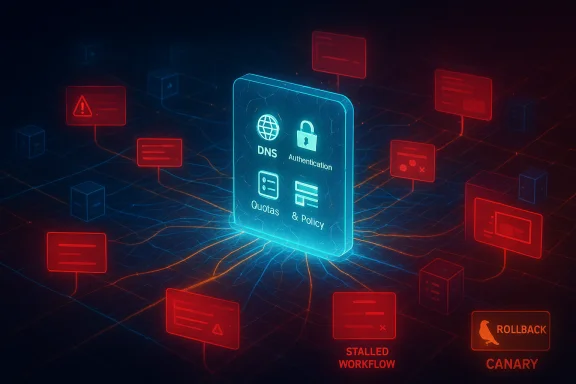
The autumn and winter of 2025 were defined less by a single headline outage than by a pattern: a string of failures across the world’s largest cloud and edge providers that repeatedly knocked consumer apps, enterprise systems and critical services offline. Those incidents exposed a shared weakness in modern internet architecture — control‑plane fragility — where DNS, identity, quota and configuration systems became single points of catastrophic failure. A concise, corroborated review of the five highest‑impact outages in 2025 shows how similar technical symptoms (DNS failures, configuration propagation errors, malformed policy updates) repeatedly translated into enormous economic and social consequences, and why organizations must urgently treat these control planes as first‑class resilience problems.
The consolidation of cloud and edge services into a handful of hyperscalers and global CDNs delivers massive benefits — lower costs, rapid feature velocity and global reach — but it concentrates operational risk into a small set of primitives: DNS and service discovery, global edge routing and CDN fabrics, authentication and identity systems, and quota/policy control planes. When those primitives fail, entire ecosystems of dependent services show the same outward symptom: login failures, 5xx errors, timeouts and blank pages. Multiple independent technical reconstructions and provider incident reports confirm this pattern for the major 2025 outages.
Below is a verified timeline and technical summary of the five major incidents that dominated coverage and operational postures in 2025. Each incident is cross‑checked against provider statements, independent post‑mortems or reputable incident reporting where available.
For organizations that rely on cloud and edge providers, the imperative is simple and operational: assume abundant fragility, plan for the rare but consequential “bad day,” and make control‑plane survivability a funded, measurable program. That program should include multi‑region and multi‑provider strategies for the few primitives that must survive outages; thorough testing of DNS, identity and policy failures; and contractual commitments from vendors for transparency and remediation.
The internet did not fall apart in 2025 because hardware melted down; it faltered because the logical systems — the address book, the traffic cop, and the gatekeepers — temporarily misbehaved. Fix those systems, and the next wave of outages will be smaller and less disruptive. The technology is available; the discipline to implement it must now catch up.
Source: Communications Today From AWS to beyond — The 2025 cloud outages that brought the internet to a standstill | Communications Today
 Background / Overview
The consolidation of cloud and edge services into a handful of hyperscalers and global CDNs delivers massive benefits — lower costs, rapid feature velocity and global reach — but it concentrates operational risk into a small set of primitives: DNS and service discovery, global edge routing and CDN fabrics, authentication and identity systems, and quota/policy control planes. When those primitives fail, entire ecosystems of dependent services show the same outward symptom: login failures, 5xx errors, timeouts and blank pages. Multiple independent technical reconstructions and provider incident reports confirm this pattern for the major 2025 outages.Below is a verified timeline and technical summary of the five major incidents that dominated coverage and operational postures in 2025. Each incident is cross‑checked against provider statements, independent post‑mortems or reputable incident reporting where available.
1) The Christmas gaming meltdown — Epic Online Services authentication outage
What happened
On December 24–25, 2025, login and matchmaking failures prevented players from accessing major multiplayer titles — notably Fortnite, Rocket League and ARC Raiders — during peak holiday hours. Public outage trackers and vendor status pages recorded repeated spikes in reports as authentication attempts returned errors or timed out. Epic’s public status page showed ongoing investigations and recovery updates for Epic Online Services (EOS) authentication and matchmaking, confirming the outage originated in EOS infrastructure rather than being a simple client‑side or single‑title problem.Technical anatomy
The proximate failure was an authentication/control‑plane problem in Epic Online Services used by multiple games for account validation and session issuance. When EOS authentication is unavailable, game servers that still run will often refuse players who cannot prove entitlement or session state — producing what looks like an across‑the‑board outage for many distinct titles. Real‑time player reports and the Epic status timeline show repeated cycles of partial restoration and relapse, consistent with control‑plane instability rather than steady capacity exhaustion.Why it mattered
Shared third‑party services for authentication create a high‑impact coupling: a single EOS outage can simultaneously halt logins, purchases and matchmaking across dozens of games. Holiday traffic spikes magnified the operational stress and made the user impact highly visible. Early misattribution to upstream providers (some social chatter blamed cloud infra) underscores how messy real‑time attribution is during multi‑service incidents. Public trackers and Epic’s own status updates are the authoritative timeline for this event; press and social reports vary in their audience‑level counts, so treat single numbers (like a particular Downdetector peak) as indicative rather than definitive.2) Cloudflare: a pair of edge disasters (Nov. 18 and Dec. 5, 2025)
November 18 — Bot‑management bug
On November 18, a latent bug in Cloudflare’s bot‑management pipeline caused a multi‑hour global outage that manifested as mass 5xx errors and authentication failures for platforms that rely on Cloudflare’s edge. Cloudflare’s own incident post detailed how a database permission change produced duplicate rows in a generated “feature file” used by its bot‑mitigation model; the file doubled in size, exceeded an internal limit, and caused proxy processes to crash. The faulty configuration propagated across the fleet and produced repeated fail/recover cycles until Cloudflare rolled back the feature file and restarted proxies. Cloudflare’s technical blog provides a step‑by‑step account and remediation actions. Independent reporting confirmed the global footprint: ChatGPT, Spotify, X (formerly Twitter) and other major platforms were affected while Cloudflare worked through mitigation and rollbacks. The outage demonstrates how a single, fast‑propagated configuration artifact in an edge product can create a simultaneous failure across sites that are otherwise unrelated.December 5 — Firewall / WAF rollout problem
Two weeks later Cloudflare suffered a quicker but still damaging disruption on December 5 when a change to WAF body‑parsing logic — intended to mitigate an industry vulnerability — triggered a null‑reference failure in an older proxy engine. That rollout, applied rapidly across the network, returned HTTP 500 results for a subset of customers and briefly affected LinkedIn, Zoom, Shopify and other high‑traffic properties. Cloudflare’s incident note explains the technical path and emphasizes the company will add roll‑out guardrails and “global kill switches” to prevent similar propagation.Operational lesson
Edge policy engines (bot management, WAF, rate limiting) are high‑blast‑radius features. Rapid propagation without robust canaries, size/load limits, and emergency rollback mechanisms turns security fixes into availability risks. Cloudflare’s post‑incident remediation commitments — staged rollouts, stronger validation for generated configuration files, and emergency cutoff switches — are the right start; customers must also design applications to degrade gracefully if Turnstile/WAF decisions fail.3) Amazon Web Services — US‑EAST‑1 DNS / DynamoDB automation bug (Oct. 20, 2025)
What occurred
The largest single outage of 2025 began in AWS’s US‑EAST‑1 (Northern Virginia) region on October 19–20. The proximate symptom was DNS resolution failures for the DynamoDB regional API endpoint, produced by a race condition in DynamoDB’s DNS automation subsystem that left an empty DNS answer for the service’s hostname. Because DynamoDB functions as a low‑latency metadata store used by many AWS control‑plane subsystems, the DNS error cascaded: internal orchestration stalled, EC2 instance launches were throttled, and a wide set of downstream services saw elevated error rates. Multiple independent technical reconstructions and reporting align with AWS’ public timeline and the pattern of cascading control‑plane failures.Technical anatomy
The outage’s root trigger was internal automation that manages DNS for DynamoDB endpoints. A delayed “enactor” process reapplied an outdated plan after a cleanup job removed the valid plan, resulting in an empty DNS record for dynamodb.us‑east‑1.amazonaws.com. The empty DNS answer made the service unreachable to new connections even though host capacity remained intact; client libraries timed out, created retry storms, and amplified load on resolvers and control planes. Recovery required manually disabling the automation, restoring DNS state, throttling new operations, and draining long backlogs. Independent telemetry firms and incident reconstructions documented the same sequence.Scale and caveats
Public outage trackers showed millions of user reports across affected services during the event, and many high‑profile consumer apps and enterprise systems reported partial or full outages at various times. Careful analysts note that aggregate counts (for example, “17 million Downdetector reports”) are aggregator‑dependent; use such figures as a scale indicator rather than a precise audit. The technical truth — a DNS automation defect that created empty answers and propagated through a tightly coupled control plane — is supported by multiple independent reconstructions and AWS’ subsequent mitigation actions.4) Microsoft Azure — Azure Front Door configuration change (Oct. 29, 2025)
Summary
Less than ten days after the AWS disruption, Microsoft Azure experienced a global outage beginning October 29 tied to a configuration change in Azure Front Door (AFD), Microsoft’s global edge and application delivery fabric. A misapplied configuration propagated across AFD nodes, affecting routing and DNS behavior and causing authentication and management failures across Microsoft 365, the Azure Portal, Xbox Live and numerous enterprise endpoints. Microsoft’s incident notices and independent monitoring detail the detection, the block on further AFD changes, and the rollback to a last‑known‑good configuration.Technical details and impact
AFD handles TLS termination, routing, WAF enforcement and often fronts identity token exchanges for Microsoft services. A flawed tenant configuration therefore prevented token issuance and routing to healthy backends in many cases, producing sign‑in failures and blank admin blades for services that relied on AFD ingress. Microsoft mitigated by freezing AFD updates, failing the Azure Portal away from affected AFD paths, and rolling back the faulty configuration to restore traffic to healthy PoPs. The staged rollback and DNS convergence created a tail of residual errors as caches and resolver TTLs expired.Why this is instructive
AFD’s responsibilities make it a single‑change blast radius: mistakes in global routing pipelines will show up as authentication or access failures across an ecosystem of dependent services. The event reinforces a recurring theme of 2025: fast global configuration changes without conservative canaries or immediate rollback capability are existential risks for an edge fabric.5) Google Cloud — Service Control quota policy crash (June 12, 2025)
What the provider reported
In June, Google Cloud and Google Workspace products experienced increased 503 errors after a faulty quota policy update replicated blank fields into Service Control’s policy store. Google’s incident notes explain that a feature added to Service Control lacked sufficient error handling and a protective feature flag; when a malformed policy was inserted into the Spanner store, regional Service Control binaries exercised a previously untested code path, encountered a null pointer, and crashed in a crash loop. The error propagated globally because the policy metadata is replicated rapidly across regions. Google’s status post and incident report describe the failure and remediation steps.Systemic takeaways
This outage underlines the perils of global replication for control metadata: a malformed policy or schema change that is instantly replicated can exercise corner cases in newly deployed binaries that were never exercised during rollout. Google’s remediation priorities (modularize Service Control, ensure fail‑open behavior, enforce feature flags and incremental replication) are precisely the kinds of engineering controls needed to prevent global cascades from a single malformed policy update. Independent analyses and the Google status account align closely on the root mechanics.Cross‑incident analysis: common technical threads
- Control‑plane coupling: Every major outage in 2025 traced back to failures in systems that act as control planes — DNS for service discovery, edge routing for ingress, authentication services for identity, and quota/policy stores for API gating. These control planes sit on the critical path for many downstream operations and are often implicitly trusted to be highly available.
- Automation and rollout risk: Latent bugs in automation (DNS enactors, bot‑management generators, or feature rollouts) can lie dormant until a particular input or timing condition triggers them. Rapid, global propagation turns a local defect into a global outage; protective feature flags, staged rollouts, canaries and automated sanity checks are essential to avoid this class of failure. Cloudflare, Google and AWS explicitly point to rollout and automation gaps in their posts.
- Cache and DNS convergence tails: Fixing the control plane often happens quickly, but recovery visible to users is extended by DNS TTLs, ISP resolver caches and distributed caches at the edge. Rolling back a bad configuration is necessary but not sufficient to restore immediate global availability — caches must converge, backlogs must drain and retry storms must subside.
- Amplification via retries and backlogs: Standard client SDKs and middleware poorly instrumented for failure will retry aggressively without jitter, producing retry storms that amplify partial failures into full collapse. Many post‑incident reconstructions emphasize the role of exponential backoff, idempotent operations and circuit breakers in containing systemic amplification.
- Attribution confusion and public communications: Real‑time signals during outages are noisy. Early claims that pinned blame on one provider often proved premature. Accurate root‑cause statements require provider post‑mortems and should be preferred over social tracker anecdotes; families of monitors and status pages (including provider status pages) are the authoritative sources for incident timelines.
Practical mitigations for IT teams and platform owners
Every Windows administrator, SRE and enterprise IT leader should treat these incidents as practical requirements, not optional best practice. The following is a prioritized action list:- Map critical dependencies: inventory control plane dependencies — DNS, identity, quota services, CDN frontends — and identify which systems are single points of failure.
- Design for graceful degradation: ensure authentication failures produce read‑only or cached experiences where feasible; use offline tokens and local caches for critical admin functions.
- Implement multi‑region and multi‑provider plans for mission‑critical primitives (active‑active where possible; cross‑provider failover where economically feasible).
- Harden DNS and service discovery: monitor DNS answer correctness and TTL behavior from multiple resolvers, and validate service discovery paths in failover scenarios.
- Harden retry logic and add circuit breakers: enforce exponential backoff with jitter and make retry policies conservative for control‑plane operations.
- Validate vendor dependences contractually: insist on post‑incident transparency, defined SLAs for control‑plane availability, and runbook access for critical incident response.
- Practice incident rehearsal: run scheduled chaos testing that includes control‑plane failures and simulated DNS/identity outages to validate customer‑facing fallback behaviors.
Strengths and improvements — a balanced verdict
These outages are not an argument to abandon cloud or edge services — hyperscalers and CDNs provide immense value and continue to power innovation. The 2025 incidents instead reveal where engineering discipline must shift:- Strengths: modern cloud stacks deliver unmatched scale, performance and feature velocity. Managed primitives let teams build faster and focus on business logic rather than infrastructure plumbing.
- Weaknesses: the convenience of global shared control planes brings correlated fragility. Automation, if unguarded, becomes a vector for wide blast radii. Edge engines and control planes are now as mission‑critical as power and networking.
Risks that remain
- Hidden internal couplings between control planes remain difficult for customers to observe and test. Public post‑mortems rarely reveal the full internal dependency graphs. Treat this opacity as risk — assume your vendor’s control plane could have single‑region authoritative state.
- Real‑time attribution will continue to be noisy; early blame can be wrong and harm remediation coordination. Rely on provider status channels and post‑incident reports for final cause statements.
- Regulatory and insurance responses will lag the technical fixes; expect contractual friction and slow compensation processes following major outages. Document impact comprehensively and maintain playbooks for reconciliation.
Closing analysis — architecting resilience into the internet
The 2025 outages are not a defeat for cloud: they are a clear roadmap for what resilience looks like going forward. The common failure modes — DNS automation race conditions, configuration propagation errors, insufficiently guarded feature rollouts and untested binary code paths — are fixable with engineering rigor, conservative rollout practices, and a change in the cultural assumption that global propagation equals safety.For organizations that rely on cloud and edge providers, the imperative is simple and operational: assume abundant fragility, plan for the rare but consequential “bad day,” and make control‑plane survivability a funded, measurable program. That program should include multi‑region and multi‑provider strategies for the few primitives that must survive outages; thorough testing of DNS, identity and policy failures; and contractual commitments from vendors for transparency and remediation.
The internet did not fall apart in 2025 because hardware melted down; it faltered because the logical systems — the address book, the traffic cop, and the gatekeepers — temporarily misbehaved. Fix those systems, and the next wave of outages will be smaller and less disruptive. The technology is available; the discipline to implement it must now catch up.
Source: Communications Today From AWS to beyond — The 2025 cloud outages that brought the internet to a standstill | Communications Today
