

Cooler Master’s Sneaker X Gaming PC has always been about more than raw specs. It is a statement build, part enthusiast machine and part industrial design piece, aimed at buyers who want their desktop to be as visually memorable as it is capable. The version described by the retailer, however, raises an immediate question: it mixes a Cooler Master Sneaker X chassis with a far more modern hardware stack than the prebuilt Sneaker X configuration currently shown by Cooler Master itself. That gap matters, because in the premium prebuilt market, what a system looks like and what it actually contains are not the same thing. Cooler Master’s own Sneaker X Gaming PC page currently lists a much older Core i5-12400F, RTX 3050, 16GB DDR5, and 1TB SSD configuration, while Intel and NVIDIA’s official product pages confirm that the cited Core i5-14600K and RTX 4060 Ti are real, high-end mainstream parts with very different performance and power characteristics (coolermaster.com)
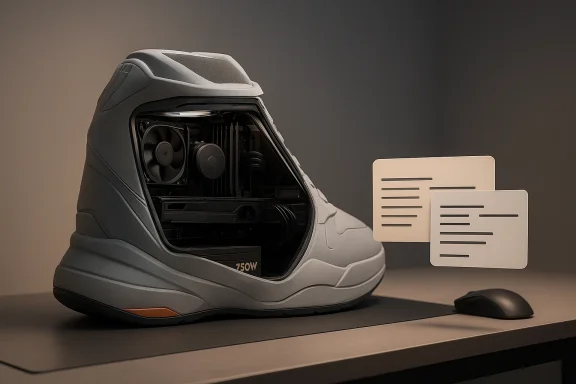
Cooler Master’s Sneaker X is not just another gaming desktop in an unusual case. It comes out of the company’s broader push into design-led systems that blur the line between PC hardware and lifestyle product, a strategy Cooler Master has repeatedly highlighted through products like Shark X, Dyn X, and its CMODX platform. The Sneaker X case itself was presented as a sneaker-inspired art object, with Cooler Master describing it as an homage to youth culture and custom modding rather than a conventional tower. That positioning makes sense in a market where high-end PCs are increasingly sold as personal identity pieces, not merely utility boxes.
That design-first approach has a business logic behind it. Enthusiast buyers already accept price premiums for boutique cases, premium cooling, and hand-assembled systems, so a distinctive enclosure can create a moat that commodity ATX towers cannot. The tradeoff is that a design icon can become frozen in time if the internal platform lags behind current-generation CPUs and GPUs. When that happens, the outside still feels new, but the inside starts to read like inventory clearance. Cooler Master’s current official Sneaker X Gaming PC page illustrates that tension clearly by pairing the chassis with a 12th-gen i5 and RTX 3050 rather than a 14th-gen platform. (coolermaster.com)
The retailer listing circulating with this claim presents the opposite problem: the interior looks much more ambitious than the official Sneaker X configuration. It promises a Core i5-14600K, RTX 4060 Ti, 32GB DDR5, 2TB NVMe SSD, a 360mm AIO, and an 850W Gold PSU. Those parts are perfectly plausible together, but they describe a much more performance-focused build than Cooler Master’s own current catalog page. In other words, this is either a separately customized build using the Sneaker X case, a reseller-assembled configuration, or a listing that is leaning heavily on branding while making the package sound more premium than the official system. (coolermaster.com)
The backdrop also includes broader market movement in prebuilt gaming PCs. After the pandemic-era frenzy, buyers have become more selective, and the old formula of “add a flashy case and a midrange GPU” no longer automatically commands a premium. Today’s buyers expect clearer value, quieter thermals, better cable management, and credible after-sale support. That is why claims like assembled in the USA, 1-year warranty, and lifetime tech support matter so much; they are not decorative extras, but signals meant to reassure buyers who may never open the machine themselves. Those claims are also exactly the kind of details that deserve extra scrutiny when a system is sold through a nonstandard storefront rather than an established PC integrator. Trust is part of the product.
The GPU side is equally important. NVIDIA’s official RTX 4060 Ti page shows that the card is based on the Ada Lovelace architecture and, in the standard 8GB model, is marketed with 4352 CUDA cores and 8GB GDDR6 memory. NVIDIA positions it for modern gaming features such as DLSS 3, ray tracing, and VR support, while its own product page shows the 8GB model benchmarked against older GPUs at 1080p with highest settings. That makes it a solid upper-mainstream GPU, but not a magic bullet for every modern game at ultra settings, especially once textures, ray tracing, and higher-resolution displays enter the chat. (nvidia.com)
What makes this specific combination noteworthy is that it shifts the conversation from casual gaming to platform longevity. A 14-core Intel chip and 32GB of DDR5 memory create room for streaming, content creation, modded games, and heavier multitasking. But the 8GB VRAM ceiling on the RTX 4060 Ti can still become a pressure point in some newer games, especially if the buyer expects “1440p high settings” to mean everything maxed forever. That distinction is where polished sales copy often runs ahead of reality.
The challenge is that unusual cases can narrow the practical path to upgradeability. A conventional mid-tower can absorb a broad range of motherboards, coolers, and GPUs, but a sculptural case often imposes constraints on radiator placement, cable routing, and component clearance. That does not make the Sneaker X worse; it makes it more opinionated. Buyers who love the aesthetic may never care, while buyers who prioritize easy future swaps should ask whether the visual payoff is worth the thermal and service complexity.
The RTX 4060 Ti is the more nuanced part of the story. NVIDIA’s own positioning emphasizes ray tracing, DLSS, and efficiency, and that is fair. But the card is still fundamentally a mainstream GPU, not an enthusiast-tier part, and 8GB of VRAM is where some buyers will begin to feel friction in the years ahead. For esports, older AAA games, and many 1440p titles with settings tuned intelligently, it is a strong performer. For “everything maxed, every time,” it is not the class of GPU that delivers that promise without compromise. (nvidia.com)
The distinction matters because modern game performance is increasingly feature-dependent. DLSS can be the difference between a good experience and a great one, and frame generation can help in supported titles, but those are not blanket solutions. Buyers should think of this system as a machine that rewards reasonable settings, not as a pure no-compromise ultra preset box.
That said, a big cooler and a big power supply are not automatically proof of a superior build. They are often the right components, but the quality of the radiator, fan curve, pump setup, and case airflow path still matters more than the label alone. In a visually distinctive chassis, thermal engineering has to work around the design, not just behind it. That is why boutique systems often look effortlessly premium on the product page and then become more complicated in long-term ownership.
If the build is real and the cooling implementation is competent, the platform should handle the i5-14600K without drama. If the AIO or airflow path is mediocre, however, the design may become a liability. That is especially relevant for buyers who plan long gaming sessions, room-temperature variations, or future CPU upgrades.
The “no bloatware” claim is less easy to verify from a listing alone. In general, prebuilt systems vary widely in how cleanly they arrive. Some ship nearly bare except for drivers and utility software, while others arrive with vendor suites, trialware, or hardware-monitoring tools that need manual cleanup. Buyers should treat “no bloatware” as a nice promise, not a guarantee, unless the seller documents a truly clean Windows installation process.
There is also a support expectation embedded in the software side of the listing. When a seller promises lifetime tech support, the buyer imagines a smoother ownership curve, especially for driver updates, RGB quirks, BIOS questions, and troubleshooting. Those promises are valuable, but they are only as good as the company actually answering the phone or email. Support is the hidden spec sheet.
That difference is not a problem by itself. Many boutique cases are used for multiple configurations, and a reseller may legitimately pair better parts with the chassis. The issue is branding clarity. If the seller is using Cooler Master imagery to imply an official factory configuration, the consumer could reasonably assume they are buying a product that Cooler Master itself has validated in that exact form. When the actual parts diverge, so does the implied trust relationship.
The broader lesson is that industrial design branding can sometimes obscure the actual platform economics. A stylish case does not change the fact that buyers are still paying for a CPU, GPU, motherboard, memory, storage, PSU, and assembly labor. If the internals are good, fine. If the internals are merely average and the styling does most of the heavy lifting, the buyer should demand a discount, not a premium.
That is why Sneaker X is strategically interesting even if this particular listing is only partially aligned with Cooler Master’s official configuration. The market increasingly rewards products that can be photographed well, shared easily, and recognized instantly. The same logic has helped mechanical keyboards, boutique audio gear, and limited-edition monitors command premium attention. PCs are now part of that lifestyle economy, especially when they are designed to look like sculptures rather than appliances.
This is especially true in the RTX 4060 Ti class. Since the GPU is powerful but not exotic, value comparisons are straightforward. A flashy enclosure can add desirability, but it cannot erase the arithmetic of performance per dollar. In a market that has become far more rational than it was three years ago, that arithmetic matters again.
At the same time, buyers are getting smarter about what premium actually means. They are less willing to pay for a flashy shell unless the GPU, CPU, storage, cooling, and support stack are all credible. That means the future of systems like Sneaker X will depend on transparency as much as imagination.
Source: notiexpressdemexico.com https://notiexpressdemexico.com/pro...4600K-RTX-4060-Ti-32GB-DDR5-2TB-NVMe/1278701/
 Background
Cooler Master’s Sneaker X is not just another gaming desktop in an unusual case. It comes out of the company’s broader push into design-led systems that blur the line between PC hardware and lifestyle product, a strategy Cooler Master has repeatedly highlighted through products like Shark X, Dyn X, and its CMODX platform. The Sneaker X case itself was presented as a sneaker-inspired art object, with Cooler Master describing it as an homage to youth culture and custom modding rather than a conventional tower. That positioning makes sense in a market where high-end PCs are increasingly sold as personal identity pieces, not merely utility boxes.That design-first approach has a business logic behind it. Enthusiast buyers already accept price premiums for boutique cases, premium cooling, and hand-assembled systems, so a distinctive enclosure can create a moat that commodity ATX towers cannot. The tradeoff is that a design icon can become frozen in time if the internal platform lags behind current-generation CPUs and GPUs. When that happens, the outside still feels new, but the inside starts to read like inventory clearance. Cooler Master’s current official Sneaker X Gaming PC page illustrates that tension clearly by pairing the chassis with a 12th-gen i5 and RTX 3050 rather than a 14th-gen platform. (coolermaster.com)
The retailer listing circulating with this claim presents the opposite problem: the interior looks much more ambitious than the official Sneaker X configuration. It promises a Core i5-14600K, RTX 4060 Ti, 32GB DDR5, 2TB NVMe SSD, a 360mm AIO, and an 850W Gold PSU. Those parts are perfectly plausible together, but they describe a much more performance-focused build than Cooler Master’s own current catalog page. In other words, this is either a separately customized build using the Sneaker X case, a reseller-assembled configuration, or a listing that is leaning heavily on branding while making the package sound more premium than the official system. (coolermaster.com)
The backdrop also includes broader market movement in prebuilt gaming PCs. After the pandemic-era frenzy, buyers have become more selective, and the old formula of “add a flashy case and a midrange GPU” no longer automatically commands a premium. Today’s buyers expect clearer value, quieter thermals, better cable management, and credible after-sale support. That is why claims like assembled in the USA, 1-year warranty, and lifetime tech support matter so much; they are not decorative extras, but signals meant to reassure buyers who may never open the machine themselves. Those claims are also exactly the kind of details that deserve extra scrutiny when a system is sold through a nonstandard storefront rather than an established PC integrator. Trust is part of the product.
What the Official Specs Actually Tell Us
The first useful reference point is Intel’s own documentation for the Core i5-14600K. Intel lists the processor as a 14-core chip with 6 P-cores and 8 E-cores, 20 threads, 24 MB of L3 cache, a base power of 125W, and a maximum turbo power of 181W. Intel also lists peak turbo frequencies up to 5.3 GHz, which helps explain why this CPU sits in a sweet spot for upper-midrange gaming and mixed-use workloads. It is not a low-power chip, and it is not a “set it and forget it” part in the thermal sense. (cdrdv2-public.intel.com)The GPU side is equally important. NVIDIA’s official RTX 4060 Ti page shows that the card is based on the Ada Lovelace architecture and, in the standard 8GB model, is marketed with 4352 CUDA cores and 8GB GDDR6 memory. NVIDIA positions it for modern gaming features such as DLSS 3, ray tracing, and VR support, while its own product page shows the 8GB model benchmarked against older GPUs at 1080p with highest settings. That makes it a solid upper-mainstream GPU, but not a magic bullet for every modern game at ultra settings, especially once textures, ray tracing, and higher-resolution displays enter the chat. (nvidia.com)
Why the CPU-GPU Pairing Matters
The i5-14600K and RTX 4060 Ti are a sensible match on paper. The CPU is fast enough to feed the GPU without creating a major bottleneck in most gaming scenarios, and the GPU is strong enough to make the PC feel legitimately premium for 1080p and many 1440p titles. That said, the balance is not as simple as “more FPS equals better value.” In a premium case like Sneaker X, the system is partly selling design prestige, and that premium has to be justified against what a similarly priced conventional tower could deliver.What makes this specific combination noteworthy is that it shifts the conversation from casual gaming to platform longevity. A 14-core Intel chip and 32GB of DDR5 memory create room for streaming, content creation, modded games, and heavier multitasking. But the 8GB VRAM ceiling on the RTX 4060 Ti can still become a pressure point in some newer games, especially if the buyer expects “1440p high settings” to mean everything maxed forever. That distinction is where polished sales copy often runs ahead of reality.
Key Takeaways
- Core i5-14600K is a strong upper-mainstream CPU, not an entry-level part.
- RTX 4060 Ti 8GB is capable, but its memory headroom is the limiting factor more often than raw shader performance.
- 32GB DDR5 is a real quality-of-life upgrade for gaming plus multitasking.
- 2TB NVMe SSD meaningfully improves install flexibility and reduces immediate storage anxiety.
The Sneaker X Case as a Product Signal
Cooler Master’s Sneaker X chassis is the main reason this system exists in the first place. The case is intended to make the PC feel like a collectible object, and that is not a trivial detail. In premium computing, industrial design often does as much selling as benchmark charts do, because buyers want systems that are visible in a room, not hidden under a desk. Cooler Master has clearly embraced that logic across its recent “art PC” efforts, from Shark X to the Sneaker X family.The challenge is that unusual cases can narrow the practical path to upgradeability. A conventional mid-tower can absorb a broad range of motherboards, coolers, and GPUs, but a sculptural case often imposes constraints on radiator placement, cable routing, and component clearance. That does not make the Sneaker X worse; it makes it more opinionated. Buyers who love the aesthetic may never care, while buyers who prioritize easy future swaps should ask whether the visual payoff is worth the thermal and service complexity.
Design Versus Serviceability
There is also a branding risk. A case like Sneaker X tends to attract attention from shoppers who may not be deep PC builders. That makes the bundled configuration especially important, because the chassis alone does not guarantee the value of the whole machine. If a retailer attaches current-gen parts to the Sneaker X name, the case becomes a premium packaging layer around the real product: a custom prebuilt PC. If the buyer assumes they are purchasing an official Cooler Master SKU, confusion can follow. That distinction is essential.Practical Implications
- The case is a design-first enclosure, not a generic chassis.
- The unusual form factor can complicate future upgrades and service access.
- Premium styling can justify a higher price only if the internal parts are strong enough.
- Buyers should verify whether the system is a Cooler Master official prebuilt or a reseller custom build.
Performance Expectations: What Buyers Should Realistically Expect
On raw capability, the described machine is still attractive. The i5-14600K provides more than enough CPU headroom for high-refresh gaming, light productivity, and streaming while gaming. Intel’s official specs support the conclusion that this processor sits in a robust class with plenty of threads and high boost clocks, which is exactly what modern game engines and background tasks can use. (cdrdv2-public.intel.com)The RTX 4060 Ti is the more nuanced part of the story. NVIDIA’s own positioning emphasizes ray tracing, DLSS, and efficiency, and that is fair. But the card is still fundamentally a mainstream GPU, not an enthusiast-tier part, and 8GB of VRAM is where some buyers will begin to feel friction in the years ahead. For esports, older AAA games, and many 1440p titles with settings tuned intelligently, it is a strong performer. For “everything maxed, every time,” it is not the class of GPU that delivers that promise without compromise. (nvidia.com)
Gaming at 1080p and 1440p
At 1080p, this machine should feel excellent. The CPU is more than sufficient, the GPU is well matched, and the extra RAM and SSD capacity are overkill in a good way. At 1440p, the system remains credible, but game-by-game tuning matters more. If the retailer’s claim of “60+ FPS on high settings” is taken as a broad marketing statement rather than a guarantee for every new release, it is plausible; if read as a universal promise, it is too optimistic.The distinction matters because modern game performance is increasingly feature-dependent. DLSS can be the difference between a good experience and a great one, and frame generation can help in supported titles, but those are not blanket solutions. Buyers should think of this system as a machine that rewards reasonable settings, not as a pure no-compromise ultra preset box.
What the Configuration Does Well
- Strong CPU performance for gaming and multitasking.
- Enough RAM for streaming, browsers, launchers, and game clients.
- Large SSD storage for a substantial library.
- Good match for 1080p high-refresh and 1440p tuned gaming.
Cooling, Power, and the Importance of Thermal Headroom
A 360mm AIO and 850W Gold PSU are the sort of components that make a listing feel serious. They suggest that whoever assembled the machine anticipated heat and power delivery rather than trying to shave costs in invisible places. On a K-series Intel chip like the 14600K, cooling is not a cosmetic issue; it directly affects how consistently the CPU can hold boost behavior under gaming and streaming load. Intel’s power figures make it clear that this CPU can draw meaningfully more power under turbo conditions than its nominal base rating suggests. (cdrdv2-public.intel.com)That said, a big cooler and a big power supply are not automatically proof of a superior build. They are often the right components, but the quality of the radiator, fan curve, pump setup, and case airflow path still matters more than the label alone. In a visually distinctive chassis, thermal engineering has to work around the design, not just behind it. That is why boutique systems often look effortlessly premium on the product page and then become more complicated in long-term ownership.
Thermal Strategy Is Part of the Product
The most attractive part of the listing may actually be the one that gets ignored: the promise that the machine is assembled to be quiet and stable rather than merely fast. Gaming buyers often underestimate how much thermal headroom affects the feel of a system. A cooler machine is less likely to throttle, less likely to become noisy under load, and less likely to feel old before its time.If the build is real and the cooling implementation is competent, the platform should handle the i5-14600K without drama. If the AIO or airflow path is mediocre, however, the design may become a liability. That is especially relevant for buyers who plan long gaming sessions, room-temperature variations, or future CPU upgrades.
Cooling and Power Checklist
- 360mm AIO is appropriate for a higher-end Intel K-series chip.
- 850W Gold PSU gives comfortable overhead for transient loads.
- Actual results depend on fan curve tuning and case airflow.
- Boutique cases can prioritize style at the expense of service simplicity.
Windows 11, Drivers, and the Real-World User Experience
The listing’s promise of Windows 11 is unsurprising, but it still matters. Windows 11 remains the natural home for current-generation Intel and NVIDIA hardware, especially when the system is meant for modern gaming and mixed productivity. NVIDIA’s RTX 4060 Ti page specifically references Windows 11 in performance testing, and Intel’s 14th-gen platform is squarely in the modern desktop ecosystem. (nvidia.com)The “no bloatware” claim is less easy to verify from a listing alone. In general, prebuilt systems vary widely in how cleanly they arrive. Some ship nearly bare except for drivers and utility software, while others arrive with vendor suites, trialware, or hardware-monitoring tools that need manual cleanup. Buyers should treat “no bloatware” as a nice promise, not a guarantee, unless the seller documents a truly clean Windows installation process.
Consumer Versus Creator Use
For consumers, the main benefit of this configuration is convenience. Everything is assembled, shipped, and ready to boot, which lowers the barrier for buyers who do not want to build a PC themselves. For streamers and creators, the stronger CPU, 32GB of memory, and roomy SSD add practical flexibility beyond gaming alone. That makes the system more versatile than a typical budget prebuilt, even if it is still fundamentally a gaming-first machine.There is also a support expectation embedded in the software side of the listing. When a seller promises lifetime tech support, the buyer imagines a smoother ownership curve, especially for driver updates, RGB quirks, BIOS questions, and troubleshooting. Those promises are valuable, but they are only as good as the company actually answering the phone or email. Support is the hidden spec sheet.
What Buyers Should Verify
- Is Windows 11 installed cleanly or with vendor utilities?
- Are chipset, Wi-Fi, GPU, and audio drivers fully updated at shipping?
- Does the seller provide a clear recovery path if the OS needs reinstalling?
- Is “lifetime tech support” actually documented in writing?
How This Compares With Cooler Master’s Own Sneaker X Positioning
Cooler Master’s official Sneaker X Gaming PC page is a useful reality check. The company currently shows a much more modest build: Core i5-12400F, RTX 3050, 16GB DDR5, 1TB SSD, MPG B760I Edge WiFi, and a V850 SFX Gold PSU. That official configuration confirms that the Sneaker X line is already being sold as a premium aesthetic platform, but also that Cooler Master is not, at least on that page, presenting it as a cutting-edge high-FPS monster. (coolermaster.com)That difference is not a problem by itself. Many boutique cases are used for multiple configurations, and a reseller may legitimately pair better parts with the chassis. The issue is branding clarity. If the seller is using Cooler Master imagery to imply an official factory configuration, the consumer could reasonably assume they are buying a product that Cooler Master itself has validated in that exact form. When the actual parts diverge, so does the implied trust relationship.
What the Mismatch Suggests
There are three plausible explanations. First, the listing could be a custom-built system assembled by a third party using a Sneaker X case. Second, it could be a retailer-specific bundle not mirrored on Cooler Master’s global site. Third, and most concerning, it could be a marketing page that overstates the pedigree of the machine. Any of those scenarios would justify closer scrutiny before purchase.The broader lesson is that industrial design branding can sometimes obscure the actual platform economics. A stylish case does not change the fact that buyers are still paying for a CPU, GPU, motherboard, memory, storage, PSU, and assembly labor. If the internals are good, fine. If the internals are merely average and the styling does most of the heavy lifting, the buyer should demand a discount, not a premium.
Comparison Points
- Official Cooler Master Sneaker X page shows a much lower-spec system.
- A reseller build could still be valid, but it should be labeled clearly.
- Buyers should separate case value from component value.
- Branding alone should not justify a top-tier price.
The Market Context: Why These Builds Exist
The premium prebuilt category has become more fragmented. On one end are utilitarian systems that compete on price and quiet competence. On the other are expression-driven PCs that compete on style, exclusivity, and social-media appeal. Cooler Master’s more theatrical desktops sit squarely in the second camp, where the buyer is not simply purchasing a computer but also a conversation piece.That is why Sneaker X is strategically interesting even if this particular listing is only partially aligned with Cooler Master’s official configuration. The market increasingly rewards products that can be photographed well, shared easily, and recognized instantly. The same logic has helped mechanical keyboards, boutique audio gear, and limited-edition monitors command premium attention. PCs are now part of that lifestyle economy, especially when they are designed to look like sculptures rather than appliances.
Competitive Implications
For rivals, the message is clear: a plain tower no longer wins by default. Boutique system builders need either stronger specs, lower prices, or sharper differentiation. Cooler Master’s bet is that design equity can convert into aspiration, and in some cases it can. But if competitors can offer similar internals inside cleaner, more serviceable, and less expensive chassis, the premium becomes harder to defend.This is especially true in the RTX 4060 Ti class. Since the GPU is powerful but not exotic, value comparisons are straightforward. A flashy enclosure can add desirability, but it cannot erase the arithmetic of performance per dollar. In a market that has become far more rational than it was three years ago, that arithmetic matters again.
Market Forces at Work
- Buyers want unique designs but still expect strong value.
- Prebuilts are judged more harshly on price transparency than before.
- Midrange GPUs need real justification when sold in luxury packaging.
- Boutique PCs succeed when they feel special, not merely expensive.
Strengths and Opportunities
This kind of system can absolutely make sense for the right buyer. If the build is accurate and the seller is reputable, it offers a strong mix of style, convenience, and everyday speed. The opportunity is to own a PC that feels custom without requiring the buyer to build it from scratch.- Distinctive design that stands out in any room.
- Strong CPU performance for gaming and multitasking.
- 32GB DDR5 helps with longevity and heavy app use.
- 2TB SSD capacity is genuinely practical.
- Good thermal potential if the cooling setup is executed well.
- Ready-to-use convenience for buyers who want a turnkey machine.
- Streaming and creator flexibility beyond gaming alone.
Risks and Concerns
The main concern is not that the hardware is bad; it is that the marketing may be doing more work than the product page admits. The official Cooler Master Sneaker X system on the company site is far lower spec than the machine described by the retailer, which makes verification essential. Buyers should assume nothing until the exact part numbers are confirmed in writing.- Brand/spec mismatch between the official Cooler Master page and the retailer listing.
- Possible ambiguity over whether this is an official Cooler Master prebuilt or a third-party build.
- RTX 4060 Ti 8GB may age faster than some buyers expect.
- High-end styling can inflate price beyond the value of the internals.
- Thermal performance depends on the quality of the actual assembly.
- Claims like lifetime support and no bloatware require verification.
- Unknown retailer reputation adds trust risk to the purchase.
Looking Ahead
The Sneaker X concept is likely to remain relevant even if this specific configuration is merely a retailer-customized variant rather than a factory build. That is because the underlying trend is bigger than any one SKU: premium PCs are becoming identity products, and identity products can survive more than one generation of internal hardware. If Cooler Master continues updating the line with more modern internals, the design could become a durable platform rather than a one-off novelty.At the same time, buyers are getting smarter about what premium actually means. They are less willing to pay for a flashy shell unless the GPU, CPU, storage, cooling, and support stack are all credible. That means the future of systems like Sneaker X will depend on transparency as much as imagination.
- Future refreshes should align design prestige with current-generation silicon.
- Buyers will increasingly demand exact part transparency.
- Premium prebuilts will need stronger support and warranty clarity.
- GPU choice will matter more as games continue to push VRAM demands.
- Boutique desktops will succeed when they feel both exclusive and honest.
Source: notiexpressdemexico.com https://notiexpressdemexico.com/pro...4600K-RTX-4060-Ti-32GB-DDR5-2TB-NVMe/1278701/
