

Microsoft’s Copilot team closed out 2025 with a playful, data-rich year-in-review that doubles as a cultural temperature check: a short Copilot blog post and a deeper MAI research paper together map how millions of people used AI as everything from a health coach in their pocket to a weekday coding partner — and they do it while leaning into internet culture, memes, and the very human desire to feel like the “main character.” The headline numbers are striking: Microsoft analyzed 37.5 million de-identified Copilot conversations from January through September and surfaced consistent patterns by device, time of day, and intent — while MAI also announced a programmatic push toward what it calls humanist superintelligence, a deliberately framed research agenda intended to keep advanced AI systems under human-centered constraints. This feature unpacks what Microsoft published, verifies the core claims against independent coverage, and evaluates what the data and strategic signaling mean for users, Windows ecosystems, and the broader AI landscape. The analysis highlights clear strengths — deeper, contextualized user insights; product signals toward personalization and safety; and a renewed focus on human-centered AI — while calling out legitimate risks like overreliance on automated advice, subtle behavior shaping by product design, and gaps in independent verification of sensational micro-stats. The piece also offers practical guidance for users, developers, and IT professionals who need to interpret Copilot’s data-driven positioning as they make product and privacy decisions.
Microsoft’s consumer-facing Copilot team published a short trend recap titled “Main Character Energy: 2025 trend recap,” pairing lighthearted social commentary with a list of behavioral multipliers and cultural trends. The post points readers to MAI’s deeper research work for technical context and for the underlying dataset. The substantive research behind the recap is captured in MAI’s December report, “It’s About Time: The Copilot Usage Report 2025,” which analyzes 37.5 million de-identified conversations collected between January and September 2025. The study uses automated classifiers to label each interaction by topic and intent, and it explicitly excludes enterprise and school accounts to focus on consumer behavior. That report is the source for several core findings that appear in the Copilot blog’s recap: desktop use skews toward work and technical topics during business hours, while mobile usage is dominated by health and fitness queries across every hour of the day. Parallel to these consumer analytics, MAI publicly formalized a strategic initiative to pursue “Humanist Superintelligence” and created a Superintelligence Team under Microsoft AI leadership. This strategic framing emphasizes alignment, containment, and domain-specific application rather than an unrestricted pursuit of ever-larger models for their own sake. The language and hiring signals indicate intentional positioning: MAI wants to be seen as both ambitious in capability and cautious in governance.
But product teams and platform designers must be mindful that celebrating certain behaviors can validate them at scale. When a major platform highlights trending behaviors, the platform helps amplify those behaviors — both the positive (entrepreneurial focus, self-improvement) and the harmful (excessive self-focus, echo chambers). This is a behavioral power; with it comes responsibility to measure downstream social outcomes, not just short-term engagement metrics.
For Windows users and IT professionals, the practical posture is clear: take advantage of Copilot’s contextual strengths (desktop productivity, mobile health triage), enforce enterprise-grade safeguards where corporate data is involved, and insist on reproducible safety signals from vendors. For policymakers and civil society, the MAI announcements are worth engagement — the “humanist” framing is promising, but it must be matched by measurable commitments and independent oversight.
Microsoft’s Copilot and MAI are investing in the next stage of AI’s integration into daily life. The 2025 trend recap is a snapshot of that inflection: useful, culturally savvy, and data-driven — but also a reminder that scale increases stakes, and the company, users, and regulators must move in concert to ensure those stakes tilt toward shared benefit rather than unintended harm.
Source: Microsoft Main Character Energy: 2025 trend recap | Microsoft Copilot Blog
 Background: Copilot, MAI, and the year in numbers
Microsoft’s consumer-facing Copilot team published a short trend recap titled “Main Character Energy: 2025 trend recap,” pairing lighthearted social commentary with a list of behavioral multipliers and cultural trends. The post points readers to MAI’s deeper research work for technical context and for the underlying dataset. The substantive research behind the recap is captured in MAI’s December report, “It’s About Time: The Copilot Usage Report 2025,” which analyzes 37.5 million de-identified conversations collected between January and September 2025. The study uses automated classifiers to label each interaction by topic and intent, and it explicitly excludes enterprise and school accounts to focus on consumer behavior. That report is the source for several core findings that appear in the Copilot blog’s recap: desktop use skews toward work and technical topics during business hours, while mobile usage is dominated by health and fitness queries across every hour of the day. Parallel to these consumer analytics, MAI publicly formalized a strategic initiative to pursue “Humanist Superintelligence” and created a Superintelligence Team under Microsoft AI leadership. This strategic framing emphasizes alignment, containment, and domain-specific application rather than an unrestricted pursuit of ever-larger models for their own sake. The language and hiring signals indicate intentional positioning: MAI wants to be seen as both ambitious in capability and cautious in governance. What the numbers actually say: verified takeaways
1) Scale and scope of the dataset
- Microsoft reports analyzing 37.5 million de-identified consumer conversations with Copilot (Jan–Sep 2025), excluding enterprise and education accounts. The dataset’s scale enables statistically robust temporal analysis but does not, by design, reveal individual-level details.
- Independent technology press coverage confirms the sample size and the study’s time window, and places MAI’s analysis in the context of broader industry trend reports. Coverage by outlets summarizing the study reinforces the same top-line claims.
2) Device and time-of-day differentiation
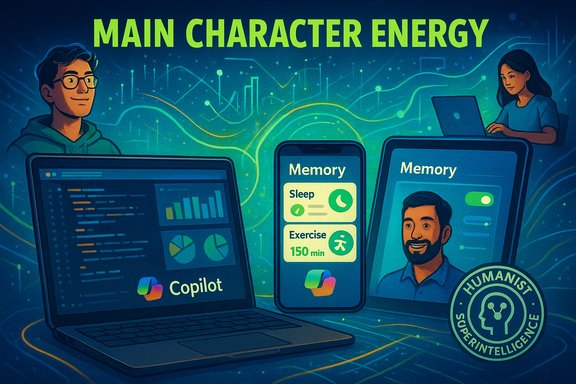
- On desktop, Copilot usage concentrates on workplace and technical tasks during business hours — coding, document work, troubleshooting. On mobile, Copilot is used all day for health and fitness queries, and “health + information-seeking” is the most frequent topic-intent pair on phones. These patterns are consistent across the analysis window.
3) Growing role as an “advice engine”
- The analysis highlights a trend away from purely fact-finding queries toward advice-seeking behavior — relationship counseling, life decisions, and personal planning. MAI interprets this as Copilot becoming a trusted everyday companion, not just a search or task tool.
4) Cultural findings and “viral” metrics
- The Copilot team’s recap stitches together playful multipliers — for example, that users referenced “main character energy” 7x more than “NPCs,” or that people “agonized about Jeremiah 4x more than Conrad (and 1200x more than Cam Cameron).” These snippets are drawn from the same MAI-labelled dataset but are primarily high-level, descriptive counts intended for storytelling rather than scientific inference. Where independent outlets report on the general patterns, they do not (and cannot practically) verify each playful micro-stat independently. Treat the micro-multipliers as platform-derived observables, useful for tone and product design but limited for external validation.
What Microsoft is doing technically and organizationally
Humanist Superintelligence: signaling and structure
MAI has publicly articulated a programmatic pathway to “Humanist Superintelligence” — a phrase Microsoft is using to describe advanced, domain-focused AI systems that emphasize safety, controllability, and human benefit. Announcements and company pages highlight the formation of a Superintelligence Team and call for interdisciplinary hiring in pre-training, post-training, multimodal work, and infrastructure. This is both a research posture and a public relations framing that attempts to reconcile capability development with governance.Product work: Copilot personalization and memory
Across late 2025, Microsoft documented and rolled out Copilot updates that favor personalization: better memory controls, richer multimodal capabilities (vision + voice), and context-aware experiences that attempt to make Copilot feel like a persistent companion across devices. The Copilot app and in-product placements on Windows and Edge are intended to capture these daily rhythms the usage report describes. Those product moves are consistent with the usage patterns derived from the dataset: if people consult Copilot differently on phones versus desktops, personalized memory and device-aware behaviors are essential product levers.Strengths: why this data matters
- Scale and signal fidelity: A 37.5M conversation sample is large enough to show consistent device/time patterns that smaller studies cannot. Those patterns help product teams prioritize features (mobile health tooling, desktop productivity integrations) with empirical grounding.
- Contextual insights for product design: Knowing that users seek health guidance on phones across all hours suggests new UX and safety features: source citations, triage flows, and integration with trusted health resources. The MAI analysis explicitly addresses this and suggests product-level improvements.
- Clear governance messaging: MAI’s “Humanist Superintelligence” framing is a public commitment to safety-first research and to embedding limits and alignment into advanced systems. For regulators and partners, that language signals intent to pair capability with governance.
- Cultural relevance and engagement: Packaging research findings into a playful, meme-aware blog post broadens reach and helps the product remain culturally relevant — a design choice that benefits user attention and adoption in the short term.
Risks and blind spots: where to be skeptical
- De-identified doesn’t mean risk-free. Microsoft emphasizes de-identification and summary-level extraction. But de-identification practices vary in robustness. Aggregated topic data reduces re-identification risk, yet the collection and retention of conversation summaries that can reveal sensitive behaviors or health problems must be scrutinized in light of regulatory standards (HIPAA-like protections in the U.S., GDPR in Europe) and cross-border data flows. The MAI report outlines the process, but independent audits are needed for full assurance.
- Advice-seeking is brittle. Users seeking relationship, legal, or medical advice from a general-purpose model risk encountering outdated, biased, or hallucinated responses. The dataset shows Copilot is increasingly used for advice; this amplifies the need for guardrails (clear disclaimers, citations to trusted sources, escalation to professionals). External reporting confirms Microsoft is iterating on such safeguards, but the practical effect will be judged by real-world performance, not marketing.
- Product nudge and behavior shaping. The team’s own presentation — labeling certain behaviors “brain rot” vs “core memory,” or celebrating “main character energy” — reflects choices that can nudge user behavior. Metrics-driven personalization can be beneficial, but it also risks amplifying attention economy harms, creating filter bubbles, or normalizing certain cultural frames for large audiences.
- Micro-statistics and interpretability. The Copilot blog’s playful multipliers (e.g., “Jeremiah 4x more than Conrad…1200x more than Cam Cameron”) are striking but lack external reproducibility. They’re useful storytelling but not scientific conclusions; journalists, enterprise customers, and policymakers should treat them as descriptive platform artifacts rather than independently verified research results.
- Concentration risk in AI governance and talent. MAI’s creation of a Superintelligence Team and the hiring push are strategically sensible but also concentrate technical capability. Centralized capability is efficient but concentrates responsibility and risk; effective external governance, independent audits, and multi-stakeholder engagement are essential checks on those concentrations.
Practical guidance: what Windows users, admins, and developers should do
For everyday Windows and Copilot users
- Treat Copilot as a helpful assistant — not a substitute for professional advice. For health or legal matters, use Copilot to gather background information and supportive tools but confirm with licensed professionals.
- Review privacy settings and memory controls. If Copilot saves profile details or preferences, use opt-in controls and periodic deletion to limit persistent storage of sensitive personal data. Microsoft has published memory controls in product updates; enable and review them regularly.
- Enable source-aware responses where available. Prefer Copilot experiences that include citations or links to authoritative sources when seeking factual information.
For IT administrators and security teams
- Differentiate consumer and enterprise deployment. Enterprise installations and data handling requirements differ dramatically from consumer Copilot usage; treat the MAI usage report as a reflection of consumer patterns only (enterprise and education were excluded from the dataset). If you deploy Copilot for business, verify enterprise-grade controls and compliance features.
- Audit and log Copilot integrations. Where Copilot connects to internal systems (file systems, ticketing, code repos), log access and implement least privilege to limit accidental data leakage.
- Educate users on safe usage patterns. Provide quick guidance — similar to the user list above — so staff understand when to escalate human judgment versus relying on AI assistance.
For developers and product teams
- Design for explainability. When Copilot suggests code, medical info, or strategic advice, include provenance metadata and confidence levels.
- Stress-test for edge-case hallucinations. Built-in fallback and user correction mechanisms should be routine.
- Use the MAI findings to align feature rollout with actual behavior. Mobile-first health features and desktop productivity integrations are directly supported by the Copilot usage signal; prioritize those that reduce friction and increase safety.
Policy, governance, and third-party verification
- Independent audits are essential. De-identified data and internal privacy claims are necessary first steps, but independent privacy audits and model evaluations (including adversarial testing) will be the real test of whether MAI’s “humanist” claims hold up in practice. External reporting indicates MAI is making governance claims publicly, but independent verification is limited so far.
- Regulatory alignment. The U.S., EU, and other jurisdictions are intensifying scrutiny of AI. Microsoft’s public messaging about human-centered constraints and controlled research agendas positions MAI to engage proactively with regulators — but the company must continue to publish reproducible evaluation metrics, red-team findings, and mitigation strategies.
- Open collaboration with researchers and clinicians. For health-related advice (a large chunk of mobile usage), MAI should expand external partnerships with medical institutions and clinician researchers to validate triage logic and ensure recommendations meet clinical standards.
Cultural and social implications: “main character energy” as a product metric
Microsoft’s Copilot recap intentionally blends culture and analytics. Framing user behaviors around memes — main character energy, aura farming, rizz — resonates with younger audiences and plants product hooks in cultural vernacular. That’s a pragmatic growth strategy: language and tone can increase engagement and retention.But product teams and platform designers must be mindful that celebrating certain behaviors can validate them at scale. When a major platform highlights trending behaviors, the platform helps amplify those behaviors — both the positive (entrepreneurial focus, self-improvement) and the harmful (excessive self-focus, echo chambers). This is a behavioral power; with it comes responsibility to measure downstream social outcomes, not just short-term engagement metrics.
Where the data can — and can’t — answer questions
- The MAI report can robustly describe aggregate patterns: device differences, time-of-day signals, and rising advice-seeking intent. Those findings are repeatable within the dataset and are corroborated by independent reporting.
- The report cannot verify small, user-level causal claims (e.g., whether Copilot caused someone to change careers, or whether “main character” posts led to a quantifiable increase in wellbeing). Nor can it independently validate some of the playful micro-stats without access to the underlying labeled data and classifier thresholds. Treat micro-statistics as illustrative rather than causal.
Bottom line: pragmatic optimism with accountability
Microsoft’s 2025 Copilot recap and the associated MAI usage report are valuable because they combine product storytelling with a large-scale empirical window into how people integrate AI into daily life. The core takeaways are credible: Copilot is becoming a multi-role assistant — contextually different on phone and desktop — and it’s now more often used for advice. MAI’s strategic push toward “Humanist Superintelligence” signals an organizational commitment to pairing capability with constraints and governance. That said, momentum and intent are not substitutes for independent verification. The most important near-term priorities should be transparent evaluation, third-party audits (especially for privacy and safety), and user education about when to accept AI assistance and when to consult human experts. Product designers must resist the temptation to optimize solely for engagement metrics when the data they publish shows Copilot operates in deeply personal domains like health and relationships.For Windows users and IT professionals, the practical posture is clear: take advantage of Copilot’s contextual strengths (desktop productivity, mobile health triage), enforce enterprise-grade safeguards where corporate data is involved, and insist on reproducible safety signals from vendors. For policymakers and civil society, the MAI announcements are worth engagement — the “humanist” framing is promising, but it must be matched by measurable commitments and independent oversight.
Microsoft’s Copilot and MAI are investing in the next stage of AI’s integration into daily life. The 2025 trend recap is a snapshot of that inflection: useful, culturally savvy, and data-driven — but also a reminder that scale increases stakes, and the company, users, and regulators must move in concert to ensure those stakes tilt toward shared benefit rather than unintended harm.
Source: Microsoft Main Character Energy: 2025 trend recap | Microsoft Copilot Blog
