

ESW says it is launching Copilot Ascend™, a role‑based Microsoft Copilot training and enablement program aimed at converting pilot‑stage AI experiments into repeatable, measurable workplace capability.
ESW (eSoftware Associates), a US‑based Microsoft partner, published a press release on January 13, 2026 outlining Copilot Ascend™ as a packaged training and adoption service built around Microsoft Copilot and Microsoft 365 workflows. The vendor frames the product as a three‑part mixture of instructor‑led sessions, hands‑on workshops, and adoption playbooks, targeted to HR, IT, business managers and executives. The launch sits in a broader market context where Microsoft has been expanding Copilot availability and pricing options for organizations of all sizes. In late 2025 Microsoft introduced Microsoft 365 Copilot Business at an SMB‑friendly list price of $21 per user per month for customers with up to 300 seats, explicitly signaling a push to make Copilot adoption more affordable for small and mid‑sized organizations. That pricing and SKU positioning is documented in Microsoft’s official communications and Partner Center guidance. Why does that matter? Lower per‑seat cost combined with a sharper partner ecosystem has broadened the addressable market for Copilot—but it also sharpens the central challenge ESW is addressing: licenses and models alone do not create operational value. Training, governance, and tenant readiness are required to realize productivity gains at scale.
Independent research and industry analyses converge on a common finding: many generative AI pilots fail to produce measurable P&L impact when organizations neglect integration, governance, and workforce readiness. An MIT‑connected study reported that a large majority of enterprise gen‑AI deployments produced no measurable P&L impact, attributing most failures to flawed integration with existing workflows. At the same time, vendor‑commissioned Forrester TEI studies model significant ROI for organizations that combine technology with focused training and change management—showing the gap between optimistic projection and real‑world outcomes depends largely on adoption design. These two perspectives together make the case for rigorous enablement rather than optimistic self‑service deployments. Key failure modes training addresses:
Concretely, buyers should map vendor claims to these vendor‑agnostic buyers’ criteria:
That said, the value of any vendor program hinges on execution and measurement. Buyers should treat ESW’s public claims as a starting point: verify trainer credentials, require deliverable‑level governance artifacts, negotiate clear KPIs, and include FinOps protections. Independent evidence shows that without those guardrails even well‑funded AI pilots struggle to move from novelty to business impact.
ESW’s Copilot Ascend™ is a timely commercial response to a real market problem: organizations now have broad access to Copilot licensing but lack the people, process and governance discipline to deliver repeatable outcomes. The program’s stated emphasis on role‑based instruction and governance is the right approach in principle; the prudent buyer will insist on verifiable trainer credentials, tenant‑level deliverables, measurable pilot outcomes, and explicit cost controls before committing to scale. Conclusion: Copilot licensing is necessary but insufficient—structured enablement, governance, and measurement turn seats into capability. Copilot Ascend™ promises to be one of several partner routes to that capability; its ultimate value will be decided in the pilot metrics and governance artifacts buyers require before broad deployment.
Source: The Manila Times ESW Launches Copilot Ascend™, a Microsoft AI Training Program Designed to Build Real Workforce Capability
 Background / Overview
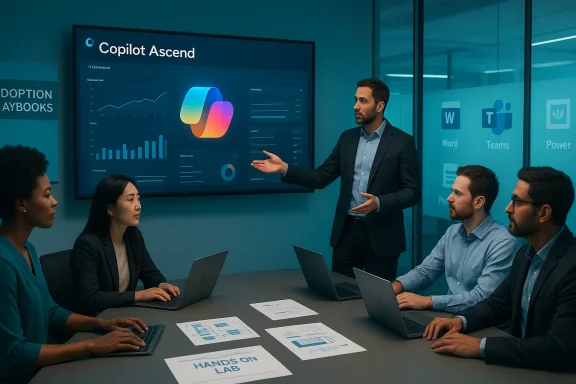
ESW (eSoftware Associates), a US‑based Microsoft partner, published a press release on January 13, 2026 outlining Copilot Ascend™ as a packaged training and adoption service built around Microsoft Copilot and Microsoft 365 workflows. The vendor frames the product as a three‑part mixture of instructor‑led sessions, hands‑on workshops, and adoption playbooks, targeted to HR, IT, business managers and executives. The launch sits in a broader market context where Microsoft has been expanding Copilot availability and pricing options for organizations of all sizes. In late 2025 Microsoft introduced Microsoft 365 Copilot Business at an SMB‑friendly list price of $21 per user per month for customers with up to 300 seats, explicitly signaling a push to make Copilot adoption more affordable for small and mid‑sized organizations. That pricing and SKU positioning is documented in Microsoft’s official communications and Partner Center guidance. Why does that matter? Lower per‑seat cost combined with a sharper partner ecosystem has broadened the addressable market for Copilot—but it also sharpens the central challenge ESW is addressing: licenses and models alone do not create operational value. Training, governance, and tenant readiness are required to realize productivity gains at scale.What ESW is offering: program anatomy
ESW describes Copilot Ascend™ as a structured program delivered by Microsoft Certified Trainers and available remotely or on site. The vendor lists these headline components:- Role‑based Copilot instruction for staff, managers, and executives
- Hands‑on workshops focused on real Microsoft 365 workflows
- Practical guidance for Copilot usage in Word, Excel, Teams, Outlook, and Power Platform
- Executive and leadership sessions focused on AI adoption and decision support
- Adoption strategies and playbooks to reinforce confidence and consistent usage
Delivery model and practical features
ESW indicates the program blends instructor‑led sessions with hands‑on labs and adoption guidance. Typical training modules, as framed by ESW and mirrored across partner offerings, commonly include:- Promptcraft and reusable prompt playbooks mapped to corporate templates
- App‑specific labs (Word drafting patterns, Excel data tasks, Teams meeting triage)
- Power Platform/agent labs for low‑code workflows and approved write‑backs
- Governance artifacts: sensitivity label mapping, DLP and conditional access recommendations
- Executive briefings with KPIs and measurement plans to track adoption
Why training matters: the adoption gap and evidence
There are two consistent realities in corporate deployments of generative AI: (1) the technology changes quickly, and (2) value accrues to organizations that treat Copilot as a change‑and‑process challenge, not merely a license purchase.Independent research and industry analyses converge on a common finding: many generative AI pilots fail to produce measurable P&L impact when organizations neglect integration, governance, and workforce readiness. An MIT‑connected study reported that a large majority of enterprise gen‑AI deployments produced no measurable P&L impact, attributing most failures to flawed integration with existing workflows. At the same time, vendor‑commissioned Forrester TEI studies model significant ROI for organizations that combine technology with focused training and change management—showing the gap between optimistic projection and real‑world outcomes depends largely on adoption design. These two perspectives together make the case for rigorous enablement rather than optimistic self‑service deployments. Key failure modes training addresses:
- Skill gap: users need pattern‑based prompts and validation practices to convert AI outputs into reliable business artifacts.
- Governance gap: without Purview/DLP and Entra identity controls, prompts and agents may surface or misuse sensitive information. Microsoft’s documentation is explicit about using Purview controls to limit Copilot processing and to detect risky interaction patterns.
- Operational gap: tenant readiness—indexing, permission hygiene, and authoritative content sources—reduces hallucination risk and increases output quality.
Technical and compliance considerations: grounding training in governance
One of the most load‑bearing claims in partner enablement playbooks is that training alone is insufficient—training must be paired with tenant‑level governance and data posture work. Microsoft’s Purview and Copilot-related guidance provides specific mechanisms partners and customers should integrate into any enablement program:- Purview sensitivity labels can be used to exclude or prevent certain items from being processed by Copilot (DLP controls for Copilot interactions).
- Endpoint DLP can warn or block attempts to paste sensitive content into third‑party generative AI sites.
- Purview DSPM and Insider Risk templates include risky‑AI usage detection for prompt injection and accidental exposures.
- Agents created with Copilot Studio honor sensitivity labels and can inherit labels for newly created content—important for audit and retention policies.
FinOps and lifecycle governance
Training programs frequently trigger consumption increases—Copilot queries, agent invocations, and Power Platform runs incur meterable costs; partners must plan FinOps controls such as consumption dashboards, caps, and alerting thresholds. ESW’s public materials mention governance and operational scaling as part of their broader services; buyers should insist on clear cost controls and lifecycle governance (ownership, naming, retirement rules) as part of any engagement.How Copilot Ascend sits in the market
ESW’s offering is not unique in concept: a number of systems integrators and specialist consultancies now package role‑based Copilot enablement, combining training, governance artifacts, and tenant hardening. What differentiates partner offers is depth of tenant integration, the quality of hands‑on labs, and deliverables that reduce operational risk.Concretely, buyers should map vendor claims to these vendor‑agnostic buyers’ criteria:
- Trainer credentials and evidence of Microsoft Certified Trainer status. ESW states the program is delivered by Microsoft Certified Trainers; buyers should request trainer CVs and Microsoft partner attestations. This is a vendor claim and is straightforward to verify ahead of contracting.
- Tenant readiness deliverables: clear scope on indexing, semantic index or Dataverse configuration, Purview/DLP mapping, and permission audits. Training without these deliverables produces weaker outcomes.
- Measurement plan: pre/post KPI definitions (time‑to‑first‑draft, ticket deflection, agent invocation counts, DLP incidents) and telemetry dashboards as contract deliverables. Forrester TEI reports and Microsoft case studies consistently call out measurement and formal training time as inputs to realistic ROI models.
Strengths in ESW’s approach
- Role‑based focus. Tailoring content for staff, managers and executives aligns training to real work outcomes rather than generic tool demos. Role differentiation improves relevance and adoption speed.
- Hands‑on, workflow‑centered practice. Teaching Copilot inside Word, Excel, Teams, Outlook and Power Platform with real team artifacts increases transfer of learning and reduces the risk of shadow AI adoption.
- Governance-first language. ESW’s messaging references Purview/DLP alignment and tenant readiness, indicating they intend to combine training with compliance artifacts rather than delivering pedagogy in isolation. That alignment follows Microsoft’s own guidance on safe Copilot deployment.
- Delivery flexibility. On‑site and remote options plus executive briefings and train‑the‑trainer patterns fit modern enterprise learning‑and‑change programs.
Risks, gaps and caveats
- Vendor claims are not guarantees. ESW’s marketing claims about outcomes (faster drafts, retention uplift, measurable productivity) are directional and depend on client context, the quality of tenant hardening, and agreed measurement. Treat vendor ROI and benefit language as targets to be verified in pilot contracts, not promises.
- Trainer certification is verifiable but not sufficient. Microsoft Certified Trainer status validates a baseline of instructor competence, yet buyers should ask for sample curricula, prior client references, and evidence of running tenant‑specific labs to validate operational experience.
- Data residency and routing must be explicit. Contracts should state where prompts and any captured telemetry are processed and retained, and whether any third‑party inference endpoints are used. Hidden routing or third‑party model hops are an operational and compliance risk; Microsoft and partners provide mechanisms to control this, and buyers must insist on transparency.
- Agent sprawl and lifecycle costs. If training encourages many teams to create Copilot agents, the organization must have lifecycle governance (versioning, ownership, retirement rules) to avoid unmanaged growth that increases support burden and risk. Include agent governance plans in scope.
- Consumption spikes and FinOps exposure. Expect short‑term increases in meterable consumption after training. Include consumption dashboards, caps, and an agreed escalation process in the engagement to avoid surprise bills.
Practical buyer checklist (what to request before signing)
- Request the full Copilot Ascend syllabus and map each module to your prioritized workflows and use cases. Confirm time allocation for hands‑on practice vs lecture.
- Ask for trainer credentials and sample CVs (Microsoft Certified Trainer proof and customer references). Vet trainer experience with tenant‑specific Copilot scenarios.
- Confirm tenant‑level prep work: indexing, sensitivity label mapping, Dataverse/semantic index work, and permission audits. Clarify what is included vs out of scope.
- Insist on governance deliverables: Purview/DLP mapping, Entra identity recommendations, agent ownership lists, and telemetry dashboards. Microsoft Purview offers documented controls buyers should expect to see operationalized.
- Define KPIs and measurement approach (time‑to‑first‑draft, weekly active usage, DLP incidents, ticket deflection) and agree pre/post baselines for the pilot period. Forrester TEI methodologies provide a consistent model for these measurements.
- Add FinOps clauses: consumption caps, alerts, and review cadence for inference and Power Platform run costs.
How to measure training success and ROI
Good measurement uses both leading and lagging indicators:- Leading indicators: number of users trained, prompt library downloads, agent invocation counts, weekly active Copilot usage.
- Lagging indicators: reduction in time‑to‑first‑draft, percentage of tickets deflected by Copilot‑assisted triage, error‑rate change in automated workflows, and employee satisfaction/retention metrics.
- Safety metrics: DLP incidents, number of high‑risk writeback attempts blocked, and frequency of escalation to human review.
Where Copilot Ascend can deliver fastest value
- Document‑heavy teams that repeatedly create first drafts (marketing briefs, legal redlines, HR onboarding materials) can see rapid time‑to‑first‑draft improvements when prompts and templates are standardized and validated.
- Finance and operations teams that use Excel heavily can benefit from Copilot prompts and low‑code Power Platform patterns that eliminate repetitive manual steps—provided training includes audit and validation exercises.
- IT service teams that integrate Copilot into triage and documentation can reduce ticket volume through consistent playbooks and agent triage rules.
Verdict: a pragmatic enablement play — with buyer discipline
ESW’s Copilot Ascend™ is a pragmatic entrant into a crowded but necessary space: enterprise Copilot enablement. The program’s stated structure—role‑based instruction, hands‑on labs, executive sessions and governance artifacts—maps to industry best practices for closing the adoption gap between Copilot licenses and measurable outcomes. The vendor’s broader Copilot services (Orbit, agentic offerings) position ESW as a single‑vendor partner for organizations that prefer combined training + managed services.That said, the value of any vendor program hinges on execution and measurement. Buyers should treat ESW’s public claims as a starting point: verify trainer credentials, require deliverable‑level governance artifacts, negotiate clear KPIs, and include FinOps protections. Independent evidence shows that without those guardrails even well‑funded AI pilots struggle to move from novelty to business impact.
Final recommendations for IT, HR and business leaders
- Make adoption outcomes contractual. Require pre/post metrics and a pilot acceptance phase before broad roll‑out.
- Insist on tenant work up front. Training must be paired with Purview/DLP mapping, indexing and permission clean‑up. Microsoft’s Purview docs and partner guidance describe concrete controls that should be reflected in the engagement.
- Build a train‑the‑trainer path and internal champion network to sustain capability beyond one‑off workshops. Forrester and Microsoft materials show ongoing learning is a necessary cost of capturing Copilot value.
- Put FinOps on the checklist. Define consumption controls, alerts, and routine reviews to avoid unexpected bills after training expands use.
ESW’s Copilot Ascend™ is a timely commercial response to a real market problem: organizations now have broad access to Copilot licensing but lack the people, process and governance discipline to deliver repeatable outcomes. The program’s stated emphasis on role‑based instruction and governance is the right approach in principle; the prudent buyer will insist on verifiable trainer credentials, tenant‑level deliverables, measurable pilot outcomes, and explicit cost controls before committing to scale. Conclusion: Copilot licensing is necessary but insufficient—structured enablement, governance, and measurement turn seats into capability. Copilot Ascend™ promises to be one of several partner routes to that capability; its ultimate value will be decided in the pilot metrics and governance artifacts buyers require before broad deployment.
Source: The Manila Times ESW Launches Copilot Ascend™, a Microsoft AI Training Program Designed to Build Real Workforce Capability
