

On July 2, 2026, GitHub announced that Copilot CLI can now run inside GitHub Actions using the workflow’s built-in
That matters because the awkward secret at the center of many AI-in-CI experiments has been an actual secret: a long-lived personal access token, often minted by a human, stored in a repo or organization secret, and quietly relied on by automation that outlives the person who created it. GitHub’s new path does not make AI agents in pipelines magically safe. It does, however, remove one of the least defensible pieces of the stack.
The immediate change is simple enough. A GitHub Actions workflow can authenticate Copilot CLI with
That is a small YAML change with a large administrative consequence. Instead of asking a developer or platform engineer to generate a fine-grained personal access token with Copilot request permissions, rotate it, protect it, and remember who owns it, the workflow can use the same ephemeral token model that Actions already uses for repository automation.
The old pattern was always a mismatch. Personal access tokens are personal by design, while CI/CD jobs are institutional by nature. A nightly changelog summarizer, release-note generator, codebase explainer, or issue triage assistant is not acting as Alice from platform engineering in any meaningful sense. It is acting as the repository’s automation layer.
This is why the change is more than a convenience feature. It is GitHub acknowledging that AI-assisted automation should not depend on a credential model inherited from human command-line use. If Copilot CLI is going to become another programmable tool in the build pipeline, it needs to behave like one.
That is the real product boundary. GitHub is not just making authentication easier; it is making Copilot CLI a first-class enterprise workload. The workflow is no longer borrowing a user’s Copilot entitlement through a token. It is drawing from the organization’s account, under an organization policy, from an organization repository, inside an organization-controlled workflow.
There is an important catch here. GitHub says user-level budgets are not considered when billing directly to the organization because the cost is not attributed to a user. That is logical from an accounting perspective, but it changes the risk model. A developer experimenting locally may be constrained by a personal budget or quota. A workflow running on a schedule, on many branches, across many repositories, can become a spending surface of its own.
This is the bargain GitHub is offering enterprise administrators: fewer unmanaged secrets in exchange for more centralized consumption. For most organizations, that is a better bargain. But it is not a free one.
Fine-grained PATs improved the situation, but they did not fix the conceptual problem. Even a carefully scoped PAT remains a human-issued credential being used by a non-human process. It can sit in a secret for months. It can be copied between repositories. It can be named vaguely enough that nobody wants to delete it. It can become part of the infrastructure by accident rather than design.
Actions’
For WindowsForum readers who manage mixed estates, that distinction should sound familiar. It is the same reason mature Windows shops prefer managed identities, service principals, short-lived credentials, and policy-scoped automation over “Bob’s admin password in a scheduled task.” The tooling has changed; the lesson has not.
But the security story is subtler than “no PAT, no problem.” The workflow still has to be allowed to ask Copilot to do things. Copilot CLI still runs in the context of a runner. It can still read files available to the job. Depending on the prompt, permissions, and tool configuration, it may still produce output that influences commits, pull requests, reports, or downstream automation.
The blast radius has moved from long-lived credential theft toward workflow governance. That is a better place to manage risk, but it requires discipline. Organizations now need to think about which repositories should be allowed to run Copilot CLI, which events should trigger those jobs, whether pull requests from forks can reach the relevant workflow, and what output from the AI is allowed to modify.
This is especially important because AI in CI/CD is not merely another linter. A linter applies a deterministic rule set to a known input. An agentic CLI takes instructions, reads context, and produces text or code that may be acted upon. That makes identity cleaner, but behavior still probabilistic.
This avoids a common weirdness in AI developer tools: a company pays for a product, but automation consumption is routed through a particular employee’s account, token, or budget. That model creates bad incentives. The person whose token is used may become the accidental cost center. The person maintaining the workflow may not be the one whose limits are consumed. Finance and platform engineering may see usage after the fact, but not where governance decisions are made.
Organization billing makes the deployment model more honest. If a team wants Copilot CLI to run every morning across a monorepo, that should be an organizational decision, not an invisible drain on an individual’s allowance. It also makes it easier for administrators to say no, or to say yes only in repositories where the benefit is worth the spend.
The missing piece is that organization-level spend controls now become more important. GitHub notes that there are multiple ways to manage spend with this billing method, but the key practical point is that user-level budgets do not apply. That sentence should be highlighted in every platform engineering rollout plan. The old guardrail may not be the new guardrail.
The fact that the policy may be enabled by default when the existing Copilot CLI policy is enabled will be convenient for organizations already comfortable with the tool. It may also surprise administrators who treated “Copilot CLI allowed” as a user productivity setting rather than a CI/CD billing and automation setting. The same feature name now spans a wider operational surface.
This is a recurring pattern in the AI tooling market. Features first arrive as developer conveniences, then become enterprise platform primitives. When that happens, the administrative meaning changes. A toggle that once meant “developers can use this in a terminal” begins to mean “workflows can spend organizational credits and run AI prompts in automation.”
For IT leaders, the response should not be panic. It should be inventory. Which organizations have Copilot CLI enabled? Which repositories are allowed to run Actions? Which workflows already install Copilot CLI? Which secrets were created solely to support old PAT-based authentication? Which policies need to be updated before teams discover the feature by copying a blog post into production?
For those environments, the removal of PATs from Copilot CLI automation is one more step toward treating GitHub as part of the enterprise control plane. The same administrator who worries about Entra ID conditional access, privileged access workstations, certificate lifetimes, and service account sprawl should care about long-lived GitHub tokens hiding in CI/CD settings.
There is a cultural angle, too. Windows administrators have spent years cleaning up brittle scheduled tasks, forgotten service accounts, and scripts that run only because one person’s credentials still work. GitHub Actions can reproduce those mistakes in a more modern costume. AI agents make the consequences more interesting, but not fundamentally different.
The right lesson is not that Copilot CLI is dangerous. The right lesson is that automation identity matters. When a robot does work for the business, it should authenticate as automation, be governed as automation, and be billed as automation. GitHub’s change moves Copilot CLI in that direction.
That shift changes the deployment audience. A developer using Copilot in Visual Studio Code can accept or reject a suggestion in the moment. A CI job using Copilot CLI may run on a schedule, after a merge, or in response to a repository event. Its output may be reviewed later, or in some cases automatically fed into another step.
This is why GitHub’s authentication change is necessary but not sufficient. Once AI requests are easy to put in Actions workflows, more teams will put them there. Some will do it thoughtfully. Some will paste examples, grant broad permissions, and discover later that the job runs far more often than expected.
The lesson from the last decade of CI/CD is that convenience wins. If the secure path is cumbersome and the risky path is easy, teams choose the risky path under deadline pressure. By making the better credential path easier, GitHub reduces one source of bad behavior. It does not eliminate the need for policy, review, and observability.
Using
This is where least privilege becomes more than a security slogan. The new
The most defensible pattern is to keep Copilot-generated output in the suggestion lane unless there is a very clear reason to automate further. Draft a changelog, but require review before committing it. Summarize a pull request, but do not let the summary decide whether the build passes. Generate an issue triage label, but make sure maintainers can audit why it appeared.
The migration should be treated like any other credential retirement project. Identify workflows using Copilot CLI. Determine whether they are in organization-owned repositories. Confirm that the Copilot policy allows organization-billed CLI usage. Update workflow permissions to include
The final step matters. Many organizations accumulate secrets because removing them feels riskier than keeping them. Over time, nobody knows whether a secret is still used, so everyone becomes afraid to touch it. A feature like this creates a rare cleanup window: a concrete reason to retire a category of long-lived token.
Administrators should also look for naming drift. A secret called
That is good for GitHub. It keeps AI developer workflows inside GitHub’s control plane rather than scattering them across third-party wrappers, unmanaged API keys, and shadow automation. It is also attractive for enterprises, because centralized policy is easier to defend than a thousand ad hoc developer setups.
But standardization always comes with lock-in pressure. The more workflows depend on Copilot-specific permissions, Copilot-specific billing semantics, and Copilot CLI behavior, the more GitHub becomes not just the repository host but the agent runtime. That may be exactly what many organizations want. It also deserves deliberate architectural thought.
The pragmatic view is that most teams will accept the trade-off if the integration reduces friction and improves security. Platform teams rarely object to lock-in in the abstract; they object when lock-in makes operations worse. Here, GitHub can argue that it is making operations better by replacing PAT sprawl with native workflow identity.
The distinction matters because defaults are only safe when teams actually use them. A stale workflow can continue using a PAT. A copied example can still grant too many permissions. A scheduled job can still run too often. A prompt can still consume more credits than expected. A generated change can still be wrong.
Security teams should resist turning this into another blanket prohibition. The feature solves a real problem, and forbidding it may simply push teams back toward less visible AI automation. The better move is to publish a sanctioned pattern: which repositories may use Copilot CLI, what permissions are required, how prompts should handle untrusted input, how outputs are reviewed, and how spend is monitored.
Developer experience teams should also care. If the approved pattern is easy, people will use it. If it requires a ticket, a wiki scavenger hunt, and three Slack approvals, someone will mint a token and move on. GitHub has lowered the product friction; organizations need to lower the internal friction without removing the guardrails.
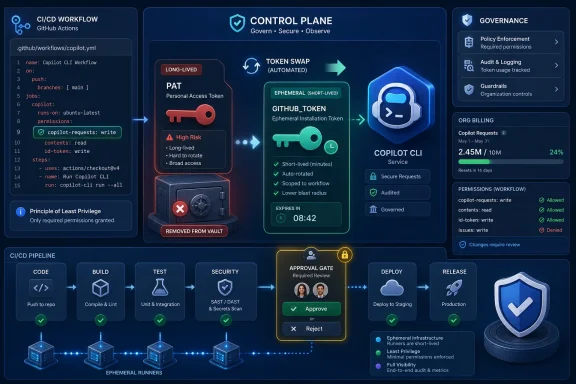
GITHUB_TOKEN, removing the previous need to create and store a personal access token for automated Copilot requests. The change sounds like plumbing, but it is really a governance decision. GitHub is moving agentic developer tooling from the personal account era into the managed automation era, where identity, billing, and policy live closer to the repository than the individual developer.That matters because the awkward secret at the center of many AI-in-CI experiments has been an actual secret: a long-lived personal access token, often minted by a human, stored in a repo or organization secret, and quietly relied on by automation that outlives the person who created it. GitHub’s new path does not make AI agents in pipelines magically safe. It does, however, remove one of the least defensible pieces of the stack.
 GitHub Retires the Human Token From the Robot Job
The immediate change is simple enough. A GitHub Actions workflow can authenticate Copilot CLI with GITHUB_TOKEN, provided the repository belongs to an organization and the organization has enabled the relevant Copilot policy. The workflow must request the copilot-requests: write permission, and the Copilot CLI installation must be recent enough to understand the new authentication flow.That is a small YAML change with a large administrative consequence. Instead of asking a developer or platform engineer to generate a fine-grained personal access token with Copilot request permissions, rotate it, protect it, and remember who owns it, the workflow can use the same ephemeral token model that Actions already uses for repository automation.
The old pattern was always a mismatch. Personal access tokens are personal by design, while CI/CD jobs are institutional by nature. A nightly changelog summarizer, release-note generator, codebase explainer, or issue triage assistant is not acting as Alice from platform engineering in any meaningful sense. It is acting as the repository’s automation layer.
This is why the change is more than a convenience feature. It is GitHub acknowledging that AI-assisted automation should not depend on a credential model inherited from human command-line use. If Copilot CLI is going to become another programmable tool in the build pipeline, it needs to behave like one.
The Real Product Is Not the CLI, It Is the Control Plane
GitHub’s announcement spends its words on token handling, but the more interesting move is the policy and billing architecture around it. Organizations must enable “Allow use of Copilot CLI billed to the organization,” and GitHub says the setting is enabled by default when the existing Copilot CLI policy is already enabled. Once that policy is active, AI credits consumed by Copilot CLI in an organization-owned repository are billed directly to the organization.That is the real product boundary. GitHub is not just making authentication easier; it is making Copilot CLI a first-class enterprise workload. The workflow is no longer borrowing a user’s Copilot entitlement through a token. It is drawing from the organization’s account, under an organization policy, from an organization repository, inside an organization-controlled workflow.
There is an important catch here. GitHub says user-level budgets are not considered when billing directly to the organization because the cost is not attributed to a user. That is logical from an accounting perspective, but it changes the risk model. A developer experimenting locally may be constrained by a personal budget or quota. A workflow running on a schedule, on many branches, across many repositories, can become a spending surface of its own.
This is the bargain GitHub is offering enterprise administrators: fewer unmanaged secrets in exchange for more centralized consumption. For most organizations, that is a better bargain. But it is not a free one.
PATs Were the Wrong Abstraction for Agentic CI
Personal access tokens have been the duct tape of developer automation for years. They are easy to mint, easy to paste into a secret store, and easy to forget. They also carry a familiar set of problems: unclear ownership, inconsistent rotation, overbroad permissions, stale credentials after employee departures, and poor visibility into why a particular token exists.Fine-grained PATs improved the situation, but they did not fix the conceptual problem. Even a carefully scoped PAT remains a human-issued credential being used by a non-human process. It can sit in a secret for months. It can be copied between repositories. It can be named vaguely enough that nobody wants to delete it. It can become part of the infrastructure by accident rather than design.
Actions’
GITHUB_TOKEN is not perfect, but it is a better fit for this job. It is generated for a workflow run, governed through workflow permissions, and already understood by administrators who manage GitHub Actions at scale. The token belongs to the automation context, not to a person pretending to be automation.For WindowsForum readers who manage mixed estates, that distinction should sound familiar. It is the same reason mature Windows shops prefer managed identities, service principals, short-lived credentials, and policy-scoped automation over “Bob’s admin password in a scheduled task.” The tooling has changed; the lesson has not.
The YAML Gets Cleaner, but the Blast Radius Moves
The operational benefit is obvious. A workflow that previously needed a storedCOPILOT_GITHUB_TOKEN backed by a PAT can now rely on the default Actions token with explicit Copilot request permission. That reduces setup friction and eliminates one more secret from the repository or organization secret inventory.But the security story is subtler than “no PAT, no problem.” The workflow still has to be allowed to ask Copilot to do things. Copilot CLI still runs in the context of a runner. It can still read files available to the job. Depending on the prompt, permissions, and tool configuration, it may still produce output that influences commits, pull requests, reports, or downstream automation.
The blast radius has moved from long-lived credential theft toward workflow governance. That is a better place to manage risk, but it requires discipline. Organizations now need to think about which repositories should be allowed to run Copilot CLI, which events should trigger those jobs, whether pull requests from forks can reach the relevant workflow, and what output from the AI is allowed to modify.
This is especially important because AI in CI/CD is not merely another linter. A linter applies a deterministic rule set to a known input. An agentic CLI takes instructions, reads context, and produces text or code that may be acted upon. That makes identity cleaner, but behavior still probabilistic.
Billing Finally Matches the Way Automation Actually Works
The billing change deserves as much attention as the security change. By billing organization-owned repository usage directly to the organization, GitHub is aligning Copilot CLI with how teams actually deploy automation. A workflow that summarizes every day’s commits, drafts release notes, or opens housekeeping pull requests is not one developer’s usage. It is shared infrastructure.This avoids a common weirdness in AI developer tools: a company pays for a product, but automation consumption is routed through a particular employee’s account, token, or budget. That model creates bad incentives. The person whose token is used may become the accidental cost center. The person maintaining the workflow may not be the one whose limits are consumed. Finance and platform engineering may see usage after the fact, but not where governance decisions are made.
Organization billing makes the deployment model more honest. If a team wants Copilot CLI to run every morning across a monorepo, that should be an organizational decision, not an invisible drain on an individual’s allowance. It also makes it easier for administrators to say no, or to say yes only in repositories where the benefit is worth the spend.
The missing piece is that organization-level spend controls now become more important. GitHub notes that there are multiple ways to manage spend with this billing method, but the key practical point is that user-level budgets do not apply. That sentence should be highlighted in every platform engineering rollout plan. The old guardrail may not be the new guardrail.
The Enterprise Admin Gets a New Toggle With Real Consequences
The policy requirement is not decorative. GitHub is making administrators explicitly decide whether Copilot CLI can be used in this billed-to-organization mode. That is the correct default posture for a capability that combines AI requests, automation, and centralized billing.The fact that the policy may be enabled by default when the existing Copilot CLI policy is enabled will be convenient for organizations already comfortable with the tool. It may also surprise administrators who treated “Copilot CLI allowed” as a user productivity setting rather than a CI/CD billing and automation setting. The same feature name now spans a wider operational surface.
This is a recurring pattern in the AI tooling market. Features first arrive as developer conveniences, then become enterprise platform primitives. When that happens, the administrative meaning changes. A toggle that once meant “developers can use this in a terminal” begins to mean “workflows can spend organizational credits and run AI prompts in automation.”
For IT leaders, the response should not be panic. It should be inventory. Which organizations have Copilot CLI enabled? Which repositories are allowed to run Actions? Which workflows already install Copilot CLI? Which secrets were created solely to support old PAT-based authentication? Which policies need to be updated before teams discover the feature by copying a blog post into production?
Windows Shops Should Read This as a DevSecOps Story
At first glance, this is a GitHub story rather than a Windows story. But Windows-heavy organizations are rarely Windows-only anymore. They run PowerShell in GitHub Actions, deploy to Azure, manage infrastructure-as-code, build .NET and Node applications, package desktop software, and maintain repositories that are as much operational machinery as source control.For those environments, the removal of PATs from Copilot CLI automation is one more step toward treating GitHub as part of the enterprise control plane. The same administrator who worries about Entra ID conditional access, privileged access workstations, certificate lifetimes, and service account sprawl should care about long-lived GitHub tokens hiding in CI/CD settings.
There is a cultural angle, too. Windows administrators have spent years cleaning up brittle scheduled tasks, forgotten service accounts, and scripts that run only because one person’s credentials still work. GitHub Actions can reproduce those mistakes in a more modern costume. AI agents make the consequences more interesting, but not fundamentally different.
The right lesson is not that Copilot CLI is dangerous. The right lesson is that automation identity matters. When a robot does work for the business, it should authenticate as automation, be governed as automation, and be billed as automation. GitHub’s change moves Copilot CLI in that direction.
AI in the Pipeline Is Becoming Normal Faster Than Its Guardrails
The larger industry trend is unmistakable. AI coding tools are leaving the editor and entering the workflow. They summarize changes, classify issues, suggest fixes, draft documentation, generate tests, open pull requests, and increasingly act through command-line interfaces that can be scripted like any other tool.That shift changes the deployment audience. A developer using Copilot in Visual Studio Code can accept or reject a suggestion in the moment. A CI job using Copilot CLI may run on a schedule, after a merge, or in response to a repository event. Its output may be reviewed later, or in some cases automatically fed into another step.
This is why GitHub’s authentication change is necessary but not sufficient. Once AI requests are easy to put in Actions workflows, more teams will put them there. Some will do it thoughtfully. Some will paste examples, grant broad permissions, and discover later that the job runs far more often than expected.
The lesson from the last decade of CI/CD is that convenience wins. If the secure path is cumbersome and the risky path is easy, teams choose the risky path under deadline pressure. By making the better credential path easier, GitHub reduces one source of bad behavior. It does not eliminate the need for policy, review, and observability.
Prompt Injection Is the Uninvited Guest in Every Agentic Workflow
Any discussion of AI agents in GitHub Actions has to acknowledge prompt injection. The risk is not science fiction. If a workflow asks an AI tool to summarize issues, review pull request text, inspect commit messages, or process repository content, then untrusted text may become part of the prompt context. An attacker does not need to steal a token if they can influence what the agent is instructed to do.Using
GITHUB_TOKEN instead of a PAT helps with credential hygiene, but it does not make the agent immune to malicious instructions embedded in code comments, issue bodies, test fixtures, Markdown files, or pull request descriptions. The workflow designer still has to decide what the tool can read, what it can write, and whether its output is advisory or authoritative.This is where least privilege becomes more than a security slogan. The new
copilot-requests: write permission should be granted only where needed. Repository permissions for the same job should be no broader than necessary. Jobs that analyze untrusted pull requests should be isolated from jobs that can push commits, publish packages, or access sensitive secrets.The most defensible pattern is to keep Copilot-generated output in the suggestion lane unless there is a very clear reason to automate further. Draft a changelog, but require review before committing it. Summarize a pull request, but do not let the summary decide whether the build passes. Generate an issue triage label, but make sure maintainers can audit why it appeared.
The Secret Store Gets Cleaner, Not Empty
One practical benefit of the change is cleanup. Organizations that adopted PAT-based Copilot CLI automation can begin removing those secrets from repositories and organization settings once workflows are updated. That is not glamorous work, but it is exactly the kind of hygiene that prevents ugly incidents later.The migration should be treated like any other credential retirement project. Identify workflows using Copilot CLI. Determine whether they are in organization-owned repositories. Confirm that the Copilot policy allows organization-billed CLI usage. Update workflow permissions to include
copilot-requests: write. Move authentication to GITHUB_TOKEN. Then delete the old PAT secret rather than leaving it around “just in case.”The final step matters. Many organizations accumulate secrets because removing them feels riskier than keeping them. Over time, nobody knows whether a secret is still used, so everyone becomes afraid to touch it. A feature like this creates a rare cleanup window: a concrete reason to retire a category of long-lived token.
Administrators should also look for naming drift. A secret called
COPILOT_GITHUB_TOKEN, PERSONAL_ACCESS_TOKEN, GH_TOKEN, or BOT_PAT may or may not be tied to Copilot CLI. The inventory work is tedious, but it is better than discovering that a former employee’s token is still powering an AI workflow six months after offboarding.GitHub Is Quietly Standardizing the Agent Stack
Viewed narrowly, this update lets one CLI authenticate with one token in one automation environment. Viewed strategically, it is part of GitHub’s attempt to make the platform itself the place where agents run, spend, and obey policy. Copilot CLI, GitHub Actions, organization billing, repository permissions, and Copilot policies are being pulled into the same orbit.That is good for GitHub. It keeps AI developer workflows inside GitHub’s control plane rather than scattering them across third-party wrappers, unmanaged API keys, and shadow automation. It is also attractive for enterprises, because centralized policy is easier to defend than a thousand ad hoc developer setups.
But standardization always comes with lock-in pressure. The more workflows depend on Copilot-specific permissions, Copilot-specific billing semantics, and Copilot CLI behavior, the more GitHub becomes not just the repository host but the agent runtime. That may be exactly what many organizations want. It also deserves deliberate architectural thought.
The pragmatic view is that most teams will accept the trade-off if the integration reduces friction and improves security. Platform teams rarely object to lock-in in the abstract; they object when lock-in makes operations worse. Here, GitHub can argue that it is making operations better by replacing PAT sprawl with native workflow identity.
The New Safe Default Is Still Something You Have to Build
There is a tempting headline version of this story: Copilot CLI no longer needs PATs in GitHub Actions. That is true, but incomplete. The better version is that GitHub has made the safer authentication model the easier model for organization-owned repositories.The distinction matters because defaults are only safe when teams actually use them. A stale workflow can continue using a PAT. A copied example can still grant too many permissions. A scheduled job can still run too often. A prompt can still consume more credits than expected. A generated change can still be wrong.
Security teams should resist turning this into another blanket prohibition. The feature solves a real problem, and forbidding it may simply push teams back toward less visible AI automation. The better move is to publish a sanctioned pattern: which repositories may use Copilot CLI, what permissions are required, how prompts should handle untrusted input, how outputs are reviewed, and how spend is monitored.
Developer experience teams should also care. If the approved pattern is easy, people will use it. If it requires a ticket, a wiki scavenger hunt, and three Slack approvals, someone will mint a token and move on. GitHub has lowered the product friction; organizations need to lower the internal friction without removing the guardrails.
The Changelog Line That Should Trigger a Secret Audit
The concrete implications are straightforward, but they cut across security, finance, and developer productivity. This is not a feature teams should discover only when a workflow starts failing or a bill arrives.- Organizations can now run Copilot CLI in GitHub Actions with the built-in
GITHUB_TOKENinstead of storing a personal access token for that purpose. - Workflows need the explicit
copilot-requests: writepermission before they can use the new authentication model. - Organization-owned repository usage is billed to the organization, and user-level budgets do not apply when costs are not attributed to a specific user.
- Administrators must review the Copilot policy that allows Copilot CLI usage billed to the organization, especially where older CLI policies were already enabled.
- Teams should update Copilot CLI to a recent version before relying on this workflow path.
- Existing PAT-backed Copilot automation should be inventoried, migrated, tested, and then removed from secret stores rather than left behind as a fallback.
References
- Primary source: The GitHub Blog
Published: Thu, 02 Jul 2026 20:25:32 GMT
Copilot CLI no longer needs a personal access token in GitHub Actions - GitHub Changelog
You can now run GitHub Copilot CLI in GitHub Actions using the built-in GITHUB_TOKEN. This means that you no longer need to create and store a personal access token (PAT),…github.blog
- Official source: docs.github.com
Automating tasks with Copilot CLI and GitHub Actions - GitHub Docs
Integrate GitHub Copilot CLI into your GitHub Actions workflows. docs.github.com
- Official source: github.com
GitHub Copilot CLI · GitHub
GitHub is where people build software. More than 150 million people use GitHub to discover, fork, and contribute to over 420 million projects. github.com
- Related coverage: webfiddle.net
- Related coverage: labs.cloudsecurityalliance.org
Comment and Control: GitHub AI Agents as Credential Exfiltrators
PDF documentlabs.cloudsecurityalliance.org
- Official source: github.github.com
- Related coverage: writeabout.net
