Microsoft Copilot Expands with Claude Models, Copilot Cowork and Agent 365

  • Thread Author
Microsoft’s Copilot has taken a decisive step from “help me write” to “do it for me”: the company has integrated Anthropic’s Claude models into Microsoft 365 Copilot and Copilot Studio, and simultaneously unveiled a new, agentic product called Copilot Cowork — built in collaboration with Anthropic — plus an enterprise control plane (Agent 365) and a new Microsoft 365 E7 bundle aimed at governing and commercializing agent-driven work. tps://www.microsoft.com/en-us/microsoft-copilot/blog/copilot-studio/anthropic-joins-the-multi-model-lineup-in-microsoft-copilot-studio/?msockid=2acbb910877a615128f6af93862260f2&utm_source=openai))

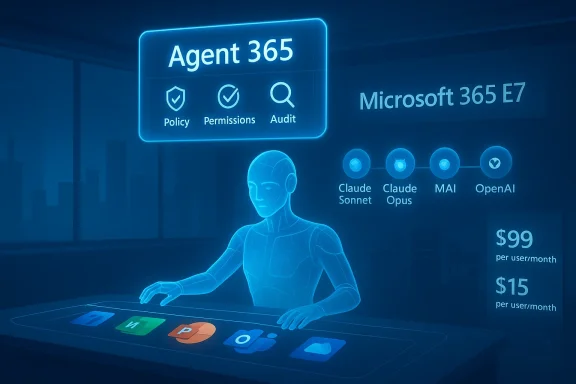
Blue holographic Agent 365 at a desk with the Microsoft 365 E7 interface.Background / Overview​

Microsoft 365 Copilot first arrived as a productivity augmentation inside Word, Excel, PowerPoint, Outlook and Teams: a generative-AI assistant that drafts, summarizes and accelerates routine tasks. Over the past year Microsoft has shifted that product toward a multi-model orchestration layer — one that can route workloads to different LLM providers depending on the job. Anthropic’s Claude family has now joined the lineup alongside OpenAI and Microsoft’s own MAI models, giving organizations explicit model choice inside Copilot’s Researcher agent and Copilot Studio.
Copilot Cowork represents the next stage of that evolution: rather than returning drafts and suggestions, Cowork is designed to plan, execute and return finished work across Microsoft 365 apps by running as a long‑running, permissioned agent that can access emails, calendars and files with admin controls. Microsoft has introduced Agent 365 as a governance and management plane to register, monitor and control these agents at scale, and has packaged those capabilities into a new Microsoft 365 E7 commercial tier. The company says Copilot Cowork is entering limited research previews now and broader rollout will follow through its Frontier programs.

What changed — the concrete announcements​

  • Microsoft has added Anthropic’s Claude Sonnet and Claude Opus model families as selectable backends inside Microsoft 365 Copilot and Copilot Studio, exposed initially in Researcher and agent-builder experiences. This expands Copilot’s architecture from a single-provider model to a multi-model orchestration layer.
  • Microsoft announced Copilot Cowork, an agentic, multi‑step assistant designed to autonomously complete workflows — scheduling, data assembly, report generation and cross-app workflows — and return deliverables rather than drafts. The capability is being piloted in research previews.
  • To govern agent scale and reduce operational risk, Microsoft introduced Agent 365, a control plane for discovery, lifecycle management, and policy enforcement for agents. Agent 365 is being positioned as the enterprise management layer for agent deployments.
  • Microsoft has packaged these capabilities into a premium commercial SKU, Microsoft 365 E7, which the company says will be available May 1 at a list price of $99 per user per month; Agent 365 is listed as an add-on priced at $15 per user per month in Microsoft’s commercial materials. These prices are central to Microsoft’s plan to move large enterprises toward seat-based, governed agent deployments.
These elements together mark a strategic pivot: Copilot is being positioned as an orchestration layer that chooses the best model for the task and an operational platform that lets IT run and govern autonomous agents inside corporate tenants.

Technical architecture: multi‑model orchestration and agent control​

How model choice works in practice​

Microsoft’s multi-model approach exposes multiple LLM providers inside Copilot and Copilot Studio. Builders and end users can route workloads to:
  • Microsoft’s in-house models (MAI family) for latency-sensitive or low-cost routing.
  • OpenAI models where Microsoft still decides they are the best fit.
  • Anthropic’s Claude family for tasks Microsoft deems better suited to Claude’s reasoning style or safety characteristics.
This is surfaced in the Researcher experience (a “Try Claude” option) and Copilot Studio, where agent builders can pick a preferred model per skill or task. The goal is to select “the right model for the right job” programmatically while retaining enterprise controls.

Agent runtime and Work IQ​

Copilot Cowork is layered on top of an intelligence orchestration layer Microsoft calls Work IQ (a context and planning layer). Work IQ mediates intent, context, and data access; Copilot Cowork plans multi-step sequences, issues app-level actions via connectors, and returns completed artifacts (documents, spreadsheets, calendars). Agent 365 provides the control plane for registering agents, setting permissions, auditing actions, and enforcing corporate policies.

Hosting and data flow: AWS, Azure — and the nuance​

One of the most consequential technical details is where Anthropic’s models run when used inside Copilot. Early integrations used Anthropic-hosted endpoints on AWS, which meant Microsoft routed selected workloads outside Azure before bringing contractual protections to bear. However, an infrastructure and investment pact between Microsoft, Anthropic and third parties has evolved rapidly, and some Anthropic capacity and enterprise offerings are now available to run on Azure as well. That transition is ongoing and regionally variable, and Microsoft’s documentation notes that Anthropic model usage in Copilot may be excluded from the EU Data Boundary in some cases. Enterprises should treat hosting and regional processing guarantees as a live operational variable and verify tenant-level settings with their Microsoft account team.

Cross‑checked facts (what we verified)​

  • Anthropic models are available as model choices inside Microsoft 365 Copilot and Copilot Studio. This is confirmed in Microsoft’s Copilot blog and multiple independent outlets.
  • Copilot Cowork was announced as a new agentic experience built with Anthropic technology and is entering research previews; Microsoft announced Agent 365 and the E7 bundle contemporaneously. Multiple outlets, including Microsoft’s own Microsoft 365 blog and mainstream coverage, report these elements together.
  • Microsoft’s new E7 price point of $99/user/month and Agent 365’s $15/user/month are the list figures announced in Microsoft’s March materials; independent reporting picked up and repeated the same pricing. Pricing should be treated as list guidance until invoiced contracts and partner quotes are issued.
  • Anthropic models used inside Microsoft offerings are covered by Microsoft’s Product Terms and Data Protection Addendum, but may be excluded from the EU Data Boundary and certain in‑country processing commitments. This nuance appears in Microsoft documentation and multiple compliance-focused reporting sources. Enterprises with EU or in‑country residency needs should verify applicability immediately.

Strengths and opportunities​

  • Model choice reduces vendor lock‑in. Giving enterprises multiple model backends reduces reliance on a single provider and allows IT to match model strengths to tasks (e.g., reasoning, safe summarization, code generation). This opens product differentiation and improves resilience against a single provider outage.
  • Agentic automation could multiply productivity. Copilot Cowork’s promise is not incremental; it is a change in workflow design. Long‑running agents that can coordinate across email, calendar and files — and return finished documents — can compress days of work into hours for many knowledge tasks. For teams with repeatable, multi-step processes, that’s a huge efficiency play.
  • Governance and control are baked in at announcement. Microsoft’s launch emphasizes Agent 365 and E7 as governance-first offerings. Providing a first-party control plane that ties agent identities, permissions, and audit logs into existing Microsoft security primitives addresses a major enterprise adoption blocker.
  • Commercial packaging simplifies procurement. The E7 bundle and per-user Agent 365 pricing give IT leaders a straightforward procurement path for large-scale agentization efforts — which, summed up, lowers friction for enterprise experiments at scale.

Risks, unknowns and areas that need scrutiny​

  • Data residency and EU Data Boundary exclusions. While Microsoft states Anthropic is a subprocessor and covered by Microsoft’s DPA and EDP, it explicitly notes that Anthropic model processing is currently excluded from the EU Data Boundary and some in‑country commitments. For organizations governed by strict data residency laws (finance, government, health), this exclusion is a potential compliance showstopper unless and until regionally localized hosting is guaranteed. Enterprises must map the exclusions to their regulatory obligations before enabling Anthropic models.
  • Operational risk of autonomous agents. Agents that act across email, calendar and files create new attack surfaces: misconfigured permissions, phishing vectors that fool agents into executing malicious requests, or flawed agent planning that performs unintended actions. Microsoft frames Agent 365 as the mitigation, but this is a classic governance-versus-convenience tradeoff: defense-in-depth, policy fencing and human-in-the-loop safeguards remain necessary.
  • Transparency and traceability of agent actions. For legal and audit purposes, enterprises require tamper-proof logs, provenance, and easy rollbacks. The announced platform promises audit trails, but buyers should validate whether logs are sufficiently granular, immutable, and exportable to SIEM and eDiscovery tools they already use. Independent verification is required.
  • Hidden costs from agent usage. Microsoft advertises E7 as an economical bundle, but agent workloads are message- and compute‑intensive. PAYGO meters, per‑agent interactions and model choices (especially if routed to third-party hosts) can add unpredictable operational spend. Organizations must model realistic agent usage patterns and use the provided Agent Cost Estimators before wide enablement.
  • Model provenance and behavior variance. Different LLMs exhibit different hallucination profiles, response styles and safety filters. Routing a mission-critical compliance summary through a model tuned for creative writing could produce dangerous results. Copilot’s multi-model orchestration needs robust “model factsheets” and per-task model selection guardrails to avoid unpredictable outputs.

Comparison: Copilot Cowork vs Anthropic Cowork and other agent frameworks​

Anthropic’s own Cowork product (a desktop-scoped agent for folder-based automation) and Claude Cowork research previews have emphasized file-level autonomy and local workflows. Microsoft’s Copilot Cowork differs in three ways:
  • Scale and enterprise integration — Copilot Cowork is integrated into Microsoft 365 and designed to operate across tenants with centralized governance via Agent 365.
  • Multi‑model orchestration — Microsoft’s version can choose between MAI, OpenAI and Anthropic depending on task alignment.
  • Commercial packaging — Microsoft bundles governance, identity (Entra), security, and consumption models together (E7 + Agent 365) for enterprise procurement.
That means Microsoft’s offering leans heavier on tenant controls and corporate compliance, while Anthropic’s Cowork exploration emphasizes agent capabilities and desktop-level automation. Both approaches are complementary in the short term, but customers should evaluate which architecture fits their trust and governance model.

Practical checklist for IT and security teams (what to do now)​

  • Confirm your organizational requirements for data residency, export controls, and regulatory compliance. If you have EU data residency needs, verify whether Anthropic model usage is permitted for your tenant or whether it will be blocked by policy. Action: Engage legal/compliance and your Microsoft account rep.
  • Run a pilot in an isolated tenant or test group. Start with read‑only agent scenarios (summaries, drafts) before enabling agents with write permissions to email or calendar. Monitor behavior, cost, and audit logs.
  • Map permissions and implement least‑privilege policies for agents. Use Agent 365 to constrain scopes, set time-limited tokens and require escalation for high-risk operations.
  • Stress-test provenance, logging and eDiscovery. Ensure Agent 365 logs can be exported to SIEM and that audit trails meet internal retention and legal discovery requirements. Validate immutability guarantees.
  • Model selection governance: define which tasks are routed to which model families, and create a model-factsheet registry for reviewers to understand model tradeoffs. Start with a conservative default (e.g., MAI/OpenAI) for sensitive tasks.
  • Cost modeling: estimate message and compute consumption for anticipated agent workflows and run cost-breakdown simulations (prepaid vs PAYGO). Factor in potential third-party hosting fees when Anthropic models are not hosted in Azure.

Governance recommendations and vendor questions to ask​

  • Can Agent 365 enforce per-agent network egress policies and prevent agents from using unapproved external connectors?
  • What guarantees exist for data residency and in‑country processing per region and per model family?
  • Will Anthropic‑processed outputs be recorded inside our tenant logs with sufficient provenance for audits and litigation hold?
  • How do licensing and PAYGO meters apply when agents perform repeated, high-frequency background interactions?
  • What are Microsoft’s SLAs for agent runtime availability, and what fail-safe measures exist to stop runaway agent behavior?
Insist on written clarifications in contracts for the EU Data Boundary, in‑country processing, and third-party subprocessor lists.

Potential regulatory and ethical flashpoints​

  • Automated agents that access personal inboxes and calendars create new privacy exposures. The combination of autonomous action and sensitive PII demands strong human oversight and explicit consent models for employee data access.
  • Agents can amplify bias and produce materially misleading artifacts. For regulated outputs (e.g., financial reports, clinire secondary human verification and a documented approval workflow before publication.
  • The “double-agent” risk — where a poorly governed agent becomes a vector for exfiltration or policy violation — is real. Microsoft’s framing of Agent 365 is a recognition of this risk; it is not a panacea. Organizations must treat agents as first-class endpoints in their security posture.

Where reporting and documentation still felt thin (and what to watch)​

  • Precise regional hosting guarantees for Anthropic models across all Microsoft locales remain uneven in public documentation. Microsoft’s statements indicate the situation is changing; treat any single-page claim as provisional until it is listed in contractual Product Terms for your tenant. Caution: vendors’ public blogs can predate contractual updates.
  • The functional details of Agent 365 (policy granularity, API access, SIEM integration and retention guarantees) are high-impact but not yet exhaustively documented in public product literature. Operational buyers should seek an architecture session with Microsoft engineering and request a security architecture whitepaper.
  • Real-world agent failure modes — e.g., poorly constrained agents booking travel that violates policy, or agents publishing inaccurate regulatory reports — have limited public case studies. Early enterprise pilots will produce these use cases rapidly; customers should ask Microsoft for documented mitigation patterns and safety‑by‑design checklists.

Final analysis — balancing optimism with operational realism​

Microsoft’s orchestration of Anthropic into Copilot and the launch of Copilot Cowork mark a clear industry inflection: mainstream workplace software is moving from assistant to autonomous coworker. That change promises large productivity gains but simultaneously raises governance, compliance and operational questions that classical IT and security teams have not had to manage at this scale.
Positive takeaways:
  • Enterprises now have a path to richer, multi‑modal, multi‑model automation inside the tools they already use.
  • Microsoft’s packaging (Agent 365 + E7) acknowledges governance needs rather than leaving them to ad-hoc controls.
  • Model choice lets organizations tailor outcomes based on task-critical attributes like reasoning style, safety and cost.
Warning signs:
  • Data residency caveats — especially EU Data Boundary exclusions — are real and materially important for regulated organizations.
  • Autonomous agents enlarge the attack surface and require a reconceptualization of identity, permissions, and audit at machine scale.
  • Cost and behavior unpredictability remain until organizations run realistic agents in controlled pilots and model consumption closely.
The pragmatic path for most organizations is incremental: run conservative pilots, insist on contractual clarity around data residency and subprocessing, instrument Agent 365 aggressively, and apply human-in-the-loop approvals for any agent that performs external‑facing or compliance‑sensitive work. Microsoft has built the scaffolding to enable agentic productivity at scale; the business value will track to how well IT teams manage the scaffolding — not how flashy the demos are.

Microsoft’s move to make Copilot a multi-model, agentic platform changes the calculus for enterprise AI adoption: the question is no longer whether AI can help with drafting, but whether organizations are ready — technically, contractually, and culturally — to hand parts of the day’s work to a machine coworker. The next six to twelve months will be decisive as early pilots translate into operational patterns, policy templates and vendor contract language that will define what responsible agent adoption looks like across industries.

Source: Tech in Asia https://www.techinasia.com/news/microsoft-integrates-anthropic-tech-into-copilot-cowork/
Source: blockchain.news Microsoft Copilot Cowork Launch: Latest Analysis on Automated Task Orchestration in M365 | AI News Detail
 

Microsoft’s Copilot has moved from suggestion engine to autonomous teammate: this week Microsoft introduced Copilot Cowork, an agentic extension of Microsoft 365 Copilot built in collaboration with Anthropic that can plan, execute and return finished work across Office apps — supported by a new Agent 365 control plane and a bundled enterprise offering called Microsoft 365 E7. tps://www.microsoft.com/en-us/microsoft-copilot/blog/copilot-studio/anthropic-joins-the-multi-model-lineup-in-microsoft-copilot-studio/?msockid=101bdce9bdd661291799ca59bc956088&utm_source=openai))

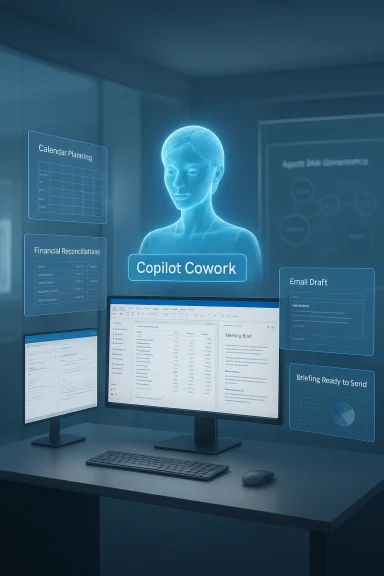
A holographic Copilot Cowork assistant hovers over a desk with multiple monitors.Background​

Microsoft’s Copilot program has been evolving for more than two years from a chat-first assistant into an embedded, cross-application productivity fabric inside Word, Excel, PowerPoint, Outlook and Teams. What changed this week is an explicit pivot from “help me write or summarfor me” — long-running, permissioned AI agents that accept high-level instructions and complete multi-step workflows on behalf of users.
This latest phase, which Microsoft calls part of Wave 3 of Microsoft 365 Copilot and the broader “Frontier” push, pairs three visible pieces:
  • Copilot Cowork — the agent experience that runs multi-step tasks,
  • Agent 365 — an orchestration and governance control plane for tracking, managing and securing agents across an organization, and
  • Microsoft 365 E7: The Frontier Suite — a commercial bundle that packages Copilot, Agent 365 and advanced security into a single enterprise SKU.
Microsoft and Anthropic both contributed in different ways: Anthropic’s Claude family and Cowork agent architecture are integrated into the Copilot experience as a model option and as the technical starting point for Copilot Cowork. Microsoft emphasizes running these agents within a customer’s Microsoft 365 tenancy and security boundaries, surfaced through an intelligence layer it calls Work IQ. These choices are intended to make agentic work auditable and enterprise-friendly.

What Copilot Cowork does — features and user scenarios​

Copilot Cowork is being pitched as a “digital coworker” that can take a single instruction and carry out a multi-step project across email, calendar, files, spreadsheets and meetings. In early demos and reporting the product is shown performing tasks such as assembling a meeting-ready presentation, extracting and reconciling financial numbers from spreadsheets, drafting and sending coordinating emails, and scheduling time in calendars — all with minimal human supervision.
Key capabilities Microsoft is highlighting:
  • Long-running, permissioned agents that keep state across multiple interactions and can interact with calendars, inboxes and files when explicitly authorized.
  • Multi-step orchestration that plans, executes and iterates (for example: research → create spreadsheet → generate slides → email stakeholders).
  • Model choice and multi-model routing — organizations can run agents using Anthropic’s Claude models or Microsoft’s other model partners depending on the task and required reasoning style.
  • Auditable outputs and actions — every agent action and artifact is recw and regulatory compliance.
  • Integration with Work IQ — context-aware intelligence that supplies relationships, priorities, and relevant files to the agent so that outputs are grounded in the company’s own data.
These are not limited to specialized teams: Microsoft frames the scenario as “vibe working,” where business users can describe outcomes in plain language and hand routine or complex work to an agent so humans can focus on higher-value judgment and oversight.

How it works: Anthropic, Work IQ, and Agent 365​

Anthropic and Claude integration​

Microsoft has added Anthropic’s Claude models to its multi-model Copilot platform; the company says Copilot Cowork uses the same “agentic harness” concept that Anthropic built for Claude Cowork while adapting it for cloud, tenant-integrated operation inside Microsoft 365. That means the high-level reasoning and chain-of-thought orchestration is powered by Claude-style models in some configurations, while Microsoft still supports other models where appropriate. This multi-model approach is deliberate: Microsoft wants to pick the right model for the right task and give customers choice.

Work IQ: context and grounding​

Work IQ is Microsoft’s intelligence layer that aggregates signals across Microsoft 365 — calendar relationships, email threads, recent documents, team memberships and meeting notes — and provides that context to agents so their outputs are grounded in a user’s real work. That grounding is critical because an agent’s ability to act across apps reliably depends on correct references to the organization’s people, documents and permissions. Microsoft advertises that Work IQ enables agents to be context-aware while still operating under tenant controls.

Agent 365: management, governance, and audit​

Agent 365 is the control plane Microsoft is shipping to let IT and security teams register, observe, govern and apply policy to agents, similar to how organizations already manage human users with identity, endpoint and data-loss prevention tooling. Microsoft’s messaging is explicit: treat agents as first-class identities and subject them to the same security lifecycle (enrollment, permissioning, monitoring, and retirement). The company says Agent 365 will be generally available starting May 1 and priced as a standalone $15-per-user-per-month add-on, with the E7 bundle including it as part of a broader package. Reported availability dates and pricing come from Microsoft’s announcement and corroborating coverage; these are company-provided details that enterprises should confirm with Microsoft sales reps.

Licensing and the commercial play: Microsoft 365 E7​

Microsoft packaged these agent features into a higher-tier commercial offering called Microsoft 365 E7: The Frontier Suite. The publicized list price is $99 per user per month for the E7 bundle — a package that combines Microsoft 365 E5, Copilot, Agent 365, Entra Suite, and enhanced Defender, Intune and Purview capabilities. Microsoft positions E7 as a simpler, lower aggregate price than purchasing those components separately. The Agent 365 control plane will also be available standalone for organizations that want governance but not the full E7 bundle.
A quick caveat: pricing and availability statements in press coverage largely mirror Microsoft’s announcement and its regional communications; enterprises should verify contract terms and regional rollouts directly with Microsoft because introductory pricing and bundling can vary by market and negotiated agreements.

Strengths and potential upside for organizations​

Microsoft’s Copilot Cowork and its Frontier suite present a string of credible advantages — especially for large organizations already embedded i:
  • Seamless enterprise integration: Agents run inside a tenant’s security and compliance boundaries and are tied into existing identity and DLP tooling, reducing the friction of connecting generative AI to corporate data. This is a major practical advantage for regulated industries.
  • Model diversity and specialization: Offering Anthropic’s Claude as an option alongside Microsoft’s other models creates choice and lets IT route tasks to the model that best fits the workload (reasoning-heavy tasks, code, or shorter-form responses). Multi-model orches-vendor lock-in risk.
  • Agent lifecycle governance: The Agent 365 control plane recognizes a real, emergent need: agents multiply quickly, and without management they become untracked contributors to business operations and risk. Centralized registries, policy controls and auditing are sensible first steps to make agent deployment scalable and safe.
  • Productivity yield: For routine, multi-step administrative workflows — scheduling, report assembly, routine data reconciliation, first-draft creation — an agent that can fully complete the task can free skilled employees for mission-critical decisions. If the accuracy is high, this translates into measurable labor savings.

Real risks and unresolved questions​

While the product addresses many engineering gaps, the agentic approach amplifies both traditional and AI-specific risks. Organizations should not proceed reflexively.
  • Data leakage and control gaps: Even when agents run inside a tenant, complexity creates attack surface. Agents that can send email, change calendar entries, create files, or call external services become operational actors — and that increases risk if permissions are misconfigured or compromised. Recent incidents where Copilot accessed sensitive items (reported internally and patched) demonstrate how server-side logic errors can expose data despite intended protections; these events highlight the need for continuous verification, not trust by default.
  • Over-trust in automation: Agents may return polished artifacts that look authoritative while containing subtle errors in data, analysis, or citations. When Copilot produces slide decks or reconciled financials, these outputs require human review; misplaced confidence could create legal, reporting or customer-facing damage.
  • Agent proliferation and sprawl: Microsoft itself reports rapid agent creation in early previews. Company-provided numbers (like tens of millions of agents appearing in an Agent 365 registry and more than 500,000 visible internally) are meaningful indicators of adoption velocity — but these are self-reported and should be taken as indicative rather than independently verified. Rapid growth without governance increases operational risk.
  • Security of third-party models and hosting: Anthropic’s models may be accessed or hosted differently from Microsoft’s own model instances. In previous rollouts Anthropic’s models were accessed via API and sometimes hosted on different cloud infrastructure; organizations must verify where models run and how data flows when choosing which model to route to. Model-hosting decisions affect compliance and data residency.
  • Auditability and regulatory compliance: Agents that take autonomous action create new audit trails and governance obligations. For regulated sectors (healthcare, finance, government) existing compliance programs must be extended to cover agent behavior, decisions, retention of outputs, and rights to human review. Agent 365 aims to be the control plane for these needs, but integration with external compliance audits and legal discovery processes must be validated by each organization.

Competitive landscape — where this fits in the market​

Microsoft’s move is both defensive and offensive. It addresses the risk that specialized agent startups and rival cloud vendors could own the new “do-it-for-me” layer of work automation, while also creating a commercial pathway to monetize agent use at scale.
  • Anthropic, with its Claude Cowork product, was an early public demonstration of agentic workflows; Microsoft’s offering uses that design as a reference while embedding the feature inside Microsoft 365. Anthropic continues to enhance its enterprise plugins and Cowork capabilities independently.
  • Google and other cloud vendors are pushing their own agent and AI productivity strategies; Google has been integrating AI across Workspace. Large SaaS vendors such as Salesforce are also building agentic assistants tailored to CRM or customer workflows. Microsoft’s differentiator is the breadth of its installed base and the degree to which agents can access native tenant data and corporate security tooling.
  • Open-source and start-up ecosystems are accelerating agent frameworks (open-source agents, niche vertical solutions). Microsoft’s E7 commercial play counters the argument that agents will only lower software spending by offering a bundled enterprise-grade path that includes governance and security.

Operational checklist for IT leaders — deploy safely, fast​

If your organization is evaluating Copilot Cowork or similar agentic tools, consider these practical steps:
  • Start small with a pilot: assign a narrow, low-risk set of workflows (meeting prep, internal reporting drafts) and measure both productivity and error rates.
  • Define agent identities and permissions: treat each agent as a user; enforce principle-of-least-privilege and require explicit approval for any action that creates outbound communication or modifies business records.
  • Instrument monitoring and alerting: integrate Agent 365 (or your vendor’s control plane) with SIEM, Defender and identity logs so unusual agent activity generates alerts.
  • Create a human-in-the-loop policy: mandate human sign-off thresholds for any agent action that affects external stakeholders, financials, regulatory filings, or customer-facing content.
  • Retain audit trails and versioned outputs: ensure that every agent action stores an auditable record and that generated artifacts include provenance metadata (which model, which inputs, which human approvals).
  • Train users and set expectations: educate employees about agent limitations and craft internal messaging that emphasizes review responsibilities and accountability.
  • Validate model-hosting and data residency: verify where each model executes and whether data sent to third-party models leaves your compliance boundaries.

Technical verification, what’s confirmed and what needs caution​

  • Confirmed: Microsoft publicly announced Anthropic models joining the Copilot model lineup and showed Copilot Cowork as a research preview; Microsoft documented multi-model support in Copilot Studio and highlighted Agent 365 and E7 as commercial mechanisms to manage agents. These details appear across Microsoft communications and reporting by independent outlets.
  • Company-reported metrics: statements like “tens of millions of agents in the Agent 365 registry” and “visibility into more than 500,000 agents internally” are Microsoft-provided figures repeated in press coverage; treat them as company claims that have not yet been independently audited. Enterprises should request substantiation during procurement discussions.
  • Pricing and dates: press reporting and Microsoft regional posts give a general availability target of May 1 for Agent 365 and a headline price for the E7 bundle at $99 per user per month, with Agent 365 available at $15 per user. These appear consistent across Microsoft’s announcement and multiple outlets, but final contract pricing and enterprise licensing often vary by region and negotiated discounts — confirm through official Microsoft channels. ([geekwire.com](Microsoft’s new Copilot Cowork integrates Anthropic’s Claude in rollout of new E7 licensing tier or region-dependent items: model hosting locations, exact data residency behavior for Anthropic model runs, and the final enterprise SLA terms are not fully enumerable from press materials. Treat statements about where models are hosted and data retention as potentially variable and require legal/technical confirmation. Flag these items in RFPs and security questionnaires.

What this means for the future of work and IT​

The industry shift from “assistants” to “agents” is less a single product release than a structural change in how software will be consumed. If agents work as advertised, organizations will stop using some legacy workflows and invest more in agent orchestration, audits and agent lifecycle management.
For CIOs and CISOs this means:
  • New operational disciplines — treating agents as first-class identities, folding them into identity lifecycle, and applying the same MDM, DLP and compliance controls used for humans.
  • Vendor diligence — rigorous model-hosting, data-flow, and supply-chain assessments become procurement essentials.
  • Change in skills and roles — teams that once built integrations and repetitive processes will shift to designing and supervising agents, validating outputs, and focusing on exception handling.
  • Commercial recalibration — pricing models may evolve; while Microsoft currently sells per-seat bundles, the industry could pivot toward consumption-based models as agentization matures. Microsoft’s leaders say customers still prefer per-user pricing today, but that could change as agents scale differently than human seats.

Conclusion​

Copilot Cowork marks the clearest signal yet that mainstream productivity suites will become platforms for autonomous agents. Microsoft’s combination of a tenant-bound agent experience, multi-model choice (including Anthropic’s Claude), and a control plane for governance is a pragmatic, enterprise-ready approach that addresses many immediate concerns around security and auditability.
That said, the move amplifies operational and compliance responsibilities for IT leaders: agents multiply rapidly, create new attack surfaces, and produce outputs that demand verification. Organizations should treat Copilot Cowork and Agent 365 as powerful tools that require careful rollout plans, robust guardrails and ongoing measurement.
The promise is tangible — reduced time on routine work and faster delivery of business artifacts — but the payoff will depend on disciplined governance, honest measurement of agent accuracy, and vendor transparency about where models run and how data flows. For any organization evaluating agentic AI at scale, the immediate priority should be controlled pilots, clear human review policies, and tightly scoped permissioning. The era of the digital coworker has arrived; now the work shifts to making coworkers safe, reliable, and accountable.

Source: People Matters - HR News Microsoft launches Copilot Cowork as AI agents reshape workplace software
Source: Techlusive Microsoft unveils Copilot Cowork: AI that can complete your office work automatically
 

Microsoft’s Copilot has quietly moved from “help me draft” to “do the work for me”: Copilot Cowork is a new, agentic layer inside Microsoft 365 that translates natural‑language instructions into multi‑step, cross‑app actions — planning, executing and returning finished outputs across Outlook, Teams, Word, Excel, PowerPoint and shared files — and it does so with Anthropic’s Claude technology under the hood.

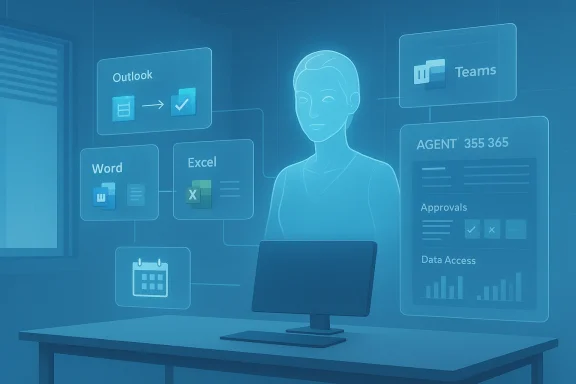
A holographic blue office scene with a computer and floating productivity apps like Outlook, Word, Excel, and Teams.Background​

Microsoft launched Copilot as a generative assistant woven into Microsoft 365 to help users summarize, draft, and analyze content inside Office apps. Over the last year that assistant has steadily acquired deeper integrations — connectors into mail and drives, file export workflows, and in‑canvas “agents” for specific apps — but the Copilot Cowork announcement marks a step change: the company is packaging run long‑running tasks with permissioned access to tenant data, while introducing a governance and management plane for enterprises.
This is not just a feature toggle. Microsoft is rolling Cowork into a broader commercial and technical strategy that includes:
  • formal multi‑model support (Anthropic’s Claude alongside OpenAI models),
  • a new Agent 365 control plane for managing and auditing agents,
  • the Work IQ intelligence layer that supplies the agent with context drawn from calendar, email, meetings and files,
  • and a premium Microsoft 365 E7 bundle aimed at enterprise customers.
Those announcements were published alongside Microsoft’s product briefings and covered broadly in the trade press; several outlets confirm the research‑preview status and limited pilot distribution that began in March.

What is Copilot Cowork? An operational definition​

Copilot Cowork can be described succinctly: a permissioned, agentic AI coworker that accepts a natural‑language brief, plans the required steps, performs actions across Microsoft 365 apps and systems, and returns a final product — not simply suggestions or drafts. Key attributes include:
  • Multi‑step workflow execution: Cowork can orchestrate a series of dependent tasks (research, data retrieval, spreadsheet generation, draft creation, slide assembly, email dispatch).
  • Model diversity: Anthropic’s Claude models (Sonnet/Opus families) are available as processing backends for these agents, giving organizations explicit model choice.
  • Work IQ context: Agents are grounded in a Work IQ intelligence layer that pulls signals from Outlook, Teams, OneDrive/SharePoint, calendars and chats to keep actions contextually accurate and relevant.
  • Agent management and governance: Agent 365 is introduced as a control plane to configure, monitor, and set guardrails for agent behavior across the enterprise.
Each of the above is not hypothetical — Microsoft and multiple reporting outlets present them as core product elements in Wave 3 of Copilot.

How Copilot Cowork works — a technical walkthrough​

1. Intent capture and task planning​

A user types or speaks a request such as “Prepare a Q1 sales briefing: pull X spreadsheet, analyze sales by region, create three slides highlighting top trends, draft the email to the execs and schedule a follow‑up meeting.” Copilot Cowork parses the brief, breaks it into discrete subtasks, and constructs an execution plan. This plan is visible to users and can be paused or edited before execution.

2. Permissioned data access​

Before agents act, they request and receive tenant‑scoped permissions to the necessary data (mailbox search, SharePoint/OneDrive files, Teams transcripts). Microsoft emphasizes the tenant boundary: Cowork runs in the customer’s Microsoft 365 tenancy under Microsoft’s enterprise data protections. This is a critical design choice for enterprise risk management.

3. Execution across apps​

Cowork’s execution engine can:
  • open spreadsheets and insert formulas,
  • extract meeting notes and surface action items,
  • compile slide decks consistent with corporate brand kits,
  • draft and send emails from Outlook,
  • schedule meetings in Teams — all as part of a single, coordinated workflow. The idea is that the agent returns a finished, verifiable artifact instead of unstructured suggestions.

4. Governance, audit and rollback​

Agent 365 and Microsoft’s enterprise controls log agent actions, expose change histories, and provide admin tools to set policies for data access, required approvals, and retention. Administrators can disable or constrain agents, route sensitive tasks for human approval, and audit for compliance. Those management features are central to Microsoft’s pitch to CIOs and CISOs.

Where Anthropic fits in: why Claude matters​

Microsoft’s Copilot platform was historically partnered tightly with OpenAI models, but recent moves formalize Anthropic as a first‑class model provider inside the Copilot ecosystem. Anthropic’s Claude Cowork technology — an agent‑centric offering designed to act rather than only converse — is the technical foundation for the Cowork experience in Microsoft’s implementation. The move reflects Microsoft’s multi‑model strategy to give customers choice and competitive performance characteristics.
Anthropic’s models are already operating as subprocessors for certain Copilot capabilities, and Microsoft has integrated Claude into Copilot Studio as an option for customers building specialized agents. The result is model diversity across the same tenant, with Microsoft retaining enterprise controls and contractual obligations.

Business packaging and pricing — what enterprises will pay​

Microsoft has paired Copilot Cowork with a broader commercial play:
  • a new Microsoft 365 Enterprise E7 tier positioned at roughly $99 per user per month (announced for a May 1 availability window in press briefings),
  • a separate Agent 365 management add‑on priced around $15 per user for enterprises that need large‑scale agent governance and orchestration.
Pricing is important because it frames adoption: organizations must weigh per‑seat AI costs and the operational burden of agent governance against potential productivity gains. Multiple outlets reported the price and timing alongside Microsoft’s announcement; Microsoft’s own briefings and Learn documentation also describe the E7/Agent 365 positioning.

Strengths — what Copilot Cowork gets right​

  • Real‑world productivity gains: Automating routine multi‑step tasks (report generation, scheduling, inter‑app reconciliation) frees knowledge workers for higher‑value work. The promise of a single agent that reliably completes a multi‑app workflow is compelling for information‑heavy roles.
  • Enterprise‑first governance: Microsoft built Agent 365 and emphasized tenant boundaries and auditing from day one — a pragmatic acknowledgement that agentic AI cannot scale in large organizations without administrative control. That focus lowers the barrier for conservative IT shops.
  • Model choice and competition: Adding Anthropic’s Claude reduces single‑vendor model lock‑in and gives organizations choices that may be better for particular workloads (e.g., creative drafting vs. structured data analysis). Multi‑model routing allows IT to pick the model that best fits privacy, safety, and output quality goals.
  • Contextual grounding via Work IQ: By drawing on calendar, email and file signals, Cowork can make decisions that align with organizational context, reducing hallucination risk and improving relevance. This contextual integration is a practical differentiator versus generic agents.

Risks and unanswered questions — what IT and security teams must examine​

Data exposure and subprocessors​

Running Anthropic models as subprocessors introduces additional contractual and technical considerations. Even with tenant‑scoped protections, organizations must validate where models execute, what telemetry is retained, and whether any sensitive data could be exposed outside defined boundaries. Microsoft’s public materials note Anthropic operates as a subprocessor for some Copilot capabilities, but organizations should treat that as a negotiation point for enterprise contracts.

Agent autonomy versus human oversight​

The core value of Cowork — acting on behalf of users — is also the core risk. Agents that send emails, modify spreadsheets, or book meetings carry the potential for accidental actions, data leakage, or reputational damage if not carefully constrained. The control plane promises audit and approvals, but real deployments will reveal how granular and enforceable those policies are. Early pilots will be crucial for testing policy fidelity.

Compliance and regulatory risk​

Industries with strict data residency, recordkeeping, or audit requirements (finance, healthcare, government) will need to confirm whether agent logs, model prompts and outputs meet regulatory obligations. The combination of long‑running agents and multi‑model routing complicates standard compliance playbooks. Microsoft positions Agent 365 and Purview‑style tooling to help, but customers must validate controls against their regulator’s expectations.

Economic calculus and productivity measurement​

At $99 per seat for E7 plus agent management fees, the ROI must be demonstrable. Organizations should pilot with narrow, high‑value workflows where automation yields measurable time or error reductions before broad rollouts. The risk is paying for broad seat licenses without anchored productivity objectives.

Deployment checklist for IT leaders​

If you’re evaluating Copilot Cowork for pilot or production, treat the rollout like an automation program with governance baked in. Recommended initial steps:
  • Inventory high‑value, repeatable workflows (reporting, investor decks, monthly reconciliations) that map cleanly to multi‑step automation.
  • Run a controlled research preview with small teams and explicit measurement goals (time saved, error reduction, cycle time).
  • Validate data flows and subprocessors: confirm where models run, how telemetry is stored, and the ability to redact or purge prompts.
  • Configure Agent 365 policies: mandatory approvals, read‑only modes, and role‑based access for agents.
  • Train staff on agent monitoring and remediation protocols (how to pause, inspect and rollback agent actions).
  • Measure business metrics and refine. Scale only when governance, security and ROI thresholds are met.
Each step should be documented and assigned to accountable owners, blending IT, legal, security and the business unit sponsor.

Developer and ISV implications​

Copilot Studio’s support for Anthropic models and agent authoring changes the ISV landscape. Independent developers and systems integrators can:
  • build specialized agents that perform domain tasks inside a tenant,
  • instrument agents with tenant‑specific connectors and data sources,
  • provide verification and human‑in‑the‑loop wrappers that increase trust.
For those building custom agents, Microsoft’s documentation recommends sandboxing, thorough input validation, and robust logging. Copilot Studio’s multi‑model support will encourage a new class of enterprise apps where the AI agent is the product.

Competitive context: Microsoft’s bet vs. the market​

Copilot Cowork positions Microsoft squarely in the market for enterprise “digital coworkers,” competing with specialist automation vendors, RPA providers, cloud AI players, and emerging models from OpenAI and Anthropic themselves.
  • Microsoft’s advantage: deep integration into the productivity stack, centralized governance, and the ability to route work to tenant‑trusted models.
  • The challenge: ensuring agents behave predictably at scale and avoiding the appearance of vendor‑led “feature bloat” that charges for automation that is hard to measure.
Multiple industry outlets emphasized that this is Wave 3 of Copilot — the product is now intended to do work, not only to offer suggestions — and that Microsoft is commercializing agent management aggressively. The market will judge whether enterprises value the convenience enough to pay the E7/Agent 365 premhttps://fortune.com/2026/03/09/microsoft-copilot-cowork-ai-agents-anthropic-e7-m365-saas//)

Practical scenarios where Cowork shines — three examples​

  • Sales operations: Cowork collates CRM snapshots, updates forecast spreadsheets with correct formulas, creates an executive summary slide deck, and emails stakeholders — all triggered by “Build the Q1 forecast pack with regional variance analysis.” This reduces friction in cross‑system reporting.
  • HR onboarding: Cowork assembles a tailored onboarding packet by pulling policy docs from SharePoint, generating a role‑specific checklist in Excel, scheduling intro meetings, and emailing the new hire calendar invites. This replaces manual handoffs across systems.
  • Finance reconciliations: Cowork pulls bank statements, applies formulaic reconciliation in Excel, flags anomalies for human review, and drafts a summarized report — a process that traditionally involves multiple manual copy/pastes. Agentic automation reduces repetitive risk.
These are realistic first pilots: high‑value, repeatable, and bounded in scope.

What to watch in the coming months​

  • Pilot outcomes and real‑world audits — early adopter case studies will show whether agents actually save time without increasing error. Expect public pilot reports from Microsoft’s Frontier program participants in late March and April.
  • Regulatory scrutiny — sectors with strict controls will probe subprocessors and model reuse; expect more contractual detail from Microsoft for regulated customers.
  • Tooling maturity — how fine‑grained Agent 365’s policy controls are (per‑agent data scopes, conditional approvals) will determine enterprise comfort levels.
  • Model handling and explainability — organizations will ask for better traceability: which model produced which step and why. Multi‑model environments require stronger provenance tools.

Final assessment​

Copilot Cowork is a consequential step in enterprise AI: it crystallizes the move from “assistants” to “coworkers” and pairs that capability with the governance tooling enterprises demanded. Microsoft’s decision to integrate Anthropic’s Claude models reflects both technical prudence and competitive strategy — model diversity lowers risk and improves choice. The agentic approach promises real productivity gains, especially where workflows are repeatable and cross‑system.
That said, the technology raises nontrivial governance, compliance and economic questions. The most likely successful deployments will be conservative, well‑instrumented pilots that target measurable outcomes. Enterprises that skip those pilots and opt for blanket E7 rollouts risk paying high per‑seat fees for automation that is poorly measured and weakly governed.
For IT leaders and technical decision makers, the sensible path is deliberate: run targeted pilots, insist on clear subprocessors and data residency commitments, exercise Agent 365’s policy controls, and require measurable ROI before broad adoption. Copilot Cowork is powerful — but its utility will depend on governance, measurement and the care organizations take in defining what agents are allowed to do on their behalf.

Conclusion
Copilot Cowork represents Microsoft’s clearest articulation yet of a future where AI does more than assist: it completes work across a company’s productivity fabric. For enterprises, that future holds real promise — and real responsibility. The immediate imperative is practical: test, govern, measure and iterate before giving agents the keys to your calendars, mailboxes and financial spreadsheets. The technology is arriving; how well it helps will depend on the guardrails we build around it.

Source: Pulse 2.0 Microsoft: Copilot Cowork Introduced To Turn AI Requests Into Automated Workplace Actions
Source: El-Balad.com Microsoft Unveils AI-Powered Copilot Cowork for M365 with Anthropic’s Support
 

Back
Top