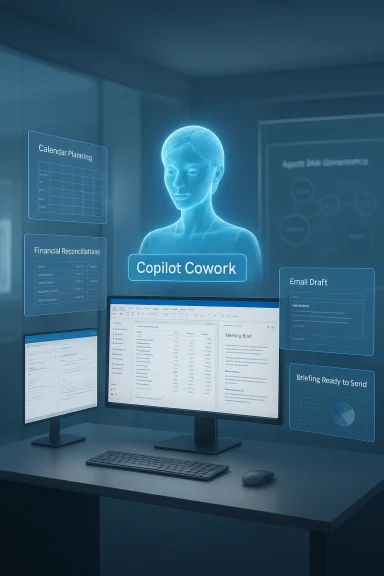
Microsoft’s Copilot has taken a decisive step from “help me write” to “do it for me”: the company has integrated Anthropic’s Claude models into Microsoft 365 Copilot and Copilot Studio, and simultaneously unveiled a new, agentic product called Copilot Cowork — built in collaboration with Anthropic — plus an enterprise control plane (Agent 365) and a new Microsoft 365 E7 bundle aimed at governing and commercializing agent-driven work. tps://www.microsoft.com/en-us/microsoft-copilot/blog/copilot-studio/anthropic-joins-the-multi-model-lineup-in-microsoft-copilot-studio/?msockid=2acbb910877a615128f6af93862260f2&utm_source=openai))
Microsoft 365 Copilot first arrived as a productivity augmentation inside Word, Excel, PowerPoint, Outlook and Teams: a generative-AI assistant that drafts, summarizes and accelerates routine tasks. Over the past year Microsoft has shifted that product toward a multi-model orchestration layer — one that can route workloads to different LLM providers depending on the job. Anthropic’s Claude family has now joined the lineup alongside OpenAI and Microsoft’s own MAI models, giving organizations explicit model choice inside Copilot’s Researcher agent and Copilot Studio.
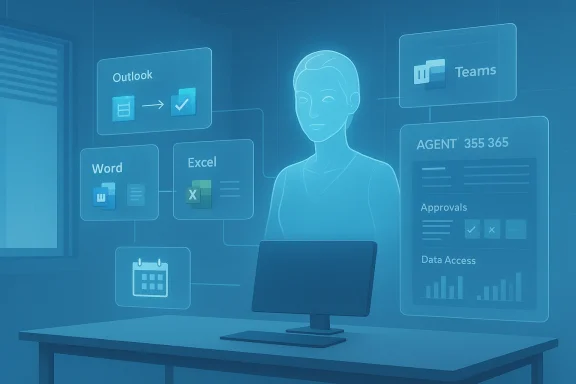
Copilot Cowork represents the next stage of that evolution: rather than returning drafts and suggestions, Cowork is designed to plan, execute and return finished work across Microsoft 365 apps by running as a long‑running, permissioned agent that can access emails, calendars and files with admin controls. Microsoft has introduced Agent 365 as a governance and management plane to register, monitor and control these agents at scale, and has packaged those capabilities into a new Microsoft 365 E7 commercial tier. The company says Copilot Cowork is entering limited research previews now and broader rollout will follow through its Frontier programs.
Positive takeaways:
Microsoft’s move to make Copilot a multi-model, agentic platform changes the calculus for enterprise AI adoption: the question is no longer whether AI can help with drafting, but whether organizations are ready — technically, contractually, and culturally — to hand parts of the day’s work to a machine coworker. The next six to twelve months will be decisive as early pilots translate into operational patterns, policy templates and vendor contract language that will define what responsible agent adoption looks like across industries.
Source: Tech in Asia https://www.techinasia.com/news/microsoft-integrates-anthropic-tech-into-copilot-cowork/
Source: blockchain.news Microsoft Copilot Cowork Launch: Latest Analysis on Automated Task Orchestration in M365 | AI News Detail
 Background / Overview
Microsoft 365 Copilot first arrived as a productivity augmentation inside Word, Excel, PowerPoint, Outlook and Teams: a generative-AI assistant that drafts, summarizes and accelerates routine tasks. Over the past year Microsoft has shifted that product toward a multi-model orchestration layer — one that can route workloads to different LLM providers depending on the job. Anthropic’s Claude family has now joined the lineup alongside OpenAI and Microsoft’s own MAI models, giving organizations explicit model choice inside Copilot’s Researcher agent and Copilot Studio.Copilot Cowork represents the next stage of that evolution: rather than returning drafts and suggestions, Cowork is designed to plan, execute and return finished work across Microsoft 365 apps by running as a long‑running, permissioned agent that can access emails, calendars and files with admin controls. Microsoft has introduced Agent 365 as a governance and management plane to register, monitor and control these agents at scale, and has packaged those capabilities into a new Microsoft 365 E7 commercial tier. The company says Copilot Cowork is entering limited research previews now and broader rollout will follow through its Frontier programs.
What changed — the concrete announcements
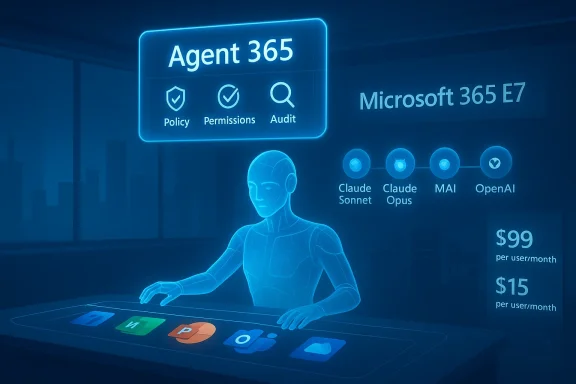
- Microsoft has added Anthropic’s Claude Sonnet and Claude Opus model families as selectable backends inside Microsoft 365 Copilot and Copilot Studio, exposed initially in Researcher and agent-builder experiences. This expands Copilot’s architecture from a single-provider model to a multi-model orchestration layer.
- Microsoft announced Copilot Cowork, an agentic, multi‑step assistant designed to autonomously complete workflows — scheduling, data assembly, report generation and cross-app workflows — and return deliverables rather than drafts. The capability is being piloted in research previews.
- To govern agent scale and reduce operational risk, Microsoft introduced Agent 365, a control plane for discovery, lifecycle management, and policy enforcement for agents. Agent 365 is being positioned as the enterprise management layer for agent deployments.
- Microsoft has packaged these capabilities into a premium commercial SKU, Microsoft 365 E7, which the company says will be available May 1 at a list price of $99 per user per month; Agent 365 is listed as an add-on priced at $15 per user per month in Microsoft’s commercial materials. These prices are central to Microsoft’s plan to move large enterprises toward seat-based, governed agent deployments.
Technical architecture: multi‑model orchestration and agent control
How model choice works in practice
Microsoft’s multi-model approach exposes multiple LLM providers inside Copilot and Copilot Studio. Builders and end users can route workloads to:- Microsoft’s in-house models (MAI family) for latency-sensitive or low-cost routing.
- OpenAI models where Microsoft still decides they are the best fit.
- Anthropic’s Claude family for tasks Microsoft deems better suited to Claude’s reasoning style or safety characteristics.
Agent runtime and Work IQ
Copilot Cowork is layered on top of an intelligence orchestration layer Microsoft calls Work IQ (a context and planning layer). Work IQ mediates intent, context, and data access; Copilot Cowork plans multi-step sequences, issues app-level actions via connectors, and returns completed artifacts (documents, spreadsheets, calendars). Agent 365 provides the control plane for registering agents, setting permissions, auditing actions, and enforcing corporate policies.Hosting and data flow: AWS, Azure — and the nuance
One of the most consequential technical details is where Anthropic’s models run when used inside Copilot. Early integrations used Anthropic-hosted endpoints on AWS, which meant Microsoft routed selected workloads outside Azure before bringing contractual protections to bear. However, an infrastructure and investment pact between Microsoft, Anthropic and third parties has evolved rapidly, and some Anthropic capacity and enterprise offerings are now available to run on Azure as well. That transition is ongoing and regionally variable, and Microsoft’s documentation notes that Anthropic model usage in Copilot may be excluded from the EU Data Boundary in some cases. Enterprises should treat hosting and regional processing guarantees as a live operational variable and verify tenant-level settings with their Microsoft account team.Cross‑checked facts (what we verified)
- Anthropic models are available as model choices inside Microsoft 365 Copilot and Copilot Studio. This is confirmed in Microsoft’s Copilot blog and multiple independent outlets.
- Copilot Cowork was announced as a new agentic experience built with Anthropic technology and is entering research previews; Microsoft announced Agent 365 and the E7 bundle contemporaneously. Multiple outlets, including Microsoft’s own Microsoft 365 blog and mainstream coverage, report these elements together.
- Microsoft’s new E7 price point of $99/user/month and Agent 365’s $15/user/month are the list figures announced in Microsoft’s March materials; independent reporting picked up and repeated the same pricing. Pricing should be treated as list guidance until invoiced contracts and partner quotes are issued.
- Anthropic models used inside Microsoft offerings are covered by Microsoft’s Product Terms and Data Protection Addendum, but may be excluded from the EU Data Boundary and certain in‑country processing commitments. This nuance appears in Microsoft documentation and multiple compliance-focused reporting sources. Enterprises with EU or in‑country residency needs should verify applicability immediately.
Strengths and opportunities
- Model choice reduces vendor lock‑in. Giving enterprises multiple model backends reduces reliance on a single provider and allows IT to match model strengths to tasks (e.g., reasoning, safe summarization, code generation). This opens product differentiation and improves resilience against a single provider outage.
- Agentic automation could multiply productivity. Copilot Cowork’s promise is not incremental; it is a change in workflow design. Long‑running agents that can coordinate across email, calendar and files — and return finished documents — can compress days of work into hours for many knowledge tasks. For teams with repeatable, multi-step processes, that’s a huge efficiency play.
- Governance and control are baked in at announcement. Microsoft’s launch emphasizes Agent 365 and E7 as governance-first offerings. Providing a first-party control plane that ties agent identities, permissions, and audit logs into existing Microsoft security primitives addresses a major enterprise adoption blocker.
- Commercial packaging simplifies procurement. The E7 bundle and per-user Agent 365 pricing give IT leaders a straightforward procurement path for large-scale agentization efforts — which, summed up, lowers friction for enterprise experiments at scale.
Risks, unknowns and areas that need scrutiny
- Data residency and EU Data Boundary exclusions. While Microsoft states Anthropic is a subprocessor and covered by Microsoft’s DPA and EDP, it explicitly notes that Anthropic model processing is currently excluded from the EU Data Boundary and some in‑country commitments. For organizations governed by strict data residency laws (finance, government, health), this exclusion is a potential compliance showstopper unless and until regionally localized hosting is guaranteed. Enterprises must map the exclusions to their regulatory obligations before enabling Anthropic models.
- Operational risk of autonomous agents. Agents that act across email, calendar and files create new attack surfaces: misconfigured permissions, phishing vectors that fool agents into executing malicious requests, or flawed agent planning that performs unintended actions. Microsoft frames Agent 365 as the mitigation, but this is a classic governance-versus-convenience tradeoff: defense-in-depth, policy fencing and human-in-the-loop safeguards remain necessary.
- Transparency and traceability of agent actions. For legal and audit purposes, enterprises require tamper-proof logs, provenance, and easy rollbacks. The announced platform promises audit trails, but buyers should validate whether logs are sufficiently granular, immutable, and exportable to SIEM and eDiscovery tools they already use. Independent verification is required.
- Hidden costs from agent usage. Microsoft advertises E7 as an economical bundle, but agent workloads are message- and compute‑intensive. PAYGO meters, per‑agent interactions and model choices (especially if routed to third-party hosts) can add unpredictable operational spend. Organizations must model realistic agent usage patterns and use the provided Agent Cost Estimators before wide enablement.
- Model provenance and behavior variance. Different LLMs exhibit different hallucination profiles, response styles and safety filters. Routing a mission-critical compliance summary through a model tuned for creative writing could produce dangerous results. Copilot’s multi-model orchestration needs robust “model factsheets” and per-task model selection guardrails to avoid unpredictable outputs.
Comparison: Copilot Cowork vs Anthropic Cowork and other agent frameworks
Anthropic’s own Cowork product (a desktop-scoped agent for folder-based automation) and Claude Cowork research previews have emphasized file-level autonomy and local workflows. Microsoft’s Copilot Cowork differs in three ways:- Scale and enterprise integration — Copilot Cowork is integrated into Microsoft 365 and designed to operate across tenants with centralized governance via Agent 365.
- Multi‑model orchestration — Microsoft’s version can choose between MAI, OpenAI and Anthropic depending on task alignment.
- Commercial packaging — Microsoft bundles governance, identity (Entra), security, and consumption models together (E7 + Agent 365) for enterprise procurement.
Practical checklist for IT and security teams (what to do now)
- Confirm your organizational requirements for data residency, export controls, and regulatory compliance. If you have EU data residency needs, verify whether Anthropic model usage is permitted for your tenant or whether it will be blocked by policy. Action: Engage legal/compliance and your Microsoft account rep.
- Run a pilot in an isolated tenant or test group. Start with read‑only agent scenarios (summaries, drafts) before enabling agents with write permissions to email or calendar. Monitor behavior, cost, and audit logs.
- Map permissions and implement least‑privilege policies for agents. Use Agent 365 to constrain scopes, set time-limited tokens and require escalation for high-risk operations.
- Stress-test provenance, logging and eDiscovery. Ensure Agent 365 logs can be exported to SIEM and that audit trails meet internal retention and legal discovery requirements. Validate immutability guarantees.
- Model selection governance: define which tasks are routed to which model families, and create a model-factsheet registry for reviewers to understand model tradeoffs. Start with a conservative default (e.g., MAI/OpenAI) for sensitive tasks.
- Cost modeling: estimate message and compute consumption for anticipated agent workflows and run cost-breakdown simulations (prepaid vs PAYGO). Factor in potential third-party hosting fees when Anthropic models are not hosted in Azure.
Governance recommendations and vendor questions to ask
- Can Agent 365 enforce per-agent network egress policies and prevent agents from using unapproved external connectors?
- What guarantees exist for data residency and in‑country processing per region and per model family?
- Will Anthropic‑processed outputs be recorded inside our tenant logs with sufficient provenance for audits and litigation hold?
- How do licensing and PAYGO meters apply when agents perform repeated, high-frequency background interactions?
- What are Microsoft’s SLAs for agent runtime availability, and what fail-safe measures exist to stop runaway agent behavior?
Potential regulatory and ethical flashpoints
- Automated agents that access personal inboxes and calendars create new privacy exposures. The combination of autonomous action and sensitive PII demands strong human oversight and explicit consent models for employee data access.
- Agents can amplify bias and produce materially misleading artifacts. For regulated outputs (e.g., financial reports, clinire secondary human verification and a documented approval workflow before publication.
- The “double-agent” risk — where a poorly governed agent becomes a vector for exfiltration or policy violation — is real. Microsoft’s framing of Agent 365 is a recognition of this risk; it is not a panacea. Organizations must treat agents as first-class endpoints in their security posture.
Where reporting and documentation still felt thin (and what to watch)
- Precise regional hosting guarantees for Anthropic models across all Microsoft locales remain uneven in public documentation. Microsoft’s statements indicate the situation is changing; treat any single-page claim as provisional until it is listed in contractual Product Terms for your tenant. Caution: vendors’ public blogs can predate contractual updates.
- The functional details of Agent 365 (policy granularity, API access, SIEM integration and retention guarantees) are high-impact but not yet exhaustively documented in public product literature. Operational buyers should seek an architecture session with Microsoft engineering and request a security architecture whitepaper.
- Real-world agent failure modes — e.g., poorly constrained agents booking travel that violates policy, or agents publishing inaccurate regulatory reports — have limited public case studies. Early enterprise pilots will produce these use cases rapidly; customers should ask Microsoft for documented mitigation patterns and safety‑by‑design checklists.
Final analysis — balancing optimism with operational realism
Microsoft’s orchestration of Anthropic into Copilot and the launch of Copilot Cowork mark a clear industry inflection: mainstream workplace software is moving from assistant to autonomous coworker. That change promises large productivity gains but simultaneously raises governance, compliance and operational questions that classical IT and security teams have not had to manage at this scale.Positive takeaways:
- Enterprises now have a path to richer, multi‑modal, multi‑model automation inside the tools they already use.
- Microsoft’s packaging (Agent 365 + E7) acknowledges governance needs rather than leaving them to ad-hoc controls.
- Model choice lets organizations tailor outcomes based on task-critical attributes like reasoning style, safety and cost.
- Data residency caveats — especially EU Data Boundary exclusions — are real and materially important for regulated organizations.
- Autonomous agents enlarge the attack surface and require a reconceptualization of identity, permissions, and audit at machine scale.
- Cost and behavior unpredictability remain until organizations run realistic agents in controlled pilots and model consumption closely.
Microsoft’s move to make Copilot a multi-model, agentic platform changes the calculus for enterprise AI adoption: the question is no longer whether AI can help with drafting, but whether organizations are ready — technically, contractually, and culturally — to hand parts of the day’s work to a machine coworker. The next six to twelve months will be decisive as early pilots translate into operational patterns, policy templates and vendor contract language that will define what responsible agent adoption looks like across industries.
Source: Tech in Asia https://www.techinasia.com/news/microsoft-integrates-anthropic-tech-into-copilot-cowork/
Source: blockchain.news Microsoft Copilot Cowork Launch: Latest Analysis on Automated Task Orchestration in M365 | AI News Detail