

Microsoft has quietly handed a significant piece of its next-generation workplace AI to a third party: Anthropic. The result is Copilot Cowork — a shift in Microsoft’s Copilot strategy from chat-first assistance to permissioned, long-running agents that plan, execute, and return finished work across Microsoft 365 — built in close technical collaboration with Anthropic and rolling out as a research preview inside selected enterprise channels.
Microsoft 365 Copilot began life as an LLM-powered assistant embedded across Word, Excel, PowerPoint, Outlook and Teams, designed to speed drafting, summarization and first-pass analysis inside the productivity suite. That original Copilot relied heavily on large language models and conversational interactions to help users iterate faster, but the model was still effectively a helper — it drafted, suggested, and summarized rather than taking sustained responsibility for completing multi-step tasks.
Anthropic made its name with the Claude family of models — chat-first assistants optimized for safety and controllability — and more recently with experimental agentic tools such as Cowork, which convert Claude from a conversational partner into a folder-scoped, desktop-capable assistant that can read, edit and create files inside a designated workspace. Anthropic’s Cowork emphasizes file-awareness, sandboxed execution, and task automation for non-developers.
The partnership folds these capabilities into Microsoft’s enterprise stack: Anthropic’s agent technology powers the “doing” side of Copilot Cowork, while Microsoft layers governance, identity controls, telemetry, and commercial packaging around it. That combination is intended to let Copilot move beyond short interactions and become an autonomous coworker that executes multi-step, multi-app workflows inside Microsoft 365.
But this capability also materially raises the stakes for governance. Agents that operate on real documents and return finished deliverables require rigor: least-privilege provisioning, human-in-the-loop approvals, provenance and auditability, red-team testing, and contractual clarity with model providers. Organizations that treat Copilot Cowork as a simple upgrade to Copilot chat risk surprises — both technical and commercial.
For IT leaders, the prudent path is clear: pilot cautiously, architect for containment, demand transparency around model telemetry and retention, and treat agentic AI as a new class of enterprise application that requires full lifecycle management. Done well, Copilot Cowork could move the needle on the hardest parts of knowledge work; done poorly, it will create a new class of audit, compliance and operational headaches that organizations will be forced to remediate.
In short: Copilot Cowork shows what workplace AI becomes when it stops being merely suggestive and starts taking responsibility. The operational and governance work to make that transition safe and sustainable, however, begins long before agents are turned loose on your corporate folders.
Source: inc.com https://www.inc.com/ben-sherry/micr...work-ai-heres-what-it-actually-does/91313814/
 Background
Microsoft 365 Copilot began life as an LLM-powered assistant embedded across Word, Excel, PowerPoint, Outlook and Teams, designed to speed drafting, summarization and first-pass analysis inside the productivity suite. That original Copilot relied heavily on large language models and conversational interactions to help users iterate faster, but the model was still effectively a helper — it drafted, suggested, and summarized rather than taking sustained responsibility for completing multi-step tasks.Anthropic made its name with the Claude family of models — chat-first assistants optimized for safety and controllability — and more recently with experimental agentic tools such as Cowork, which convert Claude from a conversational partner into a folder-scoped, desktop-capable assistant that can read, edit and create files inside a designated workspace. Anthropic’s Cowork emphasizes file-awareness, sandboxed execution, and task automation for non-developers.
The partnership folds these capabilities into Microsoft’s enterprise stack: Anthropic’s agent technology powers the “doing” side of Copilot Cowork, while Microsoft layers governance, identity controls, telemetry, and commercial packaging around it. That combination is intended to let Copilot move beyond short interactions and become an autonomous coworker that executes multi-step, multi-app workflows inside Microsoft 365.
What Copilot Cowork actually does
Copilot Cowork is not just a new marketing name. It represents a set of capabilities and design choices with clear implications for how work gets automated inside enterprise stacks.Agentic, multi-step task execution
- Copilot Cowork can plan multi-step workflows, execute them across Microsoft 365 applications (Outlook, Word, Excel, PowerPoint, Teams, SharePoint), and return finished deliverables to users, rather than simply returning a set of suggestions or draft text. This transforms Copilot from an assistant into a doer.
- The agentic model supports long-running tasks and may maintain context or memory across the duration of a workflow, enabling activities like research, spreadsheet construction, report compilation, and multi-message outreach that require multi-turn coordination.
Permissioned, folder- and identity-scoped access
- Anthropic’s Cowork introduced the idea of sandboxed, folder-scoped agents that are explicitly granted permission to operate inside a defined directory or dataset. Microsoft extends this to the enterprise by tying agent permissions to user identity, Azure Active Directory, and Microsoft Purview-style governance tooling. The result is an agent that acts on a well-defined, permissioned subset of tenant data.
- Administrators receive controls for provisioning, auditing, and deprovisioning agents — a necessary feature set for organizations that must manage legal, regulatory, and compliance risk when enabling autonomous AI tasks.
Multi‑model orchestration and model choice
- Microsoft has explicitly moved Copilot toward a multi-model architecture: Anthropic’s Claude family is now one selectable backend inside Copilot (alongside OpenAI and Microsoft’s own models), enabling enterprises to route workloads to the model best suited for a task. Microsoft positions Copilot as an orchestration layer that can select the optimal model for each workload.
- This multi-vendor strategy is operationalized through new orchestration tools inside Copilot Studio and the Researcher agent, allowing per-agent or per-workload model routing decisions. That flexibility is meant to reduce vendor lock-in and give organizations choice over performance, cost, and governance trade-offs.
New control and telemetry layers: Agent 365 and Work IQ
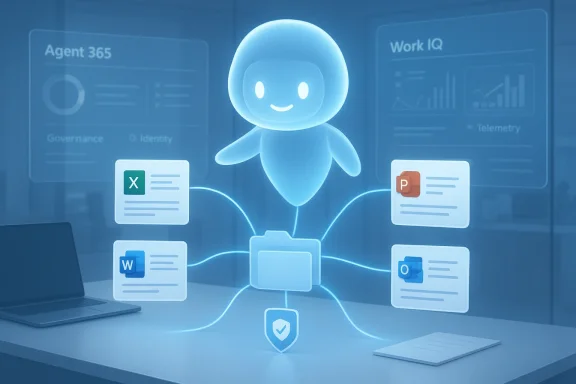
- Microsoft introduced an agent management control plane, often referred to as Agent 365, and an intelligence orchestration layer called Work IQ. Agent 365 provides admin-level controls for agent deployment, identity, and governance; Work IQ adds automation-level intelligence to measure and guide agent behavior across Microsoft 365. Together they form the management spine for Copilot Cowork at enterprise scale.
Commercial packaging and preview rollout
- Copilot Cowork was announced as a research preview and initially rolled out to limited enterprise participants and Microsoft’s Frontier channel. Microsoft is bundling agentic capabilities into new commercial tiers intended for large organizations and managed deployments. The new premium enterprise tier (marketed in internal reporting as Microsoft 365 E7) positions agentic AI as a higher‑tier capability with dedicated pricing and governance features.
How this was built: Microsoft + Anthropic dynamics
Why Anthropic?
Anthropic brings three complementary strengths to Microsoft’s table:- A safety- and policy-focused modeling approach that emphasizes controllability and reduced harmful outputs.
- Agentic experimentation (Cowork) that already implements folder‑scoped, sandboxed desktop assistants and a pattern for permissioned access.
- A model architecture and training approach designed to be integrated into third‑party orchestration systems.
Architectural notes (what’s visible today)
- Copilot Cowork runs as a permissioned service inside Microsoft 365 with integration points to OneDrive/SharePoint and Exchange for document and email access. Anthropic’s Cowork agent capability supplies the “executor” logic for complex, multi-step tasks while Microsoft handles identity, telemetry, and governance.
- The orchestration layer is model-agnostic: developers and Copilot Studio administrators can choose to route a given agent’s workload to Anthropic Claude or to other backends (OpenAI, Microsoft) depending on policy and performance needs. This is a practical incarnation of the idea that the productivity layer should decide the right model for the right job.
- Sandboxing and data-scoped permissioning are central design elements to contain risk: agents are intended to have explicit scopes (folders, mailboxes, or app connectors) rather than blanket access to tenant data. That containment model is a direct response to enterprise concerns about data leakage and uncontrolled agent behavior.
What this means for enterprises — the upside
The business case for Copilot Cowork is straightforward: it promises to accelerate complex, repetitive, and multi-step knowledge work without forcing every user to become an automation developer.- Productivity gains: Businesses can offload time-consuming synthesis tasks — building reports, compiling decks, drafting emails with attachments, or populating spreadsheets — to an autonomous agent that returns a finished deliverable. This reduces context switching and frees employees to focus on judgment and decision-making.
- Faster adoption of automation: The folder-scoped Cowork model lowers the bar for real-world automation adoption by non-technical users. Teams can create scoped agents to manage routine processes without needing full RPA or developer-driven automation.
- Choice and risk distribution: Multi-model orchestration lets customers route sensitive reasoning workloads to models they trust (or to on-premises/Microsoft-controlled variants), while routing other tasks to models optimized for creativity or speed. This supports nuanced vendor risk management.
- Operational controls for IT: Agent 365 and Work IQ position agents as managed services rather than rogue user experiments. With admin-level provisioning, telemetry and analytics, IT teams can treat agents like any other enterprise application: enforce policies, monitor usage, and audit outputs.
Risks and failure modes — what IT teams must watch for
Copilot Cowork’s promise comes with non-trivial risk trade-offs. Anthropic’s agent technology introduces automation power but also creates new attack surfaces and governance challenges.Data exposure and exfiltration
Even with folder-scoped agents, the possibility of unauthorized data movement exists if agents are misconfigured, if connectors are overly permissive, or if underlying model telemetry retains user content in unexpected ways. Enterprises must validate where conversational and document context flows, how long it persists, and whether any third-party logs are retained outside tenant controls.Hallucination and correctness
Agents that return finished work create a new verification burden: if an agent fabricates numbers, misreads a spreadsheet, or generates inaccurate legal language and that output is accepted without review, the business impact can be immediate and severe. Organizations must maintain human-in-the-loop checkpoints for any high-risk deliverables and ensure versioning and provenance for agent outputs.Privilege creep and least‑privilege erosion
Scoped permissions are effective only if they are configured correctly and monitored. Over time, teams may grant broader scopes to agents to solve edge cases, and without lifecycle controls those expanded privileges can persist. Admins need automated entitlement reviews, expiry policies, and role-based guardrails for agent provisioning.Supply‑chain and vendor risk
Relying on third-party agent models introduces dependency on that provider’s operations, policy decisions, and commercial terms. Anthropic’s role in a core productivity function raises questions about contractual SLAs, regional data residency, and response to emergent safety incidents. Multi-model support mitigates some vendor concentration risk but does not eliminate contractual and operational dependencies.Commercial complexity and cost surprises
Microsoft’s decision to surface agentic capabilities in higher-tier commercial SKUs signals that these features will carry premium pricing. Organizations should model expected usage and seat-based costs carefully, because long-running agents and high-volume model calls can rapidly increase cloud expenses if not scoped and throttled. Some internal reports reference premium tiers (e.g., Microsoft 365 E7) intended for large organizations; organizations must confirm pricing and entitlements before wide deployment.Practical steps for IT and security teams
For organizations piloting or deploying Copilot Cowork, the following practical checklist captures minimum controls and governance steps:- Inventory and scoping
- Identify processes and folders that will be candidate scopes for Cowork agents.
- Define explicit business owners for each agent and set lifecycle policies (expiration, review cadence).
- Least privilege and connector controls
- Apply least-privilege by default. Require approval workflows for any agent that needs cross-app or cross-folder access.
- Human-in-the-loop and approval gates
- For high‑risk deliverables (legal, financial, audit-facing), require a human reviewer to sign off on agent outputs before publication or submission.
- Logging, telemetry and provenance
- Enable full telemetry for agent runs, including input provenance, model selection, and output versioning; tie logs to identity for auditability.
- Red-team testing and scenario playbooks
- Simulate malicious or accidental misuse scenarios to evaluate agent behavior under adversarial inputs, and maintain playbooks for incident response.
- Cost controls and quotas
- Apply model usage caps, timeout limits for long-running tasks, and cost alerts tied to agent behavior. Review billing models for multi-model routing to understand per-model pricing impacts.
- Legal and compliance review
- Have legal and compliance review agent use cases for recordkeeping needs, regulatory disclosures, and data residency constraints. Ensure contractual guarantees for model providers are adequate.
Critical analysis: Strengths, trade‑offs, and open questions
Strengths
- The Microsoft + Anthropic approach accelerates practical agentic automation for enterprises by combining Anthropic’s safe-by-design modeling with Microsoft’s identity and governance stack. This integration is both pragmatic and strategically sound: enterprises get the power of agents while Microsoft can position Copilot as an orchestration and governance layer.
- Multi-model orchestration is a real competitive advantage. By letting organizations choose the model backend for different tasks, Microsoft reduces lock-in risk and introduces a policy surface that aligns model selection with legal, performance and cost objectives.
- Packaging agent management as a managed platform (Agent 365, Work IQ) treats AI agents as first-class enterprise services, which is an important step toward mature operationalization and scale.
Trade-offs and unresolved issues
- Safety vs. autonomy: Anthropic’s emphasis on safety helps, but handing agents permissioned access to real business data inherently raises new safety and correctness challenges. The fact that agents can return finished work increases the stakes of hallucination or subtle misinterpretations. Enterprises will need to accept ongoing verification costs.
- Surveillance vs. usability: The telemetry and audit requirements that make this safe for enterprise also create a surveillance surface for employees. Organizations must strike a balance between governance visibility and user trust; overzealous logging or monitoring can backfire culturally.
- Commercial clarity: While Microsoft has signaled premium packaging for agentic capabilities, final pricing, billing granularity (per-agent, per-run, per-model), and migration paths for smaller teams remain unclear. Early adopters should expect evolving commercial terms and should validate entitlements carefully.
- Operational complexity: Multi-model orchestration plus agent management introduces new operational surfaces (model routing policies, agent lifecycle, cross-tenant governance). IT organizations must add new tooling and operational expertise to manage agents at scale.
Open technical questions (that remain to be verified during previews)
- Model telemetry and retention: Which parts of agent inputs and outputs are logged by Anthropic versus Microsoft, and how long are those records retained? This is critical to compliance and must be explicitly confirmed in configuration and contractual terms.
- On‑premises and regional availability: How will Anthropic model usage be supported for customers with strict data residency requirements? The current preview model may not offer full regional deployment parity. Enterprises with strict data constraints should confirm availability before rolling out agents broadly.
- Interoperability with existing automation stacks: How well will Copilot Cowork integrate with RPA systems, internal APIs, and bespoke data sources? The preview indicates connectors into the Microsoft 365 ecosystem, but integration to broader enterprise automation platforms will be an important area to test.
Scenarios and examples — what to expect in practice
To make the implications concrete, here are three plausible enterprise scenarios that demonstrate both the upside and the control needs.1) Financial reporting assistant
An accounting team creates a Cowork agent scoped to a finance folder and a target Excel workbook. The agent compiles quarter-to-date data, runs reconciliations, generates written narrative, and prepares a presentation deck. The agent emails the draft to the head of finance for approval. Controls: folder scoping, human-in-the-loop signoff, output provenance and versioning. Risks: incorrect calculations, misapplied accounting logic, or accidental sharing of PII if connector scopes are misconfigured.2) Legal contract assistant
A legal team provisions an agent with read-only access to a contract repository and write access to a staging folder. The agent drafts a standard amendment and highlights deviation from templates. Controls: limited write scope, review workflows, retention of agent decisions for audit. Risks: nuanced legal language may be misinterpreted; legal signoff remains mandatory.3) Sales enablement automation
A sales operations team uses an agent to generate tailored proposals by combining CRM data with product collateral. The agent creates slides, customizes pricing tables, and prepares outreach sequences. Controls: strict connector permissions to CRM, cost throttling for model calls, and approval gates for final documents. Risks: inadvertent inclusion of confidential pricing or client data, or churn from unexpected model behavior.Recommendations for pilots and adoption roadmaps
- Start small and scoped. Pilot one or two well-understood workflows with narrow agent scopes and strong human approval gates. Treat each pilot as a controlled experiment with explicit success metrics (time saved, error rate, user satisfaction).
- Define an agent lifecycle playbook. Every agent should have an owner, a documented purpose, a deprecation date, and a review cadence. This reduces privilege creep and prevents “zombie” agents with stale access.
- Invest in observability and evaluation tooling. Logging, provenance, and output validation are not optional; they should be integrated into the deployment pipeline. Use red-team tests to probe agent boundaries before production release.
- Negotiate vendor guarantees. Clarify retention policies, incident response SLAs, and regional deployment commitments with Anthropic and Microsoft. Ensure contractual clarity for data residency and for handling safety incidents or model updates.
- Manage cost and billing proactively. Model routing choices affect both performance and cost; apply quotas and cost alerts and monitor usage during the pilot phase to avoid surprises.
Final assessment
Microsoft’s partnership with Anthropic to produce Copilot Cowork is a pragmatic, bold move that accelerates the next wave of enterprise automation: agents that do the work for you, not just tell you how to do it. By combining Anthropic’s folder-scoped agent model with Microsoft’s identity, governance and enterprise management capabilities, Copilot Cowork promises real productivity gains while offering enterprises explicit model choice and vendor diversification.But this capability also materially raises the stakes for governance. Agents that operate on real documents and return finished deliverables require rigor: least-privilege provisioning, human-in-the-loop approvals, provenance and auditability, red-team testing, and contractual clarity with model providers. Organizations that treat Copilot Cowork as a simple upgrade to Copilot chat risk surprises — both technical and commercial.
For IT leaders, the prudent path is clear: pilot cautiously, architect for containment, demand transparency around model telemetry and retention, and treat agentic AI as a new class of enterprise application that requires full lifecycle management. Done well, Copilot Cowork could move the needle on the hardest parts of knowledge work; done poorly, it will create a new class of audit, compliance and operational headaches that organizations will be forced to remediate.
In short: Copilot Cowork shows what workplace AI becomes when it stops being merely suggestive and starts taking responsibility. The operational and governance work to make that transition safe and sustainable, however, begins long before agents are turned loose on your corporate folders.
Source: inc.com https://www.inc.com/ben-sherry/micr...work-ai-heres-what-it-actually-does/91313814/