

Microsoft’s latest Copilot Cowork rollout marks a decisive shift in enterprise AI: from answering prompts to orchestrating work across files, apps, and teams. Now available through Microsoft’s Frontier program, Copilot Cowork is designed to take an outcome, break it into steps, and carry that work forward over time with visible progress and human steering. Microsoft is positioning the feature as part of a broader Wave 3 of Microsoft 365 Copilot, one that leans heavily into multi-model AI, longer-running workflows, and tighter enterprise controls. (microsoft.com)
The timing matters. Microsoft has spent the past year steadily expanding Copilot from a conversational assistant into a platform for agents, workflow automation, and model choice, while also making Anthropic’s Claude family available in parts of Microsoft 365 Copilot and Copilot Studio. Copilot Cowork is the most explicit sign yet that Microsoft wants enterprise customers to think about AI not as a feature, but as an operating layer for actual work. (microsoft.com)
Microsoft’s Copilot story has changed quickly, but the underlying strategy has been consistent: make AI useful in the flow of work, then move from single-turn help to richer, multi-step automation. In earlier phases, Copilot was largely about drafting text, summarizing meetings, and pulling together information from Microsoft 365 data. That was valuable, but it still left the human user responsible for stitching the pieces into a process. (microsoft.com)
The company’s recent roadmap shows a clear evolution. In 2025, Microsoft introduced agents such as App Builder and Workflows to help employees create software and automate tasks using natural language. It also expanded Copilot Studio with model selection and multi-agent capabilities, signaling that the company was no longer betting on a single model or a single interaction style. (microsoft.com)
That shift accelerated as Microsoft began more openly embracing multi-model design. Rather than tie every workflow to OpenAI alone, Microsoft started offering Anthropic models in Researcher and Copilot Studio, and later described Copilot as a system that “hosts the best innovation from across the industry.” That phrasing is not accidental. It reflects a platform strategy in which the company wants to be the place where enterprises select, compare, and govern AI models rather than commit to one vendor’s strengths and limitations. (microsoft.com)
The Frontier program is central to this strategy. Microsoft uses it as a controlled early-access channel for customers with Microsoft 365 Copilot licenses, letting the company test capabilities while they are still in development and exposing them to organizations willing to experiment under enterprise guardrails. In practice, Frontier has become Microsoft’s proving ground for the next generation of agentic features. (microsoft.com)
Another important backdrop is Microsoft’s growing emphasis on trust, governance, and security boundaries. The company has repeatedly argued that AI adoption fails when it outpaces controls, and its newer agent products are framed around observability, permissions, auditability, and policy enforcement. That is especially important as Copilot moves from content creation into systems that can trigger actions, coordinate tools, and potentially amplify operational mistakes if left unchecked. (microsoft.com)
The key practical change is that Copilot is no longer limited to generating a document or answering a question. Instead, it can coordinate tasks, surface progress, and preserve human oversight while the workflow advances. That matters because enterprise work rarely happens inside one application or one file. It usually spans inboxes, shared documents, calendars, chat channels, approvals, and line-of-business systems. (microsoft.com)
Microsoft’s own examples are telling. The company frames Cowork as useful for coordinating customer issue resolution, follow-up tasks, scheduling, reporting, and other repeatable work that crosses department boundaries. These are not glamorous use cases, but they are exactly where enterprise software creates value: the mundane glue work that consumes time, attention, and coordination overhead.
The user experience is also notable because it tries to preserve a sense of control. Instead of hiding the process inside a black box, Microsoft emphasizes visible steps and opportunities to steer. That should make adoption easier for risk-sensitive teams, even if it does not eliminate all concerns about quality or compliance. (microsoft.com)
That model diversity is already visible in Researcher, Copilot Studio, and Office agent experiences. Microsoft has made Anthropic models available alongside OpenAI models in selected experiences, and it has said users can switch between them based on the task. This is significant because model choice is no longer just a developer concern; it is becoming an enterprise feature tied to reliability, specialization, and governance. (microsoft.com)
The rationale is straightforward. Different models can be better suited to different stages of a workflow, such as planning, drafting, critique, or comparison. In a mature enterprise AI system, one model may generate the first pass while another evaluates it, or multiple models may run side by side to expose divergence and reduce blind spots. Microsoft is increasingly presenting this as a feature, not a workaround. (blogs.microsoft.com)
That is a strong competitive narrative because Microsoft can combine first-party productivity software, cloud infrastructure, identity, compliance, and a growing roster of model partners. Rivals may offer strong individual components, but Microsoft is pushing for system-level stickiness. (microsoft.com)
That separation matters. Many AI failures happen because systems are asked to both create and verify in the same step, which can lead to confident but shallow outputs. By splitting generation and critique, Microsoft is aligning its product design with a basic principle of quality assurance: the reviewer should not be the same as the first-pass creator when accuracy really matters. (blogs.microsoft.com)
Microsoft also says this approach improved Researcher’s results on its DRACO benchmark by 13.8 percent. Even if benchmark gains do not always translate directly into day-to-day work quality, the direction is important. It suggests the company is trying to make multi-model coordination measurable, not just aspirational.
It also helps Microsoft tell a stronger trust story. If AI can demonstrate that it reviewed itself through a different lens, enterprises may be more willing to let it operate on sensitive or strategic work. That said, critique is still an AI process, not a human audit, so it should be seen as an enhancement rather than a guarantee. (blogs.microsoft.com)
In customer support, for example, a case may require triage, data gathering, cross-team follow-up, scheduling, and status updates. A tool like Cowork could help orchestrate those steps while keeping the human in control. The result is not necessarily full automation, but a thinner layer of manual coordination and fewer missed steps.
Operations teams may see similar benefits in reporting, scheduling, compliance checks, and recurring process management. These tasks are often structured enough for AI to help, but messy enough that a simple one-shot copilot is insufficient. That is exactly the middle ground Microsoft seems to be targeting. (microsoft.com)
The enterprise case is therefore much stronger because Microsoft can bundle productivity, identity, governance, and workflow under one roof. That makes the platform more attractive to CIOs and security teams, but it also means adoption will depend on confidence, not just novelty. Enterprise AI buys trust as much as it buys time. (blogs.microsoft.com)
This emphasis is not cosmetic. As AI systems get better at taking actions rather than just suggesting them, the risk profile changes. A model that writes a summary can still be wrong, but a model that sends an email, updates a record, or schedules an action can create downstream consequences when it errs. (microsoft.com)
Microsoft’s broader agent strategy reflects that concern. The company has also introduced Agent 365 as a control plane for agents, framed around observing, governing, and securing AI across the organization. That suggests Microsoft knows that enterprises will not scale agentic systems unless they can see what those systems are doing and constrain them when needed. (blogs.microsoft.com)
That is why Microsoft repeatedly highlights enterprise-grade controls. It wants to reassure customers that the move toward long-running workflows does not mean surrendering oversight. Whether those controls are sufficient in practice will depend on implementation detail, but the strategic intent is clear. (microsoft.com)
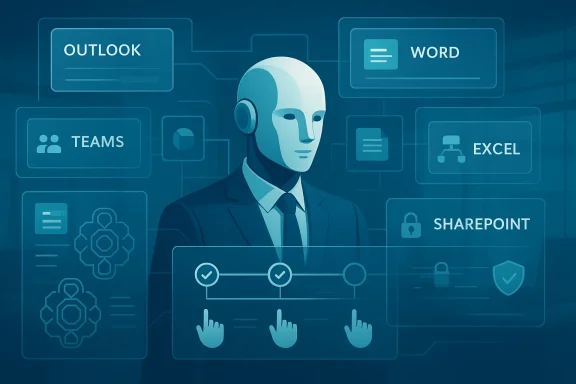
That position gives Microsoft a strong distribution edge. If agents live inside Word, Outlook, Teams, SharePoint, Excel, and Copilot Studio, the company can turn AI into a default behavior rather than a separate destination. That makes adoption easier and switching harder. (microsoft.com)
At the same time, Microsoft’s embrace of Anthropic alongside OpenAI signals a more pragmatic industry posture. Rather than framing the AI race as a binary contest, Microsoft is increasingly acting like a platform broker that can assemble the right model mix for a given task. That is a more enterprise-friendly story than ideological model loyalty. (microsoft.com)
This is where platform power compounds. The more work Microsoft can keep inside its own agentic fabric, the more value it can extract from data, identity, telemetry, and workflow context. That creates a feedback loop that rivals will struggle to match without comparable enterprise reach. (blogs.microsoft.com)
We should also expect the company to keep expanding the menu of model choices and agent types. Microsoft has made it clear that it sees AI as a heterogeneous ecosystem, not a single-model stack, and that means more experimentation with combinations of OpenAI, Anthropic, and internal orchestration layers. The unanswered question is whether customers will value that flexibility enough to embrace the added complexity. (microsoft.com)
Source: cxtoday.com Microsoft Copilot Cowork Signals Shift to Multi-Step AI Workflows for Enterprise Users
The timing matters. Microsoft has spent the past year steadily expanding Copilot from a conversational assistant into a platform for agents, workflow automation, and model choice, while also making Anthropic’s Claude family available in parts of Microsoft 365 Copilot and Copilot Studio. Copilot Cowork is the most explicit sign yet that Microsoft wants enterprise customers to think about AI not as a feature, but as an operating layer for actual work. (microsoft.com)
 Background
Microsoft’s Copilot story has changed quickly, but the underlying strategy has been consistent: make AI useful in the flow of work, then move from single-turn help to richer, multi-step automation. In earlier phases, Copilot was largely about drafting text, summarizing meetings, and pulling together information from Microsoft 365 data. That was valuable, but it still left the human user responsible for stitching the pieces into a process. (microsoft.com)The company’s recent roadmap shows a clear evolution. In 2025, Microsoft introduced agents such as App Builder and Workflows to help employees create software and automate tasks using natural language. It also expanded Copilot Studio with model selection and multi-agent capabilities, signaling that the company was no longer betting on a single model or a single interaction style. (microsoft.com)
That shift accelerated as Microsoft began more openly embracing multi-model design. Rather than tie every workflow to OpenAI alone, Microsoft started offering Anthropic models in Researcher and Copilot Studio, and later described Copilot as a system that “hosts the best innovation from across the industry.” That phrasing is not accidental. It reflects a platform strategy in which the company wants to be the place where enterprises select, compare, and govern AI models rather than commit to one vendor’s strengths and limitations. (microsoft.com)
The Frontier program is central to this strategy. Microsoft uses it as a controlled early-access channel for customers with Microsoft 365 Copilot licenses, letting the company test capabilities while they are still in development and exposing them to organizations willing to experiment under enterprise guardrails. In practice, Frontier has become Microsoft’s proving ground for the next generation of agentic features. (microsoft.com)
Another important backdrop is Microsoft’s growing emphasis on trust, governance, and security boundaries. The company has repeatedly argued that AI adoption fails when it outpaces controls, and its newer agent products are framed around observability, permissions, auditability, and policy enforcement. That is especially important as Copilot moves from content creation into systems that can trigger actions, coordinate tools, and potentially amplify operational mistakes if left unchecked. (microsoft.com)
Why this release is different
The difference between “generate me a report” and “manage the process that produces the report” is enormous. The former is a productivity boost; the latter is workflow delegation. Microsoft is betting that enterprises want AI to do more than surface answers — they want it to help run the work itself. (microsoft.com)- Prompting solves one task.
- Orchestration solves a chain of tasks.
- Governed autonomy is what makes that chain usable in enterprise settings.
- Model diversity reduces dependence on one vendor’s strengths.
- Visible progress gives humans a chance to intervene before errors compound.
What Copilot Cowork actually does
Copilot Cowork is built around a simple but powerful idea: the user defines an outcome, and Copilot handles the intermediate steps. Microsoft says the system can break down complex requests, reason across tools and files, and keep work moving for minutes or hours rather than just one conversational turn. That places it squarely in the emerging class of long-running agentic workflows. (microsoft.com)The key practical change is that Copilot is no longer limited to generating a document or answering a question. Instead, it can coordinate tasks, surface progress, and preserve human oversight while the workflow advances. That matters because enterprise work rarely happens inside one application or one file. It usually spans inboxes, shared documents, calendars, chat channels, approvals, and line-of-business systems. (microsoft.com)
Microsoft’s own examples are telling. The company frames Cowork as useful for coordinating customer issue resolution, follow-up tasks, scheduling, reporting, and other repeatable work that crosses department boundaries. These are not glamorous use cases, but they are exactly where enterprise software creates value: the mundane glue work that consumes time, attention, and coordination overhead.
Human oversight remains central
Microsoft is careful to say that Copilot Cowork is observable, transparent, and interruptible. Progress can be reviewed, guided, or stopped, and the work runs within Microsoft’s identity and governance framework. That design choice reflects an important lesson from early agent systems: useful autonomy in enterprise settings usually means bounded autonomy, not free-roaming execution. (microsoft.com)The user experience is also notable because it tries to preserve a sense of control. Instead of hiding the process inside a black box, Microsoft emphasizes visible steps and opportunities to steer. That should make adoption easier for risk-sensitive teams, even if it does not eliminate all concerns about quality or compliance. (microsoft.com)
The enterprise angle
For enterprise users, the biggest promise is reduced handoff friction. A workflow that would normally require a person to copy data between systems, draft a status update, send reminders, and confirm completion could become one guided AI-driven sequence. That is exactly the kind of efficiency that appeals to operations, support, and customer experience teams.- Fewer manual handoffs across apps and teams.
- More consistent execution of repeatable business processes.
- Better visibility into task status and intermediate outputs.
- Faster resolution for multi-department cases.
- Less context switching for knowledge workers.
Why Microsoft is leaning into multi-model AI
The most important strategic message in Microsoft’s announcement is not just that Copilot Cowork exists. It is that Microsoft now frames Copilot as model diverse by design. The company says it is not betting on one model, but building a system where different models can be used for different jobs. In other words, Microsoft wants AI modularity to become part of the enterprise value proposition. (blogs.microsoft.com)That model diversity is already visible in Researcher, Copilot Studio, and Office agent experiences. Microsoft has made Anthropic models available alongside OpenAI models in selected experiences, and it has said users can switch between them based on the task. This is significant because model choice is no longer just a developer concern; it is becoming an enterprise feature tied to reliability, specialization, and governance. (microsoft.com)
The rationale is straightforward. Different models can be better suited to different stages of a workflow, such as planning, drafting, critique, or comparison. In a mature enterprise AI system, one model may generate the first pass while another evaluates it, or multiple models may run side by side to expose divergence and reduce blind spots. Microsoft is increasingly presenting this as a feature, not a workaround. (blogs.microsoft.com)
The competitive message
This approach puts pressure on rivals that are still positioning AI mainly as chat, search, or one-model agent experiences. Microsoft is effectively saying that the future of enterprise AI is not a single chatbot with plugins. It is a composable operating environment where model selection, orchestration, and governance are native parts of the stack. (blogs.microsoft.com)That is a strong competitive narrative because Microsoft can combine first-party productivity software, cloud infrastructure, identity, compliance, and a growing roster of model partners. Rivals may offer strong individual components, but Microsoft is pushing for system-level stickiness. (microsoft.com)
Model diversity in practice
There is also a subtle but important trust argument here. When enterprises can compare outputs from multiple models, they are less likely to treat any single answer as authoritative. That can improve confidence, especially for research, analysis, and decision support workflows where errors are costly. Transparency is not the same as correctness, but it can help users spot uncertainty sooner.- Planning can use one model.
- Drafting can use another.
- Critique and review can use a separate evaluator.
- Side-by-side comparison can expose disagreement.
- Workload-specific selection can improve fit for purpose.
Researcher, Critique, and the evaluation problem
Microsoft’s Researcher tool is an important companion to Copilot Cowork because it shows how the company is thinking about quality control in AI-generated work. The company says Researcher synthesizes information across sources and that its new Critique function separates content generation from evaluation by using multiple models in sequence. One model drafts, another reviews, and the result is refined before delivery. (microsoft.com)That separation matters. Many AI failures happen because systems are asked to both create and verify in the same step, which can lead to confident but shallow outputs. By splitting generation and critique, Microsoft is aligning its product design with a basic principle of quality assurance: the reviewer should not be the same as the first-pass creator when accuracy really matters. (blogs.microsoft.com)
Microsoft also says this approach improved Researcher’s results on its DRACO benchmark by 13.8 percent. Even if benchmark gains do not always translate directly into day-to-day work quality, the direction is important. It suggests the company is trying to make multi-model coordination measurable, not just aspirational.
Why critique matters for enterprises
Enterprise buyers do not just want clever AI; they want predictable AI. A critique step can reduce obvious factual issues, improve completeness, and force the model to defend its own reasoning more carefully. That is especially useful for research, quarterly reporting, competitive analysis, and internal briefing materials. (microsoft.com)It also helps Microsoft tell a stronger trust story. If AI can demonstrate that it reviewed itself through a different lens, enterprises may be more willing to let it operate on sensitive or strategic work. That said, critique is still an AI process, not a human audit, so it should be seen as an enhancement rather than a guarantee. (blogs.microsoft.com)
Model council and side-by-side reasoning
Microsoft and Satya Nadella have also talked about a “model council” style experience, where multiple models respond to the same prompt and users can inspect where they agree or diverge. That is a powerful idea because it exposes the reasoning surface instead of obscuring it behind one answer. It does not solve uncertainty, but it makes uncertainty visible.- Generation and evaluation are now distinct steps.
- Benchmarking can measure multi-model gains.
- Side-by-side outputs improve user judgment.
- Divergence can be more informative than consensus.
- Human review remains essential for high-stakes decisions.
Enterprise use cases: where Cowork may matter most
The most immediate value for Copilot Cowork is likely to come from teams that already live in workflows, not documents. Customer experience, operations, finance, and internal service functions all handle repetitive work that spans systems and requires coordination. That makes them ideal candidates for long-running, multi-step AI assistance.In customer support, for example, a case may require triage, data gathering, cross-team follow-up, scheduling, and status updates. A tool like Cowork could help orchestrate those steps while keeping the human in control. The result is not necessarily full automation, but a thinner layer of manual coordination and fewer missed steps.
Operations teams may see similar benefits in reporting, scheduling, compliance checks, and recurring process management. These tasks are often structured enough for AI to help, but messy enough that a simple one-shot copilot is insufficient. That is exactly the middle ground Microsoft seems to be targeting. (microsoft.com)
Consumer vs enterprise impact
The consumer impact of these features will likely be less dramatic in the short term. Consumers tend to use AI for writing, planning, and lightweight assistance, where the value is immediate but the need for governance is lower. Enterprises, by contrast, care about permissions, audit trails, and how AI behaves across shared systems. (microsoft.com)The enterprise case is therefore much stronger because Microsoft can bundle productivity, identity, governance, and workflow under one roof. That makes the platform more attractive to CIOs and security teams, but it also means adoption will depend on confidence, not just novelty. Enterprise AI buys trust as much as it buys time. (blogs.microsoft.com)
Practical benefits likely to emerge first
Some of the earliest wins are likely to be modest but cumulative. Saving five minutes here and ten minutes there across thousands of employees is often more valuable than one headline-grabbing automation demo. In enterprise software, compounding efficiency beats theatrical automation.- Customer issue coordination
- Follow-up and reminder automation
- Meeting and calendar management
- Reporting and status generation
- Cross-system data gathering
- Routine task handoff reduction
Security, governance, and the boundaries of autonomy
Microsoft is making a point of saying that Cowork operates within enterprise security and governance boundaries. That includes permissions, identity controls, auditability, and the ability for users to review or stop work in progress. In practice, these protections are likely to be just as important as the AI capability itself. (microsoft.com)This emphasis is not cosmetic. As AI systems get better at taking actions rather than just suggesting them, the risk profile changes. A model that writes a summary can still be wrong, but a model that sends an email, updates a record, or schedules an action can create downstream consequences when it errs. (microsoft.com)
Microsoft’s broader agent strategy reflects that concern. The company has also introduced Agent 365 as a control plane for agents, framed around observing, governing, and securing AI across the organization. That suggests Microsoft knows that enterprises will not scale agentic systems unless they can see what those systems are doing and constrain them when needed. (blogs.microsoft.com)
The compliance angle
For regulated industries, this is not just about best practice; it is about adoption feasibility. Financial services, healthcare, government, and large-scale industrial organizations often need strict controls over data access and system actions. A workflow agent that cannot prove what it saw, what it changed, and why it acted will struggle in those environments. (microsoft.com)That is why Microsoft repeatedly highlights enterprise-grade controls. It wants to reassure customers that the move toward long-running workflows does not mean surrendering oversight. Whether those controls are sufficient in practice will depend on implementation detail, but the strategic intent is clear. (microsoft.com)
The hidden operational risk
There is also a subtler risk: automation can create complacency. If a workflow seems reliable most of the time, users may stop validating edge cases and treat the system as more deterministic than it really is. That is how small errors become systemic ones. Visible progress helps, but it does not eliminate model failure. (microsoft.com)- Auditability will shape enterprise adoption.
- Permissions must remain granular.
- Human review is still essential.
- Sensitive data handling will be scrutinized.
- Regulated industries will move cautiously.
- Operational errors may scale faster than before.
How this compares with the broader AI market
Microsoft’s move reflects a larger market-wide pivot from chatbots to agentic systems. Across the industry, vendors are trying to make AI less like a search box and more like a collaborator that can plan, coordinate, and follow through. Microsoft’s advantage is that it already owns much of the workplace stack where those agents will live. (microsoft.com)That position gives Microsoft a strong distribution edge. If agents live inside Word, Outlook, Teams, SharePoint, Excel, and Copilot Studio, the company can turn AI into a default behavior rather than a separate destination. That makes adoption easier and switching harder. (microsoft.com)
At the same time, Microsoft’s embrace of Anthropic alongside OpenAI signals a more pragmatic industry posture. Rather than framing the AI race as a binary contest, Microsoft is increasingly acting like a platform broker that can assemble the right model mix for a given task. That is a more enterprise-friendly story than ideological model loyalty. (microsoft.com)
Why rivals should pay attention
Competing productivity suites and standalone AI vendors now face a tougher question: can they offer not just smart responses, but governed execution across real business systems? If they cannot, they may be confined to the role of point solutions while Microsoft becomes the layer where the work actually happens. (microsoft.com)This is where platform power compounds. The more work Microsoft can keep inside its own agentic fabric, the more value it can extract from data, identity, telemetry, and workflow context. That creates a feedback loop that rivals will struggle to match without comparable enterprise reach. (blogs.microsoft.com)
The strategic risk for Microsoft
Of course, Microsoft’s breadth can also be a liability. The more features it adds, the more it has to explain, govern, and support. A sprawling AI platform can impress buyers and still fail if customers find it too complex to operationalize. Breadth is not the same as maturity. (blogs.microsoft.com)- Platform integration is Microsoft’s biggest advantage.
- Model diversity is becoming a differentiator.
- Workflow ownership may matter more than chat quality.
- Customer lock-in could intensify if agents become embedded.
- Complexity could slow real-world deployment.
Strengths and Opportunities
Microsoft’s Copilot Cowork push is compelling because it aligns product design with how real work actually happens: across applications, over time, and with multiple checks along the way. It also matches what enterprise buyers increasingly ask for — not just generative capability, but governance, observability, and choice. If Microsoft executes well, this could become one of the company’s most important Copilot evolutions yet. (microsoft.com)- Multi-step execution is more useful than one-off generation for many business tasks.
- Human-in-the-loop controls reduce fear around agent autonomy.
- Model diversity allows better task-model matching.
- Researcher critique creates a clearer quality-assurance pattern.
- Enterprise governance strengthens credibility in regulated sectors.
- Frontier program testing lets Microsoft refine the experience before broad rollout.
- Cross-app orchestration fits the realities of modern knowledge work.
Risks and Concerns
The biggest concern is that users may overestimate how reliable a multi-step agent really is. The more work a system performs on its own, the more damaging a subtle error can become, especially if it propagates across emails, documents, calendars, or approvals. Microsoft’s safeguards help, but they are not a substitute for disciplined deployment and active oversight. (microsoft.com)- Hallucinations can still cascade through multi-step workflows.
- Over-automation may reduce human vigilance.
- Governance complexity could slow enterprise rollout.
- Model inconsistency may confuse users if outputs diverge too often.
- Vendor dependence may deepen as more work runs inside Microsoft’s stack.
- Benchmark gains may not fully reflect real-world performance.
- Compliance expectations will rise as AI actions become more operational.
Looking Ahead
The next phase will be about proof, not promise. Microsoft now has to show that Copilot Cowork can deliver reliable, measurable value in real enterprise environments, not just in demos and preview programs. That will require strong performance, careful customer education, and enough transparency for IT leaders to trust the system at scale. (microsoft.com)We should also expect the company to keep expanding the menu of model choices and agent types. Microsoft has made it clear that it sees AI as a heterogeneous ecosystem, not a single-model stack, and that means more experimentation with combinations of OpenAI, Anthropic, and internal orchestration layers. The unanswered question is whether customers will value that flexibility enough to embrace the added complexity. (microsoft.com)
What to watch next
- Frontier program expansion to more customers and more geographies.
- Broader rollout of Copilot Cowork beyond research preview.
- Deeper multi-model workflows across Researcher, Studio, and Office apps.
- More governance tooling for audit, visibility, and agent inventory.
- Enterprise case studies showing measurable ROI and reduced cycle time.
Source: cxtoday.com Microsoft Copilot Cowork Signals Shift to Multi-Step AI Workflows for Enterprise Users
