

Microsoft’s Copilot Cowork is now rolling out to eligible Frontier users on iOS and Android through the Microsoft 365 Copilot mobile app, while adding plugin support that lets the agent use approved skills and connectors beyond Microsoft’s own productivity stack. That sounds like a feature update, but it is really a strategy update. Microsoft is trying to turn Copilot from a place where workers ask questions into a place where work is delegated, governed, and eventually automated. The mobile launch matters because agents become far more consequential once they follow the employee out of the browser and into the rhythm of the workday.
For most of Copilot’s life, Microsoft has sold the product as a productivity layer: a way to summarize meetings, draft emails, rewrite documents, and interrogate spreadsheets without learning a new interface. That framing was useful because it made generative AI feel less alien to Office users. It also limited Copilot to the role of a clever assistant waiting inside the application the user had already opened.
Copilot Cowork pushes beyond that. It is designed to accept a broader assignment, break it into steps, use business context, and produce a finished outcome across Microsoft 365. The user is no longer merely asking Word to improve a paragraph or Teams to recap a call. The user is asking an agent to carry a task across the office suite.
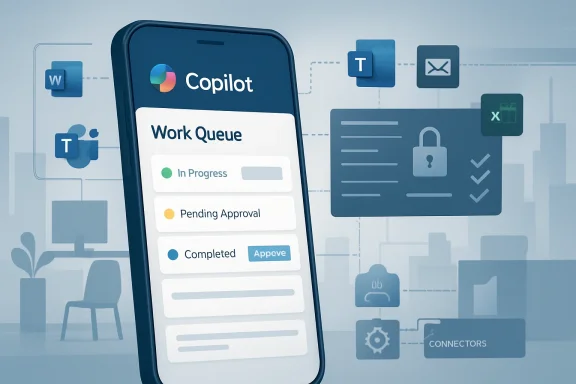
That distinction is why the mobile rollout is more than convenience. Mobile access turns Cowork into something closer to a persistent work queue: a delegated process that can be checked, steered, approved, or interrupted while the user is between meetings, commuting, or away from a desktop. The agent does not become more intelligent because it runs on a phone. It becomes more operationally plausible.
Microsoft has spent years trying to make Microsoft 365 the center of office work. Copilot Cowork is the company’s attempt to make Microsoft 365 the center of delegated office work.
That is why mobile support is strategically important. If Cowork can only run where a user is already seated with a laptop, it competes with existing habits: open Outlook, open Teams, open Excel, do the work. If Cowork can be nudged from a phone, it starts competing with the micro-decisions that fill the workday: send the recap, schedule the follow-up, update the document, pull the latest numbers, brief me before the call.
The risk, of course, is that the agent becomes another notification source in a world already overrun by pings. Microsoft’s challenge is not merely to put Cowork inside the Microsoft 365 Copilot mobile app. It is to make the agent’s interruptions feel like governance, not nagging.
The strongest version of this product is not “Copilot on your phone.” It is “work that keeps moving while you are not staring at a blank document.” That is the promise Microsoft is now trying to operationalize.
Microsoft’s plugin model for Cowork allows organizations to extend the agent with skills and connectors. Skills teach Cowork domain-specific procedures, such as HR workflows, finance analysis, legal review, sales preparation, or customer support processes. Connectors give Cowork access to systems and data outside the default Microsoft 365 graph.
That sounds familiar because it is the same broad pattern every major AI platform is now chasing: the model is not the product; the orchestrated workflow is the product. The LLM supplies reasoning and language. The platform supplies identity, permissions, context, tools, data access, auditability, and distribution.
This is where Microsoft has a real advantage. It already controls the admin center, the identity layer, the compliance story, the collaboration apps, and much of the data exhaust that office work produces. If Cowork plugins can be deployed and governed through familiar Microsoft 365 controls, Microsoft can pitch agent extensibility without asking enterprises to rebuild their security model from scratch.
That is also where the danger lies. The more useful Cowork becomes, the more it touches systems that were never designed for probabilistic software agents. A plugin that helps draft a quote is one thing. A plugin that can retrieve customer records, generate pricing, update CRM fields, or trigger downstream actions is another. The frontier between “assistant” and “operator” is not philosophical; it is an access-control problem.
Microsoft’s message is that customers can get the benefit of leading external AI systems inside Microsoft’s enterprise wrapper. In theory, that is exactly what CIOs want. They get access to stronger models and agentic techniques without sending employees into unmanaged consumer tools or shadow-AI workflows.
But the partnership also complicates Microsoft’s story. Copilot was originally sold as the Microsoft-branded AI experience woven through the company’s own productivity estate. Cowork makes that brand more modular. Under the hood, Microsoft is increasingly becoming a broker of models, tools, controls, and context.
That may be the right architecture. It may also make Copilot harder to explain. Is it a chatbot? A suite feature? A model router? An agent platform? A governance layer? A mobile work queue? The answer is becoming “yes,” which is technically impressive and commercially dangerous. Products that become too abstract often need IT departments to translate them back into use cases.
This is the strongest part of Microsoft’s argument. The company does not need to claim it has the only good model. It needs to claim it has the best workplace context, the strongest enterprise controls, and the easiest path from prompt to governed action. In that framing, Cowork is less a standalone product than a visible expression of Microsoft’s deeper moat.
Work IQ also reveals why mobile matters. A useful workplace agent is not just answering isolated questions. It is maintaining context across sessions, devices, and tasks. If the agent can start on the desktop, continue in the cloud, and ask for approval on mobile, Microsoft can make the experience feel less like a tool and more like a colleague with a queue.
That is the ambition, anyway. The phrase “AI coworker” still deserves skepticism. A coworker has judgment, accountability, institutional memory, and consequences. An agent has permissions, logs, prompts, models, and guardrails. Those are not the same thing, no matter how much the marketing department wants them to rhyme.
This is especially important with plugins. A plugin marketplace sounds empowering until every department wants a different agent connected to a different SaaS tool using a different permission model. Without strong controls, the agent ecosystem becomes the new browser extension problem: small conveniences that accumulate into a sprawling security surface.
Microsoft’s answer is to make agents manageable like enterprise software. Admins can deploy approved plugins, restrict availability, and bring Cowork into existing controls. That is not the sexy part of the story, but it is the part that determines whether Cowork becomes a production tool or a perpetual preview.
There is also a cultural governance problem. Employees need to know when Cowork is acting, when it is waiting, when it needs approval, and when it is merely drafting. If the agent’s status is ambiguous, users will either overtrust it or ignore it. Neither outcome helps Microsoft.
The Frontier program also gives Microsoft a way to manage expectations. Preview language lets the company ship quickly, gather telemetry, and iterate with customers who are more tolerant of rough edges. In the AI era, that matters because waiting for a perfectly polished enterprise agent may mean arriving after users have already built workarounds elsewhere.
But there is a tension here. Microsoft wants customers to see Cowork as the future of work, while also asking them to accept that the future is still in preview. IT leaders are used to previews, but they are not used to previews that may read sensitive documents, schedule meetings, draft communications, and connect to business systems.
The company’s challenge is to make Frontier feel like controlled innovation, not outsourced QA. If Cowork is too timid, it will disappoint. If it is too autonomous, it will alarm the people responsible for risk.
Plugins change that calculus because they allow Cowork to move into repeatable business processes. A sales team does not merely need a better email draft; it needs an agent that can gather account history, inspect pricing guidance, draft a proposal, prepare a meeting brief, and update the CRM. A finance team does not merely need a spreadsheet explanation; it needs a repeatable monthly review that pulls the right source material and flags anomalies.
That is the difference between AI as a writing tool and AI as process infrastructure. The former is easy to understand and hard to measure. The latter is harder to implement but easier to justify if it saves time across a workflow that happens hundreds or thousands of times.
Microsoft knows this. The company’s broader Copilot strategy is increasingly aimed at making agents the connective tissue between Microsoft 365 and the rest of the enterprise stack. Cowork with plugins is the clearest version of that idea so far.
A chat response is an artifact. An agentic workflow is a chain of decisions. That chain needs permissions, checkpoints, logs, rollback expectations, and human approval for sensitive actions. Microsoft appears to understand this at the product level, but every customer will have to translate it into policy.
The early deployments that succeed will likely be boring on purpose. They will start with bounded workflows, known data sources, narrow plugins, and explicit approval steps. They will avoid giving Cowork sweeping authority simply because the demo made autonomy look elegant.
That is not anti-AI caution. It is operational maturity. The organizations that get value from agents will be the ones that redesign work around verifiable delegation, not the ones that paste “use AI” into every process and hope productivity appears.
Source: Thurrott.com Microsoft Copilot Cowork - Thurrott.com
 Microsoft Is Moving Copilot From Chat Window to Work Queue
For most of Copilot’s life, Microsoft has sold the product as a productivity layer: a way to summarize meetings, draft emails, rewrite documents, and interrogate spreadsheets without learning a new interface. That framing was useful because it made generative AI feel less alien to Office users. It also limited Copilot to the role of a clever assistant waiting inside the application the user had already opened.Copilot Cowork pushes beyond that. It is designed to accept a broader assignment, break it into steps, use business context, and produce a finished outcome across Microsoft 365. The user is no longer merely asking Word to improve a paragraph or Teams to recap a call. The user is asking an agent to carry a task across the office suite.
That distinction is why the mobile rollout is more than convenience. Mobile access turns Cowork into something closer to a persistent work queue: a delegated process that can be checked, steered, approved, or interrupted while the user is between meetings, commuting, or away from a desktop. The agent does not become more intelligent because it runs on a phone. It becomes more operationally plausible.
Microsoft has spent years trying to make Microsoft 365 the center of office work. Copilot Cowork is the company’s attempt to make Microsoft 365 the center of delegated office work.
The Phone Is Where Agents Stop Being Demos
AI agents demo beautifully on desktop screens. A presenter types a polished prompt, the agent plans a task, a dashboard lights up, and everyone pretends the messy middle of work has been solved. Real knowledge work is less theatrical. It happens in scraps of time, with partial information, shifting priorities, and a constant need to approve or redirect.That is why mobile support is strategically important. If Cowork can only run where a user is already seated with a laptop, it competes with existing habits: open Outlook, open Teams, open Excel, do the work. If Cowork can be nudged from a phone, it starts competing with the micro-decisions that fill the workday: send the recap, schedule the follow-up, update the document, pull the latest numbers, brief me before the call.
The risk, of course, is that the agent becomes another notification source in a world already overrun by pings. Microsoft’s challenge is not merely to put Cowork inside the Microsoft 365 Copilot mobile app. It is to make the agent’s interruptions feel like governance, not nagging.
The strongest version of this product is not “Copilot on your phone.” It is “work that keeps moving while you are not staring at a blank document.” That is the promise Microsoft is now trying to operationalize.
Plugins Turn Cowork Into a Platform Play
The second half of the update — plugin support — is the part that should get the attention of IT departments. A general-purpose agent limited to Microsoft 365 is useful, but bounded. A general-purpose agent that can reach into approved third-party systems, line-of-business tools, databases, and specialized workflows is a platform.Microsoft’s plugin model for Cowork allows organizations to extend the agent with skills and connectors. Skills teach Cowork domain-specific procedures, such as HR workflows, finance analysis, legal review, sales preparation, or customer support processes. Connectors give Cowork access to systems and data outside the default Microsoft 365 graph.
That sounds familiar because it is the same broad pattern every major AI platform is now chasing: the model is not the product; the orchestrated workflow is the product. The LLM supplies reasoning and language. The platform supplies identity, permissions, context, tools, data access, auditability, and distribution.
This is where Microsoft has a real advantage. It already controls the admin center, the identity layer, the compliance story, the collaboration apps, and much of the data exhaust that office work produces. If Cowork plugins can be deployed and governed through familiar Microsoft 365 controls, Microsoft can pitch agent extensibility without asking enterprises to rebuild their security model from scratch.
That is also where the danger lies. The more useful Cowork becomes, the more it touches systems that were never designed for probabilistic software agents. A plugin that helps draft a quote is one thing. A plugin that can retrieve customer records, generate pricing, update CRM fields, or trigger downstream actions is another. The frontier between “assistant” and “operator” is not philosophical; it is an access-control problem.
Anthropic Gives Microsoft a Shortcut — and a Dependency
Copilot Cowork is notable because Microsoft built it in close collaboration with Anthropic, bringing technology associated with Claude Cowork into Microsoft 365 Copilot. That is a remarkable turn for a company whose AI identity has been tied so closely to OpenAI. It reflects a pragmatic truth: enterprise AI buyers do not care which frontier model family wins a brand war if the workflow works.Microsoft’s message is that customers can get the benefit of leading external AI systems inside Microsoft’s enterprise wrapper. In theory, that is exactly what CIOs want. They get access to stronger models and agentic techniques without sending employees into unmanaged consumer tools or shadow-AI workflows.
But the partnership also complicates Microsoft’s story. Copilot was originally sold as the Microsoft-branded AI experience woven through the company’s own productivity estate. Cowork makes that brand more modular. Under the hood, Microsoft is increasingly becoming a broker of models, tools, controls, and context.
That may be the right architecture. It may also make Copilot harder to explain. Is it a chatbot? A suite feature? A model router? An agent platform? A governance layer? A mobile work queue? The answer is becoming “yes,” which is technically impressive and commercially dangerous. Products that become too abstract often need IT departments to translate them back into use cases.
Work IQ Is the Real Product Microsoft Wants to Sell
Microsoft’s preferred vocabulary for this new era is Work IQ, the intelligence layer that grounds Copilot and agents in organizational context. Strip away the branding and the idea is straightforward: the agent needs to understand the user’s files, meetings, chats, calendar, relationships, business systems, and permissions to produce useful work. A generic model on the public internet cannot do that alone.This is the strongest part of Microsoft’s argument. The company does not need to claim it has the only good model. It needs to claim it has the best workplace context, the strongest enterprise controls, and the easiest path from prompt to governed action. In that framing, Cowork is less a standalone product than a visible expression of Microsoft’s deeper moat.
Work IQ also reveals why mobile matters. A useful workplace agent is not just answering isolated questions. It is maintaining context across sessions, devices, and tasks. If the agent can start on the desktop, continue in the cloud, and ask for approval on mobile, Microsoft can make the experience feel less like a tool and more like a colleague with a queue.
That is the ambition, anyway. The phrase “AI coworker” still deserves skepticism. A coworker has judgment, accountability, institutional memory, and consequences. An agent has permissions, logs, prompts, models, and guardrails. Those are not the same thing, no matter how much the marketing department wants them to rhyme.
Governance Is the Feature Enterprises Will Actually Buy
The consumer AI market rewards magic. The enterprise AI market rewards control. That is why Microsoft keeps tying Cowork to Agent 365, Microsoft 365 administration, enterprise data protection, and governance features. The agent may be exciting because it can do work, but it will only be deployable if organizations can see what it is doing and constrain where it can act.This is especially important with plugins. A plugin marketplace sounds empowering until every department wants a different agent connected to a different SaaS tool using a different permission model. Without strong controls, the agent ecosystem becomes the new browser extension problem: small conveniences that accumulate into a sprawling security surface.
Microsoft’s answer is to make agents manageable like enterprise software. Admins can deploy approved plugins, restrict availability, and bring Cowork into existing controls. That is not the sexy part of the story, but it is the part that determines whether Cowork becomes a production tool or a perpetual preview.
There is also a cultural governance problem. Employees need to know when Cowork is acting, when it is waiting, when it needs approval, and when it is merely drafting. If the agent’s status is ambiguous, users will either overtrust it or ignore it. Neither outcome helps Microsoft.
The Frontier Program Is Doing Double Duty
Cowork remains a Frontier feature, which means Microsoft is still treating it as early access rather than ordinary Microsoft 365 plumbing. That is sensible. Agentic workflows are hard to test in the abstract because their value depends on the peculiar messiness of each organization’s data, permissions, and processes.The Frontier program also gives Microsoft a way to manage expectations. Preview language lets the company ship quickly, gather telemetry, and iterate with customers who are more tolerant of rough edges. In the AI era, that matters because waiting for a perfectly polished enterprise agent may mean arriving after users have already built workarounds elsewhere.
But there is a tension here. Microsoft wants customers to see Cowork as the future of work, while also asking them to accept that the future is still in preview. IT leaders are used to previews, but they are not used to previews that may read sensitive documents, schedule meetings, draft communications, and connect to business systems.
The company’s challenge is to make Frontier feel like controlled innovation, not outsourced QA. If Cowork is too timid, it will disappoint. If it is too autonomous, it will alarm the people responsible for risk.
The Plugin Economy Will Separate Useful Agents From Office Theater
The first wave of Copilot enthusiasm was built around familiar office tricks: summarize this meeting, draft that email, make this slide better. Those features are useful, but they do not necessarily justify a platform shift. They are accelerators for existing work, not a new way to allocate work.Plugins change that calculus because they allow Cowork to move into repeatable business processes. A sales team does not merely need a better email draft; it needs an agent that can gather account history, inspect pricing guidance, draft a proposal, prepare a meeting brief, and update the CRM. A finance team does not merely need a spreadsheet explanation; it needs a repeatable monthly review that pulls the right source material and flags anomalies.
That is the difference between AI as a writing tool and AI as process infrastructure. The former is easy to understand and hard to measure. The latter is harder to implement but easier to justify if it saves time across a workflow that happens hundreds or thousands of times.
Microsoft knows this. The company’s broader Copilot strategy is increasingly aimed at making agents the connective tissue between Microsoft 365 and the rest of the enterprise stack. Cowork with plugins is the clearest version of that idea so far.
IT Should Treat Cowork Like a Junior Operator, Not a Smarter Search Box
The most dangerous mistake organizations can make with Cowork is to evaluate it like chat. Chatbots can be wrong and still be useful. Agents can be wrong and create downstream work, confusion, or risk. The evaluation criteria must change accordingly.A chat response is an artifact. An agentic workflow is a chain of decisions. That chain needs permissions, checkpoints, logs, rollback expectations, and human approval for sensitive actions. Microsoft appears to understand this at the product level, but every customer will have to translate it into policy.
The early deployments that succeed will likely be boring on purpose. They will start with bounded workflows, known data sources, narrow plugins, and explicit approval steps. They will avoid giving Cowork sweeping authority simply because the demo made autonomy look elegant.
That is not anti-AI caution. It is operational maturity. The organizations that get value from agents will be the ones that redesign work around verifiable delegation, not the ones that paste “use AI” into every process and hope productivity appears.
The Update That Turns Copilot Into a Management Problem
The practical implications of this rollout are concrete, even if Microsoft’s long-term vision remains ambitious. Cowork on mobile and plugins in Frontier give IT leaders a preview of a future in which Microsoft 365 agents are not optional sidecars but managed participants in business workflows.- Cowork is now reaching eligible Frontier users on iOS and Android through the Microsoft 365 Copilot mobile app, expanding beyond the desktop and browser surfaces where many users first encountered it.
- Plugin support gives Cowork access to approved skills and connectors, making it more useful for department-specific workflows and third-party business systems.
- Admin deployment and control will matter as much as model quality, because an agent with plugins is only as safe as its permissions and governance.
- Microsoft’s collaboration with Anthropic signals that Copilot is becoming a multi-model, multi-agent platform rather than a single Microsoft-branded chatbot.
- The best early use cases will be repeatable, bounded workflows where Cowork can gather context, draft outputs, and request approval before taking consequential action.
- Organizations should evaluate Cowork as delegated process automation, not as another chat interface with a friendlier name.
Source: Thurrott.com Microsoft Copilot Cowork - Thurrott.com
