

Microsoft’s pitch to governments is simple and persuasive: apply generative AI to the routine, repetitive parts of public-service work and free human employees to focus on higher‑value decisions and frontline care. Over the last two years Microsoft has rolled that pitch into a coordinated product strategy — from Microsoft 365 Copilot and Copilot Studio to bespoke partner solutions and Azure OpenAI integrations — and is now showcasing municipal and local‑government pilots that claim measurable time savings, faster permit approvals, and improved staff satisfaction. The vendor narrative is compelling, but the public‑sector adoption story raises as many governance, security, and operational questions as it does productivity promises.
Public administrations have long struggled with two structural pressures: escalating citizen demand for digital services and persistent budget constraints that make hiring or expanding staff untenable. Generative AI — systems that produce text, code, or structured outputs from natural language prompts — offers a new lever for efficiency because it can automate document drafting, summarize meetings, extract form data, and power conversational agents for 24/7 citizen support.
Microsoft packages these capabilities under the Copilot umbrella: Microsoft 365 Copilot integrates large language model (LLM) functionality directly into Word, Excel, PowerPoint, Teams, and other productivity apps; Copilot Studio lets governments create tailored assistants and agents; and Azure/OpenAI-based solutions provide the backbone for custom development. These products are explicitly framed as tools to reduce administrative overhead, accelerate case processing, and improve resident-facing responsiveness.
The promise of AI in government is real — but its delivery depends on careful engineering, transparent governance, and a relentless focus on the public interest.
Source: Microsoft AI in Government: Boost Public Sector Productivity
 Background: why AI is suddenly central to government IT modernization
Public administrations have long struggled with two structural pressures: escalating citizen demand for digital services and persistent budget constraints that make hiring or expanding staff untenable. Generative AI — systems that produce text, code, or structured outputs from natural language prompts — offers a new lever for efficiency because it can automate document drafting, summarize meetings, extract form data, and power conversational agents for 24/7 citizen support.Microsoft packages these capabilities under the Copilot umbrella: Microsoft 365 Copilot integrates large language model (LLM) functionality directly into Word, Excel, PowerPoint, Teams, and other productivity apps; Copilot Studio lets governments create tailored assistants and agents; and Azure/OpenAI-based solutions provide the backbone for custom development. These products are explicitly framed as tools to reduce administrative overhead, accelerate case processing, and improve resident-facing responsiveness.
The vendor case: concrete improvements in municipal workflows
Microsoft’s public sector collateral cites multiple customer stories where Copilot and Copilot Studio reportedly produced significant operational gains:- Torfaen County Borough Council says it reduced time spent on routine meeting‑minute production and onboarding tasks — with the council reporting meaningful time savings and initial improvements in service delivery; council leaders describe Copilot as enabling more personalized service for residents.
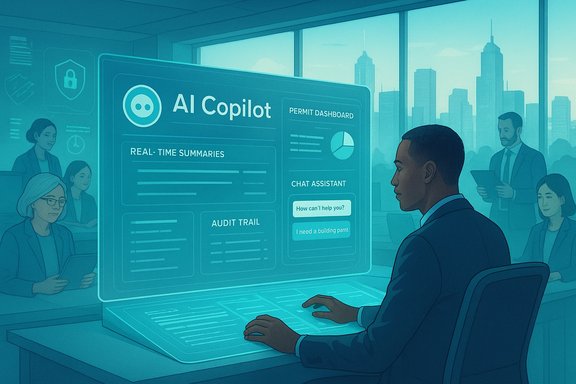
- The City of Burlington (Ontario) used Power Platform and Copilot Studio to build a permit‑tracking portal and a custom digital assistant named “CoBy,” cutting permit processing timelines from roughly 15 weeks to 5–7 weeks in their account and deploying the assistant in eight weeks. The city reports increased transparency and faster reviewer cycles as outcomes.
What independent evaluations say about productivity gains
Vendor case studies are useful for illustrating potential, but independent trials provide critical validation. Multiple external studies and government pilots now show consistent collection of time‑savings gains when generative AI is used for administrative work.- A large UK government trial covering 20,000 civil servants found that generative AI tools could save an average of about 26 minutes per user per day, effectively giving civil servants nearly two extra workweeks per year when aggregated across roles and teams. The trial framed those savings as a means to reallocate time to higher‑value public‑service activities.
- Analyst work such as Forrester’s Total Economic Impact studies (commissioned evaluations) model onboarding acceleration, reduced rework, and other efficiency gains for Microsoft Copilot deployments — though specific figures depend heavily on organizational baselines and the scope of Copilot use. These independent analyses often use conservative assumptions for adoption and ramp time, and still find positive ROI in multi‑year scenarios.
How governments are implementing Copilot: real‑world patterns
Across examples and guidance, a reproducible deployment pattern is emerging that other public bodies can emulate.1. Start small with high‑impact, low‑risk tasks
Most early deployments focus on:- Meeting summarization and minutes generation
- Drafting and editing public communications and internal templates
- Permit tracking dashboards and query routing
- Simple web chat or FAQ assistants for routine resident questions
2. Use low‑code/no‑code tooling to iterate quickly
Low‑code platforms such as Microsoft Power Platform and Copilot Studio let municipal IT teams and citizen developers prototype assistants and workflow automations within weeks, not months. Rapid iteration helps agencies test the user experience and data boundaries before committing to full‑scale integrations. Burlington’s eight‑week deployment of CoBy demonstrates this quick‑start approach.3. Layer governance and security on day one
Public agencies operate under strict data‑protection, FOI, and privacy constraints. Successful projects lock down data access, limit Copilot to corporate‑managed devices, and ensure identity and compliance controls are in place. Large vendors have begun to offer government‑grade variants for high‑security clouds (GCC, GCC‑High, DoD environments) to address these concerns. Microsoft has publicly confirmed that Copilot capabilities for high‑security government tenants are under development with staged rollouts.4. Measure and adjust: track both efficiency and risk
Meaningful evaluation uses both quantitative and qualitative KPIs:- Time saved per task (minutes/hours)
- Process cycle time (e.g., permit processing weeks)
- User satisfaction and adoption rates
- Error rates, hallucinations, and FOI disclosure risks
Strengths: what Copilot and related tools can realistically deliver
The benefits governments should expect — when deployments are well governed and designed for the task — are tangible.- Substantial time savings on routine work. Summarization, drafting, and extraction tasks are prime low‑hanging fruit. Public pilots show per‑user daily savings that scale across a workforce.
- Improved resident experience via 24/7 digital assistants. Chat assistants like Burlington’s CoBy can handle common queries round the clock and provide transparency into permits and service requests, improving perceived responsiveness.
- Faster digital transformation through low‑code. Copilot Studio and Power Platform shorten delivery time for new services and reduce dependency on scarce developer resources. This accelerates time to value.
- Potential to reduce backlogs and reallocate staff to complex cases. By automating repetitive steps, organizations can triage and prioritize human effort for cases that truly need human judgment. Independent trials model this effect as an outcome of time savings.
Risks and limits: the critical caveats governments must confront
Generative AI is not a turnkey efficiency panacea. There are several hard risks that require explicit mitigation strategies.Data protection and privacy
Public agencies handle highly sensitive personal and case data. Large language models infer and regurgitate patterns from their training data; without strict controls, model outputs can inadvertently expose private or restricted information. Vendor assurances are helpful, but agencies must implement:- Controlled data access and role‑based permissions
- Logging and audit trails for prompts and outputs
- Data minimization and redaction strategies before model consumption
Hallucinations and factual errors
Generative models can fabricate plausible‑sounding but incorrect information. In government workflows — permits, legal notices, or policy guidance — a hallucination can have outsized consequences.- Operational guardrails (human review, fact‑checking steps) are essential.
- Automation should avoid unsupervised finalization of outputs in high‑consequence contexts.
Bias, fairness, and accountability
Models can replicate and amplify biases present in training data. When AI touches decisions affecting access to services or benefits, agencies must implement bias testing, transparent decision‑paths, and appeal mechanisms.Overreliance and deskilling
There is a risk staff will rely on Copilot for judgement or craft decisions without sufficient oversight. Long‑term reliance can erode institutional knowledge and critical thinking. Training and role redesign are required to maintain competency.Vendor lock‑in and hidden costs
Low‑code accelerators and vendor‑hosted LLM services can reduce initial build time but may create dependency on a single cloud or API. Governments should evaluate portability, exportability of trained agents, and long‑term licensing costs — including seat‑based Copilot fees and professional services for tuning and governance.Security posture for high‑assurance environments
Deploying Copilot in GCC‑High or DoD environments requires meeting stringent compliance and certification standards. Microsoft has signaled progress and timelines for government‑grade Copilot offerings, but agencies with critical national‑security roles must validate controls and testing before wide adoption.Practical governance checklist for public‑sector CIOs
Agencies that want to pilot Copilot in 90 days should treat the work as an integrated program — not just a product deployment. A practical checklist:- Define high‑value, low‑risk use cases (minutes, onboarding, permit tracking).
- Establish a cross‑functional steering group (IT, legal, data protection, frontline services).
- Enforce device and identity controls (corporate‑managed devices, MFA, conditional access).
- Implement prompt and output logging for auditability.
- Require human‑in‑the‑loop review for all outputs that feed case records or public communications.
- Run bias and safety testing on templates and agents before public rollout.
- Track adoption metrics and error rates; iterate governance based on real use.
- Define an exit/rollback plan and data portability rules to avoid lock‑in.
Vendor claims versus independent verification: a close reading
Microsoft’s customer stories provide vivid, believable examples. Torfaen’s meeting‑minute improvements and Burlington’s CoBy rollout show how products are used in context. However, several vendor figures should be treated with caution until independently verified:- The Microsoft landing page and customer carousel cite specific percentage improvements (e.g., “30% reduction in new‑hire onboarding time,” “57% of users enjoying their work more,” “33% reduction in building‑permit approval process”) that originate in vendor case studies. These figures are plausible in context but are based on discrete pilots with unique baselines and measurement methods. Independent replication or third‑party audits are limited in the public record for these exact metrics. Readers should treat vendor percentages as indicative rather than universally generalizable.
- National‑scale claims (e.g., Copilot availability timelines for GCC High and DoD) have supporting public signals from Microsoft technical blogs and independent press reporting, but actual availability and certification milestones can shift. Agencies planning for DoD/GCC‑High deployments must confirm specific compliance milestones and GA dates as part of procurement and risk assessment.
Recommendations for IT leaders and procurement teams
To translate potential into safe, sustainable outcomes, adopt these practical steps:- Pilot with strict scope — pick two to three use cases with clear metrics and low regulatory risk. Examples: meeting summarization, FOI request triage, permit status chat.
- Mandate human review for record‑keeping — outputs that feed case files or policy documents must be validated by staff before becoming authoritative.
- Invest in training and change management — user adoption is the linchpin. Provide targeted training modules, Copilot prompt guidance, and incentive structures that reward validated usage.
- Design observable monitoring — keep prompt logs, output samples, and error dashboards. Track both productivity and incident metrics.
- Negotiate transparency and portability in procurement — insist on documentation about model updates, data retention, and the ability to export and migrate trained agents or datasets.
- Coordinate cross‑agency learning — publish sanitized lessons from pilots to other departments to accelerate safe adoption and avoid repeated mistakes.
The verdict: cautious optimism with clear guardrails
Generative AI for government is not a speculative future — it’s an active operational trend backed by vendor platforms, independent trials, and early municipal wins. When designed for well‑scoped tasks and wrapped in robust governance, Copilot‑style solutions can reduce routine burden, speed up resident services, and create room for staff to focus on complex, human‑centric work. At the same time, there is no shortcut around the hard work: privacy controls, audit trails, human‑in‑the‑loop checks, bias testing, and contractual safeguards on portability and security are prerequisites — not optional extras. Early adopters like Torfaen and Burlington provide useful blueprints, but their reported percentage gains should be considered pilot‑specific rather than universal benchmarks. Agencies that treat AI as a governance problem first and a productivity tool second are most likely to convert promise into durable public value.Practical next steps for public‑sector CTOs this quarter
- Identify two pilot teams and select specific, measurable use cases (meeting summaries, permit triage, onboarding).
- Assemble a short lifecycle plan (30/60/90 days) that includes governance checkpoints, human‑review rules, and rollback criteria.
- Conduct a privacy impact assessment and a bias/fairness review before any citizen‑facing rollout.
- Negotiate a vendor contract that includes data portability, audit access, and model change notifications.
- Publish a public‑facing evaluation after 90 days that includes metrics, lessons learned, and any incidents.
The promise of AI in government is real — but its delivery depends on careful engineering, transparent governance, and a relentless focus on the public interest.
Source: Microsoft AI in Government: Boost Public Sector Productivity
