

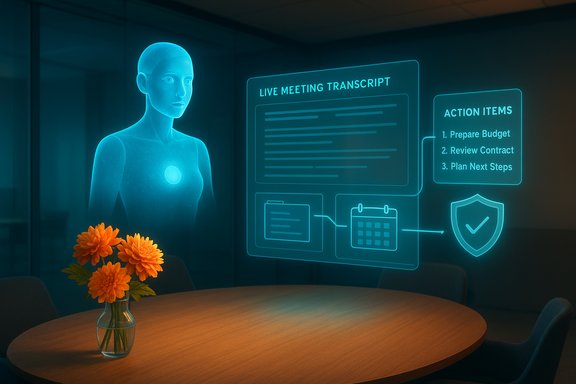
For more than a year many office meetings have acquired a third occupant: an always-listening assistant that records, transcribes, summarizes and even drafts the follow-up — and a harmless pre-meeting chat about dahlias can become a searchable action list that lives forever.
Agentic AI — the class of assistants that can not only answer questions but act across apps and services — has moved quickly from demos into everyday work tools. Vendors are embedding these assistants into calendars, mailboxes, collaboration apps and operating systems so they can pull context from multiple sources and perform multi‑step tasks on users’ behalf. That combination of deep integration and actionability is precisely what makes the tech useful and what creates new privacy and security vectors.
At the same time, meeting summarization has become one of the immediate “win” features: automatic transcriptions, recaps, and action‑item extraction save time and reduce manual follow‑up. But the same automation that saves minutes can also convert casual, off‑the‑record comments into permanent records that are distributed beyond the intended audience. Early adopters report substantial productivity gains from AI meeting recaps, but they also report privacy and governance gaps when connectors, default settings, or review practices are not explicitly controlled.
That outcome is mundane and harmless in this case, but it exposes the mechanics and the risk: everything said after “Join” can be recorded, summarized, tagged, and redistributed, often without a deliberate consent flow for the incidental conversation. The feature that creates helpful recaps is the same feature that converts private asides into durable organizational records.
This is not hypothetical: major vendors have documented capabilities to transcribe meetings, extract decisions and propose action items as part of their Copilot‑style assistants and agentic workflows.
The right approach is not to ban these tools but to treat them as infrastructure that requires design, governance and operational controls. Implement least‑privilege connectors, enable human approvals for state‑changing actions, apply DLP to transcripts, and contractually lock in retention and non‑training terms where confidentiality matters. Pilot with measurable KPIs, maintain an agent registry, and prioritize auditability.
The technology can be a productivity multiplier — but only when the governance is equally multiplied. If an organization’s rollout plan stops at “turn it on and watch the magic happen,” the magic will eventually produce surprises. Keep planting the seeds of productivity, but use a fence, a lockbox and good record‑keeping — so your dahlias stay beautiful without becoming somebody’s accidental memo.
Source: AVNetwork Agentic AI, Cindy’s Dahlias, and a Cautionary Tale
 Background: agentic AI, meeting transcripts, and why this matters now
Agentic AI — the class of assistants that can not only answer questions but act across apps and services — has moved quickly from demos into everyday work tools. Vendors are embedding these assistants into calendars, mailboxes, collaboration apps and operating systems so they can pull context from multiple sources and perform multi‑step tasks on users’ behalf. That combination of deep integration and actionability is precisely what makes the tech useful and what creates new privacy and security vectors.At the same time, meeting summarization has become one of the immediate “win” features: automatic transcriptions, recaps, and action‑item extraction save time and reduce manual follow‑up. But the same automation that saves minutes can also convert casual, off‑the‑record comments into permanent records that are distributed beyond the intended audience. Early adopters report substantial productivity gains from AI meeting recaps, but they also report privacy and governance gaps when connectors, default settings, or review practices are not explicitly controlled.
What happened with “Cindy’s dahlias” — a practical illustration
The anecdote that circulated widely this week illustrates the problem in human terms: a participant is a few minutes late to a meeting and exchanges garden chitchat; the meeting assistant transcribes the conversation, generates a meeting summary and — crucially — compiles an “action items” list that includes how to water, dig up and store dahlias for winter. The list is then attached to the meeting minutes distributed to attendees.That outcome is mundane and harmless in this case, but it exposes the mechanics and the risk: everything said after “Join” can be recorded, summarized, tagged, and redistributed, often without a deliberate consent flow for the incidental conversation. The feature that creates helpful recaps is the same feature that converts private asides into durable organizational records.
This is not hypothetical: major vendors have documented capabilities to transcribe meetings, extract decisions and propose action items as part of their Copilot‑style assistants and agentic workflows.
How these assistants work — the technical mechanics you need to know
Understanding the attack surface and privacy implications requires a basic map of the assistant’s plumbing:- Connectors and scopes: Agents often require connectors to email, calendar, chat services and cloud storage to build context. Those connectors enlarge the data plane the assistant can access.
- Transcription + retrieval: Meetings are transcribed and then paired with a retrieval stack so the assistant can ground summaries in past documents, chats, and prior meeting notes (retrieval‑augmented generation, or RAG). That grounding is what makes summaries useful — but it also means hidden context can be pulled into outputs.
- Actionability: Agentic features let assistants take steps — create calendar invites, draft and send follow‑ups, or operate on local files. These “Copilot Actions” are often gated behind opt‑in flags but can be extremely powerful if enabled.
- Logs and retention: Most enterprise deployments keep transcripts and prompt/output logs for debugging, quality improvement and regulatory discovery. Retention, review and human audit policies determine how long and under what conditions those artifacts remain accessible.
The benefits — why organizations are enabling these features
It’s important to balance the risk discussion with the productivity case. Agentic meeting assistants deliver measurable, repeatable benefits when used with proper governance:- Faster follow‑up: Automated action‑item extraction and draft follow‑ups reduce friction in multi‑stakeholder work.
- Cross‑app context: Assistants that can read calendar invites, email threads and shared docs produce richer summaries than siloed note‑taking.
- Reduced busywork: For routine tasks — scheduling, tracking decisions, drafting status reports — agents can take first drafts off human plates so people focus on higher‑value judgment.
The risks — beyond embarrassment
The dahlias example is low‑stakes, but the same mechanics create much higher impact risks across multiple domains:- Privacy leakage and PII exposure: Casual remarks may contain personally identifiable information or sensitive context that should not be recorded or stored. Without strict DLP and connector scoping, those remarks can be persisted and searchable.
- Reputational and HR risk: Off‑the‑record comments about colleagues, clients, or vendors can become formal artifacts that drive HR investigations or harm relationships.
- Data exfiltration and prompt‑level attacks: Agents that accept or ingest untrusted content can be coerced through prompt injection or content‑smuggling to reveal context, fetch external payloads, or echo hidden data. Known exploit classes (for example, “log‑to‑prompt” and ASCII smuggling) have been demonstrated against Gemini and Copilot‑style integrations.
- Shadow automation and accidental actions: If agents are permitted to act (book meetings, send mail, update tickets) without human approvals, a mistaken or hallucinated action can cause operational or financial harm.
- Auditability and legal exposure: Organizations that do not maintain auditable trails of agent reasoning, connector scope and retention policies risk compliance failures, particularly in regulated industries.
Where vendors have tried to mitigate risk — and what remains unsettled
Vendors have added a mix of engineering and policy controls:- Opt‑in agentic features: Some agent actions require explicit opt‑in in OS or app settings, and vendors have introduced admin controls to gate agent capabilities at the tenant level. For example, Copilot Actions are treated as experimental and require explicit enablement under system AI settings.
- Identity and signing for agents: Treating agents as first‑class identities with code‑signing and allow‑listing reduces the risk of rogue or unsigned agents acting in a tenant.
- Connector scoping and least privilege: Documentation and best‑practice playbooks emphasize limiting connector scopes and avoiding blanket mailbox or tenant access.
- Patching and prompt‑injection fixes: Vendors respond to discovered exploit patterns by patching parsing logic and implementing input normalization, though debate continues over whether sanitization or user training is the correct first line of defence.
Practical advice for users and Windows admins (checklist)
Protecting yourself and your organization requires practical, prioritized actions. The following checklist is ordered from immediate personal steps to longer‑term organizational controls.- Disable or opt‑out of automatic meeting recording/transcription by default unless required. If your platform allows per‑meeting consent, use it and record consent in the invite.
- Treat sensitive conversations as offline: if the topic shouldn’t be recorded, move to a phone call or a private encrypted channel that is not connected to workplace AI services. Assume anything said in a recorded session can be retained.
- Limit connector scope: admins should restrict which services agents can read (mailbox, calendar, SharePoint) and apply least‑privilege tokens; avoid tenant‑wide blanket connectors for early pilots.
- Require human approval for agent actions that change state (send mail, book travel, create tickets). Use shadow or read‑only mode for agents in early pilots.
- Configure DLP and retention: ensure transcripts, prompts and agent logs are subject to Data Loss Prevention and retention policies aligned to compliance requirements.
- Maintain an agent registry and audit trail: catalog every agent, its connector scopes, owner, and last audit. Log all agent decisions and keep prompts/outputs for a defined retention window to enable audits.
- Update user guidance and training: publish clear “what not to say” rules for meetings and include examples of PII and confidential categories that must be avoided in recorded sessions.
- Pilot in narrow domains: run 4–8 week pilots on non‑sensitive workflows, measure hallucination/error rates, and validate ROI before expanding.
- Negotiate contract protections: insist on non‑training guarantees, deletion rights, and audit clauses for transcript retention in vendor agreements. Treat vendor marketing claims of non‑use as insufficient without contractual language.
- Build incident playbooks: define a rapid response for accidental disclosures that includes communication templates, containment steps and forensic log preservation.
For IT leaders: procurement and governance (what to demand from vendors)
When evaluating agentic AI services, procurement and security teams should insist on measurable and auditable commitments:- Transparent retention and review policies — require explicit, documented retention windows for transcripts and human review processes.
- Auditability & provenance — demand logs that show which agent produced an output, which sources were retrieved, and what connectors were used.
- Scoped non‑training guarantees — contractual guarantees that tenant data will not be used to train models, or clear terms for what data is eligible and for how long. Verify with two independent assurances where possible.
- Human‑in‑the‑loop defaults for critical actions — agents should default to draft mode for external communications and require explicit human sign‑off for actions that carry legal or financial consequences.
- Independent validation and KPIs — require vendor visibility into accuracy, hallucination rates and incident response SLAs; prefer vendors willing to supply independent audits or attestations.
Technical hardening: defenses against prompt‑style attacks and exfiltration
Security teams must address model‑level threats that are specific to agentic systems:- Normalize inputs early: sanitize and normalize text across all renderers to prevent ASCII and hidden‑character smuggling. Research teams have shown how small text encodings and hidden metadata can be weaponized; normalization reduces that vector.
- Whitelist tools and connectors: restrict which external tools agents can call; use ephemeral credentials and least privilege for every tool integration.
- Limit interactive artifacts: disallow agents from producing interactive or externally linked artifacts (clickable diagrams or auto‑loading images) in sensitive contexts unless they are strictly sanitized and sandboxed. Past incidents with interactive renderers created exfiltration paths.
- Monitor for anomalous retrieval patterns: large or unusual retrievals from document stores or repeated external calls should trigger alerts and automatic human review.
Balancing innovation and caution — a realistic program roadmap
Agentic AI will continue to deliver productivity benefits; the question for responsible teams is how to adopt it. A recommended program looks like this:- Define clear, quantifiable pilot KPIs (accuracy thresholds, time saved, hallucination tolerance).
- Run a controlled pilot with limited users and connectors; collect telemetry for 30–90 days.
- Harden technical controls (DLP, connector scoping, input normalization, logging).
- Expand to broader groups only after audit logs, human‑in‑the‑loop processes and contractual protections are in place.
- Maintain an ongoing program to measure drift, update prompts and retrain human reviewers as agent behavior changes.
What claims to treat cautiously (and what we could not independently verify)
- Any vendor statement that “we do not review or retain meeting transcripts” should be treated as contractually unverifiable unless backed by explicit contractual language and technical attestations. Marketing language and product defaults vary between consumer and enterprise accounts, and enterprise protections are often tenant‑configurable. Seek contractual clarity.
- Claims that agentic features are harmless by default are misleading. Vendor defaults, preview settings and admin controls vary by release and may change; organizations must verify the current defaults and not rely on past behavior. Feature rollouts such as Copilot Actions are intentionally opt‑in in previews precisely because defaults and safeguards matter.
- When a vendor says it “patched” a vulnerability, treat that as progress but not a final fix. Patches may close a specific exploit class but the architectural pattern (agents that accept complex, multi‑format inputs and act across tools) will continue to require vigilance. Recent patches for Gemini‑class issues and Copilot renderers reduced risk but the underlying attack surface remains.
Conclusion: a cautionary gardening lesson for the AI era
Agentic AI assistants are reshaping office work: they transcribe, summarize and act — and that power is valuable. The “Cindy’s dahlias” anecdote is more than a funny vignette; it’s a practical reminder that automatic recaps lower the friction of knowledge work and simultaneously lower the friction for accidental disclosure.The right approach is not to ban these tools but to treat them as infrastructure that requires design, governance and operational controls. Implement least‑privilege connectors, enable human approvals for state‑changing actions, apply DLP to transcripts, and contractually lock in retention and non‑training terms where confidentiality matters. Pilot with measurable KPIs, maintain an agent registry, and prioritize auditability.
The technology can be a productivity multiplier — but only when the governance is equally multiplied. If an organization’s rollout plan stops at “turn it on and watch the magic happen,” the magic will eventually produce surprises. Keep planting the seeds of productivity, but use a fence, a lockbox and good record‑keeping — so your dahlias stay beautiful without becoming somebody’s accidental memo.
Source: AVNetwork Agentic AI, Cindy’s Dahlias, and a Cautionary Tale
