

Microsoft’s Copilot push is entering a noticeably more cautious phase, and Mozilla’s criticism has turned that shift into a broader argument about user choice in Windows. The immediate flashpoint is the scaling back of Copilot surfaces in apps like Notepad, but the larger issue is whether Microsoft has been using AI integration to strengthen the platform or to tighten its control over it. Mozilla’s complaint is not just about Copilot itself; it is about a pattern that it says shows up again and again across Windows, Edge, Outlook, Teams, default browser behavior, and now AI prompts. That makes this a story about product design, competition, and trust all at once.
Microsoft’s latest Copilot adjustments arrive after a long period in which the company treated AI as a universal answer for Windows, Microsoft 365, and consumer productivity. In the past two years, Copilot moved from being a branded assistant to a platform behavior, appearing in taskbar surfaces, inbox apps, and the everyday tools people use to get small jobs done quickly. That strategy made sense if the goal was to normalize AI as part of the operating system, but it also created a growing sense that users were being pushed toward features they had not requested.
Mozilla’s criticism lands because it connects Copilot to a much older Windows complaint: Microsoft’s habit of making the default experience serve Microsoft first. The browser issue is the clearest example. When Windows Search opens web results in Edge or when Microsoft apps resist the browser choice a user has already made, that is not merely an inconvenience; it is a signal about who controls the platform. Mozilla argues that Copilot is the newest expression of that same instinct, just dressed in AI language instead of browser politics.
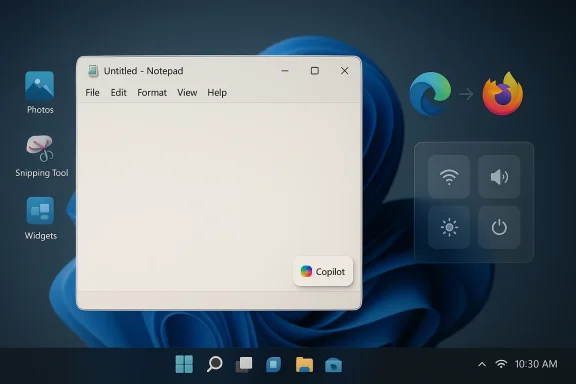
The timing also matters because Microsoft appears to be recalibrating under pressure. Community reporting in WindowsForum’s source material points to a more restrained approach in Windows 11, including fewer Copilot entry points in Notepad, Photos, Snipping Tool, and Widgets, along with more emphasis on control and predictability. That is not the language of a company that believes the original rollout was perfect. It is the language of one that has heard the backlash and is trying to stop the experience from feeling too promotional.
Historically, Microsoft has done this before. It launches a bold platform vision, lets it spread widely, and then trims it only after users push back hard enough to make the cost visible. Windows veterans know the pattern well: an initially “modern” idea slowly runs into the reality of how people actually use a desktop OS. With Copilot, the stakes are higher because Microsoft is not just selling a feature; it is trying to define the next era of Windows around AI.
Microsoft’s defenders can reasonably argue that Copilot and browser integration are meant to help users, not manipulate them. But Mozilla’s response is that a feature can be useful and still be deployed in a way that undermines choice. That distinction matters because the user does not experience the intention; the user experiences the default. If the default is persistent, intrusive, or difficult to override, it reads as coercion even when no one inside Redmond used that word.
The biggest reason Mozilla’s argument resonates is that the Windows audience still remembers earlier Microsoft platform battles. The browser wars left a long memory behind, and Copilot risks being interpreted through the same lens. In other words, the complaint is not only about a new feature but about an old playbook wearing a new label.
That is why the Notepad example matters so much. Notepad has long represented speed, restraint, and predictability. When Microsoft added AI-related features there, many users did not see a helpful upgrade; they saw the erosion of a sacred low-friction space. It is a small app, but symbolically it is huge because it exposes the exact boundary between modernization and overreach.
Mozilla is essentially saying that Copilot follows the same pattern as Windows Search and default browser steering: Microsoft is not merely making a tool available, it is nudging users toward a preferred ecosystem. Whether that is a valid business strategy is almost beside the point. The more important question is whether users can realistically opt out without friction, and whether competitors can compete on equal footing.
The issue is not that people hate AI in principle. It is that they hate being interrupted by it when the task is obvious and small. Snipping Tool should capture a screenshot and get out of the way. Notepad should let you type without a sales pitch. Widgets should glance, not nag. When a product misses that instinct, users start to feel as if the OS is arguing with them.
That feeling matters because Windows is still judged on trust. If users believe Microsoft will keep inserting platform priorities into ordinary workflows, they become more defensive about updates, more skeptical of new features, and more willing to disable whatever they can. Once that happens, even genuinely useful features suffer because they are introduced into an environment of suspicion.
Enterprises also care about licensing and data governance. If a Copilot feature arrives by default, administrators have to explain what it does, whether it transmits data, whether it requires separate licensing, and how to turn it off. That is not merely an inconvenience; it is overhead. Microsoft’s own documentation around managing Copilot behavior in Microsoft 365 suggests the company knows governance is necessary, but the challenge is that governance has often arrived after the rollout pressure, not before it.
That split explains why public backlash has been so effective. Consumers complain loudly enough to influence brand perception, while enterprise customers complain in a way that affects deployment decisions. Together, they create a rare alignment: the people who buy the software and the people who administer it are both asking Microsoft to slow down.
If Microsoft removes or reduces Copilot surfaces in Notepad, that is a practical design fix, but it is also a symbolic concession. It tells users that the company understands there is still value in making simple tools feel simple. That may sound obvious, yet in a product cycle dominated by AI branding, obvious truths often need to be rediscovered the hard way.
There is also a brand issue here. Notepad is not where users expect to be sold a future vision of Windows. The more Microsoft modernizes it, the more it risks turning a beloved utility into a case study in feature creep. Scaling back Copilot in this app may therefore do more to improve public sentiment than another flashy AI demo ever could.
Microsoft’s reported move to reduce these entry points looks less like a retreat from AI and more like an admission that “everywhere” is not the same as “useful.” The company can still keep AI in the ecosystem while pulling back from places where it feels like a disruption. That is the kind of compromise that often saves a product from becoming unpopular enough to stall.
In practical terms, users should expect fewer unsolicited Copilot prompts, fewer toolbar invitations, and a somewhat cleaner interface. The bigger question is whether Microsoft will preserve control as a principle or simply move the prompt somewhere less visible. That is the difference between a genuine reset and a cosmetic one.
The problem is not just one of ethics. It is also a market-access issue. If a platform owner can steer users toward its own browser by making the alternate path slower or more awkward, the competitor has to spend more resources just to stay visible. That is a structural advantage, and it matters whether the feature is a search result opener, a settings flow, or an AI assistant button.
That is why Copilot and browser choice belong in the same conversation. They are both about control points. In one case, Microsoft wants control over where AI appears. In the other, it wants control over where web content opens. The common thread is that Microsoft prefers a managed path over a neutral one.
There is a broader industry lesson here too. When platform vendors bundle new AI capabilities into operating systems, they tend to frame them as convenience. Rivals often see them as distribution leverage. Both things can be true at once. The question regulators and users keep asking is whether the convenience masks an unfairly tilted marketplace.
If Microsoft wants to avoid having Copilot treated like the next browser war, it will need to show that AI surfaces are genuinely optional, easy to suppress, and free of default-pressure tactics. Otherwise, the company will keep feeding the suspicion that every “helpful” feature is also a strategic funnel.
This also reflects a maturing understanding of product-market fit. A feature can win demos and still fail day-to-day. AI prompts in a live desktop environment are judged by context, timing, and frequency, not by abstract capability. Microsoft may have found that the daily cost of overexposure was starting to outweigh the strategic upside.
The company is also juggling multiple Copilot identities at once: Windows Copilot, Microsoft 365 Copilot, Copilot+ PC branding, and app-level AI features across consumer and enterprise software. That complexity alone creates pressure to simplify the experience. When a strategy becomes too layered, the risk is not just confusion; it is distrust.
A quieter Copilot can still be a successful Copilot. In fact, a less intrusive implementation may be more sustainable because it makes the feature feel chosen instead of imposed. That is a subtle but powerful distinction, especially in a market where users are increasingly wary of software that seems to want more of their attention than they want to give.
The risk, of course, is that Microsoft interprets restraint as weakness and slowly reintroduces the same behavior once the criticism fades. That would only confirm Mozilla’s point that public pressure, not product philosophy, is what truly changes the company’s course.
But the same strategy creates friction because the more Microsoft integrates AI into basic workflows, the more it risks turning neutral tools into branded pathways. That tension is especially sharp in software that people use daily. Users may accept a helper; they do not like a helper that keeps moving itself to the front of the room.
That is why the rollback matters strategically. It signals that Microsoft recognizes the conversion problem: awareness is not adoption, and visibility is not satisfaction. A feature that irritates people while still being technically optional may be a marketing win in the short term, but it is a trust loss over time.
The company’s recent moves suggest it knows this. By trimming Copilot surfaces in simple apps and emphasizing more intentional use, Microsoft is effectively saying that the feature should earn its place. That is a healthier stance than treating every empty toolbar as an invitation to put AI there.
Still, the long-term test will be whether the company keeps that restraint once the public attention moves on. If Copilot becomes quieter but more useful, Microsoft may preserve its AI story and improve Windows’ reputation at the same time. If it swings back toward overexposure, Mozilla’s critique will only become harder to dismiss.
Mozilla, meanwhile, has successfully reframed the debate from “does Copilot work?” to “who gets to decide how Windows behaves?” That is a much harder question for Microsoft to dodge because it reaches into both user experience and competition policy. The more often Microsoft is forced to explain why the default path is the Microsoft path, the more this becomes a trust story, not just a feature story.
What to watch next:
Source: Windows Report https://windowsreport.com/mozilla-criticizes-microsoft-over-copilot-push-and-lack-of-user-choice/
 Overview
Microsoft’s latest Copilot adjustments arrive after a long period in which the company treated AI as a universal answer for Windows, Microsoft 365, and consumer productivity. In the past two years, Copilot moved from being a branded assistant to a platform behavior, appearing in taskbar surfaces, inbox apps, and the everyday tools people use to get small jobs done quickly. That strategy made sense if the goal was to normalize AI as part of the operating system, but it also created a growing sense that users were being pushed toward features they had not requested.Mozilla’s criticism lands because it connects Copilot to a much older Windows complaint: Microsoft’s habit of making the default experience serve Microsoft first. The browser issue is the clearest example. When Windows Search opens web results in Edge or when Microsoft apps resist the browser choice a user has already made, that is not merely an inconvenience; it is a signal about who controls the platform. Mozilla argues that Copilot is the newest expression of that same instinct, just dressed in AI language instead of browser politics.
The timing also matters because Microsoft appears to be recalibrating under pressure. Community reporting in WindowsForum’s source material points to a more restrained approach in Windows 11, including fewer Copilot entry points in Notepad, Photos, Snipping Tool, and Widgets, along with more emphasis on control and predictability. That is not the language of a company that believes the original rollout was perfect. It is the language of one that has heard the backlash and is trying to stop the experience from feeling too promotional.
Historically, Microsoft has done this before. It launches a bold platform vision, lets it spread widely, and then trims it only after users push back hard enough to make the cost visible. Windows veterans know the pattern well: an initially “modern” idea slowly runs into the reality of how people actually use a desktop OS. With Copilot, the stakes are higher because Microsoft is not just selling a feature; it is trying to define the next era of Windows around AI.
What Mozilla Is Really Arguing
Mozilla’s public criticism is more than a complaint about interface clutter. It is an argument that Microsoft is repeatedly using its platform power to steer behavior in ways that are not transparent enough, not optional enough, and not respectful enough of the user’s preferences. That critique fits both the browser discussion and the Copilot discussion because both are about how hard Microsoft makes it to say “no.”The choice problem
At the center of Mozilla’s position is a simple idea: a platform should not make the preferred path feel like the hardest path. If a user wants Firefox, default browser settings should matter in practice, not just on paper. If a user wants a quiet text editor, Notepad should behave like a quiet text editor rather than a billboard for AI features. Those are different product categories, but they share the same concern about user agency.Microsoft’s defenders can reasonably argue that Copilot and browser integration are meant to help users, not manipulate them. But Mozilla’s response is that a feature can be useful and still be deployed in a way that undermines choice. That distinction matters because the user does not experience the intention; the user experiences the default. If the default is persistent, intrusive, or difficult to override, it reads as coercion even when no one inside Redmond used that word.
The biggest reason Mozilla’s argument resonates is that the Windows audience still remembers earlier Microsoft platform battles. The browser wars left a long memory behind, and Copilot risks being interpreted through the same lens. In other words, the complaint is not only about a new feature but about an old playbook wearing a new label.
Why Copilot is vulnerable to this critique
Copilot is especially exposed because it sits at the intersection of utility and branding. It is designed to look helpful, but Microsoft also needs it to look important to justify the company’s AI investments. That creates a tension that never fully goes away: if Copilot appears too often, it feels like advertising; if it appears too rarely, it loses strategic value.That is why the Notepad example matters so much. Notepad has long represented speed, restraint, and predictability. When Microsoft added AI-related features there, many users did not see a helpful upgrade; they saw the erosion of a sacred low-friction space. It is a small app, but symbolically it is huge because it exposes the exact boundary between modernization and overreach.
Mozilla is essentially saying that Copilot follows the same pattern as Windows Search and default browser steering: Microsoft is not merely making a tool available, it is nudging users toward a preferred ecosystem. Whether that is a valid business strategy is almost beside the point. The more important question is whether users can realistically opt out without friction, and whether competitors can compete on equal footing.
Why Windows Users React So Strongly
Windows users are unusually sensitive to clutter because the desktop is not a single app; it is the workspace for everything else. That means every extra prompt, shortcut, suggestion, or “helpful” intervention changes the emotional feel of the entire system. A mobile app can get away with more persuasion. A desktop OS, especially one used for work, cannot.The desktop is not a storefront
When Microsoft places Copilot in Notepad, Photos, Widgets, or the taskbar, it is changing the texture of the desktop. The user is no longer simply opening a tool; they are entering a managed experience. That may be good product thinking if your priority is engagement, but it is poor product thinking if your priority is quiet efficiency. Windows users have long preferred the latter, which is why the backlash has been so consistent.The issue is not that people hate AI in principle. It is that they hate being interrupted by it when the task is obvious and small. Snipping Tool should capture a screenshot and get out of the way. Notepad should let you type without a sales pitch. Widgets should glance, not nag. When a product misses that instinct, users start to feel as if the OS is arguing with them.
That feeling matters because Windows is still judged on trust. If users believe Microsoft will keep inserting platform priorities into ordinary workflows, they become more defensive about updates, more skeptical of new features, and more willing to disable whatever they can. Once that happens, even genuinely useful features suffer because they are introduced into an environment of suspicion.
Consumers versus enterprises
The consumer reaction is emotional, but the enterprise reaction is operational. Home users usually object because something feels intrusive. IT teams object because the same thing creates support burden, change-control headaches, and unpredictable behavior across managed devices. Those are different pain points, but they push in the same direction: less surprise, more control.Enterprises also care about licensing and data governance. If a Copilot feature arrives by default, administrators have to explain what it does, whether it transmits data, whether it requires separate licensing, and how to turn it off. That is not merely an inconvenience; it is overhead. Microsoft’s own documentation around managing Copilot behavior in Microsoft 365 suggests the company knows governance is necessary, but the challenge is that governance has often arrived after the rollout pressure, not before it.
That split explains why public backlash has been so effective. Consumers complain loudly enough to influence brand perception, while enterprise customers complain in a way that affects deployment decisions. Together, they create a rare alignment: the people who buy the software and the people who administer it are both asking Microsoft to slow down.
The Copilot Rollback in Windows 11
The most visible sign of change is Microsoft’s reported decision to reduce unnecessary Copilot entry points in Windows 11. Community material in the WindowsForum files points to a quieter approach in Notepad, Photos, Snipping Tool, and Widgets, combined with broader improvements to customization and update behavior. That combination matters because it suggests Microsoft understands the complaint is not just about AI; it is about control.Notepad as the symbol
Notepad is the best place to see the problem because it is such a basic utility. For decades, it has stood for minimalism, speed, and low ceremony. Once Microsoft started adding modern features such as tabs, spellcheck, autosave, and AI-assisted writing, it made the app more capable, but also less invisible. That tradeoff is now at the heart of the backlash.If Microsoft removes or reduces Copilot surfaces in Notepad, that is a practical design fix, but it is also a symbolic concession. It tells users that the company understands there is still value in making simple tools feel simple. That may sound obvious, yet in a product cycle dominated by AI branding, obvious truths often need to be rediscovered the hard way.
There is also a brand issue here. Notepad is not where users expect to be sold a future vision of Windows. The more Microsoft modernizes it, the more it risks turning a beloved utility into a case study in feature creep. Scaling back Copilot in this app may therefore do more to improve public sentiment than another flashy AI demo ever could.
Other inbox apps follow the same logic
Photos, Snipping Tool, and Widgets each have a different job, but they share one thing in common: users want them to be fast. They are not deep work surfaces. They are fast-access tools. That makes them poor places for persistent AI surfaces unless the AI is tightly contextual and clearly optional.Microsoft’s reported move to reduce these entry points looks less like a retreat from AI and more like an admission that “everywhere” is not the same as “useful.” The company can still keep AI in the ecosystem while pulling back from places where it feels like a disruption. That is the kind of compromise that often saves a product from becoming unpopular enough to stall.
In practical terms, users should expect fewer unsolicited Copilot prompts, fewer toolbar invitations, and a somewhat cleaner interface. The bigger question is whether Microsoft will preserve control as a principle or simply move the prompt somewhere less visible. That is the difference between a genuine reset and a cosmetic one.
Browser Choice and the Edge Problem
Mozilla’s browser critique is not a side note; it is the strongest evidence that this debate has been building for years. If Windows Search, Outlook, Teams, or other Microsoft apps continue to override a user’s preferred browser experience, then Microsoft is still behaving like a company that believes platform ownership should include behavioral steering. That is the core of Mozilla’s complaint.Default settings versus actual behavior
On paper, Windows lets users pick default browsers. In practice, the system often routes users through Microsoft-controlled surfaces anyway. That gap between setting and outcome is what irritates browser competitors most, because it makes the default choice feel more theoretical than real. Mozilla has a long history of arguing that this kind of design undermines competition without technically violating the appearance of user choice.The problem is not just one of ethics. It is also a market-access issue. If a platform owner can steer users toward its own browser by making the alternate path slower or more awkward, the competitor has to spend more resources just to stay visible. That is a structural advantage, and it matters whether the feature is a search result opener, a settings flow, or an AI assistant button.
That is why Copilot and browser choice belong in the same conversation. They are both about control points. In one case, Microsoft wants control over where AI appears. In the other, it wants control over where web content opens. The common thread is that Microsoft prefers a managed path over a neutral one.
Competition implications
For Firefox and other alternatives, the challenge is not simply winning on features. It is overcoming a platform that can always make the first move. That makes competition asymmetrical, especially when the default experience is designed to favor Microsoft without making the preference feel overt. Mozilla’s critique is therefore as much about competition policy as it is about product taste.There is a broader industry lesson here too. When platform vendors bundle new AI capabilities into operating systems, they tend to frame them as convenience. Rivals often see them as distribution leverage. Both things can be true at once. The question regulators and users keep asking is whether the convenience masks an unfairly tilted marketplace.
If Microsoft wants to avoid having Copilot treated like the next browser war, it will need to show that AI surfaces are genuinely optional, easy to suppress, and free of default-pressure tactics. Otherwise, the company will keep feeding the suspicion that every “helpful” feature is also a strategic funnel.
Microsoft’s AI Strategy Under Pressure
The reason this moment is interesting is that Microsoft is still deeply invested in Copilot even as it appears to be reducing its surface area in Windows. That is not a contradiction so much as a correction. The company wants AI to remain central, but it no longer seems confident that more visibility automatically equals more value.From ubiquity to restraint
Microsoft’s earlier posture was easy to describe: put Copilot everywhere. The newer posture is subtler: put Copilot where it belongs. That distinction is huge because it shows the company is learning that ambient software can become annoying if it is too ambient. Users tolerate AI when it helps, but they resist it when it starts feeling compulsory.This also reflects a maturing understanding of product-market fit. A feature can win demos and still fail day-to-day. AI prompts in a live desktop environment are judged by context, timing, and frequency, not by abstract capability. Microsoft may have found that the daily cost of overexposure was starting to outweigh the strategic upside.
The company is also juggling multiple Copilot identities at once: Windows Copilot, Microsoft 365 Copilot, Copilot+ PC branding, and app-level AI features across consumer and enterprise software. That complexity alone creates pressure to simplify the experience. When a strategy becomes too layered, the risk is not just confusion; it is distrust.
Consumer acceptance matters as much as enterprise deployment
For enterprise buyers, the question is whether Copilot can be governed. For consumers, the question is whether it can be ignored. Microsoft needs both answers to be yes if it wants the AI story to stick. That is why reducing clutter matters so much: it does not weaken the technology, but it may improve the emotional reception.A quieter Copilot can still be a successful Copilot. In fact, a less intrusive implementation may be more sustainable because it makes the feature feel chosen instead of imposed. That is a subtle but powerful distinction, especially in a market where users are increasingly wary of software that seems to want more of their attention than they want to give.
The risk, of course, is that Microsoft interprets restraint as weakness and slowly reintroduces the same behavior once the criticism fades. That would only confirm Mozilla’s point that public pressure, not product philosophy, is what truly changes the company’s course.
The Business Logic Behind the Push
Microsoft’s AI strategy is not accidental. Copilot is tied to cloud services, subscription products, device branding, and long-term platform differentiation. The company wants Windows to be the operating system people associate with modern AI use, and that requires visibility. But visibility carries a price when users perceive it as coercive or noisy.Why Microsoft pushed so hard
From a business perspective, the logic is straightforward. If Copilot becomes part of the default Windows and Microsoft 365 experience, it can drive engagement, subscriptions, and ecosystem loyalty. It also gives Microsoft a marketing story that competitors can’t easily match at the operating system level. That is powerful, especially when AI remains the industry’s central narrative.But the same strategy creates friction because the more Microsoft integrates AI into basic workflows, the more it risks turning neutral tools into branded pathways. That tension is especially sharp in software that people use daily. Users may accept a helper; they do not like a helper that keeps moving itself to the front of the room.
That is why the rollback matters strategically. It signals that Microsoft recognizes the conversion problem: awareness is not adoption, and visibility is not satisfaction. A feature that irritates people while still being technically optional may be a marketing win in the short term, but it is a trust loss over time.
The new balancing act
Microsoft now has to balance three competing goals. It needs Copilot to matter. It needs Windows to feel reliable and uncluttered. And it needs enterprises and consumers to believe they can control the experience. Those goals are compatible, but only if Microsoft is disciplined about placement and transparency.The company’s recent moves suggest it knows this. By trimming Copilot surfaces in simple apps and emphasizing more intentional use, Microsoft is effectively saying that the feature should earn its place. That is a healthier stance than treating every empty toolbar as an invitation to put AI there.
Still, the long-term test will be whether the company keeps that restraint once the public attention moves on. If Copilot becomes quieter but more useful, Microsoft may preserve its AI story and improve Windows’ reputation at the same time. If it swings back toward overexposure, Mozilla’s critique will only become harder to dismiss.
Strengths and Opportunities
Microsoft still has a real opportunity to turn this controversy into a better Windows experience. If the company uses the backlash to sharpen Copilot’s role instead of simply hiding it, it could build a more credible AI strategy that feels modern without feeling pushy. That would be a meaningful win for both consumers and IT admins.- Cleaner product design if Copilot surfaces are reduced in lightweight tools like Notepad and Snipping Tool.
- Better user trust if Microsoft proves it can respect defaults and preferences more consistently.
- Stronger enterprise reception if administrators can govern AI behavior more predictably.
- Improved brand perception if Windows feels less cluttered and less promotional.
- More durable Copilot adoption if the assistant appears only when it truly adds value.
- Competitive pressure that may push Microsoft to make Windows more open and less self-serving.
- A chance to reset the narrative from AI overload to thoughtful AI integration.
Risks and Concerns
The biggest danger is that Microsoft could treat the current backlash as a temporary PR issue rather than a structural warning. If it simply moves Copilot around instead of changing how defaults and entry points work, the criticism will come back quickly. Users notice patterns, and Mozilla is already naming the pattern out loud.- Perception of backtracking if Microsoft trims Copilot only after public pressure.
- Trust erosion if AI keeps appearing in places users do not expect.
- Enterprise friction if governance still lags behind rollout decisions.
- Competition concerns if browser choice and app defaults remain tilted toward Microsoft.
- User fatigue if Windows continues to feel like a branded AI showcase rather than a neutral desktop.
- Feature bloat if “optional” Copilot tools remain too visible to ignore.
- Strategic confusion if Microsoft sends mixed messages about whether restraint or ubiquity is the long-term goal.
Looking Ahead
Microsoft now faces a test that is as much cultural as technical. The company can keep building Copilot into the Windows ecosystem, but it will need to do so in a way that feels earned, contextual, and genuinely optional. If it does, the current criticism may look like a useful correction rather than a reputational setback.Mozilla, meanwhile, has successfully reframed the debate from “does Copilot work?” to “who gets to decide how Windows behaves?” That is a much harder question for Microsoft to dodge because it reaches into both user experience and competition policy. The more often Microsoft is forced to explain why the default path is the Microsoft path, the more this becomes a trust story, not just a feature story.
What to watch next:
- Whether Microsoft keeps reducing Copilot surfaces in future Windows 11 updates.
- Whether browser and default-app behavior becomes a renewed public issue.
- Whether enterprise admin controls for Copilot become easier to manage.
- Whether Notepad settles back into a quieter utility role.
- Whether other Microsoft apps follow the same restraint-first approach.
Source: Windows Report https://windowsreport.com/mozilla-criticizes-microsoft-over-copilot-push-and-lack-of-user-choice/
