Copilot Health: Microsoft's Personal Health Data Hub for Your Medical Records

  • Thread Author
Microsoft’s consumer Copilot just walked into the most intimate ledger most people keep: their medical record, wearable streams and lab results — and it did so with a single, public preview called Copilot Health that promises to pull those fragments together into plain‑language summaries, trend detection and appointment‑ready guidance.

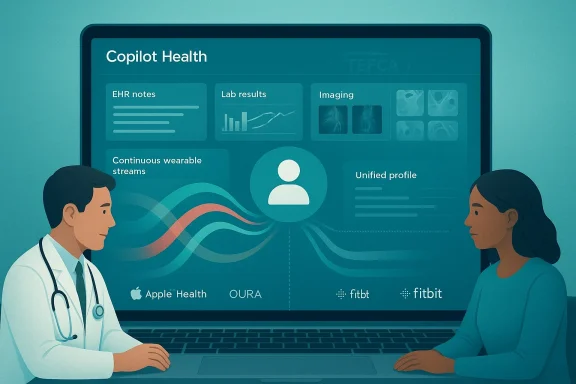
A doctor and patient review a Copilot Health dashboard on a large laptop.Background / Overview​

Microsoft’s Copilot family has evolved rapidly from productivity helpers to a collection of verticalized assistants aiming to own everyday workflows. What began as writing and scheduling help has expanded into domain copilots for finance, coding, and now health; Copilot Health is the company’s clearest push to make Copilot the” for personal medical data.
The preview, announced in mid‑March 2026, is initially available only to adults in the United States as an early access program. Microsoft frames the product as an aid to understanding — not a replacement for clinicians — and highlights privacy segmentation, grounding with curated health content, and a multi‑sohat spans clinical systems and consumer devices.
This launch sits on a foundation Microsoft has been building for years: clinical products such as Dragon Copilot for clinicians, Azure Health Data Services for standardized clinical data, and licensing deals to surface medically reviewed publisher content in consumer replies. Those pieces are now being stitched together to support a consumer‑oriented feature set that is both consequential and fragile.

What Copilot Health Says It Does​

Single pane for fragmented health data​

At its core, Copilot Health promises to aggregate three classes of personal data:
  • Electronic health records (EHRs) — visit notes, problem lists, medications, imaging reports and lab results stored by hospitals and clinics.
  • Laboratory and imaging results — discrete lab values and imaging interpretations that are often hard for patients to interpret alone.
  • Wearable telemetry — continuous biometric streams from consumer devices, specifically cited integrations include Apple Health, Oura and Fitbit.
Microsoft’s public messaging emphasizes a privacy‑segmented “health lane” inside Copilot so that medical conversations and data are separated from general Copilot workflows and memory. That segmentation is presented as both a UX boundary and a governance control intended to reduce accidental exposure and misuse.

Grounding, provenance and user empowerment​

Microsoft has said Copilotze user data with grounded, medically reviewed guidance to explain abnormal values, highlight trends, and generate actionable next steps such as appointment prep or questions to ask a clinician. The company has pursued partnerships and licensing to improve provenance — notably licensing consumer‑facing content from trusted publishers to anchor answers — and highlights tools that will show where guidance came from.

Interoperability: FHIR, TEFCA and identity​

On the technical side, Copilot Health leans on the same industry standards and policy ominated U.S. interoperability work. The product reportedly uses FHIR (Fast Healthcare Interoperability Resources) endpoints and leverages Individual Access Services (IAS) under TEFCA (the Trusted Exchange Framework and Common Agreement) through partners such as HealthEx to let individuals bring verifiable clinical records into the Copilot workspace. That design is explicitly consent‑driven in vendor messaging and is intended to allow links to tens of thousands of provider records without bespoke integrations.

Technical Anatomy (what Microsoft is likely deploying)​

Data ingestion and normalization​

Aggregating data from EHRs, labs and wearables requires robust pipelines:
  • FHIR APIs and DICOM for imaging allow structured clinical content to be pulled into a standardized store.
  • Azure Health Data Services or Microsoft’s healthcare data stack is an obvious backend candidate to normalize disparate clinical payloads into unified profiles.
Normalization matters because different EHRs code labs and observations differently; the value of any AI summary depends heavily on correct mapping and timestamping of results.

Identity, consent and TEFCA​

To connect a patient’s record across multiple providers, Copilot Health appears to rely on TEFCA‑style individual access flows and identity verification provided by partners such as HealthEx — a design that avoids Microsoft buior code for each health system while creating a verified, auditable path for data transfer. That pathway is central to any claim that Microsoft can stitch together a “complete” personal health record from multiple provider silos.

Model behavior, grounding and content provenance​

Microsoft is attempting to reduce unmoored generative outputs by pairing model responses with licensed editorial content and by building provenance surfaces — explicit statements or citations linking claims to underlying clinical notes, lab values or publisher guidance. This is a pragmatic move; it signals recognition that trust in health AI depends less on rhetoric than on the ability to show why the assistant made a recommendation.

Why this matters: benefits and immediate use cases​

  • Patient understanding: For many patients, lab reference ranges and visit notes are opaque. An assistant that summarizes key changes and flags actionable items can improve health literacy and appointment efficiency.
  • Care prep and adherence: Copilot Health could produce appointment checklists, medication question lists, and simplified explanations of imaging or lab trends — practical outputs that clinicians and patients both value.
  • Longitudinal trend detection: Continuous device data (sleep, heart rate variability, step counts) combined with clinical labs could highlight meaningful trends earlier than episodic care does. This is particularly valuable for chronic disease monitoring where moderation and early detection matter. ([axios.com](https://www.axios.com/2026/03/12/microsoft-copilot-healt- Consumer convenience and platform lock‑in: If Copilot Health succeeds at consolidating health data, Microsoft gains a powerful consumer relationship — the company’s broader ecosystem incentives (email, calendar, cloud storage) make Copilot a natural place for users to centralize personal information.

The risks and failure modes Microsoft must manage​

No single paragraph captures the combinations of safety, privacy and usability risks here. Below are the most important, high‑impact concerns.

1) Accuracy and "hallucinations"​

Generative models can invent plausible but false statements. In health contexts, plausible falsehoods can be dangerous. Even with grounding and licensed content, the assistant may misinterpret a lab trend, conflate similar conditions, or produce an overconfident next step that a clinician would never endorse. Microsoft’s emphasis on provenance reduces but does not eliminate this risk. Independent validation and clinician oversight remain essential.

2) Data qualirable streams are noisy, device‑dependent and vary in clinical validity. Combining high‑precision clinical labs with consumer heart‑rate streams risks over‑interpreting device artifacts as medical signals. Academic work shows LLMs can add value to wearable interpretation, but only within carefully validated pipelines — conversion and denoising steps are essential to reliable outputs. ([arxiv.org](AI on the Pulse: Real-Time Health Anomaly Detection with Wearable and Ambient Intelligence?## 3) Privacy, consent and default settings​

Microsoft says health data will be “segmented” and governed separately from general Copilot memory, but prior reports show Copilot memory has begun using signals from other Microsoft services unless users opt out. Any default on/off behavior or hidden toggles creates real privacy risk if users do not understand the scope of sharing. The stakes here are higher than for calendar or email: medical da protections (HIPAA for covered entities) and social harms if leaked.

4) Liability and clinical responsibility​

Who is responsible if Copilot Health suggests an inappropriate next step and a patient acts on it? Microsoft frames the product as educational aniented, but the line between advice and medical decision support is thin. Regulators and litigators will want to know where the company drew its line and how it documents provenance and disclaimers.

5) Interoperability gaps and false completeness​

TEFCA/IAS and FHIR endpoints cover many providers but not every practice, especially small clinics or non‑participating hospitals. Users may get a false sense of completeness: a Copilot‑generated “comprehensive” chart can still omit entire episodes of care if the underlying providers are not connected or the identity link fails. That false completeness is dangerous in clinical contexts.

6) Platform concentration and data governance​

If consumers entrust a single platform with their aggregated medical histories, high‑value target for attackers and an influential gatekeeper in care decisions. Consumers must weigh convenience against centralization risk; regulators will be watching for anti‑competitive lock‑in effects as well.

Cross‑checking the most load‑bearing claims​

  • Launch timing and scope — Microsoft previewed Copilot Health in mid‑March 2026 as a U.S. early access program. This was widely reported in press coverage and Microsoft’s Copilot updates.
  • Device and data integrations — Apple Health, Oura and Fitbit were explicitly cited as wearable sources Microsoft intends to ingest. That detail appears in multiple reporting articles and internal previews.
  • TEFCA and FHIR usage — Partners such as HealthEx have stated they will connect TEFCA IAS and FHIR endpoints to power individual access flows into Copilot Health. This was described in partner announcements and reporting focused on the integration path.
  • Grounding and publisher licensing — Microsoft has negotiated licensing and editorial relationships to surface medically reviewed content (for example, Harvard Health Publishing content has been discussed as a licensed grounding source in thlth strategy). Independent reporting and earlier threads corroborate that licensing strategy.
Where public reporting or vendor statements make definitive claims that cannot be independently verified (for example, exact security control configurations, the full list of provider partners on day one, or internal model‑training restrictions), treat those claims cautiously until Microsoft publishes technical documentation or independent audits are available.

Critical analysis: strengths, gaps and what Microsoft must prove​

Strengths​

  • Unified user experience: Microsoft uniquely controls multiple consumer touchpoints (desktop, mobile, cloud) and has the scale to make a consolidated health hub convenient and discoverable.
  • Standards‑based integration plan: Building on FHIR, DICOM and TEFCA IAS is the correct approach to avoid brittle point‑to‑point connectors and to rely on emergent national interoperability infrastructure.
  • Editorial grounding: Licensing medically reviewed content and surfacing provenance will materially reduce some categories of hallucination and improve user trust compared with free‑form chatbots that lack source attribution.

Gaps and skepticism​

  • Operational safety: Microsoft must show real‑world, cross‑vendor validation demonstrating that model outputs track clinician judgment and that false positives/negatives are understood and minimized.
  • Privacy defaults: Segmentation language is necessary but insufficient; the company needs clear, user‑facing controls, immutable audit logs, and simple ways to revoke access and export data.
  • Regulatory posture: Consumers and clinicians need clarity about HIPAA exposure, whether Microsoft will act as a business associate in some flows, and how responsibility is allocated when clinical advice is requested.
  • Provenance realism: Citing a publisher or a lab value is good; showing the exact note or recoa conclusion — and making that accessible to clinicians — is better. The company must avoid hand‑waving provenance in favor of verifiable, linked evidence.
Microsoft will be judged less by marketing claims and more by the technical documentation, compliance attestations, and independent third‑party audits it releases in the months after preview. Until those artefacts exist, many promises remain aspirational.

Practical guidance for users, clinicians and IT teams​

For consumers (patients)​

  • Treat Copilot Health as a preparation and interpretation tool — use it to organize questions, grasp high‑level trends, and prepare for visits, not as a substitute for professional medical advice.
  • Confirm which providers are included in your linked record and verify that nothing critical is missing before making decisions.
  • Check and lock down privacy settings. If in doubt, limit what you upload or connect and prefer manual export/import for sensitive records.
  • Keep copies: export or print important summaries and share them with clinicians through established channels, rather than relying on the assistant alone.

For clinicians and care organizations​

  • Expect more prepared patients but plan for new kinds of pre‑visit disclosures and potential misinterpretations; set clinic workflows to validate patient‑generated summaries.
  • Work with your EHR vendor and IT team to understand how FHIR access is executed and what TEFCA IAS flows will mean for inbound patient requests.
  • Advocate for audit trails and consent receipts that can be reconciled into the patient’s legal record when necessary.

For IT and security leaders​

  • Evaluate vendor attestation and compliance — request HIPAA, SOC and penetration test reports where applicable.
  • Require role‑based access, granular consent captures, and short retention windows for any Copilot‑generated artifacts you allow into enterprise systems.
  • Prepare incident response playbooks for accidental disclosures involving Copilot Health, includin accessed what and when.

Competition and the broader landscape​

Copilot Health does not appear in isolation; competitors from cloud providers and AI startups are racing to offer consumer health companions and clinical decision support. OpenAI introduced a health capability in early 2026 and Amazon has pursued health AI in retail and cloud contexts as well. The strategic play is straightforward: whichever platform becomesd aggregator of health data gains a persistent engagement advantage and potentially a monetizable pathway into clinical services. Microsoft’s advantage is integration with office productivity workflows and enterprise relationships with health systems, but competitors are agile and well‑funded.

What to watch next (short and medium term)​

  • Will Microsoft publish a detailed technical whitepaper describing data flows, retention policies, model evaluation metrics, and third‑party audit results? That will be the clearest signal of readiness.
  • How robust are identity and consent receipts produced via TEFCA IAS flows? The operational reliability of identity verification will determine how comprehensive the aggregated records become.
  • Will Microsoft commit to explicit limitations on uses of Copilot Health data for model training, and will those commitments be verifiable via audits or cryptographic proofs?
  • Will regulators characterize a consumer Copilot that provides actionable health guidance as a medical device or a decision‑support tool subject to medical device rules? Regulatory treatment will shape both product design and risk management obligations.

Conclusion: a measured opportunity, not a done deal​

Copilot Health is a consequential and logical next step for a company that already sits at many of the touchpoints people use to manage life. The promise — a single, private workspace that translates tests and wearable streams into clear, actionable guidance — could genuinely increase health literacy and reduce friction in care.
But promise is not proof. The high bar for safety, privacy and clinical reliability demands transparent technical documentation, robust consent engineering, independent evaluation and clear regulatory alignment. Microsoft’s stated use of standards such as FHIR and TEFCA, partnerships for identity and provenance, and editorial licensing are good design choices. Yet the outcome will depend on rigorous operational execution and whether the company demonstrates how it prevents hallucinations, enforces privacy by default, and reconciles liability with clinicians and patients.
For users: be curious, stay cautious, and use Copilot Health as an assistant to prepare for clinical care — not as a clinical authority. For organizations and regulators: insist on documentation, audits and enforceable controls before equating convenience with safety. If Microsoft can answer those questions with concrete evidence and independent validation, Copilot Health may become a helpful bridge between fragmented data and meaningful care; until then, the tool is an enormous convenience with equally enormous responsibilities attached.

Source: reclaimthenet.org Microsoft Copilot Health Centralizes Personal Medical Records
Source: Fitt Insider Microsoft Launches AI Health Copilot
 

Microsoft’s consumer Copilot just moved from calendar fixes and document drafting into the most intimate ledger many people keep: their medical record, wearable telemetry, and laboratory results — and the company is asking users to let it stitch those pieces into a single, AI-driven health workspace.

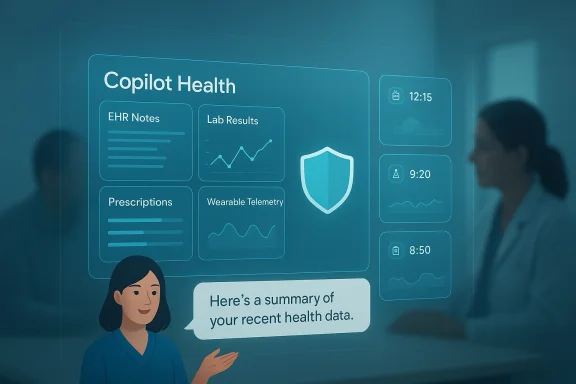
A holographic health dashboard labeled 'Copilot Health' displays notes, lab results, prescriptions, and wearable data.Background / Overview​

Microsoft unveiled Copilot Health as a U.S.-only preview that promises to aggregate electronic health records (EHRs), lab reports, prescriptions, and continuous wearable telemetry into a dedicated “health lane” inside Copilot. The company positions this as a private, privacy‑segmented space where generative AI will explain findings in plain language, highlight trends, and suggest actionable next steps to help people prepare for clinical visits and better understand their own data.
The pitch is familiar: take scattered, confusing medical notes and device signals, apply AI to surface patterns and plain‑English explanations, and hand the user something they can actually discuss with a clinician. Microsoft frames Copilot Health as a consumer bridge to clinical care — a personal health concierge rather than a replacement for professional diagnosis. The preview opened with an early access waitlist and appears aimed first at U.S. adults while Microsoft iterates on integrations and safety controls.

What Copilot Health says it will do​

Core capabilities (as described in early reporting)​

  • Aggregate data from clinical sources: EHRs, visit notes, laboratory results, imaging summaries, and prescriptions.
  • Ingest continuous telemetry from consumer wearables and fitness trackers — Apple Health, Fitbit, Oura and similar devices — to detect trends and contextualize lab values or symptoms.
  • Present plain‑language explanations of medical findings, highlight significant trends (e.g., rising HbA1c, irregular heart-rate episodes), and prepare appointment‑ready summaries or “what to ask your doctor” prompts.
  • Create a privacy‑segmented workspace inside Copilot so health conversations, uploads, and data are separated from general Copilot usage and search. Microsoft emphasizes separation to limit cross‑pollination with other product telemetry.

Integration approach and ecosystem hints​

Early reporting indicates Microsoft will rely on existing interoperability standards and third‑party partners to connect clinical records and personal health records into Copilot Health, including FHIR/HL7‑style connectors and health exchange services that bridge provider systems to consumer platforms. One preview report flagged a company called HealthEx as a partner for personal health record integration, while Microsoft’s general Copilot health strategy has previously included licensing medically‑reviewed content for grounding AI responses.

Why this matters: potential benefits​

Microsoft’s pitch targets three persistent problems in consumer health data:
  • Fragmentation: many patients have data scattered across clinics, labs, and devices. Copilot Health promises to create a single, queryable view.
  • Comprehension: lab reports and visit notes are often opaque. Natural‑language explanations and highlighting could reduce confusion and improve patient engagement.
  • Visit preparedness: by generating concise summaries or suggested questions, Copilot Health could make clinical encounters more efficient and more focused.
If implemented carefully, these features could improve patient activation (people doing a better job of managing chronic disease), reduce unnecessary follow-ups, and give clinicians clearer, patient‑vetted data during visits. For caregivers and people managing complex conditions, a reliable, integrated view of vitals, meds, and labs could have clear, day‑to‑day value.

The architecture Microsoft appears to be leaning on​

Privacy segmentation and data flow​

Microsoft describes Copilot Health as a privacy‑segmented “health lane” inside the broader Copilot experience. That means health data and health‑focused interactions are stored and processed in a compartment designed to reduce the chance that medical content mixes into general Copilot model training or cross‑product telemetry. The company’s messaging repeatedly stresses separation and private workspaces.

Data sources and connectors​

To make the hub useful, Microsoft needs: provider EHR connectors, lab result ingestion, patient‑facing health record aggregation, and wearable telemetry streams. Early reporting points to partnerships and industry interoperability standards as the plumbing that will enable these flows. Those integrations are nontrivial: connecting to thousands of disparate provider systems reliably and at scale has been the strategic challenge for many health‑tech vendors for years.

Grounding via clinical content​

Microsoft has previously licensed medically‑reviewed consumer health content to improve provenance in health Q&A. Embedding editorially curated sources (for example, publisher‑vetted guidance) alongside model output is an explicit tactic to reduce hallucination risk and give users clearer provenance for answers. Reported licensing of trusted health content is a notable step toward grounding.

Critical analysis: strengths and sensible design choices​

1) Focus on privacy‑segmentation is the right idea​

Segregating medical chats from general Copilot workflows is a necessary, not optional, design choice. Health data is among the most sensitive classes of personal information, and any AI product that touches it must minimize cross‑contamination with broader telemetry and training datasets. Microsoft’s explicit emphasis on a separated health lane is a pragmatic response to that requirement.

2) Practical, consumer‑facing features address real pain points​

Providing plain‑language summaries, trend detection across labs and wearables, and appointment prep sheets targets activities patients already struggle with. The value proposition is both tangible and immediately understandable to typical users — which improves the odds of adoption, assuming the system is accurate and trustworthy.

3) Leveraging interoperability standards and partners reduces barriers to EHR access​

Rather than reinventing connectors, Microsoft appears to be working with existing standards and specialist integrators to reach EHRs and lab systems. That is a wiser path than bespoke adapters; relying on the health‑IT ecosystem increases the chance of stable, maintainable connections.

The hard truths and key risks​

The promise is substantial, but so are the hazards. Below are the principal risks Copilot Health must overcome.

Accuracy and clinical safety​

  • Generative models can hallucinate, misinterpret, or combine facts in ways that are persuasive but incorrect. In a health context, such errors can cause harm — wrong dosage interpretation, missed red flags, or misprioritized urgency. Even explanation quality matters: oversimplified or misleading language can change a user’s actions. Microsoft has signaled that Copilot Health is not a replacement for medical professionals, but the real world rarely keeps systems and users within ideal boundaries.
  • Licensing editorial content improves grounding but does not eliminate hallucination risk where AI synthesizes across multiple, conflicting sources. Clinical validation and conservative answer framing are essential.

Privacy, governance, and legal exposure​

  • Health data is regulated in many jurisdictions. U.S. federal rules (e.g., HIPAA) and state laws create obligations for covered entities and business associates; whether a consumer app becomes a “business associate” or how a platform stores and processes EHR data matters for liability. Microsoft must clarify contracts, responsibilities, and data handling for providers and users.
  • Even with a privacy‑segmented lane, telemetry bugs or design defects can leak sensitive content into broader products — a failure mode that affected Copilot previously when enterprise DLP protections were bypassed in another Copilot experience. That incident is a cautionary reminder: implementation bugs, not just policies, create exposure.

Provenance and auditability​

  • Clinical decisions require provenance: what data, what source, and what editorial guidance backed a particular recommendation? For clinicians (and for regulatory comfort), Copilot Health must provide deterministic provenance traces — timestamped citations back to the original lab result, visit note, or publisher article — not just model‑generated summaries. Without that, clinicians cannot safely rely on the assistant. Early reporting highlights Microsoft’s intent to ground answers, but full operational provenance will be a demanding engineering and UX requirement.

Interoperability and unequal coverage​

  • Achieving reliable access to records across all provider systems is an operational mountain. Some institutions are easier to connect to than others; certain community providers, proprietary labs, or international systems may be unavailable. That patchiness can create uneven experiences and potential blind spots. Microsoft’s reliance on third‑party connectors helps, but it does not guarantee uniform coverage.

User expectations and overreliance​

  • Even with careful language, many users will treat an assistant’s confident summary as a de facto diagnosis. The company must design friction and guardrails to prevent overreliance: e.g., forced disclaimers, clear signposting of non‑diagnostic status, and strong prompts to seek clinician review for actionable recommendations.

Governance, regulation, and where Microsoft must show its work​

  • HIPAA and contracts: Microsoft should publish clear guidance on how Copilot Health handles PHI, whether it signs BAA‑equivalent agreements for provider integrations, and how it differentiates consumer PHR ingestion from covered entity processing. Ambiguity here invites both regulatory risk and loss of trust.
  • Auditable provenance: Every AI claim that could impact care should be accompanied by an auditable breadcrumb trail linking back to the underlying lab, note, or vetted editorial content source. This is not optional in clinical contexts; it’s foundational to clinician trust.
  • Clinical validation: Before surfacing “next steps” or triage advice, Microsoft must publish clinical validation studies or third‑party audits demonstrating accuracy, sensitivity, and specificity for the most consequential classes of recommendations. Peer review or independent evaluation will be critical for adoption beyond consumer curiosity.
  • Error handling and human escalation: Clear policies must exist for how the system handles contradictions between sources, ambiguous lab trends, or signals that legitimately require urgent attention. Automatic escalation prompts and emergency guidance need carefully engineered decision trees.

Practical advice for users and clinicians today​

  • Treat Copilot Health as a data navigator, not a clinician. Use it to aggregate and summarize; always verify critical clinical actions with a licensed professional.
  • Check provenance on every important recommendation. If the assistant can show the originating lab value, date, and clinic note, that increases trust. If answers lack citations, treat them skeptically.
  • For clinicians: insist on access to raw data and timestamps, not filtered summaries. If patients arrive with AI‑generated previsit notes, clinicians should verify accuracy against the EHR rather than assuming correctness.
  • Organizations and IT teams integrating Copilot Health should require contractual clarity (e.g., BAAs) and test DLP and access policies thoroughly — past Copilot defects show that policy is only as strong as its implementation.

Competitive and market context​

Microsoft is not the only major vendor chasing the “consumer health assistant” space. Cloud giants and specialized health‑tech firms are each trying to own parts of the patient experience — from data aggregation to triage to chronic care management. The strategic logic is straightforward: the platform that becomes the trusted repository and conversational interface for personal health data gains enormous leverage for ancillary services and retention.
Microsoft’s competitive advantages are material: existing enterprise relationships with hospitals, cloud infrastructure, and the massive Copilot footprint across consumer and productivity surfaces. But competitors will push back on features, claims, price, and privacy, making the next 12–24 months a high‑stakes race in both product and policy.

Technical and product recommendations (what Microsoft should prioritize)​

  • Implement tamper‑proof provenance UIs that let users and clinicians inspect the original record with a single click. Make provenance machine‑readable for audit logs.
  • Ship conservative clinical templates first: start with low‑risk features (appointment prep, longitudinal trend visualization) and gate higher‑risk actions (triage, treatment suggestions) behind clinician validation.
  • Publish third‑party audits and metrics: release evaluation datasets, error rates, and results of red‑team audits to create external accountability.
  • Harden DLP and enforce BAA‑style commitments in provider integrations; require penetration testing and formal verification of separation between health lanes and general model training telemetry. Past Copilot DLP issues should guide extra caution.
  • Provide robust consent flows and export controls: users must be able to remove their data, export it in interoperable formats, and see a clear log of which third parties had access.

Open questions and unverifiable points​

  • Scale and provider coverage: reporting indicates Microsoft will rely on partners and standards, but public verification of which providers, labs, or national networks are included is currently incomplete. Users should assume coverage will be patchy initially and verify whether their providers are connected. This is a practical limitation and not a product failure per se, but it affects utility.
  • Liability model: Microsoft’s public messaging stresses the product is not a replacement for clinicians, but the legal architecture — who bears liability for incorrect advice, and under which contracts — is not fully transparent in early reports. That will be a heavy lift for conservative health systems.
  • Scope of clinical grounding: Microsoft has licensed editorial content in other health initiatives to improve answer quality, but it is not yet clear how Copilot Health will balance editorial guidance against individualized data synthesis. The precise mix of curated content and dynamic model output requires further public clarification.
Where claims or partner names were unclear in early coverage, those items should be treated as provisional until Microsoft publishes formal technical documentation or a product whitepaper.

The user experience question: balancing utility with safety​

Designers face a UX tension: the more the assistant simplifies and recommends, the more helpful it will be — and the greater the risk of unsafe overreliance. Microsoft’s challenge is to find a middle path that:
  • Maximizes patient comprehension and empowerment;
  • Preserves clinician oversight and provenance; and
  • Minimizes pathways for dangerous automation (e.g., auto‑treatment suggestions without clinician review).
Good product decisions will err on the side of friction for higher‑risk outcomes and seamlessness for benign tasks like appointment prep or trend visualization.

Conclusion​

Copilot Health is a consequential move: it takes Microsoft’s well‑resourced Copilot platform and applies it to the single most intimate data domain most consumers have — their health. The potential benefits are real and practical: reduced fragmentation, clearer patient understanding, and smarter previsit preparation. Microsoft’s decision to create a privacy‑segmented health lane and to lean on interoperability partners and curated medical content are sensible starting points.
But the product also exposes deep, systemic risks. Hallucination, inadequate provenance, regulatory ambiguity, integration fragility, and the specter of implementation bugs mean that Copilot Health must be rolled out with exceptional caution, transparent audits, and clear legal and technical guardrails. Past Copilot defects offer a concrete reminder: policy commitments are necessary but not sufficient — robust engineering and independent verification are essential.
For users: test the tool as a data navigator and always verify medical action with clinicians. For providers and regulators: demand auditable provenance, contractual clarity, and independent clinical validation before relying on AI‑generated guidance. For Microsoft: publish your safety metrics, harden separation layers, and phase the most consequential features behind clinical evaluation.
Copilot Health could become a genuinely helpful layer between patients and fragmented care — but only if Microsoft treats clinical safety, privacy, and provenance as the core product requirements, not optional features.

Source: extremetech.com Microsoft’s Copilot Health Wants to Read Your Vitals, Decipher Your Medical Records
Source: Moneycontrol.com https://www.moneycontrol.com/techno...ds-into-one-ai-hub-article-13859640.html/amp/
 

Microsoft’s Copilot has moved from calendar nudges and document drafts to the most intimate ledger many of us keep: our medical records, lab results, and wearable telemetry. With the March 12, 2026 rollout of Copilot Health, Microsoft is offering a dedicated, privacy‑segmented space inside Copilot that promises to synthesize EHR data, continuous device streams, and verified medical content into plain‑language insights—while explicitly framing the product as not a replacement for clinical care. (microsoft.ai)

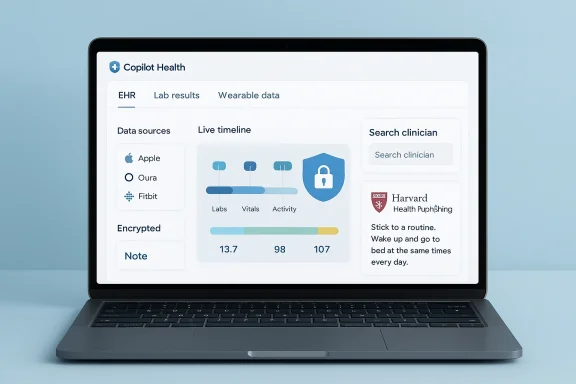
Laptop screen shows Copilot Health EHR dashboard with data sources and live timeline.Background / Overview​

Microsoft announced Copilot Health as a U.S.‑only preview, opening a waitlist for adults 18 and older and positioning the feature as a cautious, phased rollout. The company frames the product as a consumer-facing “health lane” inside Copilot: a private workspace where users can bring together their medical history, lab reports and wearable telemetry so an AI assistant can explain findings, highlight trends, and help prepare users for clinical visits. The announcement emphasizes clinical verification, separate encryption and access controls, and explicit non‑use of uploaded personal health data for future model training. (microsoft.ai)
This launch comes amid an accelerating race among major AI platforms to own consumer health interactions. OpenAI released ChatGPT Health earlier this year and other players—Amazon, Anthropic and specialized startups—are all pushing health‑focused features and connectors. Microsoft’s pitch mixes technical scale (EHR and wearable connectors), editorial provenance (licensed clinical content and expert review), and enterprise pedigree (existing healthcare partnerships and clinician‑facing Copilot products).

What Copilot Health Does: Features and claims​

Copilot Health is presented as an integrated consumer health assistant with several practical capabilities. Key claims from Microsoft’s announcement include:
  • A separate, secure Copilot workspace dedicated to health conversations and data. Conversations and stored health data are isolated from general Copilot interactions and subject to additional access controls and encryption. (microsoft.ai)
  • Support for wearable data from over 50 device models and platforms including Apple Health, Oura and Fitbit, allowing activity, sleep, vitals and other trends to feed into the personal health profile. (microsoft.ai)
  • The ability to pull medical records from more than 50,000 U.S. hospitals and provider organizations through a HealthEx integration, bringing visit summaries, medication lists and test results into the same workspace. (microsoft.ai)
  • Importation and interpretation of lab test results via Function (a lab data connector), so users can receive plain‑language explanations of blood tests and other results. (microsoft.ai)
  • In‑app clinician search and navigation powered by real‑time U.S. provider directories (search by specialty, location, language and insurance) to help users find clinicians who accept their insurance. (microsoft.ai)
  • Strong privacy guarantees in Microsoft’s messaging: Copilot Health data is encrypted at rest and in transit, users can disconnect connectors at any time, and Microsoft states personal data in Copilot Health will not be used to train its general AI models. (microsoft.ai)
Independent reporting and briefings from news outlets confirm many of those headline details and place the release in context: Microsoft intends Copilot Health as a scaled consumer play that leverages prior investments in clinical products and partnerships, and executives describe it as the next major focus area for AI.

How it plugs into the health data ecosystem​

EHR connectivity and HealthEx​

Microsoft states Copilot Health connects to health records from more than 50,000 U.S. providers through HealthEx, a platform that helps standardize provider directories and patient access. If implemented as described, that breadth gives Copilot Health a direct line to real clinical documentation—visit summaries, medication lists and ch is rare for consumer apps. (microsoft.ai)
But “connected” is a broad technical claim. Practical EHR interoperability requires mappings, consent flows, identity matching, and error‑handling for fragmented records. Microsoft’s approach appears to rely on existing third‑party provider‑directory and record‑retrieval services rather than direct integration with every EHR vendor, a pragmatic model that accelerates coverage but introduces variability in completeness and freshness.

Wearables and continuous telemetry​

Copilot Health’s support for more than 50 wearable device models—including Apple Health, Oura and Fitbit—allows it to ingest activity, sleep, and vitals trends across consumer devices. Aggregating these continuous signals with episodic clinical data (labs and notes) is where the product aims to deliver value: spotting correlations (e.g., a persistent drop in sleep efficiency preceding glycemic changes) and presenting them in user‑friendly terms. (microsoft.ai)
Yet device data quality, sampling differences, proprietary metrics, and missing metadata (how a device calculates “resting heart rate”) complicate robust interpretation. Microsoft must standardize or annotate device streams so Copilot Health’s reasoning is transparent and reproducible at the point of care. Community previews and early research reports from Microsoft show the company is aware of these usage patterns, but end-to-end validation across device models remains necessary.

Privacy, safety and governance: what Microsoft promises​

Microsoft emphasized that Copilot Health is designed to be private and governed:
  • Isolation: Health interactions are kept separate from general Copilot usage and subject to additional access controls. (microsoft.ai)
  • Encryption: Data is encrypted at rest and in transit. (microsoft.ai)
  • Control: Users can disconnect data connectors at any time and manage or delete their information. (microsoft.ai)
  • Non‑training guarantee: Microsoft explicitly states Copilot Health data will not be used to train its base AI models. (microsoft.ai)
  • Third‑party validation: The announcement also notes Copilot Health has achieved ISO/IEC 42001 certification for AI management systems, signaling an external audit of how the service is governed. (microsoft.ai)
These elements answer the immediate privacy anxieties associated with handing sensitive medical records to a consumer AI. For consumers, the promise that their personal health data won’t feed back into model training is essential; for regulators and legal teams, the governance and certification claims are a signal that Microsoft is attempting to meet formal expectations. (microsoft.ai)
However, promises must be translated into verifiable operational controls and contractual terms. Non‑use for training is a technical and legal commitment that requires robust access controls, auditing, and sometimes third‑party attestation to be credible. The company’s ISO claim and the involvement of external physician panels are steps toward that credibility—still, independent audits, contractual data‑use limits and transparent retention policies will matter far more to hospitals, payers and privacy regulators than marketing language alone. (microsoft.ai)

Clinical limits and the company’s explicit disclaimers​

Microsoft repeatedly frames Copilot Health as assistive rather than clinical:
  • The service is not intended to diagnose, treat, or prevent disease; it’s meant to help people understand test results, find a specialist, prepare for an appointment, or track trends. (microsoft.ai)
  • The product will surface citations and expert‑written answer cards (Harvard Health Publishing was specifically mentioned), and the company says responses will include clear links to source materials. (microsoft.ai)
This consumer‑oriented posture mirrors how other mainstream AI players have positioned their health offerings: useful for triage, education and navigation—but not a clinical decision tool. The distinction is important, both for user safety and for regulatory classification (a tool that claims to diagnose could be regulated as a medical device).

Strengths and opportunities​

  • Scale of data connectors. Microsoft’s stated access to 50,000 U.S. providers and dozens of wearables gives Copilot Health a practical advantage: breadth of data coverage improves the chance that a user’s records and device streams will be available for synthesis. When that happens, the product can deliver appointment prep, medication red easy lab‑result translations—very tangible consumer benefits. (microsoft.ai)
  • Editorial provenance and expert review. Licensing authoritative content (Harvard Health Publishing) and drawing on an external clinical panel increases the provenance of the guidance Copilot Health serves—this matters because trust in health content rests as much on who wrote or vetted it as on the model’s internal reasoning. (microsoft.ai)
  • Enterprise and technical pedigree. Microsoft already supports clinician‑facing Copilot products (Dragon Copilot, DAX/Dragon integrations and cloud for healthcare), which means Copilot Health’s back end can leverage enterprise security, identity and compliance know‑how developed for hospital customers. That heritage makes partnerships and integration smoother than a consumer startup might achieve.
  • Practical UX improvements for patients. Making lab results and visit summaries readable and actionable can materially improve patient experience. For many users, Copilot Health could reduce confusion, increase appointment effectiveness, and lower the cognitive friction of managing chronic conditions.nd spots and open questions
Any consumer product that ingests medical records and offers advice carries high stakes. Key risks to watch:
  • Accuracy and hallucination. Generative models can confidently state incorrect or misleading information. When the domain is health, a hallucinated claim about medication interactions or lab interpretation can cause real harm. Microsoft’s strategy of layered, cited content and clinical oversight reduces but does not eliminate this risk; rigorous clinical validation and post‑release monitoring will be essential. (microsoft.ai)
  • Data completeness and provenance. EHR entries are noisy, contain clinician shorthand, and split information across multiple systems. HealthEx and other connectors may deliver incomplete or de‑duplicated records. Copilot Health must surface provenance metadata (where each datum came from, timestamp, and whether the record was parsed or OCRd) so users and clinicians can assess reliability.
  • Liability and regulatory classification. If users act on a Copilot Health suggestion and suffer harm, who is responsible—the user, the clinicians who prepared the original notes, the EHR vendor, or Micrplicit non‑diagnostic claim keeps Copilot Health out of certain regulatory categories, but as capabilities expand, regulators in the U.S. and abroad may scrutinize labels, claims and evidence for safety.
  • Privacy vs. utility tradeoffs. Microsoft promises data won’t be used for training, but other uses (analytics, aggregate model improvement, support troubleshooting) are common; users and institutions will expect hard contractual limits, not just marketing language. Additionally, long‑term retention policies, cross‑jurisdictional law enforcement requests, and the company’s obligations under enterprise agreements for shared accounts require transparency. (microsoft.ai)
  • Digital divide and accessibility. Copilot Health launches in English in the U.S. first, which is sensible commercially but limits access for non‑English speakers and people without connected devices or consistent digital identity. Microsoft cites collaborations with community groups like AARP, but equitable access remains a challenge. (microsoft.ai)
  • Vendor lock‑in and interoperability. Heavy reliance on proprietary connectors and third‑party directories can create a lock‑in dynamic: once your records are aggregated into a platform, moving them elsewhere may be frictioned by different schemas and access tokens. Consumers and privacy advocates will want straightforward export tools and clear, standardized consent flows.

How Copilot Health compares to other consumer AI health offerings​

  • OpenAI’s ChatGPT Health: ChatGPT Healthseparate “Health” space to connect medical records and wellness apps; both products emphasize non‑diagnostic support and use connectors to Apple Health and other services. The major differentiator for Microsoft is its broader enterprise footprint in healthcare (Dragon Copilot, Microsoft Cloud for Healthcare) and explicit provider‑directory integrations designed to surface clinicians by insurance and location.
  • Amazon and other competitors: Amazon has targeted health through partnerships and targeted services (e.g., One Medical integrations). Anthropic and specialist vendors have pursued “healthcare‑grade” models and connectors too. The competitive field tilts between consumer reach (OpenAI & Microsoft), deep enterprise integration (Microsoft & AWS), and clinical specialization (vendors working with hospital systems). Microsoft’s advantage is combining consumer UX with enterprise connectors and clinical content licensing.

Practical advice for users and organizations​

If you’re a consumer considering Copilot Health:
  • Treat it as an assistant, not a diagnosis engine. Use it to summarize notes, translate lab jargon, prepare questions for your clinician, or find specialists—not to replace clinical decision making. (microsoft.ai)
  • Check provenance. When Copilot Health summarizes a finding, look for the source (clinic note, lab PDF, wearable) and the timestamp. If the tool can’t cite a source, be skeptical.
  • Use export and deletion controls. If you try the service, test how easy it is to disconnect connectors, export your aggregated record, and delete stored data. These controls are central to meaningful privacy. ([microsoft.ai/news/introducing-copilot-health/))
  • Keep clinicians in the loop. Before acting on any treatment or medication guidance, confirm with your clinician. Save Copilot Health outputs as visit prep, not definitive prescriptions.
If yor clinician evaluating patient use:
  • Clarify expectations with patients about what the assistant provides and what it does not.
  • Establish triage rules for how Copilot‑generated summaries should be handled in the workflow (e.g., flagged for review vs. direct incorporation into the medical record).
  • Audit data flows and consent. Ensure that records exported to consumer apps are covered by appropriate consents and that re‑identification risks are understood.
  • Negotiate data‑use terms that include audit rights, breach notification timelines, and verifiable non‑training clauses for patient data.

Technical and regulatory roadmap Microsoft must address​

  • Evidence of clinical validation. Microsoft has signaled internal research paths and cited MAI‑DxO and other research initiatives; publishing peer‑reviewed validation studies demonstrating Copilot Health’s safety and efficacy in specific use cases will be crucial. (microsoft.ai)
  • Third‑party audits and transparency reports. ISO/IEC 42001 is an important governance milestone, but ongoing independent audits, model cards, red‑team results and transparency reporting on incidents will increase trust. (microsoft.ai)
  • Robust consent and identity flows. Accurate identity matching across EHRs and wearable accounts is nontrivial. Microsoft must make matching errors obvious and provide streamlined remediation.
  • Cross‑jurisdictional privacy handling. As Microsoft expands beyond the U.S., it will face divergent privacy regimes (GDPR, regional laws). A unified approach that defaults to the strictest reasonable standard will reduce legal friction.

What this means for Windows and the Microsoft ecosystem​

Copilot Health strengthens Microsoft’s narrative of Copilot as a platform that spans personal productivity, enterprise workflows and now deeply personal health experiences. For Windows users and the broader Microsoft ecosystem, the play is strategic:
  • It ties consumer engagement to Microsoft accounts and Copilot apps, increasing the stickiness of the Copilot product family.
  • For healthcare customers already on Microsoft Cloud, tighter consumer‑to‑enterprise integration may create new service opportunities (patient portals, home monitoring programs).
  • It also magnifies the reputational risk for Microsoft: health mistakes or privacy missteps will have amplified public consequences and stricter regulatory scrutiny. (microsoft.ai)

Final assessment: promise tempered by responsibility​

Copilot Health is an ambitious, well‑resourced entry into consumer health AI. Microsoft’s connectors (50,000+ U.S. providers; 50+ wearable models), licensed clinical content, governance commitments and enterprise healthcare investments give the product real potential to ease common patient pain points—lab confusion, appointment prep, and fragmented record understanding. (microsoft.ai)
At the same time, the product surfaces classic tensions in AI for medicine:
  • The promise of better understanding versus the peril of incorrect or harmful guidance.
  • The convenience of aggregated records versus the long tail of interoperability, provenance and identity errors.
  • The marketing reassurance of non‑training commitments versus the need for independent audits, contractual limits and transparent retention policies.
For users, the immediate takeaway is pragmatic: Copilot Health can be a powerful assistant for understanding your health data and navigating care, if you treat its outputs as preparatory, not prescriptive; verify provenance; and keep your clinician involved. For Microsoft and regulators, the next phase must be proof—peer‑reviewed validation, transparent audits, strong contractual privacy guarantees, and ongoing monitoring—before Copilot Health matures from a useful consumer tool into a trusted component of everyday health workflows. (microsoft.ai)

Copilot Health puts Microsoft squarely into the consumer health AI battleground. It’s a sensible, capability‑rich first step—one that could meaningfully reduce friction for millions of patients—but its long‑term value will depend on how rigorously Microsoft backs up privacy promises, how transparently it reports validation results, and how effectively it mitigates the real clinical risks that accompany any AI‑driven health assistant.

Source: Informat.ro Copilot Health, launched by Microsoft: AI assistant for health with a focus on privacy, broad compatibility with wearable devices, and specialist search in the USA
 

Back
Top