

Microsoft’s Copilot AI has once again grabbed theadlines for its uncanny run at predicting NFL outcomes, this time delivering single-score forecasts for both the AFC and NFC championshipp games in the 2025 postseason — and prompting fresh questions about the editorial, technical, and ethical limits of using large language models as forecasting tools in sports journalism. USA TODAY’s experiment published Copilot’s picks for the conference title games (New England Patriots 23, Denver Broncos 20; Seattle Seahawks 27, Los Angeles Rams 17) and framed those outputs alongside short, human-crafted analysis. The experiment’s reported accuracy so far — a near-perfect playoff ledger and strong regular-season numbers in USA TODAY’s published ledger — makes for an attention-grabbing narrative, but the deeper story is less about a betting oracle and more about how newsroom workflows must adapt when generative AI becomes part of the production line. review
USA TODAY’s Copilot experiment is deliberately simple: editors feed Microsoft Copilot a single, canonical prompt per matchup — essentially, “Can you predict the winner and score for Team A vs. Team B?” — and publish the assistant’s deterministic, single-score output alongside a short human read that corrects obvious errors or contextualizes fragile claims. That workflow scales fast: a full weekly slate can be produced and editorialized in minutes, and the AI’s natural‑language rationales are readable and directly usable for preview copy or social cards. The format’s utility is the experiment’s core selling point.
Across the season weeks, USA TODAY reported that Copilot has produced headline-friendly results — strong weekly hit rates and an aggregated season ledger that reads like a marketer’s dream. The same files show editors repeatedly confronting three recurring problems: stale injury context, overprecision from single-point forecasts, and occasional hallucinatory metric claims. USA TODAY’s newsroom mitigated those risks with an explicit human-in-the-loop: re-prompting Copilot to correct stale facts and appending short human reads that flag conditional claims.
At the moment of USA TODAY’s championshi playoff ledger — as reported alongside the picks — was striking on paper: the assistant’s playoff record was presented as 9–1, and its 2025 regular-season record was quoted as 177–94–1. Those figures demonstrate why outlets are tempted to treat these outputs as something more than novelty copy, but they also underline why editorial provenance and process matter. The numbers reflect an experiment’s internal tally, not an audited forecasting scorecard validated against transparent methodology and real-time data feeds.
: New England Patriots 23, Denver Broncos 20
Copilot favored the Patriots and delivered a tight final-score forecast, citing New England’s postseason defensive performance as the key driver. The AI described the Patriots defense as “suffocating” in the postseason and expressed hesitation about backing Jarrett Stidham in place of injured starter Bo Nix, while also crediting Denver’s pass rush with keeping the game competitive. USA TODAY’s human read amplified that defense-first narrative and noted that if rookie QB Drake Maye cleans up costly turnovers and fumbles, New England’s well-coached defense should be able to tilt the outcome.
External reporting of the divisional outcomes that set up this matchup corroborate context Copilot referenced: Denver’s narrow overtime win over Buffalo (33–30) and Bo Nix’s ankle injury pushed Jarrett Stidham into the starting role for the Broncos, while New England’s divisional win over Houston (28–16) reinforced the Patriots’ postseason momentum. Those outcomes and injury notes were widely reported by independent outlets in the lead-up to the AFC title game.
Independent sportsbooks and projection models in the same window treated the game as close but leaned toward Seattle — oddsmakers set modest Seahawks favorites and low-to-moderate totals that reflected defensive strength on both sides. That market view aligns with Copilot’s intuition that the matchup would be competitive but tilt to an elite Seattle defense at home.
But there are critical caveats:
But the experiment also exposes enduring operational and ethical limits: data freshness, overprecision from deterministic scores, hallucinated metric claims, and the market consequences of widely published AI picks. The right editorial posture is neither reflexive rejection nor naive embrace. Instead, publishers should adopt a disciplined human-in-the-loop workflow, integrate authoritative live data feeds, convert point forecasts into probabilistic outputs, and publish provenance and calibration metrics so readers can judge the results for themselves. When used with those guardrails, Copilot-style systems can deliver real value — fast, explainable preview copy and useful hypothesis generation — without trading away trust or accuracy in the rush for novelty.
In short: Copilot’s predictions are a powerful example of generative AI’s editorial utility, but they are not a substitute for disciplined verification, probabilistic thinking, and the professional judgment that newsroom processes exist to protect.
Source: USA Today AFC and NFC championship game predictions by Microsoft Copilot AI
USA TODAY’s Copilot experiment is deliberately simple: editors feed Microsoft Copilot a single, canonical prompt per matchup — essentially, “Can you predict the winner and score for Team A vs. Team B?” — and publish the assistant’s deterministic, single-score output alongside a short human read that corrects obvious errors or contextualizes fragile claims. That workflow scales fast: a full weekly slate can be produced and editorialized in minutes, and the AI’s natural‑language rationales are readable and directly usable for preview copy or social cards. The format’s utility is the experiment’s core selling point.
Across the season weeks, USA TODAY reported that Copilot has produced headline-friendly results — strong weekly hit rates and an aggregated season ledger that reads like a marketer’s dream. The same files show editors repeatedly confronting three recurring problems: stale injury context, overprecision from single-point forecasts, and occasional hallucinatory metric claims. USA TODAY’s newsroom mitigated those risks with an explicit human-in-the-loop: re-prompting Copilot to correct stale facts and appending short human reads that flag conditional claims.
At the moment of USA TODAY’s championshi playoff ledger — as reported alongside the picks — was striking on paper: the assistant’s playoff record was presented as 9–1, and its 2025 regular-season record was quoted as 177–94–1. Those figures demonstrate why outlets are tempted to treat these outputs as something more than novelty copy, but they also underline why editorial provenance and process matter. The numbers reflect an experiment’s internal tally, not an audited forecasting scorecard validated against transparent methodology and real-time data feeds.
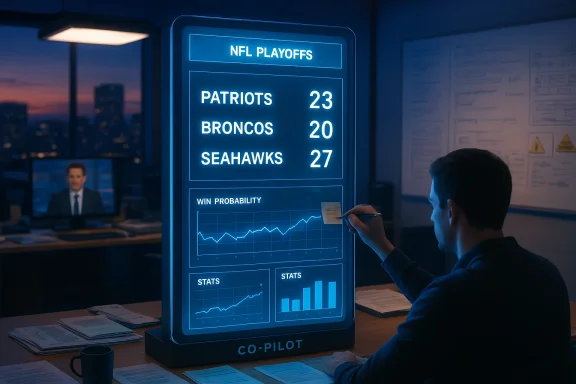 What Copilot picked for the conference championships
: New England Patriots 23, Denver Broncos 20Copilot favored the Patriots and delivered a tight final-score forecast, citing New England’s postseason defensive performance as the key driver. The AI described the Patriots defense as “suffocating” in the postseason and expressed hesitation about backing Jarrett Stidham in place of injured starter Bo Nix, while also crediting Denver’s pass rush with keeping the game competitive. USA TODAY’s human read amplified that defense-first narrative and noted that if rookie QB Drake Maye cleans up costly turnovers and fumbles, New England’s well-coached defense should be able to tilt the outcome.
External reporting of the divisional outcomes that set up this matchup corroborate context Copilot referenced: Denver’s narrow overtime win over Buffalo (33–30) and Bo Nix’s ankle injury pushed Jarrett Stidham into the starting role for the Broncos, while New England’s divisional win over Houston (28–16) reinforced the Patriots’ postseason momentum. Those outcomes and injury notes were widely reported by independent outlets in the lead-up to the AFC title game.
NFC Championship: Seattle Seahawks 27, Los Angeles Rams 17
Copilot’s NFC prediction leaned on the Seahawks’ dominant divisional-round performance — a 41–6 beatdown of the San Francisco 49ers — and described Seattle’s victory as “one of the strongest postseason statements any team has made.” The AI contrasted that with the Rams’ two narrow wins to reach the title game and emphasized Seattle’s physicality, crowd advantage at Lumen Field, and balanced offensive attack as decisive factors. USA TODAY’s human read acknowledged that the Rams’ history with the Seahawks produced several two-point games during the regular season, but still citing defensive edge and home-field conditions.Independent sportsbooks and projection models in the same window treated the game as close but leaned toward Seattle — oddsmakers set modest Seahawks favorites and low-to-moderate totals that reflected defensive strength on both sides. That market view aligns with Copilot’s intuition that the matchup would be competitive but tilt to an elite Seattle defense at home.
Why these picks matter — and what they don’t
Copilot’s outputs are valuable as content accelerants. They synthesize conventional handicapping heuristics — quarterback form, pass-rush versus protection matchups, run-fit advantages, and roster health — into crisp prose that journalists can quickly reuse. For fast-moving sports desks producing preview copy, that produces measurable savings in fort. The USA TODAY experiment demonstrates that editorial teams can produce publishable, readable preview content from Copilot faster than with purely human-only workflows.But there are critical caveats:
- Deterministic single-score forecasts imply unjustified precision. A single-point projection hides the distribution of plausible outcomes (win probability, expected point differential, percentilhe output appear far more confident than the underlying information warrants. Responsible forecasting favors probabilistic outputs or calibrated ranges.
- Data freshness is the dominant operational risk. LLMs that rely on cached knowledge or snapshot indexes routinely miss late-breaking signals (Sunday-morning scratches, practice reports, last-minute weather). USA TODAY editors had to re-prompt Copilot when the model cited stale injury information — an indispensable human safety valve.
- Hallucinated metrics and opaque weighting. When asked for causal detail, LLMs can invent plausible-sounding metrics or ordinal rankings (e.g., "No. 1 in defensive EPA per play") wce or timestamps. That makes metric claims difficult to validate and dangerous if published as authoritative.
Strengths observed in the Copilot experiment
- Speed and scale: Copilot can produce a full weekly slate of winner-and-score predictions in minutes, including short rationales that editors can reuse directly for preview copy or social he drafting time for busy sports desks and scales easily to larger editorial operations.
- Narrative alignment with human heuristics: The assistant tends to apply the same high‑signal handicapping inputs experienced analysts use — quarterback status, pass rush leverage, run defense vs. opponent rush offense — which makes its outputs read as conventional, defensible previews rather than off-tThat alignment is why many of the picks are directionally sensible.
- Readability and reuse: Copilot produces concise, human-like rationales that are editorially friendly. For newsroom production, that usability is not merely convenience — it is a production multiplier that can free jougher-value verification and nuanced analysis.
Persistent failure modes and risks
- Data freshness: Because match-day availability and injuries are fast-moving, an LLM without integrated, authoritative live feeds is brittle. Misstating a starter or active list can flip a pick’s plausibility in an instant. USA TODAY editors explicitly rechecked active/inactive lists, showing is non-negotiable.
- Overprecision and false confidence: Single-score outputs imply a level of certainty that’s unjustified in a stockhastic contest. Presenting a point forecast without a calibrated win probability risks misleading readers and bettors. Editorial teams should convert point estimates into probability bands or Monte‑Carlo distributions before publishe.
- Hallucinations and unverifiable metric claims: When the model asserts precise rankings or advanced‑metric claims, editors should demand provenance — which provider, what date, and what calculation. Without that metadata, ordinal claims about EPA, pressure rate, or yards per carry can be misleading or outright incorrecnd ethics: Publishing deterministic AI picks to large audiences can influence betting markets and create reflexive price movement. Outlets must carefully label AI-generated content and avoid presenting it as betting advice; they should also consider whether deterministic outputs should be accompanied by explicit confidence metrics.
Cross-che(verification)
To ensure the most load-bearing claims were grounded in fact, the published Copilot picks and the game-setting context were cross-checked against multiple independent outlets.- The divisional outcomes that set the championship matchups — Denver’s narrow overtime win over Buffalo and Bo Nix’s ankle injury, plus New England’s win over Houston — were reported in independent outlets covering playoff results and injury updates, corroborating the match-day context Copilot used when producing its AFC pick.
- The Seahawks’ dominant 41–6 divisional-round win over the 49ers and the Rams’ narrow overtime win to reach the NFC title game were similarly reported across multiple sports sites and matched the contextual facts referenced in Copilot’s NFC rationale. The pregame market lines and opening odds also broadly aligned with the AI’s directional view that the Seahawks would be favored at home.
- Model performance claims quoted in USA TODAY (e.g., a reported playoff ledger and season tally) are internal experiment numbers and were published as such in USA TODAY’s packages. Those internal tallies should be treated as editorial reporting of the experiment’s outcome, not as externally audited model-performance metrics. The experiment files repeatedly flag the need to publish data-cutoff timestamps and provenance when reporting performance, a best practice that preserves audience trust.
Practical newsroom recommendations
- Integrate authoritative, real-time data feeds before publishing picks as decision-grade content.
- Supply the LLM with active/inactive lists, official injury reports, and late practice notes as structured inputs.
- Require a final editorial verification step to confirm any roster-dependent claims.
- Move from single-point forecasts to probabilistic outputs.
- Ask the model (or an ensemble model) for win probability, expected point differential, and a credible score distribution (median and 25th–75th percentiles).
- Publish a confidence meter or calibration metric (e.g., historical Brier score) alongside AI predictions.
- Maintain a documented prompt and model log.
- Lock the prompt template and record the model version used, the data-cutoff timestamp, and any human edits applied to the output.
- Publish provenance metadata with each AI-assisted prediction so readers can evaluate context and freshness.
- Ensemble LLM outputs with structured models.
- Combine Copilot’s readable rationales with a statistical model that simulates thousands of outcomes from updated team metrics and market odds.
- Display both the narrative (LLM) and the numbers (simulation) to give readers both readability and calibrated probabilities.
- Label outputs clearly and manage market impact.
- Avoid releasing deterministic AI picks as betting advice.
- Publish clear disclaimers and explicit instructions to confirm late-breaking injury and lineup reports before wagering.
Technical considerations for product teams
- Retrieval augmentation and live data connectors are non-negotiable for time-sensitive forecasting. Feeding Copilot a stream of verified week‑of signals (inactives, practice reports, weather) reduces brittleness.
- Calibration tooling: publish a public performance ledger with calibration metrics (Brier score, hit rates against implied market probability) to help readers evaluate real-world skill.
- Explainability: instrument model outputs to include the top features or signals that drove the prediction (e.g., “pass rush pressure rate accounted for X% of the simulated edge”), even if those numbers are approximate. Transparent weighting helps editorial verification.
- Ensemble architecture: pair LLM narrative outputs with structured statistical engines that can be backtested and stress-tested against market movements and extreme scenarios.
Ethical and commercial implications
Deploying AI-generated picks at scale raises meaningful ethical and commercial questions for publishers:- Transparency obligations: Readers deserve to know the provenance of any AI-derived claim. Publishing the model identity, prompt, and data cutoffs is part of that duty.
- Gambling-related responsibility: Deterministic AI picks can be interpreted as betting advice. Publishers should avoid presenting AI outputs as guaranteed betting guidance and should add robust disclaimers and probabilistic framing.
- Brand risk: An AI’s streak of accuracy can create a halo effect that encourages readers to over-trust outputs. Publishers must manage expectations with clear disclosure and historical performance metrics.
- Market reflexivity: Large audiences acting on the same AI-driven signals can move betting back loops. Editorial teams should evaluate whether and how to moderate release timing or presentation format to avoid artificially amplifying market movement.
Conclusion
Microsoft Copilot’s conference‑championship picks — and USA TODAY’s willingness to publish them with short human reads — are an instructive case study in what generative AI can and cannot do for sports journalism. The AI’s strengths are obvious: speed, readable rationales, and an ability to mirror human handicapping heuristics at scale. Those strengths make Copilot an effective content accelerator for time-pressured sports desks.But the experiment also exposes enduring operational and ethical limits: data freshness, overprecision from deterministic scores, hallucinated metric claims, and the market consequences of widely published AI picks. The right editorial posture is neither reflexive rejection nor naive embrace. Instead, publishers should adopt a disciplined human-in-the-loop workflow, integrate authoritative live data feeds, convert point forecasts into probabilistic outputs, and publish provenance and calibration metrics so readers can judge the results for themselves. When used with those guardrails, Copilot-style systems can deliver real value — fast, explainable preview copy and useful hypothesis generation — without trading away trust or accuracy in the rush for novelty.
In short: Copilot’s predictions are a powerful example of generative AI’s editorial utility, but they are not a substitute for disciplined verification, probabilistic thinking, and the professional judgment that newsroom processes exist to protect.
Source: USA Today AFC and NFC championship game predictions by Microsoft Copilot AI
