

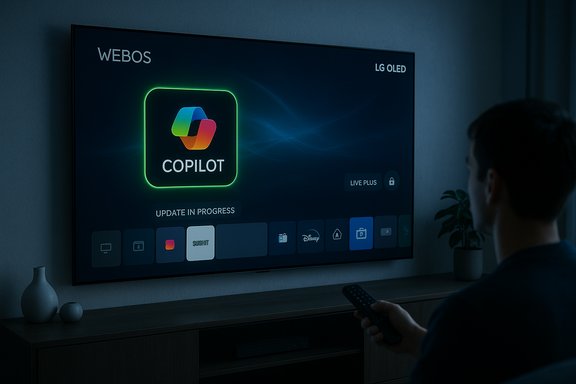
LG owners discovered Microsoft’s Copilot on their home screens after a routine webOS firmware push — and for many the app appears as a system-level component that can be hidden but not uninstalled, touching off a wave of backlash about forced software, privacy, and platform control.
At CES 2025 Microsoft, LG and other TV makers framed Copilot as the next step for TV user interfaces: a conversational assistant to help with content discovery, contextual questions about what’s on screen, and an AI-driven “search” experience built into modern smart-TV home screens. Early coverage and vendor announcements established the intent to bring Copilot to televisions as part of broader webOS and platform AI upgrades. In the weeks following those announcements, multiple LG owners reported that a webOS firmware-over-the-air (FOTA) update had delivered a new “Copilot” tile to their home screen. The consistent detail across community reports is not simply that Copilot appeared, but that the TV’s normal app-management UI did not offer an uninstall option — in many cases users could hide the tile but not delete it, and a factory reset reportedly restored the tile. Those on-the-ground reports are documented across consumer forums and social media threads. This development sits at the intersection of three trends: (1) the rapid push to add conversational AI across device categories, (2) OEMs using firmware pushes to add platform features and partner services, and (3) growing consumer sensitivity to deeply embedded services that are difficult to opt out of. The result is an unexpectedly sharp debate about the limits of vendor control over software on devices consumers have already purchased.
Regulators and consumer advocates have shown increased interest in opaque preinstalled software and post‑sale changes to device behavior. Where those regulators focus on transparency and persistent consent, episodes like this one could stimulate new rules or clearer industry guidance on uninstallability, update disclosures, and default privacy settings.
This episode will be a useful case study for policymakers and platform designers alike: AI can add tangible value to TV experiences, but only if deployment respects transparency, consent, and user autonomy. The conversation now shifts to whether LG (and Microsoft) will publish the technical details, provide removal options, or change update practices — or whether the controversy will settle as a cautionary tale about how not to ship AI into living rooms.
Key practical reminders for readers who want immediate action:
Source: www.guru3d.com https://www.guru3d.com/story/microsoft-copilot-forced-onto-lg-smart-tvs-via-webos-update/
 Background / Overview
At CES 2025 Microsoft, LG and other TV makers framed Copilot as the next step for TV user interfaces: a conversational assistant to help with content discovery, contextual questions about what’s on screen, and an AI-driven “search” experience built into modern smart-TV home screens. Early coverage and vendor announcements established the intent to bring Copilot to televisions as part of broader webOS and platform AI upgrades. In the weeks following those announcements, multiple LG owners reported that a webOS firmware-over-the-air (FOTA) update had delivered a new “Copilot” tile to their home screen. The consistent detail across community reports is not simply that Copilot appeared, but that the TV’s normal app-management UI did not offer an uninstall option — in many cases users could hide the tile but not delete it, and a factory reset reportedly restored the tile. Those on-the-ground reports are documented across consumer forums and social media threads. This development sits at the intersection of three trends: (1) the rapid push to add conversational AI across device categories, (2) OEMs using firmware pushes to add platform features and partner services, and (3) growing consumer sensitivity to deeply embedded services that are difficult to opt out of. The result is an unexpectedly sharp debate about the limits of vendor control over software on devices consumers have already purchased.What actually happened — verified facts
- Multiple community threads and firsthand posts document that some LG webOS TVs received a routine firmware update that added a Copilot tile to the home screen. The pattern is replicated across models and regions in forum reports.
- Users report the Copilot tile can be hidden but not uninstalled through the standard app manager UI; the absence of the usual uninstall affordance has been repeatedly noted in screenshots and step-by-step posts.
- A number of owners report that performing a factory reset does not permanently remove the Copilot tile; after reset the tile reappears, consistent with a system-level or firmware-baked installation. This behaviour has been widely discussed in community troubleshooting threads.
- LG publicly announced significant AI upgrades to webOS (webOS Hub 3.0 / webOS 25) and has documented standard FOTA update mechanisms for TVs; those vendor materials confirm that new system features and apps can be delivered by firmware updates.
How and why the Copilot tile may be non-removable
Technical packaging patterns that make apps “undeletable”
There are two common mechanisms device manufacturers use that explain a non-removable app behavior:- Install as a privileged system package: the vendor delivers the component outside the normal user app sandbox and marks it as a system app. The user-facing UI typically exposes only limited management (hide/disable) but not uninstall.
- Bake the package into the firmware image: the app becomes part of the installed firmware image so a factory reset re-applies the same image and the app returns.
The business logic behind embedding Copilot
From the vendor perspective, several clear incentives explain why Copilot would be distributed widely and deeply:- Feature differentiation — AI experiences are headline features that can be marketed as premium differentiators when panel hardware parity grows.
- Ecosystem reach — Microsoft benefits by expanding Copilot’s footprint beyond PCs and phones into household screens.
- Monetization and personalization — an assistant that can access on-screen context and behavioral signals can improve personalization and, indirectly, ad or promotional performance.
The privacy risk vector: why Copilot + Live Plus worries people
LG’s webOS platform includes an Automatic Content Recognition (ACR) framework — often referenced in menus as Live Plus or similar — which can analyze what’s on screen to surface contextual promotions, metadata overlays, and personalized recommendations. Live Plus and its related viewing-information services are documented parts of webOS and can be toggled off in settings, but the feature is often prominent in platform personalization flows. A conversational assistant like Copilot gains utility from context: knowing what program you’re watching, timestamps, or scene metadata enables richer replies and recommendations. That same context is exactly what ACR supplies. When a privileged assistant is added to the system image and ACR remains enabled or defaulted on, the combination increases the telemetry surface area and amplifies concerns about profiling, ad targeting, and persistent behavioral tracking. Community posts flag this interplay — Copilot’s arrival plus default-on personalization features is the central privacy worry. Caveat: claims that Copilot changed or added new classes of telemetry (for example, continuous ambient audio capture) are plausible but remain unverified without vendor disclosure or independent network/firmware forensics. Treat those claims as serious concerns that require technical confirmation.Strengths and legitimate benefits of Copilot on TVs
- Real utility for discovery: An assistant that understands context can turn clumsy remote-based search into a conversational discovery experience — e.g., “What is that actor doing right now?” or cross-app searches for a show.
- Accessibility: Voice and conversational agents can make TVs easier to use for people with mobility or vision limitations.
- Platform evolution: OEMs argue that embedding intelligent features keeps webOS competitive against other TV platforms that are pushing AI or improved UX features. LG’s webOS AI roadmap reflects these product goals.
Key risks and why the backlash matters
- Loss of consumer agency: Shipping a service that users cannot remove from owned hardware feels like a forced addition to purchased property. That’s a durable consumer-relations problem and a regulatory red flag in some jurisdictions.
- Opaque update behavior: Firmware updates happen with little fanfare for many users; surprise feature additions without clear consent degrade trust.
- Privacy amplification: If the assistant uses ACR or other contextual signals, that widens the data collected from households — and users rightly demand precise disclosure and granular controls around such flows.
- Monetization misalignment: Home-screen inventory and assistant-driven promotions create incentives to optimize for engagement and ad performance rather than purely user-facing utility.
Practical mitigations for affected owners
These options are organized from least to most disruptive. Each involves tradeoffs; none is perfect.- Toggle Live Plus / ACR and ad personalization off.
- Path (menu wording varies by model): Settings → All Settings → General → System → Additional Settings → Live Plus (or Live Promotion) and related ad personalization toggles. This reduces contextual signals but does not remove a system app.
- Hide the Copilot tile and avoid signing into a Microsoft account on the TV.
- Hiding removes daily visibility and reduces account-tied personalization.
- Keep the TV offline or block telemetry at the router.
- Disconnecting Wi‑Fi prevents cloud calls and remote updates, but breaks native streaming apps. Router-level blocking (Pi-hole, firewall rules) is a technical option but can be brittle and may interfere with legitimate services.
- Use an external streamer (Apple TV, Roku, Fire TV, Nvidia Shield).
- Route streaming via an external device and treat the TV as a display. This largely sidesteps webOS for daily streaming but sacrifices some integrated features and convenience.
- Factory reset (with caution).
- A reset may remove user-level changes but will typically re-apply the installed firmware image — if Copilot is baked into that image it will return. Do not rely on reset as a guaranteed removal unless a vendor-supplied rollback exists.
- Seek vendor support or consumer remedies.
- If the added software materially changed functionality users were promised at purchase, pursue official LG support channels, retailer remedies, or consumer-protection options in your jurisdiction.
What LG and Microsoft have said (and what remains unanswered)
- Microsoft and several TV OEMs publicly announced Copilot integrations for TV platforms at CES and in subsequent product marketing; these announcements established intent but did not detail packaging mechanics for updates.
- LG’s newsroom and platform documentation outline webOS Hub 3.0 / webOS 25 AI features and the standard FOTA update process, but vendor press materials typically do not describe whether partner apps will be installed as removable user apps or as system-level components.
- As of the current community reporting, there is no vendor technical bulletin publicly confirming that Copilot was intentionally packaged as a non-removable system app in a specific firmware build. That admission — or an explicit firmware-change note and removal pathway — would settle the most consequential technical question. Until then, independent firmware analysis or an LG technical statement is required to fully verify packaging choices.
How this fits into a broader trend: AI push vs. consumer control
The Copilot-on-TV episode is an instance of a broader pattern: platform owners and large vendors are rapidly integrating AI experiences into commodity hardware. The marketing case is strong — unique AI features sell hardware — but the execution pattern is repeating: rapid rollouts, unclear opt-in mechanics, and surprises for customers who expected a stable, controllable device.Regulators and consumer advocates have shown increased interest in opaque preinstalled software and post‑sale changes to device behavior. Where those regulators focus on transparency and persistent consent, episodes like this one could stimulate new rules or clearer industry guidance on uninstallability, update disclosures, and default privacy settings.
Recommended short-term steps for LG, Microsoft and other OEMs
- Publish clear update notes and a short, user-friendly explanation before delivering FOTA updates that change visible services.
- Provide an explicit uninstall or opt-out path for partner apps that are not essential to platform security or DRM.
- Default privacy-preserving settings for any assistant that can access contextual signals (ACR, microphones), and make the opt-in step visible at both account and device levels.
- Offer a firmware rollback or documented removal path if users object to newly installed partner services.
Final analysis and what to watch next
The Copilot appearance on LG webOS TVs — installed via firmware updates and widely reported as non-removable in the field — is a textbook show of how fast product roadmaps and platform monetization strategies can collide with user expectations about device ownership and privacy. Community reporting provides strong empirical evidence of the behaviour; vendor confirmations and technical firmware analysis are still the missing pieces that would turn strong inference into definitive fact. For owners, practical mitigations (hide the tile, disable Live Plus, avoid account sign-in, or use an external streamer) reduce exposure but do not fully address the structural problem: a purchased device whose software can be permanently changed without an easy opt-out undermines consumer control. For OEMs, the path forward should be simple: be explicit about what updates change, default to privacy-first settings, and give users real choices.This episode will be a useful case study for policymakers and platform designers alike: AI can add tangible value to TV experiences, but only if deployment respects transparency, consent, and user autonomy. The conversation now shifts to whether LG (and Microsoft) will publish the technical details, provide removal options, or change update practices — or whether the controversy will settle as a cautionary tale about how not to ship AI into living rooms.
Key practical reminders for readers who want immediate action:
- Turn off Live Plus / ACR in your TV’s settings to limit contextual signal sharing.
- Hide the Copilot tile and avoid signing into a Microsoft account on the TV.
- If you need a clean, controllable smart interface, consider routing streaming through an external device you control.
Source: www.guru3d.com https://www.guru3d.com/story/microsoft-copilot-forced-onto-lg-smart-tvs-via-webos-update/
