

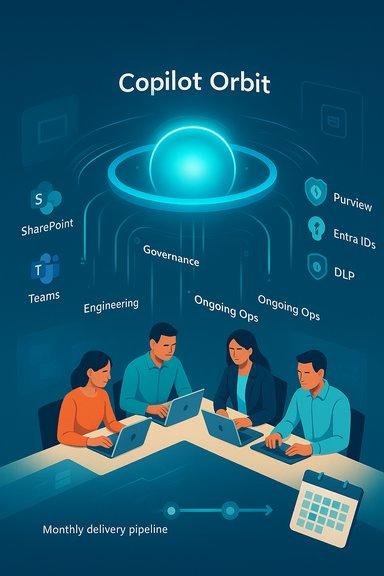
ESW has rolled out Copilot Orbit, a managed Copilot‑agent program aimed squarely at small and mid‑sized businesses that want production‑grade AI automation but lack a full in‑house AI team — a subscription service that bundles governance, data grounding, connector integration, and a repeatable monthly delivery cadence so organizations can move beyond brittle pilots to reliable, tenant‑aware agentic workflows.
Background / Overview
Microsoft’s Copilot platform has matured rapidly into a tenant‑aware ecosystem of in‑app assistants, low‑code authoring (Copilot Studio), connector‑based grounding (Graph/Dataverse/SharePoint), and expanded governance controls (Purview, Entra agent identities, Defender integration). These platform advances make it practical for partners to deliver agent‑based automation as an operational service rather than a one‑off experiment. Microsoft’s recent SMB‑focused offer, Microsoft 365 Copilot Business at $21 per user per month and targeted at organizations up to 300 seats, further lowers the licensing barrier for small businesses to adopt tenant‑aware Copilot capabilities. ESW positions Copilot Orbit as a managed, channel‑friendly answer to the common pattern: lots of AI pilots that never scale because the work required to secure, ground, integrate, test and operate agents is not merely model access — it’s production‑engineering, governance and change management. ESW’s public announcement and supporting blog post describe a subscription model delivering governance, monthly automation rollouts, telemetry and ongoing tuning — with three tiered plans labeled Core, Plus, and Scale.What Copilot Orbit is (and what it promises)
Core components and delivery model
Copilot Orbit consolidates four operational pillars into a single managed offering:- Governance and compliance — Purview/DLP alignment, Entra agent identity lifecycle, policy application and audit controls.
- Data grounding and connectors — Indexing and mapping content in SharePoint, Teams, OneDrive, Exchange and SQL so agents respond and act against authoritative tenant data.
- Agent & automation engineering — Prompt design, Copilot Studio authoring patterns, Power Automate flows, Teams/SharePoint plugins, deterministic writeback logic and staged testing.
- Ongoing ops & cadence — A monthly delivery pipeline that produces new agents or automations, plus telemetry, tuning and user enablement so value compounds instead of decaying.
- Core: Governance, monitoring, backlog management.
- Plus: Core + one new agent/automation per month.
- Scale: Two to three automations monthly, adoption enablement, and executive reporting.
Why a managed subscription matters for SMBs
Many small organizations can buy Copilot licenses but cannot reliably move a use case from proof‑of‑concept to production. The blocking work is often non‑model: content hygiene, permissions mapping, DLP alignment, identity and lifecycle controls, connector reliability, deterministic orchestration (Power Automate), and telemetry/FinOps guardrails. Copilot Orbit’s proposition is to externalize that operational burden into a predictable monthly cost and a partner team that handles the heavy lifting.How Copilot Orbit maps to Microsoft platform realities
Governance and policy alignment
Microsoft has been explicit about tightening DLP and governance for agents. Copilot Studio moved DLP enforcement from optional to a phased default, and Microsoft added Entra Agent IDs so agents have auditable identities within a tenant. Any managed program that publishes and runs agents must integrate with these primitives; ESW lists Purview/DLP and Entra identity alignment as foundational to Copilot Orbit. That alignment is essential to reduce leakage, preserve least‑privilege access, and keep agents auditable.Grounding, RAG patterns and connectors
Reliable agent behavior requires grounding — connecting language models to authoritative corporate sources via RAG (Retrieval‑Augmented Generation) or native connectors. ESW notes SharePoint, Teams, OneDrive, Exchange and SQL as the primary grounding sources, and promises mapping/indexing work so agents pull the right context. This follows Microsoft guidance to use Graph, Dataverse, and Power Platform connectors to avoid hallucinations and provide provenance. However, grounding often exposes content‑management mess (permissions inconsistencies, outdated documents), which means a non‑trivial remediation phase before agents can be trusted.Engineering pattern: LLM reasoning + deterministic orchestration
Best practice for production automations pairs LLMs for language understanding and decisions, with deterministic orchestrators (Power Automate) for retries, error handling, validation and safe writebacks. ESW’s service list — prompt engineering, Power Automate flows, plugins and testing — matches this pattern. It’s a pragmatic design: let the AI propose and draft; let deterministic logic perform transactional updates only after rules and human checkpoints.Strengths: where Copilot Orbit could deliver real value
- Channel-ready operational model: Packaging governance, connectors and development into a subscription reduces the barrier for SMBs that lack in‑house AI governance or platform teams. That reduces time‑to‑value and shifts risk to a specialist partner.
- Alignment with Microsoft primitives: By using Copilot Studio, Power Platform, Purview and Entra features, Copilot Orbit leverages existing enterprise controls and avoids reinventing security or identity. That alignment makes audits and compliance reviews simpler.
- Operational cadence and continuous improvement: A monthly delivery model forces prioritization and continuous tuning, preventing “bot rot” and ensuring automations evolve with changing data and processes.
- Clear scope for SMB scenarios: Use cases ESW highlights — invoice processing, HR onboarding, proposal drafting and help‑desk triage — are high ROI, repeatable processes where automation will be easier to scope and measure.
Risks and unresolved questions (what buyers must validate)
- Vendor promise vs. reality: The claim “agents that automate your company” is aspirational. Real automation value depends on data quality, content hygiene, permissions posture and process clarity. Buyers should treat outcome claims as conditional on prework.
- Model errors and writeback risk: Even grounded agents make mistakes. The most serious exposures happen when agents are given authority to writeback to ERP, HR, or financial systems. Contracts must require human‑in‑the‑loop for high‑risk writebacks and staged ramp‑ups before any live production writes.
- Data residency and third‑party routing: If Copilot or partner tooling routes tenant data to third‑party inference endpoints or non‑Microsoft models, legal and procurement teams must clarify retention, telemetry and contractual protections. Treat any routing to non‑Microsoft endpoints as a material risk until expressly approved.
- FinOps and consumption surprises: Agent activity consumes Copilot credits and model inference cycles; without consumption monitoring and caps, unexpected usage spikes can produce billing shock. Contracts should include dashboards, caps and alerts.
- Agent lifecycle & ownership: Agents are operational assets. Without naming, versioning, owners and retirement policies, organizations can quickly accrue unmanaged “shadow agents.” Any managed service must define lifecycle, SLAs and explicit handoff terms.
- Regulatory and sector-specific constraints: Industries with strict data residency, healthcare, or government contracts should require explicit statements about where inference and telemetry occur, model training/exposure, and how DLP and Purview controls are enforced. Microsoft’s own DLP defaults for Copilot Studio are stricter today than a year ago; partners must show proof of tenant‑level enforcement.
A practical evaluation checklist for SMBs considering Copilot Orbit (or similar managed services)
- Scope & measurable outcomes: Identify 1–3 pilot workflows with clear KPIs (time saved, error reduction, response time improvements).
- Governance proof: Request a demonstration of Entra agent identity provisioning, Purview/DLP rules applied to the agent, and audit log samples showing agent actions.
- Grounding map: Ask for a data‑mapping document that lists the connectors, indices, permissions and retention policies the agent will use. Verify test queries against a masked dataset.
- Human‑in‑the‑loop rules: Insist on explicit approval gates for any writebacks to finance, HR or production systems and a staged rollout plan.
- FinOps controls: Require live consumption dashboards, monthly budget caps, and cost alerting for Copilot credit usage.
- SLA & ownership: Define agent owners, incident SLAs, a retirement policy and IP/asset ownership for prompts and automation code.
- Data residency & model routing: Get contractual clarity on whether data is sent to Microsoft‑hosted models only, or routed elsewhere; require contractual limits on retention, reuse, and telemetry export.
- Testing & acceptance: Require a formal UAT phase with test cases, error rates, and acceptance criteria before production enablement.
Sample contract and technical clauses to request
- Agent Identity & Audit: “Provider will provision and manage Entra Agent IDs for all agents. All agent activity will be logged in tenant audit logs and provided to the customer for at least 12 months.”
- DLP & Purview Compliance: “Provider will validate Copilot Studio agent publication is subject to tenant Purview/DLP policies; any agent updates that would violate DLP are blocked until remediated.”
- Model Routing Assurance: “Customer data will not be routed to non‑Microsoft inference endpoints without written approval; if third‑party models are used, the provider will disclose retention, training, and telemetry terms.”
- Consumption Limits: “Monthly Copilot credit consumption will be capped at [X]. Provider will alert at 70% and block at 100% unless customer authorizes increase.”
- Human Approval for Writebacks: “No agent will write to financial, HR, or ERP systems without an explicit two‑person approval flow and a staged pilot authorization.”
Operational playbook: how an SMB typically pilots Copilot Orbit
- Discovery (week 0–2): Map data sources, identify candidate workflows and perform a governance gap analysis.
- Remediation & indexing (week 2–6): Fix obvious permission issues, apply sensitivity labels, build search indices and test connector reliability.
- Build & test (week 6–10): Develop the Copilot agent, create Power Automate flows for deterministic steps, and run UAT with masked or synthetic data.
- Pilot production (month 3): Run with human‑in‑the‑loop supervisors, gather telemetry and adjust prompts and flows.
- Monthly cadence (months 4+): Roll new automations, tune existing agents, run adoption sessions and produce executive reporting.
Realistic outcomes and ROI expectations
- Low‑complexity tasks (document triage, email categorization, standard invoice routing) can produce meaningful time savings within weeks if data and permissions are already reasonably organized.
- More complex cross‑system automations (ERP writebacks, multi‑system reconciliations) require longer ramp times, heavier testing and staged rollouts.
- ROI compounds when the partner enforces cadence and continuous improvement: a well‑scoped monthly delivery plan can convert manual steps into automated throughput across departments over months rather than years. ESW’s stated model is intended to deliver this serial value rather than a single‑shot bot.
Industry context: why partners are packaging managed Copilot services now
Microsoft’s evolution of Copilot — a mix of in‑app assistants, Copilot Studio authoring, Entra Agent IDs, Purview DLP enforcement and an SMB‑friendly Copilot Business SKU — has created a practical window for partners to sell operational services that go beyond licensing. For many SMBs, the technical platform is now accessible; the missing piece is operational readiness. Packaging that readiness into a subscription aligns partner incentives to operate, tune and govern agents rather than deliver one‑off projects that degrade.Where Copilot Orbit should be scrutinized during procurement
- Transparency on tooling and telemetry: Ask to see the monitoring dashboards and telemetry used to tune agents. Without visibility, customers will struggle to validate claims.
- Third‑party dependencies: Confirm whether any non‑Microsoft connectors, inference endpoints, or custom middleware are in play. Any external dependencies require legal review.
- Staffing & knowledge transfer: Define how much knowledge and IP the provider will transfer. Managed services sometimes create vendor lock‑in; require training and handover options.
Conclusion
Copilot Orbit is a pragmatic reflection of where enterprise AI stands: models and platform features are now mature enough that packaging the operational, governance and change‑management work into a monthly managed service is a sensible product for SMBs that want agentic automation but lack the staff to build and operate it. ESW’s offering maps directly onto Microsoft’s Copilot ecosystem — Copilot Studio, Purview/DLP controls, Entra agent identities and Power Platform orchestration — and promises a repeatable cadence that, if executed well, can turn pilots into production outcomes. That said, outcomes depend heavily on upstream factors: data hygiene, permissioning, human review design, FinOps controls and contractual clarity on data routing and model usage. Buyers should treat vendor outcome claims as conditional, insist on strong governance proof, human‑in‑the‑loop protections for writebacks, and definable budget controls. For SMBs that take those precautions, a managed Copilot program — properly scoped and audited — can be the difference between a stalled pilot and durable automation that actually frees teams to focus on higher‑value work.Source: Windows Report ESW Launches Copilot Orbit to Bring Enterprise-Grade AI Automation to Small Businesses
