

Microsoft's Copilot suffered a significant, regionally concentrated outage on December 9, 2025, rendering the AI assistant intermittently unavailable across the standalone Copilot service and its deep integrations inside Microsoft 365 applications such as Word, Excel, and Teams, and exposing important operational and governance risks as enterprises increasingly depend on generative AI for everyday workflows.
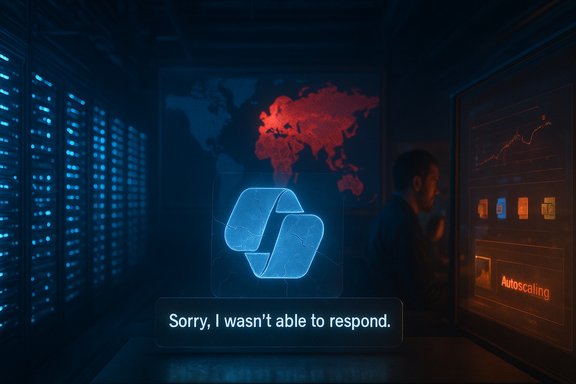
On the morning of December 9, 2025, Microsoft opened an incident under the identifier CP1193544 after telemetry indicated an unexpected increase in traffic to Copilot in the United Kingdom and parts of Europe. Customers reported a uniform failure mode across Copilot surfaces: stalled or truncated answers and a fallback message along the lines of “Sorry, I wasn’t able to respond to that, is there something else I can help with?” Outage monitors and user reports showed concentrated problem spikes originating in UK and European locales, while Microsoft engineers publicly described the remediation focus as manual scaling of capacity and load‑rebalancing to restore service availability.
This event is notable not only for the immediate disruption to productivity tools but also because it highlights how modern AI features are now mission-critical for many organizations. Copilot has been embedded into document drafting, meeting summarization, automated triage, and other workflows; when the assistant becomes unavailable, those automated processes either fail silently or require manual rework — an important operational dependency that was placed under strain by this outage.
Organizations should treat the event as a call to action: map dependencies, design layered resilience, test incident playbooks, and seek stronger contractual and technical assurances where Copilot or similar assistants play a critical role. Platform operators, meanwhile, should invest in warm-pools, robust control planes and clearer failover policies to ensure AI assistants remain reliable partners rather than brittle chokepoints.
In an era of accelerating AI adoption, operational resilience and transparent communications will determine whether these powerful assistants remain trusted tools or intermittent sources of disruption.
Source: PhotoNews Pakistan Microsoft Copilot Global Outage Hits AI Assistant & 365 Apps
 Background
On the morning of December 9, 2025, Microsoft opened an incident under the identifier CP1193544 after telemetry indicated an unexpected increase in traffic to Copilot in the United Kingdom and parts of Europe. Customers reported a uniform failure mode across Copilot surfaces: stalled or truncated answers and a fallback message along the lines of “Sorry, I wasn’t able to respond to that, is there something else I can help with?” Outage monitors and user reports showed concentrated problem spikes originating in UK and European locales, while Microsoft engineers publicly described the remediation focus as manual scaling of capacity and load‑rebalancing to restore service availability.This event is notable not only for the immediate disruption to productivity tools but also because it highlights how modern AI features are now mission-critical for many organizations. Copilot has been embedded into document drafting, meeting summarization, automated triage, and other workflows; when the assistant becomes unavailable, those automated processes either fail silently or require manual rework — an important operational dependency that was placed under strain by this outage.
What we know: verified facts and immediate timeline
- Microsoft acknowledged an incident affecting Copilot on December 9 and identified the issue as tied to service autoscaling and a regional surge in traffic.
- The outage impacted multiple Copilot surfaces: the standalone Copilot app/website, Copilot embedded in Microsoft 365 applications (Word, Excel, PowerPoint), and Copilot within Teams.
- Users encountered a consistent fallback response instead of substantive AI answers, indicating systemic inability of the inference pipeline to process requests.
- Engineers escalated to manual scaling and traffic management as the primary remediation measure while monitoring telemetry for stabilisation.
- Outage tracking sites recorded rapid spikes in user problem reports from the UK and adjacent European countries, matching Microsoft’s regional assessment.
Technical anatomy — how Copilot’s architecture makes it vulnerable to this failure mode
Multi-layered service stack
Copilot’s production architecture can be conceptually decomposed into discrete layers, each of which is a potential single‑point-of-failure in practice:- Edge/API gateway and load balancers that accept client requests and route them to regionally localised service planes.
- Service mesh and orchestration layers that manage file processing, context assembly, and request queuing.
- Model inference endpoints (hosted on Azure or Azure OpenAI Model Hosting) that run compute-intensive generative AI workloads.
- Persistent storage and identity services (OneDrive, SharePoint, Azure AD) that hold user content and auth metadata, separate from inference but tightly coupled in workflows.
Autoscaling and warm pools
Autoscaling is the canonical control used to handle variable load in cloud-native services. However, autoscaling has operational tradeoffs:- It depends on warm pools and pre‑warmed instances to handle sudden spikes without timeouts.
- If traffic growth outpaces warm-up times or triggers a control-plane race condition, autoscaling may lag just long enough for user requests to time out and yield a generic error response.
- Manual scaling is an emergency fallback but is slower and requires careful orchestration to avoid destabilising other tenants or regions.
Regionalised deployment and failover complexity
To meet latency and data‑residency requirements, many AI services run localised regional stacks. That design reduces round‑trip latency and strengthens compliance postures, but it multiplies the number of independent control planes that must scale correctly. A surge concentrated in one region can saturate a local cluster even while global capacity sits underutilised; without transparent and legally acceptable cross‑region failover, requests remain bottled up.Queueing, long‑running inference, and timeouts
Generative tasks are variable in execution time: a short query differs from a multi-file document analysis that may involve large context windows and multiple model passes. High concurrency can produce deep request queues and long tail latency. When service-level timeouts are exceeded, client‑side fallback behavior is invoked and users see stochastic failures that are hard to diagnose from their perspective.Immediate operational impact — why this outage matters to organizations
The outage is more than a UX nuisance. Copilot is woven into many business-critical functions:- Content creation and editing: Teams use Copilot to draft, rework and localise content. With Copilot down, drafts stall, deadlines slip, and human rework increases.
- Meeting summarization and action tracking: Automated meeting notes and action-item extraction are widely used; loss of these features forces manual note-taking and reduces meeting efficiency.
- Data analysis and spreadsheet automation: Copilot-assisted insights in Excel can accelerate analysis; outages make those workflows slower and error-prone.
- Helpdesk and triage automations: Organizations that route first-line support through Copilot-based automation risk service gaps when the assistant is unavailable.
- Regulatory and compliance risks: If Copilot is used to tag or normalize records for audit trails, outages can produce incomplete logs and hamper compliance evidence collection.
Strengths revealed by the incident response
Microsoft’s public handling of the incident demonstrated several operational strengths worth noting:- Telemetry-driven diagnosis: The company relied on service telemetry to detect the unusual traffic pattern and to target remediation, which reflects mature monitoring coverage.
- Prompt, candid status messaging: Microsoft used its Microsoft 365 status channels and admin center to publish incident identifiers and initial diagnostic content, helping admins correlate internal symptoms to an external incident.
- Use of manual scaling as a controlled remediation: When automated systems failed to stabilise the service promptly, engineers escalated to manual capacity increases — an accepted operational fallback to reduce mean time to recovery.
Risks and unanswered questions
Despite strengths, several gaps and risks surfaced that organizations and IT leaders should weight carefully:- Ambiguity around cross‑region failover: Public messages did not clarify whether traffic could be automatically re-routed to other regions, or whether legal/data-residency constraints prevented such failover. This ambiguity complicates recovery planning for tenants whose operations span multiple markets.
- SLA and contractual clarity: As Copilot becomes mission-critical, enterprises will expect clearer guidance on service-level commitments, credits and remediation timelines for AI capabilities that are integrated into their workflows.
- Root cause depth and repeatability: The initial explanation of “unexpected increase in traffic” is accurate but high-level; enterprise customers will expect a detailed post-incident review that explains the precise control-plane failure modes and corrective actions taken.
- Operational exposure from centralised AI: Centralised large-model services aggregate risk: a regional control-plane issue can affect thousands of tenants simultaneously, and outages can compound when downstream automation depends on multiple cloud services.
- Speculative causes require caution: Public commentary suggested alternate causes — a problematic software update, configuration regression, cascade failure, or even a security incident. At present there is no publicly verified evidence that the outage was the result of anything other than capacity and autoscaling pressure. Claims of a security breach should be treated as unverified until Microsoft publishes a transparent root-cause analysis.
Broader context — regulatory scrutiny and systemic risk
This outage arrives in an environment of increasing scrutiny of large AI operators. Regulators in the EU and elsewhere are examining how major technology firms collect and use internet content to train models, and there is growing interest in operational oversight, transparency, and systemic resilience for AI services.- Centralised AI deployments concentrate both operational risk and regulatory attention. An outage that affects essential productivity flows raises questions about the adequacy of continuity planning and about vendor responsibilities for multi-tenant AI services.
- The interplay between compliance-driven regional deployment and the need for resilient failover complicates architectural choices; data sovereignty rules can limit regional failover and thereby increase outage risk within a region.
What admins and organizations should do now
Organizations that rely on Copilot or similar centralised AI assistants should treat this incident as a prompt to revisit design assumptions and operational controls:- Review dependency mapping:
- Identify which business processes rely on Copilot or other AI features.
- Determine whether those processes are critical and document fallback procedures.
- Implement tiered resilience plans:
- Classify AI-enabled workflows by criticality and design manual workarounds or alternative automation for high‑impact functions.
- For critical automations, ensure there are documented human‑in‑the‑loop procedures that can be enacted quickly.
- Strengthen monitoring and alerting:
- Correlate internal app errors and timeouts with vendor status pages automatically.
- Create playbooks that specify immediate steps when vendor status indicates regional degradation.
- Assess contractual protections:
- Review service agreements, SLAs and contractual remedies for AI features.
- Where business-critical flows depend on Copilot, engage vendor account teams to clarify expectations for incident updates and post-incident reviews.
- Design for progressive degradation:
- Architect applications to gracefully degrade when AI inference is unavailable (e.g., queue requests, provide cached suggestions, or fall back to local scripted rules).
- Test incident playbooks:
- Run tabletop exercises that simulate Copilot unavailability and validate that users and support teams know how to proceed.
Developer and engineering takeaways
For platform engineers and product teams building and operating centrally-hosted AI services, this incident yields several concrete technical lessons:- Invest in warm-pool strategies and shorter cold-starts: Pre-warmed capacity and model instance pooling shrink the window where autoscaling lags can cause visible failures.
- Strengthen control-plane resilience: Autoscaling control planes must be tested under realistic scale bursts to ensure they do not introduce bottlenecks or race conditions.
- Improve regional observability and failover transparency: Public incident reports should clarify whether and how cross-region failover is permitted and how data-residency constraints affect failover options.
- Expose richer health signals for admins: Admin dashboards should show the difference between storage/auth availability and inference pipeline health so administrators can make informed decisions quickly.
- Consider synthetic traffic and chaos testing: Regular, controlled injection of load and chaos tests can reveal weak points before they become outages.
The human factor — communication and trust
Outages involving generative AI carry an extra human dimension: users place trust in assistants for judgment, summarization and decision support. When the assistant fails silently, trust erodes.- Effective incident messaging must balance technical accuracy with practical instruction. Telling customers the precise operational implications (which features are degraded and what temporary alternatives exist) is more useful than opaque language.
- Post‑incident transparency is critical. A thorough post‑mortem that includes root‑cause, remediation steps and timeline builds confidence and helps enterprise customers update their own continuity plans.
Scenario planning: if this becomes a pattern
If outages like this recur, organizations and regulators will likely act in several ways:- Increased contractual demands from enterprise customers for higher transparency and stronger SLAs on AI features.
- Broader enterprise adoption of multi‑vendor strategies to avoid single-vendor lock-in for mission-critical AI workflows.
- Regulatory interest in operational resilience for AI platforms, including minimum disclosure standards for outages and technical containment requirements.
- Growth of on‑premises or hybrid inference offerings that provide local continuity for core tasks while using central cloud models for non-critical features.
What remains uncertain and what to watch for
Several important questions remain open pending Microsoft’s full post-incident analysis:- The final root cause: while telemetry points to an unexpected traffic surge and autoscaling shortfall, a detailed technical narrative will be needed to confirm whether any configuration change, software bug or external dependency contributed.
- The potential for cross-regional failover and whether data‑residency rules constrained Microsoft’s mitigation options.
- Whether the event exposed broader systemic limitations in the way generative AI services are provisioned for enterprise load patterns.
- Any latent long-tail effects on customers that rely on Copilot to produce recordable outputs for compliance or audit trails.
Conclusion
The December 9 Copilot outage is a practical stress test for the modern reality of AI‑embedded productivity: when large-scale generative services become part of the core workflow, their availability becomes a business continuity issue. Microsoft’s prompt telemetry-led response and manual scaling mitigations show operational competence, but the incident also reveals the fragility that can arise from regionalised stacks, autoscaling thresholds and centralised inference dependencies.Organizations should treat the event as a call to action: map dependencies, design layered resilience, test incident playbooks, and seek stronger contractual and technical assurances where Copilot or similar assistants play a critical role. Platform operators, meanwhile, should invest in warm-pools, robust control planes and clearer failover policies to ensure AI assistants remain reliable partners rather than brittle chokepoints.
In an era of accelerating AI adoption, operational resilience and transparent communications will determine whether these powerful assistants remain trusted tools or intermittent sources of disruption.
Source: PhotoNews Pakistan Microsoft Copilot Global Outage Hits AI Assistant & 365 Apps
