

For a few hours on December 9, 2025, thousands of UK and European users found Microsoft Copilot suddenly unavailable — and the outage did more than expose a bug; it exposed a systemic fragility in how generative AI is operated, scaled, and trusted at enterprise scale.
Microsoft Copilot is no longer a novelty or an optional add‑on; it is a productivity control plane embedded in Word, Excel, Teams and standalone Copilot surfaces. That embedding makes availability a business‑critical property rather than a user convenience. Public incident tracking for the December 9 event used the code CP1193544 and described a regional outage that focused on the United Kingdom and parts of Europe, with users seeing identical fallback messages or truncated responses across multiple Copilot surfaces.
This outage arrived in a context of repeated high‑visibility incidents affecting cloud control planes and edge fabrics earlier in the year. Prior outages traced to Azure edge fabric and DNS/control‑plane configuration changes have already primed operators to worry about tightly coupled automation and brittle defaults. The December 9 event’s proximate symptom set — an unexpected traffic surge that exceeded automated autoscaling response and required manual capacity changes — crystallised an important operational tension: where automation is fastest, its failure modes are often the least graceful.
The difference is meaningful: the earlier incident was traceable to a misconfiguration; the December 9 outage was largely an operational failure driven by success — demand growth that outpaced automation. Both, however, point to the same engineering debt: autoscaling logic, deployment safeguards and regional orchestration need urgent rework for interactive AI workloads.
For IT leaders, the practical mandate is straightforward: treat Copilot and equivalent generative features as infrastructure, update runbooks, negotiate clearer SLAs, and implement multi‑layer fallbacks. For platform operators, the challenge is to make autoscaling anticipatory, build graceful degradation into surfaces, and publish timely post‑incident analyses so customers can quantify and mitigate risk. The promise of AI is real; making it reliably available at enterprise scale is the next — and necessary — engineering frontier.
Source: Techloy Microsoft Copilot outage exposes the fragility behind AI automation at scale
 Background
Microsoft Copilot is no longer a novelty or an optional add‑on; it is a productivity control plane embedded in Word, Excel, Teams and standalone Copilot surfaces. That embedding makes availability a business‑critical property rather than a user convenience. Public incident tracking for the December 9 event used the code CP1193544 and described a regional outage that focused on the United Kingdom and parts of Europe, with users seeing identical fallback messages or truncated responses across multiple Copilot surfaces.This outage arrived in a context of repeated high‑visibility incidents affecting cloud control planes and edge fabrics earlier in the year. Prior outages traced to Azure edge fabric and DNS/control‑plane configuration changes have already primed operators to worry about tightly coupled automation and brittle defaults. The December 9 event’s proximate symptom set — an unexpected traffic surge that exceeded automated autoscaling response and required manual capacity changes — crystallised an important operational tension: where automation is fastest, its failure modes are often the least graceful.
Timeline: what happened and how Microsoft responded
- Detection and public acknowledgement: Microsoft opened incident CP1193544 when telemetry flagged a rapid, regionally concentrated surge in Copilot traffic. Administrators were notified via the Microsoft 365 Admin Center and standard status channels.
- Symptom profile: Users across the standalone Copilot app and Copilot integrations inside Microsoft 365 reported uniform failure modes — truncated replies, “unable to respond” fallbacks, and stalled file‑action features. External outage monitors registered concentrated spikes in problem reports originating in the UK.
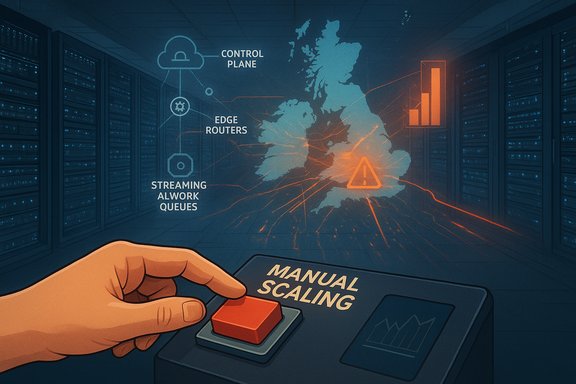
- Immediate remediation: Engineers manually increased regional capacity, adjusted load‑balancer rules, and rebalanced traffic while monitoring telemetry until error rates declined. Microsoft’s messaging emphasised manual scaling as a primary mitigation step.
- Recovery window: Service levels stabilised within hours for many tenants after capacity interventions and traffic adjustments, but the incident left administrators with unanswered questions about why automation did not respond fast enough.
Technical anatomy: why Copilot’s architecture amplifies fragility
Multi‑layered control planes
Copilot’s delivery chain spans client front‑ends, global edge routing, API gateways, session orchestration, identity/token planes and GPU‑backed inference endpoints. Each layer can act as a choke point, and a fault upstream (edge routing, load balancer) can make otherwise healthy model pools appear unreachable. That coupling increases the blast radius of control‑plane changes and traffic anomalies.Generative workloads are different
Traditional web workloads are short, stateless and predictable. Generative AI tasks are compute‑heavy, sometimes long‑running, and often bursty — they can also be highly synchronized when a large group of users adopt a new tier or feature simultaneously. Existing autoscalers are tuned for typical HTTP patterns and latency profiles; they are less well‑optimised for sudden concurrent GPU allocations with long warm‑up times. When warm pools are undersized or prediction heuristics miss a surge, autoscaling may lag long enough for queues and timeouts to trigger hard failures.Regionalisation and data‑residency tradeoffs
To meet latency and regulatory requirements, Copilot processing can be localized in‑country. Localization reduces latency but multiplies control planes and regional capacity pools. A concentrated UK surge can therefore overwhelm a local cluster even while other regions remain underutilised, and legal constraints can make cross‑region spillover complicated. The December 9 pattern — a regional surge that outstripped localized autoscaling — reflects this tradeoff.What went wrong — a concise technical reading
- A sudden, correlated traffic surge (likely tied to a pricing/rollout change or a lower‑priced tier rollout) produced a “thundering herd” hitting UK regional pools faster than autoscaling could respond. Microsoft’s public messaging described an unexpected increase in traffic as a proximate cause.
- Autoscaling policies and warm‑pool sizes for GPU‑backed model endpoints were insufficiently anticipatory, leaving a cold‑start window where requests queued and timed out. This is a common failure mode for inference workloads where instance warm‑up is non‑trivial.
- Edge routing and load‑balancer policies concentrated traffic into specific processing nodes; manual rollback and rebalancing were required to restore healthy distribution. This pattern mirrors previous incidents where control‑plane configuration changes at the edge caused outsized ripple effects.
- Manual scaling was effective but slow: engineers increased capacity and adjusted routing, but the need for human intervention signals that automation lacks robust anticipatory behaviour.
Business impact: outages are no longer just an annoyance
This outage demonstrated that when AI assistants are embedded in workflows, downtime becomes operational disruption.- Productivity: Teams relying on Copilot for drafts, summaries, and spreadsheet pulls lost an acceleration layer and reverted to manual processes, increasing cycle times and rework.
- Automation fractures: Copilot‑driven automation chains — triage rules, metadata tagging, file conversions — can stall or fail silently, creating backlog and compliance risk.
- Helpdesk surges: IT and support teams see a spike in tickets and must execute communication playbooks to reduce user confusion.
- Contractual exposure: Many buyers lack explicit resilience guarantees for AI features embedded in SaaS; outages crystallise procurement questions about SLAs, credits and post‑incident disclosures.
Comparison: the October edge/DNS incident and systemic patterns
Earlier in the year, Microsoft faced a separate outage linked to Azure edge control‑plane and DNS configuration changes that cascaded into limited traffic and authentication failures. In that incident a configuration regression produced broad effects because an empty or misinterpreted field in a control plane was treated as a deny‑all rule, causing global traffic drops. That event and the December 9 Copilot outage together reveal a repeated pattern: tightly coupled control planes plus brittle defaults equal outsized failures.The difference is meaningful: the earlier incident was traceable to a misconfiguration; the December 9 outage was largely an operational failure driven by success — demand growth that outpaced automation. Both, however, point to the same engineering debt: autoscaling logic, deployment safeguards and regional orchestration need urgent rework for interactive AI workloads.
Engineering lessons and recommended vendor actions
The outage surfaces a concrete engineering backlog for hyperscalers and platform teams delivering interactive AI:- Predictive autoscaling and warm pools: Move beyond purely reactive autoscalers. Implement demand forecasting (calendar events, tier rollouts), larger pre‑warmed GPU pools, and immediate priority scaling paths for mission‑critical tenants.
- Graceful degradation and low‑compute fallbacks: Offer deterministic, low‑compute fallbacks (cached responses, heuristic summarizers or small local models) that provide minimal but usable capabilities instead of hard failures when inference pools are saturated.
- Cross‑region surge orchestration that respects residency constraints: Build legally auditable overflow channels that can be invoked under emergency conditions, with tenant consent and audit trails. This preserves both compliance and resilience.
- Stronger edge and control‑plane deployment hygiene: Harden default behaviours so that empty or malformed configuration values are treated safely, not deny‑all. Exercise control‑plane rollbacks under load as part of standard runbooks.
- Transparent post‑incident reviews: Publish timely PIRs with clear timelines, root causes and mitigation steps. Enterprises need this data to quantify risk and update contracts and runbooks.
Practical guidance for IT leaders and architects
Enterprises must respond on three fronts: people, process and technology.Immediate (hours → days)
- Monitor Microsoft 365 Service Health for incident codes (e.g., CP1193544) and use tenant alerts as the authoritative source.
- Activate internal communications templates explaining degraded Copilot availability and provide specific manual fallbacks (templates, meeting note checklists).
- Implement circuit breakers in automations that call Copilot APIs to avoid cascading retries that make an outage worse.
Short term (weeks → months)
- Inventory critical workflows that depend on Copilot; classify by impact and design explicit human‑in‑the‑loop fallbacks.
- Add synthetic monitoring (scheduled prompts) against Copilot surfaces to detect early degradations before end users complain.
- Negotiate contractual assurances for high‑impact use cases: priority capacity reservations, deterministic RTOs, PIR delivery timelines and escalation paths.
Strategic (3+ months)
- Architect multi‑vendor or hybrid fallbacks for the most critical automations: local models, cached suggestions, or secondary providers for redundancy.
- Rehearse outage playbooks with tabletop exercises where Copilot is intentionally disabled to validate human workflows and RTOs.
Risks, unknowns and things that require caution
- Unverified causal attributions: While telemetry and public status messages point to autoscaling pressure and load‑balancer anomalies, exact root‑cause attribution (e.g., client rollout, third‑party edge failure, configuration regression, or a complex combination) has not been fully disclosed. Treat fine‑grained causality as provisional until a vendor PIR is published.
- Data residency vs resilience tradeoffs: Cross‑region failover can reduce outages but may violate locality rules; legal and procurement teams must be involved when negotiating contingency cross‑region allowances.
- SLA realism: Many SaaS contracts were written for conventional cloud services, not tightly integrated generative AI control planes. Expect procurement processes to evolve and for enterprise buyers to demand clarity and remediation options for AI features.
A short engineering playbook for making autoscaling less brittle
- Pre‑warm GPU pools for predictable events and offer tenant reservation tiers.
- Implement demand forecasting that uses product events, tier rollouts and historical adoption curves.
- Introduce graded fallbacks so that low‑value requests get served by smaller models or cached outputs when capacity is constrained.
- Harden front‑door and load‑balancer defaults; treat “empty” or malformed fields as no‑op, not deny‑all.
- Provide machine‑readable incident telemetry so tenants can automate internal responses.
Legal, procurement and governance implications
The Copilot outage crystallises several contract and governance shifts that enterprise buyers should pursue:- Demand post‑incident reviews as contractual deliverables for high‑impact outages.
- Negotiate priority capacity or reservation options for business‑critical workloads.
- Insert audit and disclosure clauses that require vendors to share tenant‑level impact analysis and timelines.
- Revisit compliance controls for AI workflows that assume continuous availability; insert compensating checks for auditability during outages.
Conclusion
The December 9 Copilot outage was not merely an isolated availability incident; it was a signal event. It demonstrated that generative AI’s transformative power carries operational costs and that current autoscaling, control‑plane hygiene, and regional orchestration practices are not yet tuned for the bursty, compute‑intensive, and synchronized nature of real‑world generative workloads. Microsoft’s engineers restored service through manual intervention, which underscores two truths: the operator playbooks are effective in crisis, and the automation that’s supposed to make systems hands‑free still needs urgent engineering improvement.For IT leaders, the practical mandate is straightforward: treat Copilot and equivalent generative features as infrastructure, update runbooks, negotiate clearer SLAs, and implement multi‑layer fallbacks. For platform operators, the challenge is to make autoscaling anticipatory, build graceful degradation into surfaces, and publish timely post‑incident analyses so customers can quantify and mitigate risk. The promise of AI is real; making it reliably available at enterprise scale is the next — and necessary — engineering frontier.
Source: Techloy Microsoft Copilot outage exposes the fragility behind AI automation at scale
