

USA TODAY Sports asked Microsoft Copilot to simulate the 2026 Kentucky Derby before Saturday’s 152nd Run for the Roses at Churchill Downs, and the chatbot picked Further Ado to win, ahead of Chief Wallabee and The Puma, using current odds, post positions, race history, and betting analysis. The prediction is not interesting because it is likely to be right. It is interesting because it shows how quickly sports media has learned to package generative AI as a new kind of handicapper: authoritative enough to headline, vague enough to escape accountability. The Derby has always been a chaos machine; AI did not solve it so much as give the chaos a clickable name.
The 2026 Kentucky Derby arrives with the kind of field that makes old-school handicappers mutter and casual bettors reach for a name they like. Renegade has floated near favoritism, Commandment has obvious appeal, Chief Wallabee has credentials, and Further Ado has been close enough to the top of the board to make an AI pick feel plausible rather than comic.
That plausibility is the trick. Copilot did not reach into a crystal ball and discover an overlooked colt with secret fractional times. It appears to have synthesized the same public inputs everyone else is chewing on: odds, posts, prep-race narratives, expert chatter, and the institutional memory of past Derbies.
That does not make the exercise worthless. It makes it recognizably modern. A generative AI Derby simulation is less like a sealed model from a professional wagering syndicate and more like a fast, fluent newsroom intern who has read every preview and can produce a clean finishing order before lunch.
The result is a prediction with the grammar of analysis and the risk profile of entertainment. It looks sharper than a coin flip because it speaks in confidence. But the race itself will still be run by young horses in traffic, not by language models.
That makes him the ideal AI pick. If he wins, the machine looks prescient. If he runs well but loses, the pick still seems defensible. If he fades, the explanation is easy: the Derby is unpredictable, the field was wide open, and racing luck matters.
In the simulation published by USA TODAY, Copilot’s top finishers largely tracked the market’s intuition. Further Ado, Chief Wallabee, The Puma, Renegade, Commandment, and So Happy all appear near the front of the predicted order, with the longest shots mostly pushed toward the back. This is not a machine rebelling against conventional wisdom; it is conventional wisdom with a synthetic voice.
That may disappoint anyone hoping AI would produce a dazzling contrarian angle. But it should not surprise anyone who has used consumer chatbots for forecasting. These systems are very good at summarizing consensus and very poor at proving they have found durable signal beyond it.
That is why the phrase AI simulation deserves scrutiny. A real simulation would require formal assumptions: pace projections, variance estimates, track condition probabilities, trip-risk modeling, jockey tendencies, historical distributions, and thousands of iterations. A chatbot-generated finishing order may be called a simulation in a newsroom headline, but unless the methodology is exposed, readers should treat it as an AI-assisted prediction.
The distinction matters because racing already has a mature ecosystem of quantitative analysis. Speed figures, pace figures, trip notes, pedigree ratings, trainer patterns, workout reports, tote movement, and sectional timing all represent attempts to convert messy equine reality into usable probabilities. Serious horseplayers do not lack data; they lack certainty.
Generative AI can summarize that world beautifully. It can explain why a horse’s post position matters, why a projected speed duel could benefit a closer, or why a prep-race win may be less impressive than the margin suggests. But unless it is connected to a disciplined racing model, it is not automatically better than the public conversation it digested.
Chief Wallabee and The Puma following him in the projected order also reinforce that sense of market-aware caution. These are not random names pulled from the bottom of the field. They are the sort of horses a broadly informed handicapper would include in exotics, especially in a Derby described by multiple outlets as unusually open.
The deeper question is whether the AI selected Further Ado because it identified a real edge or because Further Ado is the kind of horse the surrounding discourse already made legible as a winner. Generative AI tends to smooth disagreement into synthesis. It is built to produce the answer that feels most consistent with its prompt, not necessarily the answer that maximizes expected value at the windows.
That is a crucial difference. Betting value is not the same as win probability. A horse can be likely and still be a bad bet; another can be unlikely and still be mispriced. The published AI pick treats the Derby as a question of order-of-finish prediction, but wagering is a question of price.
That does not mean the market is always right. Derby pools are famous for sentimental money, casual bettors, and name-driven action. The first Saturday in May attracts people who might not bet another horse race all year, which can distort prices in ways sharper players try to exploit.
Still, the odds board has one advantage over a static AI article: it moves. By the time readers act on a Friday morning simulation, scratches, weather, track bias, late money, and paddock appearance may all have changed the real wagering landscape. A horse at 7-1 in the morning can become an entirely different proposition at 9-2 near post time.
That is where consumer AI’s smoothness can become a liability. It freezes uncertainty into prose. The market, for all its flaws, keeps arguing until the gates open.
Microsoft has spent the last several years embedding Copilot across Windows, Microsoft 365, Edge, Bing, GitHub, and the enterprise stack. A Derby prediction is not central to that strategy, but it is useful cultural oxygen. It makes Copilot feel less like a productivity feature and more like a general-purpose companion for decisions, entertainment, and daily curiosity.
The bet Microsoft wants users to make is not on Further Ado. It is on the idea that Copilot belongs in the workflow of ordinary judgment. Draft this email. Summarize this document. Explain this error code. Compare these laptops. Pick this horse.
That leap is subtle but important. Once AI becomes a normal part of low-stakes prediction, it becomes easier to trust it in medium-stakes decisions. The danger is not that someone will lose a $10 Derby bet because Copilot liked the wrong colt. The danger is that fluency becomes confused with accountability.
The format also gives editors a convenient hedge. The article can say the AI “believes” or “predicts” without claiming the newsroom endorses the result. If the pick wins, the publisher gets a victory lap. If it loses, the weirdness of AI becomes part of the entertainment.
This is not new in spirit. Newspapers have run expert picks, celebrity picks, animal picks, computer rankings, and fan polls forever. What is new is the authority generative AI borrows from the broader technological moment. A chatbot’s answer can feel scientific even when the underlying reasoning is closer to a polished literature review than a tested model.
That is especially tempting in horse racing, where the sport’s own complexity rewards any system that appears to impose order. The Derby is not just a race; it is a data swamp wearing a flower garland. AI looks useful because the human brain is already overwhelmed.
Weather forecasts have probabilities, confidence bands, model runs, and update cycles. Most AI sports predictions published for general audiences have none of that. They produce an answer, not an uncertainty structure.
That lack of transparency is not a cosmetic issue. If Copilot weighed odds heavily, the prediction is mostly market-following. If it weighted expert picks heavily, it is mostly media-following. If it weighted race history heavily, it may be overfitting old Derby patterns onto a new field. If it used track conditions, readers need to know which conditions and when they were captured.
Without that, the prediction is a starting point for conversation, not a terminal answer. It belongs beside human picks, not above them.
A good AI assistant can explain why post position matters without drowning readers in jargon. It can compare prep races, define pace pressure, summarize each contender’s case, and help a casual fan understand why a 20-1 horse is not the same thing as a no-hoper. That educational function is real.
But picking winners is where the limits show. Racing expertise often lives in details that do not reduce cleanly into scraped text: how a horse looks in the paddock, whether a workout was visually better than the clocker’s line, how a jockey adapts mid-race, whether the rail is dead, whether a horse is washed out, whether the crowd is rattling a young colt. These are not mystical factors, but they are hard to capture in a general chatbot prompt.
The human handicapper’s edge, when it exists, comes from synthesis plus judgment plus price sensitivity. AI can help with the synthesis. It has not replaced the judgment.
That shift changes the media contract. If an expert columnist picks Further Ado, readers can evaluate the columnist’s history, style, biases, and record. If Copilot picks Further Ado, readers are evaluating a brand, a model family, a prompt, and an opaque blend of source material they cannot fully inspect.
This is why AI-generated predictions should be labeled clearly and framed modestly. The problem is not that AI might be wrong. Everyone who makes Derby picks is usually wrong. The problem is that AI can make wrongness feel automated, normalized, and strangely impersonal.
Sports can absorb that better than many domains. A bad Derby pick is not a failed medical diagnosis or a mispriced mortgage risk. But low-stakes arenas are where habits of trust are formed.
The second lesson is that AI predictions become more persuasive when they choose a plausible non-favorite. Picking the chalk looks boring; picking a 50-1 shot looks unserious. Picking Further Ado creates the feeling of independent judgment without straying far from the market.
The third lesson is that readers should separate entertainment from edge. If Copilot helps you learn the field, it has value. If it convinces you that a chatbot has cracked one of the noisiest events in American sports, it has done what chatbots often do: made pattern recognition sound like certainty.
That would make AI a better tool for readers and a more honest one for publishers. It would also move the format beyond stunt content. “We asked a chatbot who would win” is a headline. “We built and tested a transparent model against five years of Derby results and current market prices” is journalism.
There is a place for both. The first is fun. The second is accountable.
For now, USA TODAY’s Copilot piece belongs to the first category. It is a snapshot of where sports media and consumer AI have met in 2026: at the intersection of curiosity, search traffic, brand experimentation, and America’s most famous horse race.
Source: USA Today Kentucky Derby AI prediction simulation: Winner, results for 2026 race
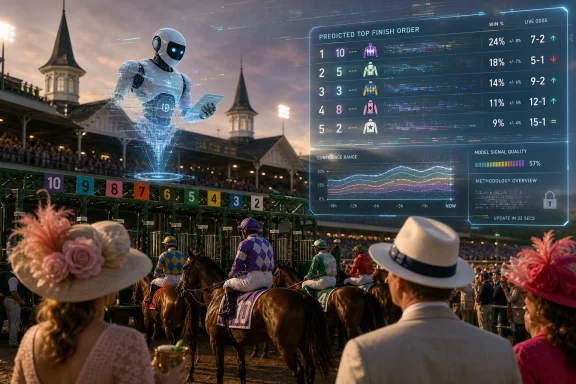 The Robot Handicapper Has Entered the Paddock
The 2026 Kentucky Derby arrives with the kind of field that makes old-school handicappers mutter and casual bettors reach for a name they like. Renegade has floated near favoritism, Commandment has obvious appeal, Chief Wallabee has credentials, and Further Ado has been close enough to the top of the board to make an AI pick feel plausible rather than comic.That plausibility is the trick. Copilot did not reach into a crystal ball and discover an overlooked colt with secret fractional times. It appears to have synthesized the same public inputs everyone else is chewing on: odds, posts, prep-race narratives, expert chatter, and the institutional memory of past Derbies.
That does not make the exercise worthless. It makes it recognizably modern. A generative AI Derby simulation is less like a sealed model from a professional wagering syndicate and more like a fast, fluent newsroom intern who has read every preview and can produce a clean finishing order before lunch.
The result is a prediction with the grammar of analysis and the risk profile of entertainment. It looks sharper than a coin flip because it speaks in confidence. But the race itself will still be run by young horses in traffic, not by language models.
Further Ado Is a Sensible Pick, Which Is Exactly the Point
Further Ado is not a reckless AI hallucination masquerading as insight. At 7-1 in USA TODAY’s snapshot of odds Friday morning, he sits in the credible-contender tier: not the favorite, not a bomb, and not the kind of selection that requires a baroque theory of pace collapse and divine intervention.That makes him the ideal AI pick. If he wins, the machine looks prescient. If he runs well but loses, the pick still seems defensible. If he fades, the explanation is easy: the Derby is unpredictable, the field was wide open, and racing luck matters.
In the simulation published by USA TODAY, Copilot’s top finishers largely tracked the market’s intuition. Further Ado, Chief Wallabee, The Puma, Renegade, Commandment, and So Happy all appear near the front of the predicted order, with the longest shots mostly pushed toward the back. This is not a machine rebelling against conventional wisdom; it is conventional wisdom with a synthetic voice.
That may disappoint anyone hoping AI would produce a dazzling contrarian angle. But it should not surprise anyone who has used consumer chatbots for forecasting. These systems are very good at summarizing consensus and very poor at proving they have found durable signal beyond it.
The Derby Is Built to Punish False Precision
The Kentucky Derby is one of America’s great annual rebukes to overconfidence. Twenty three-year-olds, many still developing, are thrown into the sport’s most theatrical traffic jam in front of a roaring crowd. A horse can be brilliant and still lose the race before the first turn because of a poor break, an awkward bump, a bad trip, or a pace scenario that turns hostile in real time.That is why the phrase AI simulation deserves scrutiny. A real simulation would require formal assumptions: pace projections, variance estimates, track condition probabilities, trip-risk modeling, jockey tendencies, historical distributions, and thousands of iterations. A chatbot-generated finishing order may be called a simulation in a newsroom headline, but unless the methodology is exposed, readers should treat it as an AI-assisted prediction.
The distinction matters because racing already has a mature ecosystem of quantitative analysis. Speed figures, pace figures, trip notes, pedigree ratings, trainer patterns, workout reports, tote movement, and sectional timing all represent attempts to convert messy equine reality into usable probabilities. Serious horseplayers do not lack data; they lack certainty.
Generative AI can summarize that world beautifully. It can explain why a horse’s post position matters, why a projected speed duel could benefit a closer, or why a prep-race win may be less impressive than the margin suggests. But unless it is connected to a disciplined racing model, it is not automatically better than the public conversation it digested.
Copilot Did Not Pick a Winner So Much as Pick a Narrative
Further Ado gives the AI prediction a tidy narrative shape. He is close enough to favoritism to be credible, but not so obvious that the pick reads as a lazy chalk selection. He occupies the sweet spot where a sports desk can say “AI likes this horse” and readers can believe there is something more interesting happening than a regurgitated odds board.Chief Wallabee and The Puma following him in the projected order also reinforce that sense of market-aware caution. These are not random names pulled from the bottom of the field. They are the sort of horses a broadly informed handicapper would include in exotics, especially in a Derby described by multiple outlets as unusually open.
The deeper question is whether the AI selected Further Ado because it identified a real edge or because Further Ado is the kind of horse the surrounding discourse already made legible as a winner. Generative AI tends to smooth disagreement into synthesis. It is built to produce the answer that feels most consistent with its prompt, not necessarily the answer that maximizes expected value at the windows.
That is a crucial difference. Betting value is not the same as win probability. A horse can be likely and still be a bad bet; another can be unlikely and still be mispriced. The published AI pick treats the Derby as a question of order-of-finish prediction, but wagering is a question of price.
The Odds Board Is the Crowd’s AI, and It Updates Faster
There is an irony in asking a chatbot to use the latest odds to forecast a race. The odds are already a live, collective forecast, shaped by public money, professional money, sentiment, rumor, and increasingly, algorithmic wagering. In pari-mutuel racing, the board is not merely a list of prices; it is the market speaking back.That does not mean the market is always right. Derby pools are famous for sentimental money, casual bettors, and name-driven action. The first Saturday in May attracts people who might not bet another horse race all year, which can distort prices in ways sharper players try to exploit.
Still, the odds board has one advantage over a static AI article: it moves. By the time readers act on a Friday morning simulation, scratches, weather, track bias, late money, and paddock appearance may all have changed the real wagering landscape. A horse at 7-1 in the morning can become an entirely different proposition at 9-2 near post time.
That is where consumer AI’s smoothness can become a liability. It freezes uncertainty into prose. The market, for all its flaws, keeps arguing until the gates open.
Microsoft Gets a Soft Power Win Without Owning the Bet
There is also a platform story hiding inside the racing story. USA TODAY did not ask an anonymous spreadsheet or a horse-racing database for a Derby order; it asked Microsoft Copilot. That brand placement matters.Microsoft has spent the last several years embedding Copilot across Windows, Microsoft 365, Edge, Bing, GitHub, and the enterprise stack. A Derby prediction is not central to that strategy, but it is useful cultural oxygen. It makes Copilot feel less like a productivity feature and more like a general-purpose companion for decisions, entertainment, and daily curiosity.
The bet Microsoft wants users to make is not on Further Ado. It is on the idea that Copilot belongs in the workflow of ordinary judgment. Draft this email. Summarize this document. Explain this error code. Compare these laptops. Pick this horse.
That leap is subtle but important. Once AI becomes a normal part of low-stakes prediction, it becomes easier to trust it in medium-stakes decisions. The danger is not that someone will lose a $10 Derby bet because Copilot liked the wrong colt. The danger is that fluency becomes confused with accountability.
Sports Media Has Found the Perfect AI Content Format
For publishers, AI predictions are almost irresistible. They are cheap to produce, easy to update, search-friendly, and tailor-made for audiences already hungry for picks. A Derby simulation offers the same promise as an NFL score projection, a March Madness bracket, or a fantasy football sleeper list: a machine has processed the noise and handed you a clean answer.The format also gives editors a convenient hedge. The article can say the AI “believes” or “predicts” without claiming the newsroom endorses the result. If the pick wins, the publisher gets a victory lap. If it loses, the weirdness of AI becomes part of the entertainment.
This is not new in spirit. Newspapers have run expert picks, celebrity picks, animal picks, computer rankings, and fan polls forever. What is new is the authority generative AI borrows from the broader technological moment. A chatbot’s answer can feel scientific even when the underlying reasoning is closer to a polished literature review than a tested model.
That is especially tempting in horse racing, where the sport’s own complexity rewards any system that appears to impose order. The Derby is not just a race; it is a data swamp wearing a flower garland. AI looks useful because the human brain is already overwhelmed.
The Smart Reader Treats the Pick as a Weather Report, Not a Map
The best way to read Copilot’s Further Ado selection is as a consensus weather report: useful, directional, and incomplete. It tells us that Further Ado sits inside the band of plausible winners. It suggests that public analysis sees enough quality, positioning, and form to make him a legitimate threat. It does not tell us what will happen when twenty horses compress into the same stretch of dirt.Weather forecasts have probabilities, confidence bands, model runs, and update cycles. Most AI sports predictions published for general audiences have none of that. They produce an answer, not an uncertainty structure.
That lack of transparency is not a cosmetic issue. If Copilot weighed odds heavily, the prediction is mostly market-following. If it weighted expert picks heavily, it is mostly media-following. If it weighted race history heavily, it may be overfitting old Derby patterns onto a new field. If it used track conditions, readers need to know which conditions and when they were captured.
Without that, the prediction is a starting point for conversation, not a terminal answer. It belongs beside human picks, not above them.
The Human Handicapper Still Has a Job
The strongest case for AI in Derby coverage is not that it will beat seasoned handicappers. It is that it can make the race more legible to the many viewers who arrive on Derby Day knowing only the hats, the song, and the mint juleps.A good AI assistant can explain why post position matters without drowning readers in jargon. It can compare prep races, define pace pressure, summarize each contender’s case, and help a casual fan understand why a 20-1 horse is not the same thing as a no-hoper. That educational function is real.
But picking winners is where the limits show. Racing expertise often lives in details that do not reduce cleanly into scraped text: how a horse looks in the paddock, whether a workout was visually better than the clocker’s line, how a jockey adapts mid-race, whether the rail is dead, whether a horse is washed out, whether the crowd is rattling a young colt. These are not mystical factors, but they are hard to capture in a general chatbot prompt.
The human handicapper’s edge, when it exists, comes from synthesis plus judgment plus price sensitivity. AI can help with the synthesis. It has not replaced the judgment.
A Derby Prediction Is Also a Prediction About Trust
The USA TODAY item lands at a moment when AI is moving from novelty to infrastructure. Readers are no longer merely asking whether a chatbot can write a poem or pass a bar exam. They are encountering AI in search results, office software, customer support, coding tools, and now sports predictions that arrive with the same casual confidence as a columnist’s pick.That shift changes the media contract. If an expert columnist picks Further Ado, readers can evaluate the columnist’s history, style, biases, and record. If Copilot picks Further Ado, readers are evaluating a brand, a model family, a prompt, and an opaque blend of source material they cannot fully inspect.
This is why AI-generated predictions should be labeled clearly and framed modestly. The problem is not that AI might be wrong. Everyone who makes Derby picks is usually wrong. The problem is that AI can make wrongness feel automated, normalized, and strangely impersonal.
Sports can absorb that better than many domains. A bad Derby pick is not a failed medical diagnosis or a mispriced mortgage risk. But low-stakes arenas are where habits of trust are formed.
The Further Ado Pick Reveals More About AI Than About the Derby
The most concrete lesson from Copilot’s Derby call is that generative AI is becoming a consensus engine for mainstream media. It can ingest a wide-open field, identify the horses already clustered near the center of serious discussion, and produce a finish order that feels coherent. That is useful. It is not magic.The second lesson is that AI predictions become more persuasive when they choose a plausible non-favorite. Picking the chalk looks boring; picking a 50-1 shot looks unserious. Picking Further Ado creates the feeling of independent judgment without straying far from the market.
The third lesson is that readers should separate entertainment from edge. If Copilot helps you learn the field, it has value. If it convinces you that a chatbot has cracked one of the noisiest events in American sports, it has done what chatbots often do: made pattern recognition sound like certainty.
The Wager Worth Making Is on Transparency
The next wave of AI sports coverage should be judged less by whether it happens to pick a winner and more by whether it explains its work. A useful AI Derby model would publish its assumptions, update with odds movement, show alternate scenarios, assign probabilities rather than only ranks, and distinguish between “most likely winner” and “best betting value.”That would make AI a better tool for readers and a more honest one for publishers. It would also move the format beyond stunt content. “We asked a chatbot who would win” is a headline. “We built and tested a transparent model against five years of Derby results and current market prices” is journalism.
There is a place for both. The first is fun. The second is accountable.
For now, USA TODAY’s Copilot piece belongs to the first category. It is a snapshot of where sports media and consumer AI have met in 2026: at the intersection of curiosity, search traffic, brand experimentation, and America’s most famous horse race.
The Roses Are Real, but the Certainty Is Synthetic
Before the gates open Saturday evening, the cleanest reading of the AI pick is also the most modest one. Copilot has identified Further Ado as a credible winner in a race where several horses can make the same claim. That is not nothing, but it is not prophecy.- Further Ado is a defensible AI selection because his odds and profile already place him among the serious contenders.
- The Copilot finishing order appears to reflect market consensus more than a radical independent handicapping theory.
- A chatbot prediction should not be confused with a transparent statistical simulation unless the model, assumptions, and probabilities are disclosed.
- The live odds board may contain fresher information than a static AI-generated article by the time post time approaches.
- The most useful role for AI in Derby coverage is explaining the field, not pretending to eliminate uncertainty.
Source: USA Today Kentucky Derby AI prediction simulation: Winner, results for 2026 race
