

Microsoft’s Copilot has quietly started nudging users to step away from the screen — but the real story isn’t the polite phrasing of a reminder, it’s what the feature reveals about Microsoft’s evolving strategy for AI inside Windows and the practical trade‑offs that matter to users and IT teams today.
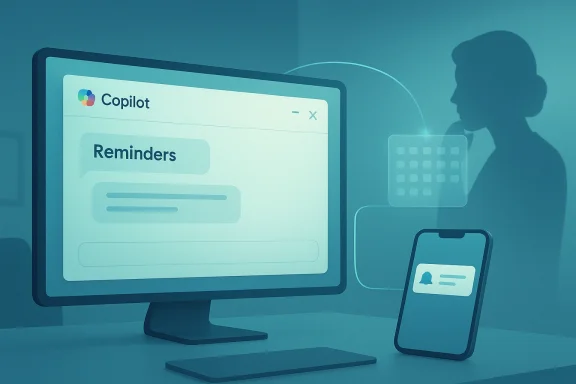
Since its integration into Windows, Copilot has been a moving target: part help desk, part writing assistant, part experimental agent. Over the last year Microsoft folded voice, vision, memory, and cross‑device sync into the Copilot umbrella, positioning the assistant as the operating system’s conversational layer rather than a simple search box. That trajectory makes a Copilot feature aimed at digital well‑being unsurprising in concept — but notable in practice, because mainstream desktop OSes rarely push gentle behavioral nudges from their embedded AI assistants. ifestation of this shift is the new Reminders functionality and isolated reports of a “Time for a break” style message appearing inside Copilot conversations. Multiple outlets have reported a staged rollout that currently prioritizes mobile delivery for notifications, while at least one hands‑on report described a contextual, conversational reminder suggesting users take a breather. Crucially, Microsoft has not made a broad, explicit announcement for the conversational “take a break” nudge — the Reminders feature itself is being rolled out quietly and incrementally.
Whether the viral “time for a break” screenshot becomes a polished, user‑configurable wellbeing feature or a short‑lived curiosity depends on execution. If Microsoft prioritizes delivery guarantees, clear privacy controls, and desktop parity, Copilot could convert conversational convenience into dependable, cross‑device utility. If not, it will remain an interesting footnote in the larger story of how operating systems learn to look after our attention.
The broad rollout of Reminders and the social reaction to a single human‑toned prompt have already achieved the core outcome of a product launch: people are talking. Now Microsoft must deliver the reliability, controls, and transparency necessary to turn that conversation into sustained adoption.
Source: WinCentral Windows 11 Copilot Now Reminds You to Take a Break
 Background
Since its integration into Windows, Copilot has been a moving target: part help desk, part writing assistant, part experimental agent. Over the last year Microsoft folded voice, vision, memory, and cross‑device sync into the Copilot umbrella, positioning the assistant as the operating system’s conversational layer rather than a simple search box. That trajectory makes a Copilot feature aimed at digital well‑being unsurprising in concept — but notable in practice, because mainstream desktop OSes rarely push gentle behavioral nudges from their embedded AI assistants. ifestation of this shift is the new Reminders functionality and isolated reports of a “Time for a break” style message appearing inside Copilot conversations. Multiple outlets have reported a staged rollout that currently prioritizes mobile delivery for notifications, while at least one hands‑on report described a contextual, conversational reminder suggesting users take a breather. Crucially, Microsoft has not made a broad, explicit announcement for the conversational “take a break” nudge — the Reminders feature itself is being rolled out quietly and incrementally. What the new Copilot alerts actually are
The Reminders feature — the verified basics
- Copilot now supports creating reminders conversationally across Copilot surfaces: mobile app, web, and in some cases Windows 11 Copilot. You can ask Copilot to remind you at a specific time, after a short interval, or on a recurring cadence.
- At launch, delivery is mobile‑first: notifications are sent as push alerts to Android and iOS devices with the Copilot mobile app installed and notifications enabled. Desktop parity — native Windows Action Center or Outlook calendar notifications — is not yet guaranteed for all users within the initial rollout.
- There are reported active‑reminder limits tied to account tiering: commonly reported as up to 5 active reminders for free accounts and up to 20 for Microsoft 365 subscribers. Treat these quota numbers as provisional until Microsoft codifies them in official docs.
The “take a break” conversational prompt — anecdote vs. product
A separate but related item has drawn disproportionate attention: one reporter observed Copilot surfacing a human‑toned nudge during an extended chat that read something like “Time for a break? Copilot is an AI, but you’re nds‑on report is the origin of the viral social posts and screenshots. Important validation points:- The observed break prompt is anecdotal — it was documented in a single hands‑on report and has not been enumerated in Microsoft’s public release notes as a deliberate, named feature. Treat the specific text and timing of that message as illustrative rather than an official, guaranteed product behavior.
- Technically, such contextual nudges are easy to implement: Copilot already collects session signals (timestamps, chat history, interaction density) that can be used by heuristics to trigger non‑intrusive UI messages. The engineering plausibility is high even when corporate messaging hasn’t yet labeled the capability.
Where users are seeing alerts — UX and placement
- The official delivery path for scheduled reminders today is the Copilot mobile app. To receive notifications you must have the app installed and notifications enabled. Several early tests confirm that if push permissions are denied, reminders do not arrive.
- The conversational nudge reported by one outlet appeared inside the Copilot chat UI, not as a system throttle or an error message. It was dismissible and didn’t block continued use. That behavior, if replicated, favors a soft nudge that preserves autonomy rather than a hard enforcement mechanism.
- Desktop users should expect inconsistent parity for now: some Windows 11 builds and environments may allow creating a reminder from the Copilot desktop surface, but reliable desktop notification display and calendar integration are not yet universal. Industry testing has already found flaky delivery in some environments, so don’t rely on Reminders for mission‑critical alerts today.
How Reminders work (features and limitations)
Feature snapshot
- Natural language scheduling: set reminders using plain phrases (e.g., “Remind me in 10 minutes,” “Every Monday remind me…”).
- Recurring and one‑time reminders: supports repeated schedules and one‑off prompts.
- Dynamic/creative content: Copilot can generate new content each recurrence (e.g., a daily vocabulary word), which turns reminders into content engines as well as timers. Keep in mind that AI‑generated coity and occasionally be inaccurate.
Known limitations and early‑stage gaps
- Mobile‑first delivery only: reminders currently arrive on phones; desktop notification parity and calendar syncing are limited or absent in many accounts.
- Reliability concerns: independent tests in early rollout found missed or delayed notifications; one PCWorld test reported reminders did not reliably trigger on the phone, raising questions about dependability for important events. That’s a red flag for users expecting guaranteed delivery.
- Quotas and retention: early reports indicate tiered caps (5 free / 20 paid), but Microsoft’s official retention and storage semantics for reminders (where they’re stored, eDiscovery exposure, retention windows) are not yet fully detailed publicly. Enterprises should treat this as an open governance variable.
Why Microsoft built reminders (what this signals strategically)
- Human‑centered framing: The appearance of wellness‑style prompts — even if limited — signals Microsoft is thinking about AI that recognizes human limits, not merely one that drives higher engagement. It’s a different posture from the classic growth‑maximizing playbook that prioritizes more usage.
- Copilot as a cross‑device assistant: Reminders are an obvious piece of the puzzle for turning Copilot into a daily companes and PCs, tying conversations to real‑world timebound actions. The mobile push model reflects Microsoft’s prioritization of where people actually look for alerts: their pocket.
- Product consolidation and upsell: Basic reminders cover consumer needs, but the reported quota caps encourage upgrading to Microsoft 365 tiers for heavier usage — a familiar pattern for SaaS product design. Expect integrations with Outlook, Microsoft epen over time as the company fills gaps.
How this compares to competitors
- OpenAI’s ChatGPT introduced a Tasks feature earlier that allowand notifications across platforms — a precedent for assistant‑driven reminders. Google’s Gemini has implemented scheduled actions with deep ties to Gmail and Calenrs bring Microsoft to feature parity in the basic sense but currently lag in desktop/system integration and cross‑service orchestration.
- Differentiators Microsoft can exploit:
- Native Microsoft 365 integration (Outlook, Teams, OneDrive) — the potential is large if the company executes desktop and calendar parity well.
- Rich context from Windows sessions (open apps, files, screen content) — Copilot could attach reminders to specific contextual artifacts more n task apps.
Privacy, security, and enterprise governance
This is the section IT tt.Data handling — what to verify before adoption
- Ask: Where are reminders stored? Are they persisted in Copilot Memory, crosoft account, or only retained transiently on a service node? Microsoft’s published memory controls exist, but explicit documentation for the new Reminders storage and retention policies may lag the consumer rollout. Treat undisclosed retention semantics as a governance risk.
- Check: Are reminders included in eDiscovery and tenant‑level retention? For organizations, any feature that writes user content to the cloud must be mapped to compliance processes. If reminders are stored in a tenant‑accessible location, they may be subject to discovery and retention rules.
Notification surface risk
- Push notifications are visible on device lock screens. For corporate devices or BYOD setups, reminders that include sensitive content can leak information. Admins should evaluate MDM/Intune policies to restrict Copilot behavior or lock‑screen notification previews.
Best practices for administrators
- Inventory Copilot settings across the tenant: who has Memory enabled, and which connectors are permitted?
- Pilot Reminders with a small group: validate notification behavior across DND/Focus modes, OS versions, and device platforms before rolling out more broadly.
- Apply DLP/conditional access rules: prevent uploading of regulated PII into Copilot prompts and reminders unless explicitly allowed by policy.
Usability and ethical considerations for nudging attention
Digital nudges are not neutral. Research on Screen Time and otows mixed results: a timely, optional reminder can reduce fatigue for some users while provok in others. Design recommendations for responsible nudges include:- Transparency: the nudge should explain why it appeared (e.g., “You’ve been interacting with Copilot for X minutes”). That reduces confusion and increases trust.
- Control: provide easy snooze, dismiss, and opt‑ouon’t feel coerced.
- Minimal telemetry: log nudges only when necessary and ensure telemetry is privacy‑safe and auditable for enterprise compliance.
Reliability: why tests matter (and what early tests show)
Independent testing is already revealing pain points.- PCWorld tried Copilot Reminders and reported *unreliable delivery failed to trigger the expected phone buzz, undermining trust in the feature for real‑world scheduling. That kind of flaky behavior is the biggest practical risk for users who might migrate important aut redundancy. (pcworld.com)
- Windows Central and other outlets have similarly noted rollout inconsistencies and urged Microsoft to prioritize desktop parity, queueing/retry logic, and delivery receipts — features that turn a convele tool.
Concrete recommendations for users
- If you want to experiment:
- Install the Copilot mobile app and enable notifications.
- Create a low‑risk test reminder (“Remind me in five minutes to check this feature”) and observe how it behaves across Focus/Do Not Disturb modes and when the phone is locked.
- For redundant important alerts, duplicate them in Outlook Calendar or Microsoft To Do.
- If you don’t want nudges:
- Look for a setting in the Copilot UI to opt out of wellbeing prompts or send feedback through the app. Early reports indicate explicit global controls for the break prompt may be absent, so use the feedback mechanism until Microsoft provides a toggle.
Risks and unknowns worth watching
- Quotas and monetization: reported 5/20 reminder caps are plausible but provisional; Microsoft could usMicrosoft 365 upgrades. Keep an eye on how caps change.
- Time zone and travel edge cases: reminders created on one device and delivered in another time zone are a classic failure mode; Microsoft must clearly display scheduled timezone metadata to avoid missed or mistimed notifications.
- Enterprise retention and discovery: if reminders persist in cloud memory, they may be subject to eDiscovery; enterprises need definitive documentation about storage, access controls, and retention.
- Nudging ethics: platforms that attempt attention management must be transparent, auditable, and user controlled to avoid paternalism.
What Microsoft should fix next (priority roadmap)
- Desktop parity: deliver reliable native Windows notifications and Action Center integration so reminders appear where desktop users expect them.
- Delivery receipts and retry logic: implement server‑side queueing, explicit delivery status, and retry semantics so reminders are dependable.
- Clear quotas and retention policy: publish explicit limits, storage location, and enterprise controls to reduce ambiguity and build trust.
- Opt‑out and customization: add per‑user and per‑tenant controls for wellbeing nudges and provide quick actions (snooze, dismiss, set preferences).
The bigger picture: why a small nudge matters
On the surface the Copilot “take a break” story is a viral quirk: an assistant telling its human operator to rest. Under the hood, however, it illuminates a deeper product stance shift. Microsoft is experimenting with AI that manages time and attention as a first‑class capability in a desktop OS — an idea that has UX, governance, and business implications.- For users, the feature can be a helpful friction reduction: conversational setup, recurring dynamic content, and cross‑device reach are genuinely useful when they work reliably.
- For enterprises, the move requires immediate governance thinking: where reminders store data, how notifications surface on BYOD, and whether assistants become sanctioned productivity tools or shadow IT.
- For product design, it’s an invitation: if Microsoft stitches Reminders tightly into Outlook, Teams, and Windows notifications, Copilot moves from novelty to daily habit. If reliability and privacy aren’t fixed, the feature will be ignored or actively resisted.
Final verdict
The Copilot Reminders rollout is a meaningful, plausible extension of Microsoft’s assistant playbook: it turns conversations into timebound actions and nudges attention in ways that feel humane. But early rollout realities matter more than tone. Mobile‑first delivery, quota ambiguity, and reliability issues mean Copilot is not yet ready to replace system alarms or calendar tools for critical workflows. Administrators must treat the feature as experimental and control access in regulated environments, while individual users should adopt it for low‑risk tasks and keep backups for anything important.Whether the viral “time for a break” screenshot becomes a polished, user‑configurable wellbeing feature or a short‑lived curiosity depends on execution. If Microsoft prioritizes delivery guarantees, clear privacy controls, and desktop parity, Copilot could convert conversational convenience into dependable, cross‑device utility. If not, it will remain an interesting footnote in the larger story of how operating systems learn to look after our attention.
The broad rollout of Reminders and the social reaction to a single human‑toned prompt have already achieved the core outcome of a product launch: people are talking. Now Microsoft must deliver the reliability, controls, and transparency necessary to turn that conversation into sustained adoption.
Source: WinCentral Windows 11 Copilot Now Reminds You to Take a Break
