

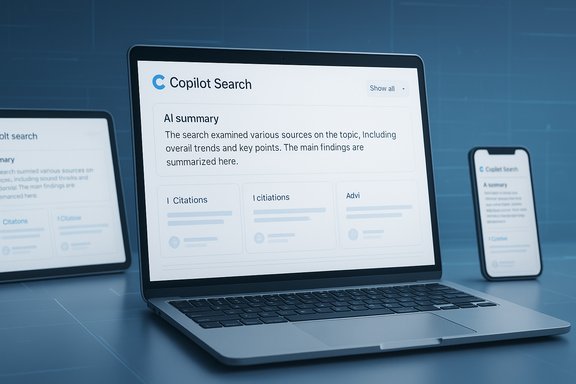
Microsoft has quietly folded a full-fledged search experience into Copilot, reshaping how the assistant surfaces answers and — importantly for publishers — how it credits the sites that powered those answers. The Fall Release brings a dedicated Search mode inside Copilot, more prominent, clickable citations, a consolidated “Show all” reference pane, and navigation links designed to function like traditional search shortcuts while keeping AI-generated summaries front and center.
Microsoft’s Copilot evolution has shifted from a chat-first helper to a multi-modal assistant that lives across Windows, Edge, and mobile. The new Copilot Search features are framed as part of a human-centered approach: keep the convenience of synthesized answers but restore the traceability that users — and publishers — rely on. The company calls the change “bringing the best of AI search to Copilot,” and says the goal is to combine intelligent answers with trusted sources. This is not an experiment isolated to a single surface — Microsoft positions the update as a cross-platform change available on copilot.com, Copilot apps for iOS and Android, and in Edge’s Copilot Mode. That parity matters: the more tightly integrated Copilot is with the browsing and operating system experience, the more its citation behavior will matter to the broader web ecosystem.
Microsoft’s move tightens the loop between search and generative AI: answers become faster and easier to verify, and publishers get clearer attribution. The net effect will depend on rollout details, ranking behavior, and how users choose between reading a synthesized answer and clicking through to the source. For Windows users and admins, the sensible posture is pragmatic optimism: embrace the efficiency gains, but keep the verification checklist and governance guardrails close at hand.
Source: Search Engine Roundtable Microsoft Copilot Adds AI Search With Better Links & Citations
 Background
Microsoft’s Copilot evolution has shifted from a chat-first helper to a multi-modal assistant that lives across Windows, Edge, and mobile. The new Copilot Search features are framed as part of a human-centered approach: keep the convenience of synthesized answers but restore the traceability that users — and publishers — rely on. The company calls the change “bringing the best of AI search to Copilot,” and says the goal is to combine intelligent answers with trusted sources. This is not an experiment isolated to a single surface — Microsoft positions the update as a cross-platform change available on copilot.com, Copilot apps for iOS and Android, and in Edge’s Copilot Mode. That parity matters: the more tightly integrated Copilot is with the browsing and operating system experience, the more its citation behavior will matter to the broader web ecosystem. What Microsoft announced — the essentials
- A dedicated Search experience in Copilot: a selectable “Search” mode that emphasizes references and adapts output depth depending on the query.
- More prominent, clickable citations in Copilot responses so users can jump directly to publisher content.
- A consolidated “Show all” list of references — an aggregated pane that surfaces all sources used to generate a response.
- Top-of-response navigation links for quick, single-click access to obvious destinations (official sites, popular services).
- UI optimizations intended to make the assistant search-first when the user indicates they want that behavior, including cards for navigational queries and improvements to the internal prompt used to fetch and rank sources.
Why this matters: the UX and the ecosystem
Faster verification without detours
Generative assistants historically traded speed for traceability: nice summaries, but opaque sourcing. The new model reduces that tradeoff by placing clickable citations right alongside answers and by offering a one-click “Show all” pane that aggregates the references behind any response. That’s a concrete UX win for tasks that require rapid validation — research, travel planning, quick technical checks, and news verification.Publisher-facing intent
Microsoft explicitly says these citation changes were made with publishers and content owners in mind, framing the UI tweaks as attempts to be “publisher-friendly” by surfacing links more prominently and returning more traffic or at least clearer credit to originators. Whether that intent converts to meaningful click-through volume will depend on execution and on how much users rely on the summarized content versus clicking deeper. Early independent coverage calls out the emphasis on publisher visibility as one of the core selling points for this update.Consistent cross-platform behavior
Because Copilot is not just a web widget but an assistant embedded across platforms (web, Edge, iOS, Android), the way it shows citations will affect many users. Microsoft’s announcement states the features are available across Copilot surfaces, which reduces fragmentation of experience and keeps the same provenance model regardless of where you ask your question. This matters from a product-design and privacy perspective: how and where Copilot fetches source content, and whether connector or local-data access is involved, may differ by platform.Technical verification: what we can confirm (and what remains opaque)
Microsoft’s blog post and multiple independent reports confirm the core claims: Copilot’s results now include prominent, clickable citations, a Show all aggregated references pane, and a dedicated Search mode that adapts response length and depth to the query. Those claims map to observable UI changes Microsoft surfaced and to hands-on reporting by independent outlets. However, several technical details remain opaque or only partly documented:- Citation selection and weighting: Microsoft explains the UI and the UX goal, but the internal ranking logic — how sources are selected, weighted, or prioritized in the aggregated list — is not public. That means independent verification of whether certain publishers are favored or penalized requires telemetry and controlled testing. Treat claims about “how” sources are chosen as partially unverifiable without Microsoft’s internal ranking documentation or independent large-scale measurement.
- Model boundaries and local inference: Microsoft’s announcement describes optimized prompts and better search behavior, but it does not enumerate which model components run locally versus server-side, or exactly how prompt optimization was performed. Those implementation specifics remain partially opaque and subject to change. Any claim about on-device inference, caching, or model versions should be considered speculative unless confirmed by Microsoft documentation or code-level evidence.
- Citation reliability vs. hallucination: Adding citations reduces hallucination risk, but it does not guarantee that citations support the generated claims. Two common failure modes persist: (1) the assistant generates a confident claim and ties it to unrelated or weakly related links, and (2) the assistant synthesizes a novel claim that is not explicitly supported by any cited source. Users must still verify that the cited passages actually back the summarized assertions. Microsoft’s shift toward visible provenance mitigates the problem but does not eliminate it.
Hands-on UX walkthrough (what to expect)
- Open Copilot (copilot.com, Edge Copilot Mode, or the Copilot mobile app).
- In the composer, select the mode dropdown and choose Search to enter the search-first experience.
- Ask a query that benefits from verification, for example: “Best neighborhoods to stay in Rome for first-time visitors.”
- Copilot returns a concise, AI-generated summary at the top with navigation links where appropriate, and clickable source citations either inline or grouped at the bottom.
- Click Show all to open the right-pane list of aggregated references and related results to review the original publisher content side-by-side with the summary.
Strengths and practical benefits
- Speed and verification: Clickable citations shorten the validation loop from minutes to seconds. That’s valuable for journalists, IT pros, and power users who frequently need to confirm facts quickly.
- Balanced UX: The two-tiered answer pattern (top-line synthesis + side/bottom sources) gives both fast answers and the means to deep-dive when required.
- Publisher visibility: By surfacing publishers more prominently, Copilot aims to return recognition — and potentially traffic — to content creators, addressing a core publisher complaint about opaque AI summarization.
- Cross-platform reach: Availability across web, mobile, and Edge reduces platform-specific surprises and keeps the provenance model consistent for users.
- Navigation-first behavior for common queries: Dedicated top links for clear navigational intents (e.g., official government sites, brand homepages) reduces friction for routine tasks.
Risks, trade-offs, and governance considerations
1) Citation is not a guarantee of quality
A link alone doesn’t prove an assistant’s claim. Users must confirm whether the citation actually supports any asserted facts. There is a risk that readers assume provenance equals validation; it does not. Until independent audits measure citation quality and relevance at scale, the presence of links should be treated as helpful but not definitive.2) The new UX could change traffic flows
Even with prominent links, AI summaries can satisfy many users without clicks. This “zero-click” dynamic means publishers might still see fewer visits even as their names appear more often; visibility does not necessarily equal downstream engagement. SEO and analytics teams will need new metrics focused on attribution and brand lift in addition to raw click traffic.3) Hallucination and misattribution remain possible
Citations reduce certain hallucination modes but do not eliminate the possibility that a summary mischaracterizes a source or stitches together bits from unrelated sources. Users should maintain skepticism for critical decisions and verify claims directly against the cited texts.4) Privacy and enterprise governance
Copilot’s extended capabilities — connectors to OneDrive, Outlook, or third-party clouds — are opt-in, but administrators must understand consent mechanics, logging, data retention, and how Copilot answers derived from enterprise content are recorded or surfaced. Governance policies should be updated to include Copilot-specific rules about connectors, retention, and auditing.5) Economic and editorial influence
If Copilot’s internal ranking tilts toward particular publishers (either intentionally for quality or unintentionally due to indexing biases), the platform could influence which publishers gain attention. Transparency around citation sourcing and ranking is essential to avoid perceived or real favoritism. Microsoft has signaled publisher-friendly intent, but algorithmic details are not public.What publishers and IT admins should do now
- Publishers and SEO teams:
- Monitor brand impressions and AI citation visibility in analytics dashboards.
- Test a sampling of queries to see whether pages are being cited and to evaluate how citations are framed.
- Optimize content for clear, factual snippets that AI can cite reliably (structured data, clear headings, and concise statements).
- IT and security admins:
- Review Copilot connector and privacy settings in your environment; require explicit opt-in where enterprise data is concerned.
- Update acceptable use and data retention policies to cover AI-generated outputs and any telemetry logged by Copilot.
- Conduct risk assessments for sensitive queries that might pull together personal data or internal documents.
- All organizations:
- Treat Copilot outputs as a starting point; require at least one direct-source confirmation for decisions with material risk.
How to evaluate citation quality empirically
- Define a test corpus of queries that reflect real-world needs (e.g., product specs, medical guidance, policy citations).
- Run each query in Copilot Search and record the summary plus the full “Show all” reference list.
- For each cited source:
- Check whether the cited passage supports the claim.
- Rate citation relevance (direct support, weak support, unrelated).
- Aggregate results to quantify:
- Percentage of claims fully supported by at least one cited source.
- Frequency of weak/incorrect citations.
- Distribution of citations by domain to detect concentration effects.
Broader implications for search and AI
The integration of a search-first mode into Copilot signals a mainstreaming of a new search paradigm: succinct AI synthesis plus immediate provenance. Competitors are pursuing similar patterns, which will push publishers and web analytics providers to rethink attribution and measurement. For users, the convenience is clear; for publishers, the business model is in flux: visibility becomes distinct from traffic, and influence metrics may matter more than pure visits.Final analysis and takeaway
Microsoft’s Copilot Search represents a meaningful step toward reconciling generative convenience with verification. The addition of a dedicated Search mode, top-of-answer navigation links, clickable citations, and an aggregated “Show all” list materially improves the assistant’s usability for verification-heavy tasks. Those improvements are confirmed in Microsoft’s product announcement and independent coverage. But the changes are not a panacea. The core algorithmic processes that select and weight citations remain opaque; citations help, but they do not automatically validate a claim. Publishers should watch how visibility translates into engagement, and IT teams must update governance and auditing practices to address new connector behaviors. Treat Copilot’s search enhancements as a powerful productivity tool — one that still requires human oversight, source confirmation, and careful governance.Microsoft’s move tightens the loop between search and generative AI: answers become faster and easier to verify, and publishers get clearer attribution. The net effect will depend on rollout details, ranking behavior, and how users choose between reading a synthesized answer and clicking through to the source. For Windows users and admins, the sensible posture is pragmatic optimism: embrace the efficiency gains, but keep the verification checklist and governance guardrails close at hand.
Source: Search Engine Roundtable Microsoft Copilot Adds AI Search With Better Links & Citations
