

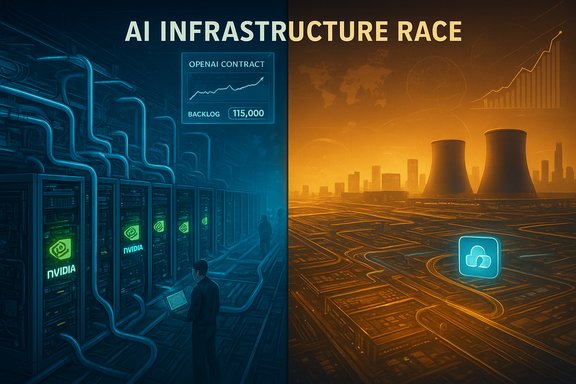
The race to build the physical backbone of modern AI — the GPU farms, liquid‑cooled racks, and multi‑gigawatt campuses that train and serve large language models — has turned into one of the most consequential infrastructure competitions in technology. In the past six months, a flurry of multi‑billion‑dollar contracts, aggressive capital spending and regulatory maneuvering has crystallized two very different investment and operational plays: CoreWeave, a GPU‑first “neocloud” built around high‑density AI compute; and Microsoft, the hyperscale platform that is pairing massive capital deployment with productized AI distribution across Windows and Microsoft 365. The contrast is stark: CoreWeave is a pure‑play growth story hinging on execution and contract conversion, while Microsoft is a diversified industrialist converting compute into recurring product revenue. Both are essential to the AI era — but they expose investors and IT leaders to very different upside and risks.
The AI infrastructure contest is not a single winner‑take‑all race. It is an ecosystem battle in which specialists, hyperscalers, silicon suppliers and sovereign clouds will each capture slices of a very large market. CoreWeave’s rise shows specialists can command premium bookings when they operationalize GPU farms fast; Microsoft’s push demonstrates why owning distribution and embedding AI into billions of seats can convert raw compute into sustainable revenue. The smarter bet depends on whether the investor or IT leader values pure compute optionality or enterprise monetization durability — and whether they can stomach either the execution risk of a high‑growth specialist or the capital‑intensive, regulatory‑sensitive path of the hyperscaler.
Source: The Globe and Mail CoreWeave vs. Microsoft: Which AI Infrastructure is the Smarter Bet?
 Background
Why AI infrastructure matters now
Modern generative AI and large language models demand unprecedented volumes of specialized compute, networking and power. Training a frontier model can require tens of thousands of high‑end accelerators, while serving production workloads needs dense clusters tuned for latency and cost. Analysts expect the AI infrastructure market to expand rapidly over the next decade: one widely cited industry forecast projects growth from roughly $60.2 billion in 2025 to about $499.3 billion by 2034 — a compound annual growth rate in the high‑20s. That scale explains why both niche GPU operators and hyperscalers are racing to lock in supply, real estate and long‑dated contracts.Two strategic plays emerge
- CoreWeave: a specialist, GPU‑first cloud optimized for training and inference, structured to win long‑dated capacity bookings from model builders and hyperscalers. Its thesis is premium pricing per GPU‑hour and tight operational focus.
- Microsoft: a diversified hyperscaler that converts capital investment into product hooks (Copilot, Azure AI Foundry, Microsoft 365 integrations), turning compute into recurring, seat‑based monetization and enterprise lock‑in.
CoreWeave: the high‑beta specialist
What CoreWeave is selling
CoreWeave’s value proposition is straightforward: deliver the densest, fastest, and most GPU‑rich capacity for AI labs and enterprises, and wrap it with developer tools and ML lifecycle services. The company has pursued an acquisition strategy to stitch infrastructure to developer workflows — buying tooling such as Weights & Biases and other ML orchestration assets to shorten customers’ time from prototype to production. These moves aim to make CoreWeave not just a rack provider but a platform for model builders.Contracts that rewrote the playbook
Throughout 2025 CoreWeave announced a sequence of large capacity orders and customer commitments that transformed its revenue visibility. Notable items include:- A sequence of incremental agreements with OpenAI that, together, expanded CoreWeave’s commitments for supporting next‑generation model training into the tens of billions of dollars; a late‑2025 expansion added roughly $6.5 billion and pushed the cumulative OpenAI exposure to about $22.4 billion.
- A secured order form with Meta Platforms committing up to $14.2 billion of cloud capacity through December 2031, with options to extend. This deal diversified CoreWeave’s customer mix beyond model labs into hyperscaler demand.
- A strategic $6.3 billion order with NVIDIA that included an unusual provision: NVIDIA would buy CoreWeave’s unused capacity under defined terms, effectively creating a backstop that reduces occupancy risk for CoreWeave’s buildouts. That arrangement ties the two companies tightly but adds counterparty concentration.
Financial profile and cash intensity
CoreWeave’s growth has been dramatic but capital‑hungry. Recent quarterly reporting showed revenue surging (quarterly revenue crossed the $1‑billion mark during 2025), and management raised FY‑2025 revenue guidance to roughly $5.15–$5.35 billion. At the same time, management signaled sustained multi‑year capital program needs: full‑year CapEx guidance in the range of $20–$23 billion, and quarterly CapEx expectations on the order of $2.9–$3.4 billion. That scale of investment is material for a newly public company and explains both investor enthusiasm and concern over leverage and execution risk.Strengths
- Pure focus on GPU compute gives CoreWeave speed and engineering depth for AI workloads.
- Large, long‑dated contracts with marquee customers (OpenAI, Meta) provide visibility into future revenue if the backlog converts as planned.
- Strategic supplier relationships — especially with NVIDIA — can secure early access to new accelerator families and favorable terms.
Risks and fragilities
- Capital intensity and leverage: the company’s balance sheet is under pressure from very large CapEx and vendor financing structures; rising rates or financing friction would amplify this risk.
- Customer concentration: despite recent diversifying orders, a handful of large clients still account for a disproportionate share of booked capacity.
- Execution risk: data‑center commissioning is a complex orchestration (permits, power, interconnects); delays mean revenue recognition slips while costs continue.
- Counterparty complexity: arrangements like NVIDIA’s purchase‑of‑unused‑capacity reduce occupancy risk but create governance and concentration exposures that are material if assumptions change.
Microsoft: the industrialized platform
A different operating model
Microsoft’s AI infrastructure play is not just about renting GPU hours — it is about embedding models and services across billions of users and tens of millions of commercial seats. Azure’s strategy combines massive capital spending on purpose‑built AI data centers with productized AI (Copilots, Azure AI Foundry) that convert compute into recurring, higher‑margin revenue streams. Microsoft’s balance sheet allows it to underwrite prolonged, noisy capex cycles while pursuing integrated monetization.Scale, milestones, and the Fairwater campus
Microsoft publicly announced a string of investments that underscore the scale of its industrial bet:- Fairwater in Mount Pleasant, Wisconsin — described by Microsoft as the “world’s most powerful AI datacenter” — is a multi‑gigawatt campus designed for hundreds of thousands of NVIDIA GPUs, liquid cooling and massive fiber interconnects. Microsoft plans to bring that site online for AI workloads and to expand Azure’s AI capacity by more than 80% in a single year.
- Azure revenue and cloud growth continue at double‑digit pace; recent quarters showed Azure and other cloud services growing well into the 30–40% range, reflecting strong demand. Microsoft’s cloud scale allows it to amortize CapEx across a diverse revenue base, softening single‑quarter margin shocks.
The revised OpenAI relationship
Late‑October 2025 reporting described a fundamental re‑engineering of the Microsoft–OpenAI partnership. Under the revised framework:- Microsoft secured a sizeable equity position and extended commercial rights that preserve Azure’s product monetization opportunities.
- OpenAI committed to a major incremental Azure spend (widely reported as approximately $250 billion over multiple years), while gaining operational flexibility to source compute from multiple partners. Microsoft retained important IP and product channels but lost exclusive control of OpenAI’s compute sourcing in certain areas. These changes reshape how Azure will capture value from model commercialization while acknowledging that frontier AI requires a distributed compute ecosystem. Because the deal and governance changes are ongoing and complex, some headline figures and valuation implications remain subject to future filings and clarifying disclosures.
Strengths
- Deep, recurring distribution: Microsoft can surface advanced models inside Office, Windows and enterprise suites — turning AI capability into sustained revenue, not just raw compute.
- Financial strength: large cash flows and credit capacity allow multi‑year CapEx programs without the same liquidity stress CoreWeave faces.
- Integration and compliance: Azure’s enterprise tooling, sovereign cloud options and compliance certifications are compelling for regulated customers.
Risks
- Massive capex increases near‑term volatility: commissioning large campuses and server refreshes creates noisy quarterly spending and margin swings.
- Competitive pricing pressure: AWS, Google Cloud and specialist providers can compete aggressively on raw compute pricing, compressing ASPs for GPU hours.
- Regulatory and antitrust scrutiny: bundling models, IP rights and distribution advantages invites regulatory attention, especially as AGI‑trigger clauses and governance around OpenAI remain contentious.
Side‑by‑side: where value and risk differ
Growth potential
- CoreWeave — As a pure‑play, CoreWeave offers asymmetric upside if it converts backlog into billed revenue at healthy realized prices. Upside is concentrated and depends on flawless execution: GPU deliveries, data‑center commissioning, and managing vendor financing.
- Microsoft — Slower headline growth but far broader monetization paths: seat‑based Copilot integration, enterprise contracts, and Azure AI services can deliver durable revenue even if raw compute prices compress.
Balance sheet and financing
- CoreWeave: levered, heavily dependent on vendor financing and capital markets. Shorter runway if bookings slow or financing terms tighten.
- Microsoft: diversified, cash‑rich, can absorb multi‑year CapEx without threatening core business continuity.
Concentration and counterparty exposure
- CoreWeave’s fortunes are tied closely to a handful of major customers and to NVIDIA as a supplier and investor; that creates tail‑risk if relationships shift.
- Microsoft’s concentration risk is lower by revenue share, but its strategic exposure to OpenAI and to the broader competitive landscape still matters materially for Azure’s AI trajectory.
Valuation and investor lens
- Market pricing for CoreWeave already reflects a high‑growth narrative. Its multiples imply flawless execution for several quarters to come.
- Microsoft trades as a diversified compounder: lower multiple but also lower downside from a revenue‑diversified base. Short‑term P&L effects from aggressive capex are probable; the long‑term prize is differentiated software monetization tied to AI features embedded across Microsoft’s product portfolio.
What to watch next — proof points that separate winners from hype
- CoreWeave: quarterly CapEx versus commissioning schedule; backlog conversion into recognized revenue (billing cadence and realized price per GPU hour); utilization and margin trends; the exit terms and guarantees embedded in NVIDIA and customer contracts.
- Microsoft: Azure AI revenue growth and gross‑margin behavior; timing and operational ramp of Fairwater and other gigawatt campuses; detail on the revised OpenAI agreement and how Azure monetizes model access within Microsoft products.
- Macro: GPU supply, export controls, and power availability — constraints here materially alter build timelines and costs for every provider. Independent open‑model releases that reduce the marginal compute needs of certain workloads could change pricing dynamics too.
Practical guidance for investors and IT decision‑makers
For investors
- Risk‑tolerant, concentrated growth allocation: CoreWeave offers asymmetric upside but expect high volatility. Size positions with an eye to potential dilution, covenant squeezes or execution delays.
- Core portfolio exposure: Microsoft provides durable enterprise AI exposure, with lower volatility and diversified monetization across software, cloud and services.
- Tactical approach: a small, monitored allocation to CoreWeave alongside a core holding in Microsoft lets investors capture pure‑play upside while retaining defensive exposure to platform‑driven AI adoption.
For IT and procurement teams
- Avoid single‑provider lock‑in for mission‑critical model training: negotiate strong migration, egress and SLA terms.
- Validate region and SKU parity before committing to large external GPU deals — not all contracted capacity maps cleanly to specific product SKUs or geographic residency needs.
- Pilot workloads to measure realistic GPU‑hour economics; distillation, quantization and model optimization can dramatically reduce cost without a proportional quality loss for many tasks.
Critical appraisal: strengths, open questions and unverifiable claims
The last year’s headlines — multi‑billion contracts, equity stakes and public‑private partnerships — are real and materially reshape incentives across the compute stack. But several important caveats apply:- Headline dollar totals in multi‑year capacity agreements are directional and meaningful, yet the economic impact depends on precise pricing, SKUs, termination triggers and delivery milestones that are often not fully disclosed in public summaries. Treat the headline numbers as useful signal, not a literal revenue schedule absent contract detail.
- Recent reports about corporate restructurings, equity valuations and AGI‑triggered clauses (notably around OpenAI and Microsoft) have large implications but include elements that are evolving and legally complex. Some widely reported valuations and timelines remain market commentary until confirmed in definitive regulatory filings. Flag those as contingent and follow subsequent company filings for confirmation.
- Supplier concentration (NVIDIA) is both a strength and a systemic risk. NVIDIA’s dominant position in high‑end accelerators creates a single point of supply stress and geopolitical exposure through semiconductor export rules. This is a structural industry fact, not opinion.
Bottom line: which is the “smarter bet”?
The smarter bet depends on objectives, time horizon and risk tolerance.- For asymmetric, high‑growth exposure to the pure compute economy — where upside concentrates around market share in GPU‑hour sales and successful conversion of large backlog — CoreWeave is the direct play. That thesis requires flawless capex execution, resilient financing access and stable GPU supply; any of those can swing outcomes sharply.
- For durable, diversified exposure to the enterprise AI transition — where compute is a means to capture recurring software and platform revenue across millions of seats — Microsoft is the pragmatic industrialist. Its scale, product distribution and balance sheet materially lower execution risk while offering steady upside as AI features proliferate across Windows, Microsoft 365 and Azure.
The AI infrastructure contest is not a single winner‑take‑all race. It is an ecosystem battle in which specialists, hyperscalers, silicon suppliers and sovereign clouds will each capture slices of a very large market. CoreWeave’s rise shows specialists can command premium bookings when they operationalize GPU farms fast; Microsoft’s push demonstrates why owning distribution and embedding AI into billions of seats can convert raw compute into sustainable revenue. The smarter bet depends on whether the investor or IT leader values pure compute optionality or enterprise monetization durability — and whether they can stomach either the execution risk of a high‑growth specialist or the capital‑intensive, regulatory‑sensitive path of the hyperscaler.
Source: The Globe and Mail CoreWeave vs. Microsoft: Which AI Infrastructure is the Smarter Bet?
