

Corsair’s new Galleon 100 SD does something most keyboard makers have only hinted at for years: it puts a full Elgato Stream Deck inside a high‑performance mechanical keyboard, and packages it as a single, polished product aimed at streamers, creators, and power users willing to pay a premium for consolidation. The result is a distinctive hybrid — a gasket‑mounted, hot‑swap mechanical board built around Corsair’s new MLX Pulse linear switches, paired with a 12‑key, full‑color Stream Deck panel, two rotary dials, and a dedicated 5‑inch display — all sold at a $349.99 MSRP and shipping now.
Corsair acquired Elgato several years ago and has steadily folded Elgato features into its ecosystem. The Galleon 100 SD (the “SD” suffix signaling Stream Deck integration) is the clearest manifestation of that strategy: rather than bundling separate peripherals, Corsair has fused the control surface and the keyboard into one unit. Announced at CES and launched at the end of January, the Galleon 100 SD is positioned as a one‑stop control center for gaming, streaming, and content workflows.
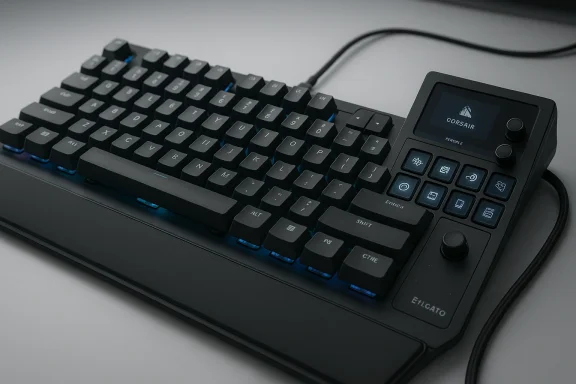
At its core the Galleon is still a mechanical keyboard: a full‑sized layout (ANSI 87‑key when configured in its TKL footprint) sits alongside a right‑hand module that can operate either as a numeric keypad or as a Stream Deck control surface. That flexible right‑side “command console” is the product’s defining innovation: the Stream Deck panel contains 12 LCD keys, two pushable rotary encoders, and a 5‑inch 720p‑class color display for visual feedback and overlays.
Gasket mounting — once a feature reserved for boutique custom keyboards — gives the Galleon more balanced feedback than typical top‑mounted prebuilt boards, and the layered damping is an explicit attempt to bridge the gap between premium custom kits and mass‑market gaming hardware. Independent reviewers who got early units describe the typing feel as improved and more refined compared with Corsair’s prior top‑mount designs.
A key practical point: while the board is hot‑swap compatible, the MLX Pulse remains the single factory switch included, and Corsair’s product imagery and messaging emphasize that switch as part of the Galleon identity.
If Corsair follows through with tighter software integration — merging Web Hub and Stream Deck controls, or enabling shared lighting profiles across iCUE and the Stream Deck module — the Galleon could set a blueprint for future peripherals. Conversely, if software remains fragmented, the board will be seen as an elegant but niche convenience product rather than a paradigm shift. Early firmware promises and Corsair’s public roadmap suggest the company recognizes this and plans continued refinement.
That said, the product has caveats: the need to run both Corsair and Elgato apps, the single factory switch option, its larger desk footprint, and the premium price all mean the Galleon is not for everyone. If you already own separate quality peripherals or prioritize a single app ecosystem from day one, you should weigh the convenience of consolidation against the flexibility of buying components separately. For those who want the Stream Deck experience under their palms without cluttering the desk, Corsair’s Galleon 100 SD is a compelling, polished choice — and a clear hint at where input hardware may head next.
Note: technical claims like 8,000 Hz polling and MLX Pulse switch measurements are Corsair’s published specifications; independent labs and long‑term user reports will be needed to quantify day‑to‑day effects across different systems.
Source: Windows Central https://www.windowscentral.com/accessories/keyboards/corsair-galleon-100-mechanical-keyboard-review/
 Background / Overview
Corsair acquired Elgato several years ago and has steadily folded Elgato features into its ecosystem. The Galleon 100 SD (the “SD” suffix signaling Stream Deck integration) is the clearest manifestation of that strategy: rather than bundling separate peripherals, Corsair has fused the control surface and the keyboard into one unit. Announced at CES and launched at the end of January, the Galleon 100 SD is positioned as a one‑stop control center for gaming, streaming, and content workflows. At its core the Galleon is still a mechanical keyboard: a full‑sized layout (ANSI 87‑key when configured in its TKL footprint) sits alongside a right‑hand module that can operate either as a numeric keypad or as a Stream Deck control surface. That flexible right‑side “command console” is the product’s defining innovation: the Stream Deck panel contains 12 LCD keys, two pushable rotary encoders, and a 5‑inch 720p‑class color display for visual feedback and overlays.
What’s inside: hardware and build quality
Chassis, mounting and acoustics
Corsair built the Galleon 100 SD around a gasket‑mounted PCB and a rigid chassis with multi‑layer sound dampening. The company highlights a six‑layer foam stack intended to reduce unwanted resonances and produce the sought‑after “thock” sound profile many enthusiasts prefer. The board has a reassuring weight and a minimalist black finish on the shipping units, and Corsair bundles a magnetic memory‑foam wrist rest.Gasket mounting — once a feature reserved for boutique custom keyboards — gives the Galleon more balanced feedback than typical top‑mounted prebuilt boards, and the layered damping is an explicit attempt to bridge the gap between premium custom kits and mass‑market gaming hardware. Independent reviewers who got early units describe the typing feel as improved and more refined compared with Corsair’s prior top‑mount designs.
Switches and hot‑swap capability
The Galleon ships with Corsair’s MLX Pulse pre‑lubed linear switches: 45 g actuation, 2.0 mm actuation point, and roughly 3.6 mm total travel. The switches use standard 3‑ and 5‑pin housings and are hot‑swappable on the stock PCB, so enthusiasts can replace them with other mechanical switches if they prefer. Corsair markets the MLX Pulse as a high‑quality prebuilt option — lightly lubed out of the box — and reviewers generally praise their smoothness and suitability for gaming.A key practical point: while the board is hot‑swap compatible, the MLX Pulse remains the single factory switch included, and Corsair’s product imagery and messaging emphasize that switch as part of the Galleon identity.
Connectivity and extras
Corsair advertises a competitive‑grade spec sheet: 8,000 Hz hyper‑polling via AXON technology, FlashTap/FlashTap‑style SOCD handling for simultaneous directional inputs, per‑key RGB lighting, and a USB passthrough. The unit uses dual USB‑C ports on the keyboard’s rear: one cable powers the keyboard, while the second enables USB passthrough, a detail that matters to users who prefer single‑cable tidiness versus those who want passthrough devices. Corsair also includes braided USB‑C cables and a magnetic wrist rest in the box.The Stream Deck integration: what it is and how it works
Physical layout and controls
The integrated Stream Deck area is not merely a cosmetic addition — it’s a functional Elgato controller physically embedded in the right side of the case. The set consists of:- 12 programmable LCD keys (the same tactile profile and visual approach as Elgato’s standalone Stream Deck products)
- A 5‑inch full‑color display above or adjacent to the keys (Corsair and reviewers report 720×1280 vertical resolution on the module)
- Two rotary encoders with push‑to‑click actions for quick adjustments and contextual navigation
- A hardware toggle that allows the panel to switch into a numeric keypad mode if you need a traditional numpad on demand.
Software and ecosystem: Elgato plugins, profiles and game integration
The Stream Deck portion is fully compatible with the Elgato Stream Deck ecosystem: you can assign multi‑action macros, app and OS controls, OBS/Twitch actions, audio controls, and a wide library of plugins from the Elgato Marketplace. Corsair promotes integrations labeled “Smart Profiles” and game‑level context switching — small but meaningful features that let the panel automatically switch profiles based on the active game or app. That makes the Stream Deck side genuinely useful beyond streaming, for music control, app launching, system monitoring, and game‑specific bindings.Two software stacks (and why that matters)
Right now the Galleon is controlled by two separate software utilities: Corsair’s Web Hub (the lightweight browser‑based control surface for keyboard customization) and Elgato’s Stream Deck app for the Stream Deck keys. That split means lighting, macro remaps and keyboard firmware are handled in one place, while the Stream Deck panel’s functions are handled in another. Reviewers and early buyers have flagged this as a friction point: you must run both utilities to unlock the board’s complete feature set, and synchronization between Corsair lighting profiles and Elgato panels isn’t seamless at launch. Corsair says firmware updates and tighter integration are planned, but at the time of release users should expect to manage both toolchains.Performance claims vs. reality — what is vendor‑claimed and what is independently verified
Corsair advertises several high‑impact performance features — notably 8,000 Hz polling, AXON technology, FlashTap SOCD handling, and the pre‑lubed MLX Pulse switch spec. Those claims are clearly spelled out on Corsair’s product pages and press materials, and they align with what reviewers observed in early units. However, two important realities apply:- High‑frequency polling and latency improvements are measurable in lab conditions. Vendor claims such as 8,000 Hz hyper‑polling are real features, but the real‑world perceptible advantage depends on host OS, USB scheduling, and the specific game. Professional verification of latency improvement versus more common 1,000 Hz or 4,000 Hz polling requires controlled benchmarks; Corsair’s 8,000 Hz number is a vendor metric supported by their AXON hardware.
- The Stream Deck module’s capabilities are identical to Elgato’s standalone devices in functionality, but any claim that keyboard‑integrated UX is universally superior is subjective. For streamers who already own a Stream Deck, consolidation is valuable; for others, buying a separate high‑quality mechanical keyboard and a standalone Stream Deck could be a better price/value path. Independent reviewers echo that Galleon is a niche but very well executed product for the right buyer.
Detailed strengths
- Integrated workflow consolidation. Put simply, the Galleon 100 SD replaces two desk items — a premium mechanical keyboard and a standalone Stream Deck — with one cohesive device. For streamers, creators, and multitasking gamers this reduces footprint and complexity.
- High‑end typing and gaming pedigree. Gasket mounting, multi‑layer dampening, and Corsair’s MLX Pulse switches combine for a satisfying typing acoustic and feel that many reviewers praised as “one of the most fun” Corsair has shipped recently. The hot‑swap PCB gives enthusiasts an easy upgrade path.
- Full Stream Deck feature set, embedded. The 12 LCD keys, two dials, and a 5‑inch display bring Elgato’s mature plugin library and app integrations directly into the keyboard. You don’t lose any of the Stream Deck’s software ecosystem by going this route.
- Competitive‑grade input features. The AXON 8,000 Hz polling and FlashTap options cater to players who want every latency advantage available, and the board supports common gamer‑oriented functions like SOCD handling. Vendor claims are clear, and reviewers confirm the responsiveness is excellent in day‑to‑day use.
Potential risks and downsides
- Price vs. modular alternatives. At $349.99, the Galleon is clearly premium — you’re paying for a two‑product consolidation and Corsair’s engineering. For users who already own a Stream Deck+ or XL, or who prioritize switch choice over integrated features, the Galleon’s value proposition weakens. Multiple reviewers have noted that unless you need the Stream Deck built into the keyboard, cheaper combinations can meet most needs.
- Software fragmentation at launch. Having to run both Corsair’s Web Hub and Elgato’s Stream Deck software is inconvenient. Corsair has stated firmware work and deeper integration are planned, but early adopters must juggle two clients until that happens. That imposes a configuration burden and increases the attack surface of potential software conflicts on some systems.
- Single factory switch option. Although the PCB is hot‑swappable, Corsair ships only the MLX Pulse switches. If you prefer heavier tactiles or adjustable magnetic actuation switches, you’ll need to buy and install replacements. That’s not a technical limitation — it’s a positioning decision that steers the product toward a particular feel out of the box.
- Supply and demand. Corsair’s own storefront notes high demand and limited stock at launch — a reality that can complicate returns, exchanges, or warranty replacement timelines for the first wave of buyers. If you prefer to wait for broader availability or community feedback, early units may be pricier to resell or harder to service quickly.
- Desk footprint and ergonomics. Despite being functionally “full‑size,” the keyboard’s physical footprint is larger than a typical TKL because of the Stream Deck module. That increases desk space requirements and changes the typing/hand placement dynamics versus a strict TKL layout. Reviewers flagged this as trivial for some users but a consideration for minimalists.
Practical buying guide: who should buy the Galleon 100 SD?
- You should consider the Galleon 100 SD if:
- You stream or create content and value a compact, single‑device control surface.
- You want a premium out‑of‑the‑box typing and gaming experience with gasket mounting and pre‑lubed switches.
- You appreciate the idea of a numeric keypad that can switch into a full Stream Deck, and you use many macro or multi‑action bindings in daily workflows.
- You might skip it if:
- You already own a high‑quality Stream Deck and a keyboard you like; buying both separately could be cheaper.
- You need a broad choice of factory switch types or are committed to VIA/Voyager‑style firmware ecosystems not currently supported.
- You dislike managing multiple software utilities and prefer a single, unified control app on day one.
Long‑term outlook and the broader market impact
The Galleon 100 SD is more than a single product launch — it’s a signal that integrated control surfaces and multi‑device consolidation are a mainstream design direction. Corsair and Elgato’s combined engineering gives them unique leverage: they can iterate on hardware and software in tandem, and the Stream Deck plugin ecosystem provides a growth path that no standalone keyboard maker can match on its own.If Corsair follows through with tighter software integration — merging Web Hub and Stream Deck controls, or enabling shared lighting profiles across iCUE and the Stream Deck module — the Galleon could set a blueprint for future peripherals. Conversely, if software remains fragmented, the board will be seen as an elegant but niche convenience product rather than a paradigm shift. Early firmware promises and Corsair’s public roadmap suggest the company recognizes this and plans continued refinement.
Final verdict
The Corsair Galleon 100 SD is an ambitious, well‑executed experiment in hardware convergence. For streamers, creators, and power users who value an integrated control surface, it is currently the best keyboard‑integrated Stream Deck on the market: the physical execution is solid, the MLX Pulse switches and gasket mount give the keyboard admirable feel, and the embedded Stream Deck panel preserves Elgato’s extensive software ecosystem. At $349.99 the price is high, but reasonable for what is effectively two high‑end peripherals in one chassis.That said, the product has caveats: the need to run both Corsair and Elgato apps, the single factory switch option, its larger desk footprint, and the premium price all mean the Galleon is not for everyone. If you already own separate quality peripherals or prioritize a single app ecosystem from day one, you should weigh the convenience of consolidation against the flexibility of buying components separately. For those who want the Stream Deck experience under their palms without cluttering the desk, Corsair’s Galleon 100 SD is a compelling, polished choice — and a clear hint at where input hardware may head next.
Note: technical claims like 8,000 Hz polling and MLX Pulse switch measurements are Corsair’s published specifications; independent labs and long‑term user reports will be needed to quantify day‑to‑day effects across different systems.
Source: Windows Central https://www.windowscentral.com/accessories/keyboards/corsair-galleon-100-mechanical-keyboard-review/
