

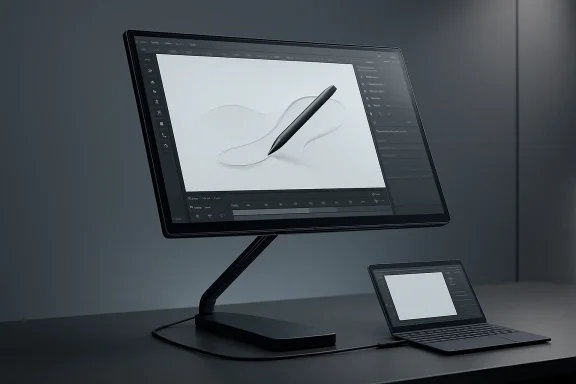
A provocative Windows Central argument has reopened one of the most interesting questions in modern Surface history: what if Microsoft Surface Studio was never meant to live or die as a PC? The all-in-one may have failed as a mainstream desktop, but its 28-inch 3:2 touch display, floating hinge, and creator-first posture remain some of the most memorable industrial design work Microsoft has ever shipped. If Microsoft no longer wants to build that class of hardware itself, licensing the design to another OEM as a premium monitor could turn a discontinued icon into a profitable Windows ecosystem showcase. The idea is not nostalgia for nostalgia’s sake; it is a practical way to preserve Surface’s experimental legacy while letting a specialist manufacturer handle production, pricing, distribution, and risk.
That distinction matters because the Surface Studio’s central weakness was also obvious from the beginning. Microsoft sold it as a complete desktop computer, yet its internals often lagged behind what workstation buyers expected for the price. The display and hinge felt futuristic, while the silicon inside could feel like yesterday’s compromise wrapped in tomorrow’s design.
By the time Surface Studio 2+ arrived in 2022, the formula looked even harder to defend. Microsoft refreshed the machine with newer components, including an 11th-generation Intel Core processor and NVIDIA RTX laptop graphics, but the market had already moved faster than the product. A premium all-in-one with mobile-class components was always going to face pressure from modular desktops, high-end laptops, and external monitors.
The proposal now gaining attention is simple but powerful: separate the Studio’s best idea from the part that aged poorly. A Surface Studio monitor would preserve the display, aspect ratio, touch layer, pen support, and gravity-defying hinge while letting users bring their own PC. That shift could transform the Studio from a niche all-in-one into a long-lived premium accessory for Windows creators, enterprises, and enthusiasts.
That aspect ratio was not a minor ergonomic detail. A taller display changes how creative and professional software feels because it reduces vertical scrolling and creates more natural room for toolbars, tracks, and reference material. For writers, designers, architects, educators, developers, and spreadsheet-heavy professionals, 3:2 can feel closer to a digital sheet of paper than a television panel repurposed for work.
Microsoft also understood the theatrical value of motion. The Zero Gravity hinge turned the Studio from a screen into a surface, letting users pull the display down toward the desk for drawing or annotation. That physical transformation gave the device its identity and separated it from iMac-style all-in-ones, conventional monitors, and pen tablets.
That elegance remains rare in the Windows monitor market. There are excellent color-accurate displays, excellent pen displays, and excellent docking monitors, but few products combine them into a single premium desktop centerpiece. A licensed Studio monitor would not need to be the cheapest or fastest display; it would need to be the most purposeful one.
A modern version should preserve the core design language while updating everything users now expect. Thin bezels, modern connectivity, higher refresh options, improved color calibration, and robust docking would be essential. The point is not to freeze the 2016 product in amber, but to translate its best ideas into 2026 expectations.
That is a dangerous bargain in any era, but it became more painful as CPU and GPU cycles accelerated. A magnificent panel can remain useful for a decade, while the computer behind it may feel dated in three or four years. By fusing both into one expensive object, Microsoft made the Studio’s best component hostage to its fastest-aging component.
The all-in-one design also limited repair and upgrade expectations. Creative professionals often want to extend the life of displays, storage, GPUs, and peripherals independently. A closed all-in-one can be beautiful, but beauty does not help when the GPU is no longer sufficient for a new rendering workload or when a business wants standardized fleet maintenance.
The Surface Studio also occupied an awkward price-performance space. It was too expensive to be a casual family desktop and too constrained to be a no-compromise workstation. Its most devoted audience understood the magic, but mainstream buyers saw a beautiful device with practical trade-offs.
A monitor-only Studio would reverse that equation. Instead of asking buyers to accept fixed internals, it would let them pair the display with a desktop tower, mini PC, laptop, workstation, or future Surface device. That modularity would make the Studio’s design easier to justify across more budgets and refresh cycles.
Licensing Surface designs would be more ambitious than licensing keyboards or mice, but the logic is similar. Microsoft owns hardware concepts with residual brand equity, and OEMs are constantly searching for products that stand out in a crowded Windows ecosystem. A licensed Studio monitor could satisfy both sides if the terms protected quality, support, and design integrity.
This approach would also fit the historical role of Surface. Surface was never only about unit sales; it was about pushing Windows hardware partners toward better ideas. The original Surface Pro helped normalize detachable 2-in-1s, and Surface Laptop helped define expectations for premium Windows notebooks. A licensed Studio monitor could perform a similar role for creative desktop displays.
For an OEM, that story has marketing value. It creates an instant halo product that could sit above conventional monitors, docking stations, and pen displays. It would also let the partner sell into Windows-heavy creator, education, and enterprise markets where Surface recognition still carries weight.
The challenge would be maintaining trust. A licensed Surface product cannot feel like a cheap imitation or a logo exercise. Microsoft would need strict industrial design, firmware, driver, accessibility, security, and warranty requirements to make the brand extension credible.
Connectivity would be just as important as image quality. A built-in Thunderbolt dock or USB4 hub could make the monitor the center of a modern Windows desk, allowing one cable to connect video, power, networking, storage, audio, and peripherals. That would make the Studio monitor especially compelling for laptop users who move between mobile and desk setups.
The product should also support multiple classes of PC. A Surface Pro, Surface Laptop, compact workstation, gaming desktop, or enterprise laptop should all be able to benefit from the same display. The entire point is to decouple the Studio experience from a single frozen motherboard.
A strong configuration would include:
A monitor version would align better with corporate procurement. Businesses could standardize on the display for design departments, executive collaboration rooms, architecture teams, medical visualization, education labs, or front-office presentation spaces while refreshing PCs separately. That separation makes budgeting and lifecycle management easier.
The bring your own PC model also helps IT teams manage performance tiers. A designer could use the Studio monitor with a powerful workstation, while a manager could use it with a business laptop. The same display experience could span multiple device classes without forcing one computer configuration on everyone.
Potential enterprise targets include:
A monitor version would lower the psychological barrier because users would not be buying into a fixed PC. A photographer could connect a desktop today and a laptop tomorrow. A student could use it with a gaming PC, then later with a professional workstation.
This matters because creators often build systems gradually. They may invest in a display first, then upgrade the PC, camera, storage, or input devices over time. A Studio monitor could become the stable center of that evolving setup.
That hybrid role is where the Studio concept shines. A user can write emails upright, pull the screen down to sketch, return it to vertical for editing, then use touch to navigate a presentation. The motion between modes becomes part of the workflow.
The key is latency, palm rejection, and pen reliability. If those areas fall short, the product becomes an expensive curiosity. If they work well, the Studio monitor could appeal to a broad class of creators who do not need a dedicated art tablet but want more direct interaction than a normal monitor provides.
A licensed Studio monitor would give Windows something visually distinctive again. It would not compete with Apple by copying the iMac; it would compete by emphasizing modularity, touch, pen, and multi-PC flexibility. That distinction matters because Windows’ strength has always been choice, not sealed simplicity.
The broader monitor market is also moving in directions that leave room for a Studio revival. OLED gaming displays dominate enthusiast attention, ultrawides attract productivity users, and USB-C docking monitors serve business buyers. A 3:2 touch-and-pen creative monitor with a premium hinge would occupy a different lane.
That said, Surface has always operated in tension with OEM partners. Microsoft built Surface PCs to set examples, and partners eventually adopted many of the ideas. A licensed design could be less threatening than Microsoft manufacturing the product itself because it would place the commercial opportunity directly in the partner channel.
The ideal partner would be one with display expertise, enterprise reach, and the discipline to avoid cheapening the Surface name. Dell, HP, Lenovo, ASUS, Samsung, LG, and others all have different strengths, but the winning candidate would need to treat the Studio monitor as a flagship. A half-hearted version would damage the idea before the market could judge it fairly.
But success created a new problem. Once the mainstream Surface portfolio became more predictable, the absence of experimental devices became more visible. Products like Surface Book, Surface Studio, Surface Duo, Surface Pro X, and Surface Laptop Studio gave the brand a sense of restless invention, even when they were commercially imperfect.
The risk for Microsoft is that Surface becomes just another premium PC line. That may be fine as a business, especially if the company’s strategic center of gravity now sits around Windows, Azure, Copilot, and AI services. Yet a purely conservative Surface portfolio leaves less room for the hardware imagination that once made Microsoft events feel unpredictable.
A Studio monitor is the clearest candidate because the display concept is separable from the failed all-in-one business model. Surface Duo is harder because phone ecosystems are brutal and software-dependent. Surface Book is harder because detachable GPU bases complicate engineering and support. Surface Studio, by contrast, has a clean second life waiting inside it.
This strategy would also send a useful message to Windows enthusiasts. Microsoft would be acknowledging that some Surface ideas still have value even when Microsoft is no longer the right company to manufacture them. That kind of humility could strengthen the brand rather than dilute it.
The hinge alone is a major engineering identity. It must feel effortless while supporting a large panel through years of movement. If it sags, wobbles, creaks, or loses calibration, the entire product’s promise collapses.
Touch and pen input also raise support expectations. Users will blame the monitor, the PC, Windows, the app, the driver, and the pen interchangeably when something goes wrong. Microsoft and the OEM would need clear certification layers to make troubleshooting manageable.
There is also an AI-era opportunity here. A Studio monitor paired with Copilot-capable PCs could become a natural canvas for visual brainstorming, annotation, document summarization, and creative iteration. That promise depends less on branding and more on whether the system feels fluid in real applications.
The OEM should not ship a bloated software suite to compensate for gaps. The best version would integrate quietly with Windows, expose essential controls, and stay out of the user’s way. Premium hardware loses its magic quickly when the software feels like an afterthought.
The question is not whether it can be cheap, but whether it can be rational. If priced like a high-end professional monitor plus a docking station plus a pen display, the value story becomes clearer. Buyers do not need it to undercut commodity displays; they need it to justify replacing several desk components with one excellent centerpiece.
A possible danger is overreaching. If the monitor lands near the price of a full workstation, many buyers will again wonder whether the Studio concept has learned anything. The product must be premium, but the absence of built-in PC components should be reflected in the price.
Microsoft Stores no longer play the same physical retail role they once did, so a partner would need strong demonstration channels. This product cannot be understood from a spec sheet alone. People need to move the hinge, draw on the panel, dock a laptop, and feel why the design is different.
The branding should be careful and explicit. Something like Surface Studio Display, Designed by Microsoft would communicate lineage while making clear that a partner manufactures and supports the product. That distinction protects Microsoft while giving the OEM a premium identity to market.
A licensed Studio monitor would be a useful test because it is ambitious without being reckless. Microsoft would not need to rebuild a full desktop line, manage a new all-in-one roadmap, or convince buyers to accept fixed internals. Instead, it could validate whether Surface design has value as a licensed ecosystem asset.
The next steps would need to be disciplined:
The Surface Studio’s tragedy was never that it lacked imagination; it was that its imagination was trapped inside the wrong business model. As a licensed monitor, the design could finally become what many users always wanted: a stunning, flexible, pen-enabled Windows canvas that outlives any single PC. Microsoft does not need to bring back the all-in-one to honor the Studio’s legacy. It only needs to let the best part of the product stand on its own, and let the right partner prove that some hardware ideas are too good to leave buried.
Source: Windows Central https://www.windowscentral.com/hard...ds-to-license-its-abandoned-surface-hardware/
 Overview
Surface Studio’s Unfinished Story
The original Surface Studio arrived in 2016 as one of Microsoft’s clearest statements that Windows hardware could still surprise people. It was not merely another all-in-one desktop; it was a drafting table, a touch-first workstation, and a display that seemed to float above the desk. For many users, the device’s emotional appeal came less from its processor or graphics card and more from the way its screen invited direct interaction.That distinction matters because the Surface Studio’s central weakness was also obvious from the beginning. Microsoft sold it as a complete desktop computer, yet its internals often lagged behind what workstation buyers expected for the price. The display and hinge felt futuristic, while the silicon inside could feel like yesterday’s compromise wrapped in tomorrow’s design.
By the time Surface Studio 2+ arrived in 2022, the formula looked even harder to defend. Microsoft refreshed the machine with newer components, including an 11th-generation Intel Core processor and NVIDIA RTX laptop graphics, but the market had already moved faster than the product. A premium all-in-one with mobile-class components was always going to face pressure from modular desktops, high-end laptops, and external monitors.
The proposal now gaining attention is simple but powerful: separate the Studio’s best idea from the part that aged poorly. A Surface Studio monitor would preserve the display, aspect ratio, touch layer, pen support, and gravity-defying hinge while letting users bring their own PC. That shift could transform the Studio from a niche all-in-one into a long-lived premium accessory for Windows creators, enterprises, and enthusiasts.
- The display aged better than the computer.
- The hinge remains genuinely distinctive.
- The all-in-one pricing model limited the audience.
- A monitor would avoid forced CPU and GPU obsolescence.
- Licensing could reduce Microsoft’s hardware exposure.
What Surface Studio Got Right
The Display Was the Product
The strongest case for a licensed Surface Studio monitor begins with the simplest observation: people remember the screen. The Studio’s large 3:2 PixelSense display was unusually well suited to documents, timelines, canvases, spreadsheets, and web pages. At a time when much of the monitor market still treated 16:9 as the default for everything, Microsoft built a workspace that felt taller, calmer, and more productive.That aspect ratio was not a minor ergonomic detail. A taller display changes how creative and professional software feels because it reduces vertical scrolling and creates more natural room for toolbars, tracks, and reference material. For writers, designers, architects, educators, developers, and spreadsheet-heavy professionals, 3:2 can feel closer to a digital sheet of paper than a television panel repurposed for work.
Microsoft also understood the theatrical value of motion. The Zero Gravity hinge turned the Studio from a screen into a surface, letting users pull the display down toward the desk for drawing or annotation. That physical transformation gave the device its identity and separated it from iMac-style all-in-ones, conventional monitors, and pen tablets.
Why the Design Still Matters
The Studio design still resonates because it solved a human problem rather than merely showcasing engineering. Most touch PCs ask users to reach awkwardly across a desk, while pen displays often require a separate tablet that duplicates another screen. Surface Studio collapsed those modes into one elegant object.That elegance remains rare in the Windows monitor market. There are excellent color-accurate displays, excellent pen displays, and excellent docking monitors, but few products combine them into a single premium desktop centerpiece. A licensed Studio monitor would not need to be the cheapest or fastest display; it would need to be the most purposeful one.
A modern version should preserve the core design language while updating everything users now expect. Thin bezels, modern connectivity, higher refresh options, improved color calibration, and robust docking would be essential. The point is not to freeze the 2016 product in amber, but to translate its best ideas into 2026 expectations.
- 3:2 remains excellent for productivity and creation.
- Touch and pen input make more sense on a movable display.
- The hinge creates a workflow, not just a visual gimmick.
- The design still has no obvious mainstream Windows equivalent.
Why the All-in-One Model Failed
Premium Price, Aging Components
The Surface Studio’s most persistent problem was not that it was expensive. Premium creative hardware can justify premium pricing when the performance, display, serviceability, and lifecycle align. The Studio struggled because buyers were asked to pay workstation-like money for a machine whose compute platform was tied permanently to the display.That is a dangerous bargain in any era, but it became more painful as CPU and GPU cycles accelerated. A magnificent panel can remain useful for a decade, while the computer behind it may feel dated in three or four years. By fusing both into one expensive object, Microsoft made the Studio’s best component hostage to its fastest-aging component.
The all-in-one design also limited repair and upgrade expectations. Creative professionals often want to extend the life of displays, storage, GPUs, and peripherals independently. A closed all-in-one can be beautiful, but beauty does not help when the GPU is no longer sufficient for a new rendering workload or when a business wants standardized fleet maintenance.
The Wrong Kind of Simplicity
All-in-ones promise simplicity, and that promise has real value. For front desks, classrooms, small studios, and executives, fewer cables and a cleaner footprint can matter. Yet the Surface Studio targeted creators and professionals whose needs often run in the opposite direction: more ports, more upgrade paths, more performance headroom, and more choice.The Surface Studio also occupied an awkward price-performance space. It was too expensive to be a casual family desktop and too constrained to be a no-compromise workstation. Its most devoted audience understood the magic, but mainstream buyers saw a beautiful device with practical trade-offs.
A monitor-only Studio would reverse that equation. Instead of asking buyers to accept fixed internals, it would let them pair the display with a desktop tower, mini PC, laptop, workstation, or future Surface device. That modularity would make the Studio’s design easier to justify across more budgets and refresh cycles.
- Displays have longer useful lives than CPUs and GPUs.
- Creative buyers often prefer modular performance.
- All-in-one repair and upgrade paths are inherently limited.
- The Studio’s design value was trapped inside a dated PC model.
- A monitor could serve multiple PCs over its lifetime.
Licensing as a Surface Survival Strategy
Microsoft Has Already Shown the Playbook
The licensing argument is stronger because Microsoft has already demonstrated a version of this strategy with accessories. The company moved away from some Microsoft-branded PC peripherals, yet the Designed by Microsoft idea lives on through third-party manufacturing arrangements. That model acknowledges a practical truth: Microsoft does not have to build every piece of hardware itself to preserve design value.Licensing Surface designs would be more ambitious than licensing keyboards or mice, but the logic is similar. Microsoft owns hardware concepts with residual brand equity, and OEMs are constantly searching for products that stand out in a crowded Windows ecosystem. A licensed Studio monitor could satisfy both sides if the terms protected quality, support, and design integrity.
This approach would also fit the historical role of Surface. Surface was never only about unit sales; it was about pushing Windows hardware partners toward better ideas. The original Surface Pro helped normalize detachable 2-in-1s, and Surface Laptop helped define expectations for premium Windows notebooks. A licensed Studio monitor could perform a similar role for creative desktop displays.
Why an OEM Might Want It
The monitor market is competitive, but much of it is segmented by specifications rather than identity. Brands fight over refresh rates, mini-LED zones, OLED panels, USB-C power delivery, and price bands. A Surface Studio monitor would enter with a recognizable story: the famous display Microsoft should have sold separately.For an OEM, that story has marketing value. It creates an instant halo product that could sit above conventional monitors, docking stations, and pen displays. It would also let the partner sell into Windows-heavy creator, education, and enterprise markets where Surface recognition still carries weight.
The challenge would be maintaining trust. A licensed Surface product cannot feel like a cheap imitation or a logo exercise. Microsoft would need strict industrial design, firmware, driver, accessibility, security, and warranty requirements to make the brand extension credible.
- Microsoft licenses the core industrial design and Surface Studio identity.
- An OEM modernizes the panel, electronics, ports, and manufacturing process.
- Microsoft certifies pen, touch, Windows Ink, color, and docking behavior.
- The OEM sells and supports the product through commercial and retail channels.
- Windows gains a flagship creator monitor without Microsoft carrying full production risk.
What a Surface Studio Monitor Should Be
More Than a Pretty Panel
A modern Surface Studio monitor would need to be more than a nostalgic shell around a display. At minimum, it should include a high-resolution 3:2 touch panel, precise pen input, wide color support, factory calibration, and a refreshed hinge that feels as effortless as the original. The panel should target serious creators, but it should also make everyday productivity feel luxurious.Connectivity would be just as important as image quality. A built-in Thunderbolt dock or USB4 hub could make the monitor the center of a modern Windows desk, allowing one cable to connect video, power, networking, storage, audio, and peripherals. That would make the Studio monitor especially compelling for laptop users who move between mobile and desk setups.
The product should also support multiple classes of PC. A Surface Pro, Surface Laptop, compact workstation, gaming desktop, or enterprise laptop should all be able to benefit from the same display. The entire point is to decouple the Studio experience from a single frozen motherboard.
Essential Specifications
Microsoft and any partner would need to resist the temptation to ship a merely adequate panel at a premium price. The original Studio’s mystique came from the sense that the display was special, so a modern product must feel equally ambitious. That does not require chasing every gaming monitor trend, but it does require excellence where creators and professionals notice.A strong configuration would include:
- A 28-inch or larger 3:2 display with very high pixel density.
- Accurate color modes for sRGB, DCI-P3, and professional workflows.
- Ten-point touch and low-latency pen support.
- A refined hinge for upright, drafting, and presentation positions.
- Thunderbolt, USB4, HDMI, DisplayPort, Ethernet, and high-wattage power delivery.
- Integrated speakers, microphones, and a Windows Hello camera.
- Firmware update support through Windows Update or a trusted OEM utility.
Enterprise Impact
A Better Fit for Business Refresh Cycles
Enterprises are often cautious about exotic hardware, and for good reason. They need predictable support, manageable fleets, stable drivers, security compliance, and repair options. The original Surface Studio was beautiful, but a costly all-in-one with limited upgrade flexibility was difficult to scale beyond specialized teams.A monitor version would align better with corporate procurement. Businesses could standardize on the display for design departments, executive collaboration rooms, architecture teams, medical visualization, education labs, or front-office presentation spaces while refreshing PCs separately. That separation makes budgeting and lifecycle management easier.
The bring your own PC model also helps IT teams manage performance tiers. A designer could use the Studio monitor with a powerful workstation, while a manager could use it with a business laptop. The same display experience could span multiple device classes without forcing one computer configuration on everyone.
Where It Could Land First
The most likely early enterprise buyers would not be generic office deployments. They would be teams that can use touch, pen, and a large adjustable canvas to speed up work or improve communication. That includes industries where visual review and collaborative annotation are daily tasks.Potential enterprise targets include:
- Architecture and engineering studios.
- Industrial design and product prototyping teams.
- Healthcare imaging and patient education spaces.
- University labs and digital art programs.
- Executive briefing rooms and collaboration suites.
- Retail design, merchandising, and training environments.
Consumer and Creator Appeal
The Desk as a Creative Surface
For consumers and independent creators, the appeal is more emotional but still practical. Many people want a desk setup that feels inspiring, especially those who spend their days editing photos, drawing, writing, coding, producing video, or teaching online. The Surface Studio design made the desk itself feel more flexible.A monitor version would lower the psychological barrier because users would not be buying into a fixed PC. A photographer could connect a desktop today and a laptop tomorrow. A student could use it with a gaming PC, then later with a professional workstation.
This matters because creators often build systems gradually. They may invest in a display first, then upgrade the PC, camera, storage, or input devices over time. A Studio monitor could become the stable center of that evolving setup.
Why It Could Beat Pen Tablets for Some Users
Dedicated pen displays from companies like Wacom remain essential in professional art workflows. They offer deep specialization, mature pen technology, and a strong base among illustrators and animators. A Surface Studio monitor would not need to defeat them outright; it would need to serve users who want one display for both traditional desktop work and hands-on creation.That hybrid role is where the Studio concept shines. A user can write emails upright, pull the screen down to sketch, return it to vertical for editing, then use touch to navigate a presentation. The motion between modes becomes part of the workflow.
The key is latency, palm rejection, and pen reliability. If those areas fall short, the product becomes an expensive curiosity. If they work well, the Studio monitor could appeal to a broad class of creators who do not need a dedicated art tablet but want more direct interaction than a normal monitor provides.
- Freelancers could keep the display across multiple PC upgrades.
- Students could pair it with cheaper PCs initially.
- Artists could use it as a secondary creation surface.
- Streamers and educators could benefit from touch-driven presentation workflows.
- Home office users could justify it as both monitor and docking hub.
Competitive Implications
A Gap in the Windows Ecosystem
Apple’s iMac remains the most recognizable premium all-in-one, but even Apple has not turned the iMac into a flexible pen-and-touch drafting surface. The Windows ecosystem, meanwhile, has plenty of hardware diversity but fewer universally recognized desktop icons. Surface Studio once filled that role, even if sales never matched its reputation.A licensed Studio monitor would give Windows something visually distinctive again. It would not compete with Apple by copying the iMac; it would compete by emphasizing modularity, touch, pen, and multi-PC flexibility. That distinction matters because Windows’ strength has always been choice, not sealed simplicity.
The broader monitor market is also moving in directions that leave room for a Studio revival. OLED gaming displays dominate enthusiast attention, ultrawides attract productivity users, and USB-C docking monitors serve business buyers. A 3:2 touch-and-pen creative monitor with a premium hinge would occupy a different lane.
Pressure on OEM Partners
There is a delicate competitive issue here. If Microsoft licenses a Surface design to one OEM, other Windows hardware partners may wonder whether that partner is receiving privileged access to Microsoft’s most iconic industrial design. Microsoft would need to frame the product carefully as an ecosystem experiment rather than favoritism.That said, Surface has always operated in tension with OEM partners. Microsoft built Surface PCs to set examples, and partners eventually adopted many of the ideas. A licensed design could be less threatening than Microsoft manufacturing the product itself because it would place the commercial opportunity directly in the partner channel.
The ideal partner would be one with display expertise, enterprise reach, and the discipline to avoid cheapening the Surface name. Dell, HP, Lenovo, ASUS, Samsung, LG, and others all have different strengths, but the winning candidate would need to treat the Studio monitor as a flagship. A half-hearted version would damage the idea before the market could judge it fairly.
- Apple would face a Windows display concept it does not directly match.
- Wacom would remain stronger for specialized artists but face broader hybrid competition.
- Premium monitor makers would see new pressure around ergonomics and pen input.
- Windows OEMs could gain a new halo category.
- Microsoft could influence design without re-entering a risky niche alone.
The Surface Brand Question
From Category Maker to Conservative Portfolio
The Surface brand feels different today because the broader PC market absorbed many of its early lessons. The detachable tablet, premium Windows laptop, precise touchpad, high-resolution display, and pen-enabled workflow are no longer shocking. In that sense, Surface succeeded so well that some of its original disruptive energy became ordinary.But success created a new problem. Once the mainstream Surface portfolio became more predictable, the absence of experimental devices became more visible. Products like Surface Book, Surface Studio, Surface Duo, Surface Pro X, and Surface Laptop Studio gave the brand a sense of restless invention, even when they were commercially imperfect.
The risk for Microsoft is that Surface becomes just another premium PC line. That may be fine as a business, especially if the company’s strategic center of gravity now sits around Windows, Azure, Copilot, and AI services. Yet a purely conservative Surface portfolio leaves less room for the hardware imagination that once made Microsoft events feel unpredictable.
Licensing as Brand Preservation
Licensing abandoned Surface designs could let Microsoft maintain a museum of living ideas instead of a graveyard of discontinued experiments. Not every concept deserves revival, and not every partner should receive access. But the best designs could continue to serve the ecosystem in revised forms.A Studio monitor is the clearest candidate because the display concept is separable from the failed all-in-one business model. Surface Duo is harder because phone ecosystems are brutal and software-dependent. Surface Book is harder because detachable GPU bases complicate engineering and support. Surface Studio, by contrast, has a clean second life waiting inside it.
This strategy would also send a useful message to Windows enthusiasts. Microsoft would be acknowledging that some Surface ideas still have value even when Microsoft is no longer the right company to manufacture them. That kind of humility could strengthen the brand rather than dilute it.
- Surface can remain a design influence without owning every SKU.
- Discontinued concepts can be reinterpreted instead of abandoned.
- Partners can take risks Microsoft no longer wants on its own books.
- Windows gains more distinctive hardware stories.
- Fans see continuity rather than cancellation.
Technical Challenges
Building the Monitor Is Not Trivial
The idea sounds straightforward, but execution would be complex. A Surface Studio monitor would require a premium panel, a rigid but elegant hinge, touch digitizers, pen integration, thermal planning for docking electronics, firmware reliability, and broad compatibility across PCs. None of those pieces is impossible, but integrating them into one polished product is expensive.The hinge alone is a major engineering identity. It must feel effortless while supporting a large panel through years of movement. If it sags, wobbles, creaks, or loses calibration, the entire product’s promise collapses.
Touch and pen input also raise support expectations. Users will blame the monitor, the PC, Windows, the app, the driver, and the pen interchangeably when something goes wrong. Microsoft and the OEM would need clear certification layers to make troubleshooting manageable.
The Windows Software Layer
The software experience must improve alongside the hardware. Windows supports touch and pen, but desktop applications vary widely in how well they handle direct manipulation. A Studio monitor would benefit from better Windows Ink consistency, stronger calibration tools, and polished on-screen controls for mode switching, color profiles, and input behavior.There is also an AI-era opportunity here. A Studio monitor paired with Copilot-capable PCs could become a natural canvas for visual brainstorming, annotation, document summarization, and creative iteration. That promise depends less on branding and more on whether the system feels fluid in real applications.
The OEM should not ship a bloated software suite to compensate for gaps. The best version would integrate quietly with Windows, expose essential controls, and stay out of the user’s way. Premium hardware loses its magic quickly when the software feels like an afterthought.
- Hinge durability must be exceptional.
- Pen latency and palm rejection must meet creator expectations.
- Docking reliability must be enterprise-grade.
- Color profiles must be easy to manage.
- Firmware updates must be safe and predictable.
- Windows integration must feel native, not bolted on.
Pricing and Market Positioning
It Cannot Be Cheap, But It Must Make Sense
A licensed Surface Studio monitor would almost certainly be expensive. The original all-in-one was costly in part because the display and hinge were not ordinary components. A modern version with Thunderbolt docking, touch, pen support, a camera, speakers, and premium materials would not compete with budget monitors.The question is not whether it can be cheap, but whether it can be rational. If priced like a high-end professional monitor plus a docking station plus a pen display, the value story becomes clearer. Buyers do not need it to undercut commodity displays; they need it to justify replacing several desk components with one excellent centerpiece.
A possible danger is overreaching. If the monitor lands near the price of a full workstation, many buyers will again wonder whether the Studio concept has learned anything. The product must be premium, but the absence of built-in PC components should be reflected in the price.
Who Should Sell It
The sales channel matters as much as the hardware. Consumer retail can create visibility, but enterprise and education channels may deliver more stable demand. Creative professionals often buy through specialized resellers, while businesses want procurement contracts, warranties, and deployment support.Microsoft Stores no longer play the same physical retail role they once did, so a partner would need strong demonstration channels. This product cannot be understood from a spec sheet alone. People need to move the hinge, draw on the panel, dock a laptop, and feel why the design is different.
The branding should be careful and explicit. Something like Surface Studio Display, Designed by Microsoft would communicate lineage while making clear that a partner manufactures and supports the product. That distinction protects Microsoft while giving the OEM a premium identity to market.
- The product should be priced below the old all-in-one model.
- Bundles with pens, docks, and warranty plans could clarify value.
- Enterprise leasing could reduce sticker shock.
- Education discounts could seed creative programs.
- Retail demos would be essential because motion sells the concept.
Strengths and Opportunities
A licensed Surface Studio monitor would not rescue every abandoned Surface idea, but it could prove that Microsoft’s best hardware concepts still have commercial life beyond Microsoft’s own manufacturing priorities. The opportunity is strongest where design, modularity, Windows integration, and partner scale overlap.- It preserves the most beloved part of Surface Studio without repeating the all-in-one mistake.
- It gives Windows a distinctive premium desktop product at a time when many PCs look interchangeable.
- It creates a longer lifecycle because users can upgrade computers without discarding the display.
- It opens enterprise niches in design, education, healthcare, collaboration, and executive workspaces.
- It lets Microsoft monetize dormant design value through licensing rather than direct inventory risk.
- It gives an OEM a halo product with instant recognition and a clear story.
- It reinforces pen and touch workflows that remain underused on traditional desktop Windows setups.
Risks and Concerns
The proposal is compelling, but it is not risk-free. The same factors that made Surface Studio memorable also make it difficult to reproduce at scale, and a poorly executed license could damage the Surface name more than another quiet discontinuation would.- Brand dilution is a real risk if the partner cuts corners or support disappoints.
- Pricing could become unrealistic if the display, hinge, and docking hardware drive costs too high.
- Pen and touch performance could fall short of dedicated creative displays.
- Enterprise IT teams may hesitate unless firmware, drivers, warranties, and repairs are predictable.
- OEM politics could become complicated if one partner receives access to a prized Surface design.
- The addressable market may remain niche despite strong enthusiasm from Surface fans.
- Windows desktop apps may not fully exploit the hardware, weakening the value proposition for some buyers.
Looking Ahead
The Next Surface Question
The broader issue is not just whether Microsoft should revive one display. It is whether the company still wants Surface to be a design laboratory or only a polished PC portfolio. Both paths can be profitable, but only one keeps the brand’s original experimental spirit alive.A licensed Studio monitor would be a useful test because it is ambitious without being reckless. Microsoft would not need to rebuild a full desktop line, manage a new all-in-one roadmap, or convince buyers to accept fixed internals. Instead, it could validate whether Surface design has value as a licensed ecosystem asset.
The next steps would need to be disciplined:
- Identify one partner with premium display and enterprise support credibility.
- Define strict Surface design and quality requirements before public branding.
- Build Windows certification around touch, pen, docking, camera, and firmware behavior.
- Launch with clear creator, education, and enterprise use cases.
- Avoid overpromising mass-market demand for a deliberately premium product.
The Surface Studio’s tragedy was never that it lacked imagination; it was that its imagination was trapped inside the wrong business model. As a licensed monitor, the design could finally become what many users always wanted: a stunning, flexible, pen-enabled Windows canvas that outlives any single PC. Microsoft does not need to bring back the all-in-one to honor the Studio’s legacy. It only needs to let the best part of the product stand on its own, and let the right partner prove that some hardware ideas are too good to leave buried.
Source: Windows Central https://www.windowscentral.com/hard...ds-to-license-its-abandoned-surface-hardware/
