

The late arrival of CP/M-86 did more than disappoint a handful of hardware vendors — it rewired the entire PC industry, handing a decisive commercial opening to Microsoft and setting the stage for decades of platform dominance built on licensing, compatibility and historical accident.
In the late 1970s and very early 1980s the microcomputer business ran on one clear de facto standard: CP/M. Gary Kildall’s CP/M family had become the default operating environment for business microcomputers that shipped with floppy disks, and its command-line API, utilities and developer base represented a huge ecosystem advantage. Hardware vendors selling 8‑bit systems — and later early 16‑bit boards built around Intel processors — expected a CP/M equivalent for any new CPU family because customers and ISVs depended on CP/M-style conventions.
Intel’s 8086 family (the 8086 itself in 1978, and the cost-reduced 8088 shortly after) brought a much larger address space and a path to more powerful software. That shift required a new OS: CP/M-86. Digital Research publicly promised an 8086 version of CP/M, targeting a late‑1979 timeframe. When CP/M-86 repeatedly failed to appear on schedule, the market pressure created a vacuum — one that Seattle Computer Products’ engineer Tim Paterson, Microsoft, and ultimately IBM would exploit.
This article reconstructs that chain of events, clarifies what is historically verifiable and what remains contested, and explains why a single product delay changed the trajectory of operating systems, silicon design and the modern software industry.
The result was straightforward market pressure: customers would not buy a platform with little or no software. Seattle Computer Products (SCP) and other OEMs who were shipping 8086 boards and wanted to support their customers’ migration to 16‑bit needed an operating system they could bundle and sell immediately. Waiting for a high‑profile but late OS was a commercial risk.
That non‑exclusive licensing flexibility mattered enormously: Microsoft did not give IBM exclusive distribution rights and was free to sell DOS to other manufacturers. Within a short time Microsoft licensed DOS to scores of PC hardware vendors. The combination of IBM’s brand and the ability for other vendors to ship IBM‑compatible PCs running Microsoft’s DOS created the x86 software and hardware ecosystem that eventually made Microsoft the dominant platform vendor.
The result: DOS was easy, cheap and broad, but it was not architected for protected multitasking, advanced memory protection or full 16‑bit native mode operation. That created a ceiling for software complexity that influenced subsequent processor design and OS strategy.
But the commercial reality was harsh: early production steppings of the 80286 behaved differently from the engineering prototypes Digital Research used during development. That mismatch meant Digital Research’s Concurrent DOS 286 struggled with compatibility and delayed its market advantage. Microsoft, in contrast, continued to focus on incremental improvements to DOS and Windows, leaving the 80286’s protected mode underutilized by mainstream desktop software for years.
The practical upshot was twofold:
Yet despite those strengths DR faced repeated business missteps:
Understanding that chain of cause and effect is not merely historical nostalgia. It’s a playbook for how ecosystems form and consolidate, for how legal and commercial choices amplify technical outcomes, and for why a strategic opening — even a small one — can hand the keys to the kingdom to whomever is ready to turn them.
Source: theregister.com How CP/M-86's delay handed Microsoft the keys to the kingdom
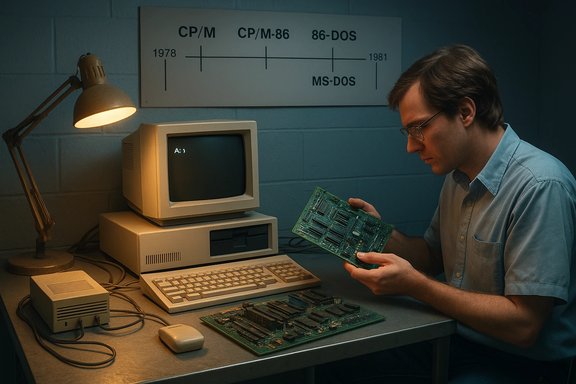 Background
In the late 1970s and very early 1980s the microcomputer business ran on one clear de facto standard: CP/M. Gary Kildall’s CP/M family had become the default operating environment for business microcomputers that shipped with floppy disks, and its command-line API, utilities and developer base represented a huge ecosystem advantage. Hardware vendors selling 8‑bit systems — and later early 16‑bit boards built around Intel processors — expected a CP/M equivalent for any new CPU family because customers and ISVs depended on CP/M-style conventions.Intel’s 8086 family (the 8086 itself in 1978, and the cost-reduced 8088 shortly after) brought a much larger address space and a path to more powerful software. That shift required a new OS: CP/M-86. Digital Research publicly promised an 8086 version of CP/M, targeting a late‑1979 timeframe. When CP/M-86 repeatedly failed to appear on schedule, the market pressure created a vacuum — one that Seattle Computer Products’ engineer Tim Paterson, Microsoft, and ultimately IBM would exploit.
This article reconstructs that chain of events, clarifies what is historically verifiable and what remains contested, and explains why a single product delay changed the trajectory of operating systems, silicon design and the modern software industry.
What went wrong: CP/M-86’s delay and the vacuum it created
The promise and the slip
Digital Research’s CP/M had earned enormous market momentum in the late 1970s. Vendors of 8086-based boards expected a CP/M successor and were told to expect CP/M-86 by late 1979. Instead, Digital Research’s 16‑bit effort arrived later: commercial CP/M-86 releases are dated around 1981. That gap — roughly a year or more depending on which milestone you use — left hardware makers with no standard, mature 16‑bit OS to ship.The result was straightforward market pressure: customers would not buy a platform with little or no software. Seattle Computer Products (SCP) and other OEMs who were shipping 8086 boards and wanted to support their customers’ migration to 16‑bit needed an operating system they could bundle and sell immediately. Waiting for a high‑profile but late OS was a commercial risk.
Who filled the vacuum (and how quickly)
Tim Paterson at SCP created QDOS (Quick and Dirty Operating System), later renamed 86‑DOS, in 1980 as a pragmatic substitute that deliberately mimicked CP/M’s API behavior so that many CP/M programs could be ported or reassembled with minimal effort. 86‑DOS was designed to run on Intel 8086/8088 CPUs and to address the immediate market need. Microsoft, which already had close ties with SCP through language tool work, recognized an opportunity and licensed — then ultimately purchased — rights to 86‑DOS. Microsoft adapted it for the IBM PC hardware, renamed it MS‑DOS, licensed it to IBM as PC‑DOS, and retained the ability to market DOS to other OEMs.That non‑exclusive licensing flexibility mattered enormously: Microsoft did not give IBM exclusive distribution rights and was free to sell DOS to other manufacturers. Within a short time Microsoft licensed DOS to scores of PC hardware vendors. The combination of IBM’s brand and the ability for other vendors to ship IBM‑compatible PCs running Microsoft’s DOS created the x86 software and hardware ecosystem that eventually made Microsoft the dominant platform vendor.
Timeline: the critical dates and milestones
- 1978 — Intel introduces the 8086 microprocessor; the architecture would become the foundation of the x86 family.
- November 1979 — Several 8086 S‑100 boards begin shipping; vendors expected CP/M‑86 to be available for bundling.
- April–August 1980 — Tim Paterson writes QDOS/86‑DOS to fill the OS gap for SCP’s 8086 board.
- December 1980 / July 1981 — Microsoft licenses and later purchases rights to 86‑DOS, then adapts it and rebrands it as MS‑DOS.
- August 12, 1981 — IBM launches the IBM PC (Model 5150) with PC‑DOS (Microsoft’s licensed MS‑DOS) as the standard low‑cost OS choice for the platform.
- 1981–1985 — Digital Research releases CP/M‑86 and develops Concurrent CP/M, Concurrent DOS and subsequent 286/386 variants, but market momentum had already favored MS‑DOS.
The “plane story” and what actually happened
A persistent myth asserts that Digital Research lost the IBM deal because Gary Kildall was out flying his private plane when IBM negotiators arrived; Dorothy McEwen, his wife and business partner, supposedly refused to sign an IBM non‑disclosure agreement (NDA) and the meeting collapsed. The reality is nuanced and less cartoonish.- Digital Research was negotiating the terms of an NDA and licensing arrangement with IBM; Dorothy McEwen did push back on IBM’s proposed one‑time payment model and the harsh terms of their NDA.
- Accounts vary on exact timing and logistics, but the canonical “Kildall refused to meet because he was joyriding” version is a simplification that leaves out the substantive legal and commercial disagreements over rights and licensing structure.
- What is verifiable is that negotiations with Digital Research did not produce a deal acceptable to IBM on IBM’s terms, and IBM turned to other suppliers — including Microsoft — to obtain a workable operating system for the PC.
How Microsoft converted an opportunity into long‑term advantage
Microsoft’s path from language vendor to OS kingpin was unexpectedly short but strategically decisive.- Microsoft recognized quickly that a CP/M‑like OS for 8086 hardware would be immensely valuable once IBM committed to a personal computer that used Intel’s 8088 CPU.
- By licensing and then buying 86‑DOS, Microsoft acquired the technical foundation and the right to adapt it for IBM’s requirements.
- Crucially, Microsoft negotiated a non‑exclusive arrangement with IBM. That meant Microsoft could (and did) license the DOS implementation to any other OEM who wanted an MS‑DOS compatible system.
- This lead to an explosion of “IBM‑compatible” hardware that standardized on the x86 architecture and the DOS API, creating the long tail of OEMs that cemented Microsoft’s role in the PC stack.
Technical fallout: DOS limitations, Intel roadmaps and Digital Research’s missed chances
The 640KB problem and DOS architecture
MS‑DOS was deliberately lightweight and closely tied to the 8086/8088 real‑address model. That architecture imposed practical memory limits — the now‑famous boundary that left only the first 640KB for conventional DOS applications, with the rest of the first megabyte reserved for BIOS, video memory and device ROMs. Those constraints were not purely Microsoft’s design flaw; they were driven by the IBM PC’s hardware architecture and by the need for a simple, compatible OS that piggybacked on existing 16‑bit real mode.The result: DOS was easy, cheap and broad, but it was not architected for protected multitasking, advanced memory protection or full 16‑bit native mode operation. That created a ceiling for software complexity that influenced subsequent processor design and OS strategy.
Intel’s chips and OS expectations
Intel’s follow‑up chip, the 80286, introduced protected mode and could address far more memory. In principle this would have enabled a leap forward for OS design: multitasking, memory protection and multiuser operation. Digital Research had worked on Concurrent CP/M and then Concurrent DOS — multitasking, multiuser OS families that could run DOS applications — and even produced a Concurrent DOS 286 designed to exploit the 80286.But the commercial reality was harsh: early production steppings of the 80286 behaved differently from the engineering prototypes Digital Research used during development. That mismatch meant Digital Research’s Concurrent DOS 286 struggled with compatibility and delayed its market advantage. Microsoft, in contrast, continued to focus on incremental improvements to DOS and Windows, leaving the 80286’s protected mode underutilized by mainstream desktop software for years.
The practical upshot was twofold:
- Intel’s protected‑mode promise went partially unrealized for consumer desktop PCs in the mid‑1980s, because the dominant OS (MS‑DOS) and major application software did not take full advantage of it.
- Intel’s later design efforts (notably the 80386 with virtual‑8086 mode) reflected lessons learned: hardware vendors had to provide better backward compatibility for DOS while enabling modern OS features, because the installed base of DOS applications was now massive.
Digital Research’s technical strengths and business weaknesses
Digital Research’s software pedigree was impressive: early multitasking and multiuser systems, the GEM graphical environment, and OS variants (Concurrent DOS, FlexOS) that offered capabilities well ahead of mainstream DOS. In several respects Digital Research had the more technically sophisticated roadmap.Yet despite those strengths DR faced repeated business missteps:
- Timing: missing the window to be first on the IBM PC platform was the decisive blow from which it could not fully recover as a mainstream desktop OS vendor.
- Contract negotiation: refusing IBM’s proposed terms (or failing to compromise quickly) ceded leverage.
- Market messaging and channels: Microsoft had the agility and distribution mindset to turn a small OS license into a worldwide platform.
Long‑term consequences and second‑order effects
The fallout from CP/M‑86’s delay cascaded through the industry in ways that became self‑amplifying.- Microsoft’s MS‑DOS dominance created a software monoculture that favored backward compatibility and a conservative evolution path for PC hardware and OSs. This contributed to design choices that prioritized compatibility over architectural innovation.
- IBM’s decision to allow Microsoft to resell PC‑DOS to other vendors enabled a competitive OEM market that drove down hardware prices, accelerated x86 adoption, and created fertile ground for commodity PCs.
- The limitations of DOS and the low‑cost PC market motivated Intel to design more compatible and flexible CPUs (80386 with virtual‑8086 mode) to allow multitasking and protect user programs while preserving compatibility with DOS.
- Those cheaper 386‑class machines created the hardware base in which open‑source operating systems like Linux could take root; inexpensive, standard x86 hardware made it feasible for hobbyists and universities to deploy and iterate on UNIX‑like systems.
Strengths, risks and counterfactuals
Notable strengths of the historical actors
- Digital Research — strong technical leadership in multitasking OS design and graphical environments; early multiuser and real‑time OS work that outpaced mainstream DOS functionality.
- Tim Paterson / Seattle Computer Products — pragmatic engineering that provided an immediate, deployable OS (86‑DOS) to keep hardware sales alive.
- Microsoft — exceptional commercial agility: recognizing a probability, moving fast to acquire the asset, and negotiating licensing terms that maximized optionality.
Strategic risks that materialized
- Platform lock‑in — the early proliferation of MS‑DOS created long‑term inertia; compatibility became the enemy of clean architectural progress.
- Monoculture fragility — concentrating so much of the software ecosystem on a single vendor’s API and on x86 hardware created both economic dependency and a single point of strategic control.
- Lost innovation — Digital Research’s inability to turn technical advances into mainstream adoption delayed the broader adoption of robust multitasking, memory protection and integrated networking that might have accelerated advanced desktop OS features earlier.
Counterfactual reflection
If CP/M‑86 had been delivered on schedule, or if Digital Research had accepted IBM’s commercial terms quickly, it’s plausible the IBM PC would have launched with CP/M‑86 as the default — and the market might have evolved quite differently. A CP/M‑centric PC ecosystem could have produced stronger alternatives to Microsoft’s later Windows, possibly accelerating native multitasking GUI systems and changing Intel’s CPU roadmap in ways that favored different OS architectures. That said, counterfactuals are slippery: IBM’s position, Microsoft’s sales acumen and the silicon economics of the early 1980s would still have exerted strong influence.What remains contested and what to treat cautiously
Several elements of the conventional story have been debated for decades:- The exact role of copying versus API compatibility in 86‑DOS’s design: 86‑DOS intentionally replicated CP/M‑style APIs to facilitate porting; whether this amounted to code theft has been the subject of investigation and dispute. Forensic analyses and court outcomes have not produced universally conclusive, universally accepted judgments.
- The precise sequence and motives of the IBM negotiations with Digital Research: the simplified “Kildall missed the meeting because he went flying” anecdote minimizes the contractual, legal and strategic reasons for the breakdown. The broader picture — that an NDA/contract impasse and timing pressure led IBM to other options — is well supported.
- Financial valuations and exact contract numbers from that era are sometimes reported with variants in different retellings; corroborating numbers across period documents is recommended if precise dollar figures are material.
Practical lessons for modern platform businesses
- Timing beats technology when markets move fast. Superior technical design will not rescue a platform if it misses the market window.
- Licensing flexibility is strategic leverage. Microsoft’s ability to license widely — not just to IBM — created a network effect that outlasted any single OEM relationship.
- Compatibility is a double-edged sword. Backward compatibility accelerates adoption but constrains long‑term architecture. Decide how much legacy burden to accept and when to break it.
- Contract terms can be destiny. Legal and commercial framing around NDAs, exclusivity and royalties can determine market access more than technical merits.
- Small engineering teams can change industries. SCP’s pragmatic QDOS demonstrated that a small, focused engineering response to a market gap can have huge downstream consequences.
Conclusion
The story of CP/M‑86’s late arrival is not a quaint footnote; it is a pivotal inflection point in computing history. A failure of timing and contract negotiation created a space that pragmatic engineering and opportunistic licensing filled. The result was a vastly different software industry architecture — one where licensing economics, backward compatibility and a fast‑moving OEM market shaped silicon design, OS evolution and ultimately who held power in the PC era.Understanding that chain of cause and effect is not merely historical nostalgia. It’s a playbook for how ecosystems form and consolidate, for how legal and commercial choices amplify technical outcomes, and for why a strategic opening — even a small one — can hand the keys to the kingdom to whomever is ready to turn them.
Source: theregister.com How CP/M-86's delay handed Microsoft the keys to the kingdom
