

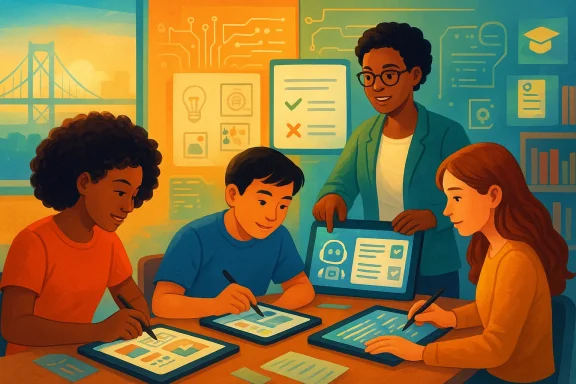
Students’ creativity and artificial intelligence are increasingly being treated as the same conversation, and that is exactly what makes this region’s future so interesting. A local feature about the role of creativity and AI in workforce development points to a broader truth: the next generation of opportunity will belong to people who can imagine, adapt, and use technology without losing their own voice. In practice, that means schools, colleges, employers, and families are being pushed to think less about whether AI is coming and more about whether students are being prepared to use it wisely. The article’s core argument is that creativity is not a soft skill sitting beside technical literacy; it is part of the technical stack itself.
The most useful way to understand this moment is to see it as the latest step in a long cycle of educational change. Every major learning technology has triggered the same anxiety: calculators would weaken math, the internet would weaken research, and now generative AI will supposedly weaken thinking itself. That fear is understandable, but the historical pattern is more complicated. The better question is not whether a tool can do work for students, but whether schools are teaching students how to think with it rather than surrender to it.
That tension is especially visible in the region’s education and workforce discussions because the local conversation is no longer about access alone. Schools used to focus on getting devices in students’ hands. Now they are asking whether those devices are fast enough, creative enough, secure enough, and AI-ready enough to support modern learning. In other words, hardware has become a curriculum issue. When a device frustrates teachers or limits student projects, it does not merely create technical inconvenience; it changes what students believe is possible.
The local story also fits a bigger shift in how communities think about talent pipelines. Employers are less interested in memorized knowledge than in adaptability, communication, and problem-solving under change. That puts a premium on students who can combine creative confidence with technological fluency. It also explains why AI has moved from being a specialist topic to a general civic topic. Families now see it as part of schooling, work, and even public identity.
Another important backdrop is the growing importance of AI literacy as a public skill rather than a niche skill. Students are being asked to distinguish between using AI as a helper and using it as a replacement for their own thinking. That distinction matters because the future workforce will not reward people who simply know how to prompt a model; it will reward people who can judge outputs, verify claims, and apply context. The region’s future therefore depends on whether education systems can teach judgment alongside speed.
There is also a cultural dimension here that should not be overlooked. Creativity is often described as the “fun” part of education, but in practice it is a training ground for iteration, audience awareness, and problem framing. Those are not decorative abilities. They are core capabilities in media, healthcare, business, engineering, and public service. Once schools start treating creativity as a serious economic asset, AI stops looking like a threat to the arts and starts looking like a tool that can amplify them.
The practical value of creativity becomes obvious when you look at how students actually learn. A learner who is comfortable making choices about layout, story, color, or format is usually also more willing to experiment with code, data, or engineering tasks later. That connection matters because technical confidence is rarely built in isolation. It grows through repeated low-stakes acts of making, revising, and trying again.
This matters for workforce development because many students self-select out of technical tracks before they ever discover they are good at them. A creative project can lower that psychological barrier. Once a student sees that invention is not only for the “math kids,” the pathway into engineering, media production, or digital design becomes more visible.
The most important nuance is that AI use is not inherently educational or anti-educational. The outcome depends on how it is used. If students ask a model to do their thinking, they risk outsourcing the very skills they need to build. If they use AI after doing their own reasoning, then the tool can become a powerful editor, assistant, or brainstorming partner.
The reason this matters so much in a regional workforce setting is that employers do not want workers who merely produce polished output. They want people who can defend decisions, catch errors, and choose the right tool for the task. A student who learns to use AI wisely gains speed without losing independence. A student who learns to lean on AI too soon may appear efficient while becoming less capable in the long run.
What stands out in the local coverage is the emphasis on low-pressure exposure. Students and adults alike benefit from events and programs that let them experiment without fear of failure. That matters because many people do not discover their strengths in formal classrooms. They discover them in workshops, fairs, demonstrations, and community programs where experimentation feels normal.
The strongest workforce programs are not those that promise a single perfect job. They are the ones that help learners see how a stack of small skills can add up to employability. Communication, collaboration, digital fluency, and creative problem-solving are all part of that stack. That is why the article’s focus on students’ creativity is so strategically important.
The public-program model works because it meets people where they are. Children can explore, teens can sample careers, and adults can reskill without feeling trapped in a formal degree-only mindset. That broad reach is especially important when a region wants to grow its talent base rather than simply recruit from elsewhere.
There is also a social benefit. These programs create shared language between students, parents, educators, and employers. That shared language matters because one of the major obstacles to workforce development is misunderstanding what modern work actually looks like. A community that can talk concretely about data, AI, and creative tools is better positioned to train for them.
This does not diminish human creativity. If anything, it raises the bar. Students now need to be able to distinguish between generated material and authored thinking. That is an important difference because the person who can ask a good question, recognize a weak answer, and refine a concept is still doing deeply creative work.
This is also where education has to become more intentional. Students should not just be told to “use AI responsibly.” They should be shown what responsibility looks like in concrete workflows. That includes disclosure, fact-checking, privacy awareness, and an understanding of when AI is helping and when it is taking over.
That is why the discussion about devices matters so much. Older machines, short battery life, and frustrating support experiences do more than waste time. They send the message that some students deserve better tools than others. When that happens, inequity is reinforced by hardware rather than policy alone.
This shift has major implications for regional schools, especially those serving students with longer commutes or fewer resources at home. A good device can extend learning beyond the classroom. A weak device can turn every off-campus hour into dead time. The better the device, the more learning can happen in transit, at home, or between classes.
For schools, the appeal is obvious. A unified stack can be easier to manage, easier to support, and easier to standardize. For competitors, the challenge is equally obvious: it is no longer enough to match a spec sheet. They have to match a complete learning story that includes creativity, mobility, collaboration, and AI readiness.
This competitive dynamic matters because it shapes what students will see as normal. If a school standardizes around one ecosystem, students start to learn its interface, habits, and assumptions. That can be a strength if the platform is good, but it can also create long-term dependence if schools do not maintain flexibility in policy and procurement.
Employers should also pay attention, because the local education conversation is increasingly about the kind of workers they want to hire. They are likely to value candidates who can communicate clearly, adapt to new tools, and handle AI as a support system rather than a shortcut. That means the school-to-work pipeline is now partially a creativity pipeline.
The region will be strongest if it treats AI literacy the way it once treated digital literacy: as a basic civic skill that must be taught early and reinforced often. That approach helps students become more confident, not less. It also helps the workforce grow in a way that is resilient rather than reactive.
It also creates an opportunity for schools and colleges to become more than service providers. They can become conveners, talent builders, and confidence engines for the region. That role is especially valuable in places that want to keep young people engaged locally rather than losing them to larger markets.
Another concern is inequity. If some students have fast devices, strong support, and reliable software while others are stuck with older hardware and limited access, then the digital divide simply shifts from availability to quality. That is a subtler but no less serious problem.
What happens next will depend on execution. Schools need better devices, better teacher support, and clearer rules. Families need to stay engaged. Employers need to keep explaining what skills matter. If those pieces move together, the region can turn a technology transition into a genuine advantage rather than a passing trend.
Source: Rocky Mount Telegram Students’ creativity, artificial intelligence key players in region’s future
 Background
The most useful way to understand this moment is to see it as the latest step in a long cycle of educational change. Every major learning technology has triggered the same anxiety: calculators would weaken math, the internet would weaken research, and now generative AI will supposedly weaken thinking itself. That fear is understandable, but the historical pattern is more complicated. The better question is not whether a tool can do work for students, but whether schools are teaching students how to think with it rather than surrender to it.That tension is especially visible in the region’s education and workforce discussions because the local conversation is no longer about access alone. Schools used to focus on getting devices in students’ hands. Now they are asking whether those devices are fast enough, creative enough, secure enough, and AI-ready enough to support modern learning. In other words, hardware has become a curriculum issue. When a device frustrates teachers or limits student projects, it does not merely create technical inconvenience; it changes what students believe is possible.
The local story also fits a bigger shift in how communities think about talent pipelines. Employers are less interested in memorized knowledge than in adaptability, communication, and problem-solving under change. That puts a premium on students who can combine creative confidence with technological fluency. It also explains why AI has moved from being a specialist topic to a general civic topic. Families now see it as part of schooling, work, and even public identity.
Another important backdrop is the growing importance of AI literacy as a public skill rather than a niche skill. Students are being asked to distinguish between using AI as a helper and using it as a replacement for their own thinking. That distinction matters because the future workforce will not reward people who simply know how to prompt a model; it will reward people who can judge outputs, verify claims, and apply context. The region’s future therefore depends on whether education systems can teach judgment alongside speed.
There is also a cultural dimension here that should not be overlooked. Creativity is often described as the “fun” part of education, but in practice it is a training ground for iteration, audience awareness, and problem framing. Those are not decorative abilities. They are core capabilities in media, healthcare, business, engineering, and public service. Once schools start treating creativity as a serious economic asset, AI stops looking like a threat to the arts and starts looking like a tool that can amplify them.
Creativity as a Regional Asset
Creativity is often discussed as an individual trait, but regional economies depend on it in much broader ways. Communities need people who can design, communicate, adapt, and invent under constraints. That is why the article’s emphasis on student creativity is so important: it treats imagination as part of the area’s long-term infrastructure rather than a hobby to be tolerated when time allows.The practical value of creativity becomes obvious when you look at how students actually learn. A learner who is comfortable making choices about layout, story, color, or format is usually also more willing to experiment with code, data, or engineering tasks later. That connection matters because technical confidence is rarely built in isolation. It grows through repeated low-stakes acts of making, revising, and trying again.
Creative confidence before technical confidence
One of the strongest ideas in the coverage is that creative confidence often comes before technical confidence. That is a subtle but important insight, because it challenges the old assumption that art and technology sit on opposite sides of a classroom divide. In reality, the student who feels safe exploring design or storytelling is often better positioned to embrace computational thinking later.This matters for workforce development because many students self-select out of technical tracks before they ever discover they are good at them. A creative project can lower that psychological barrier. Once a student sees that invention is not only for the “math kids,” the pathway into engineering, media production, or digital design becomes more visible.
- Creativity helps students see themselves in technical careers.
- Design thinking encourages iteration instead of perfectionism.
- Storytelling makes complex ideas easier to explain.
- Artistic work builds audience awareness.
- Hands-on making reduces fear of experimentation.
Artificial Intelligence as a Practical Skill
AI is no longer just a buzzword or a future promise. It is becoming a practical layer in the way students draft, brainstorm, search, and build. The local discussion captures this well by treating AI as a skill that can be taught, tested, and refined rather than as a magical shortcut. That framing is healthier because it puts responsibility back on the learner.The most important nuance is that AI use is not inherently educational or anti-educational. The outcome depends on how it is used. If students ask a model to do their thinking, they risk outsourcing the very skills they need to build. If they use AI after doing their own reasoning, then the tool can become a powerful editor, assistant, or brainstorming partner.
AI as assistant, not substitute
That distinction between assistance and substitution is the heart of responsible AI education. Students should still struggle with ideas first, because struggle builds retention, judgment, and transferable skill. Only after that should AI enter the process to test assumptions, sharpen phrasing, or surface alternative approaches.The reason this matters so much in a regional workforce setting is that employers do not want workers who merely produce polished output. They want people who can defend decisions, catch errors, and choose the right tool for the task. A student who learns to use AI wisely gains speed without losing independence. A student who learns to lean on AI too soon may appear efficient while becoming less capable in the long run.
- AI can improve brainstorming and drafting.
- AI can expose weak reasoning if used critically.
- AI should not replace original thought.
- Verification remains a human responsibility.
- Transparency about AI use builds trust.
Schools and Workforce Readiness
The education side of this story is really a workforce story in disguise. Schools are no longer just preparing students for tests; they are preparing them for an environment where creativity, AI literacy, and adaptability are baseline expectations. That makes curriculum design a regional economic issue, not simply an academic one.What stands out in the local coverage is the emphasis on low-pressure exposure. Students and adults alike benefit from events and programs that let them experiment without fear of failure. That matters because many people do not discover their strengths in formal classrooms. They discover them in workshops, fairs, demonstrations, and community programs where experimentation feels normal.
Career pathways start with exposure
This is where community colleges, schools, and public events become especially valuable. They can connect curiosity to concrete pathways in a way that a textbook cannot. A student who sees AI in action, or who tries a creative tool, may later recognize a real career lane in data, design, media, or IT.The strongest workforce programs are not those that promise a single perfect job. They are the ones that help learners see how a stack of small skills can add up to employability. Communication, collaboration, digital fluency, and creative problem-solving are all part of that stack. That is why the article’s focus on students’ creativity is so strategically important.
- Exposure reduces intimidation.
- Career sampling helps students make informed choices.
- Soft skills matter as much as technical skills.
- Regional talent pipelines begin early.
- Community institutions can lower barriers to entry.
The Role of Community Colleges and Public Programs
Community colleges are increasingly becoming the bridge between curiosity and career. They are close enough to local families to feel accessible, but substantial enough to offer real technical and workforce pathways. That makes them ideal institutions for turning creativity and AI from abstract buzzwords into lived experience.The public-program model works because it meets people where they are. Children can explore, teens can sample careers, and adults can reskill without feeling trapped in a formal degree-only mindset. That broad reach is especially important when a region wants to grow its talent base rather than simply recruit from elsewhere.
Why public-facing learning matters
Open events and community-based programs do something formal classrooms often cannot: they normalize exploration. When families see that AI and creativity are not reserved for experts, they become more willing to engage. That has a long-term effect on participation, confidence, and aspiration.There is also a social benefit. These programs create shared language between students, parents, educators, and employers. That shared language matters because one of the major obstacles to workforce development is misunderstanding what modern work actually looks like. A community that can talk concretely about data, AI, and creative tools is better positioned to train for them.
- Community programs make technology less intimidating.
- Public learning spaces support multiple age groups.
- Families become part of the talent pipeline.
- Short, hands-on sessions can spark longer-term interest.
- Shared vocabulary improves regional alignment.
Why AI Changes the Definition of Creativity
AI has forced a rethink of what creativity means in practice. If a machine can generate text, images, and ideas quickly, then creativity can no longer be defined simply as output. It must also include judgment, curation, originality, and the ability to direct tools toward meaningful goals.This does not diminish human creativity. If anything, it raises the bar. Students now need to be able to distinguish between generated material and authored thinking. That is an important difference because the person who can ask a good question, recognize a weak answer, and refine a concept is still doing deeply creative work.
Creativity in the age of automation
The rise of AI makes human taste more valuable, not less. When machines can produce volume, humans become more important as editors, selectors, and interpreters. That means creativity now includes the ability to judge what deserves to exist, not just the ability to produce something quickly.This is also where education has to become more intentional. Students should not just be told to “use AI responsibly.” They should be shown what responsibility looks like in concrete workflows. That includes disclosure, fact-checking, privacy awareness, and an understanding of when AI is helping and when it is taking over.
- Human judgment adds value in automated environments.
- Taste and curation are becoming job skills.
- AI makes originality more, not less, important.
- Students need explicit guidance on responsible use.
- Creativity now includes selection and verification.
Technology, Equity, and Access
There is a strong equity argument buried inside the local conversation. If AI and creativity are becoming standard parts of education and work, then access to capable devices, modern software, and reliable instruction is no longer optional. It is part of fair participation in civic and economic life.That is why the discussion about devices matters so much. Older machines, short battery life, and frustrating support experiences do more than waste time. They send the message that some students deserve better tools than others. When that happens, inequity is reinforced by hardware rather than policy alone.
Access is more than connectivity
A stable internet connection is important, but it is not enough. Students also need devices that can handle creative applications, run AI-enabled workflows, and survive the realities of commuting, home use, and long school days. In that sense, end-user experience has become a new front in the equity conversation.This shift has major implications for regional schools, especially those serving students with longer commutes or fewer resources at home. A good device can extend learning beyond the classroom. A weak device can turn every off-campus hour into dead time. The better the device, the more learning can happen in transit, at home, or between classes.
- Equity now includes device quality.
- Reliable hardware expands learning time.
- Offline-capable workflows reduce fragility.
- Better tools support students outside the classroom.
- Access must be judged by outcomes, not just enrollment.
The Competitive Landscape for Education Technology
The article also hints at a larger competitive battle. Microsoft is not just selling software or devices; it is trying to build an education ecosystem where hardware, cloud services, collaboration tools, and AI features all reinforce one another. That kind of integration can be powerful because it reduces friction for schools and creates habits that are hard to unwind later.For schools, the appeal is obvious. A unified stack can be easier to manage, easier to support, and easier to standardize. For competitors, the challenge is equally obvious: it is no longer enough to match a spec sheet. They have to match a complete learning story that includes creativity, mobility, collaboration, and AI readiness.
Ecosystems beat isolated features
One of the clearest lessons from the coverage is that schools do not buy devices in a vacuum. They buy outcomes, workflows, and support structures. If one ecosystem offers smoother management, better classroom continuity, and more obvious AI integration, it gains an advantage that is bigger than hardware alone.This competitive dynamic matters because it shapes what students will see as normal. If a school standardizes around one ecosystem, students start to learn its interface, habits, and assumptions. That can be a strength if the platform is good, but it can also create long-term dependence if schools do not maintain flexibility in policy and procurement.
- Integrated platforms simplify administration.
- Consistent tools reduce classroom friction.
- Ecosystem lock-in can become a long-term issue.
- Procurement decisions shape student habits.
- Competitors must compete on outcomes, not just features.
What Families and Employers Should Take From This
Families should take away one message above all: creativity and AI are no longer separate school concerns. They are both part of preparing students for adult life. The healthiest response is not panic or hype, but active engagement with how these tools are being taught and used.Employers should also pay attention, because the local education conversation is increasingly about the kind of workers they want to hire. They are likely to value candidates who can communicate clearly, adapt to new tools, and handle AI as a support system rather than a shortcut. That means the school-to-work pipeline is now partially a creativity pipeline.
A shared responsibility
Parents, educators, and employers all have a role in setting expectations. Students need permission to be creative, but they also need boundaries around AI use, privacy, and academic honesty. Those boundaries are not meant to slow them down. They are meant to make sure they become capable adults rather than dependent tool users.The region will be strongest if it treats AI literacy the way it once treated digital literacy: as a basic civic skill that must be taught early and reinforced often. That approach helps students become more confident, not less. It also helps the workforce grow in a way that is resilient rather than reactive.
- Families should ask how AI is being taught.
- Schools should explain what responsible use looks like.
- Employers should value judgment and adaptability.
- Students need both creative and technical exposure.
- Communities should treat digital fluency as foundational.
Strengths and Opportunities
The biggest strength of this regional moment is that it is not trapped in a false choice between creativity and technology. The article shows that the two reinforce each other, and that is a much healthier framework for education and economic development. It creates room for students who think visually, analytically, or experimentally to all find a place in the same future.It also creates an opportunity for schools and colleges to become more than service providers. They can become conveners, talent builders, and confidence engines for the region. That role is especially valuable in places that want to keep young people engaged locally rather than losing them to larger markets.
- Creativity can serve as an entry point into technical fields.
- AI literacy can be taught as a practical skill.
- Community programs can expand access across age groups.
- Better devices can improve both learning and morale.
- Shared digital skills strengthen regional talent pipelines.
- Public events can reduce fear around emerging technology.
- Schools can prepare students for adaptable careers, not just first jobs.
Risks and Concerns
The most obvious risk is overdependence on AI before students have developed enough independent thinking. If schools let the technology do too much of the intellectual work, they may produce polished work without durable understanding. That would create the illusion of readiness while quietly undermining long-term skill development.Another concern is inequity. If some students have fast devices, strong support, and reliable software while others are stuck with older hardware and limited access, then the digital divide simply shifts from availability to quality. That is a subtler but no less serious problem.
- AI can mask weak understanding.
- Poor device quality can deepen inequity.
- Privacy and data-use concerns remain real.
- Teachers need ongoing training, not one-time workshops.
- Overly promotional programs can lose educational credibility.
- Schools may struggle to keep pace with policy needs.
- Vendor dependence can narrow future options.
Looking Ahead
The most important question now is not whether students should use AI or be creative. It is how the region will build systems that help them do both well. The future will favor communities that treat creativity as an engine of opportunity and AI as a tool that must be learned with discipline.What happens next will depend on execution. Schools need better devices, better teacher support, and clearer rules. Families need to stay engaged. Employers need to keep explaining what skills matter. If those pieces move together, the region can turn a technology transition into a genuine advantage rather than a passing trend.
- Watch for more schools to treat AI literacy as core curriculum.
- Watch for creative subjects to gain more technical relevance.
- Watch for device quality to become a bigger procurement issue.
- Watch for public programs to bridge school and workforce goals.
- Watch for employers to ask for more adaptable, AI-literate candidates.
Source: Rocky Mount Telegram Students’ creativity, artificial intelligence key players in region’s future
