

Cribl’s new integration makes Cribl Stream a first-class, dedicated data source for Microsoft Fabric Real‑Time Intelligence, enabling organizations to pipe, enrich, and optimize high‑volume telemetry directly into Fabric Eventstream for real‑time security, operations, and AI workloads.
Cribl and Microsoft have deepened a partnership that began with marketplace and commercial arrangements in 2024 and is now expanding into direct product-level integration. The new capability lists Cribl as a ready-to-use data source inside Microsoft Fabric Real‑Time Intelligence (RTI) while offering a corresponding Fabric RTI destination inside Cribl Stream and Cribl Edge. Together, these pieces create a managed path for non‑Azure‑native telemetry to flow into Fabric’s Eventstream layer with transformations, reductions, and enrichment applied before ingestion.
This development was announced in mid‑November and rolled out in concert with Microsoft Ignite activities, positioning the integration as broadly available and supported by updated release notes and product documentation. Microsoft’s Fabric documentation already includes a Cribl source workflow for Eventstream and Cribl’s release notes add a Fabric RTI destination to Stream and Edge, indicating coordinated engineering and productization between the vendors.
Key technical points verified in vendor documentation and product notes:
However, the most compelling claims in vendor messaging (e.g., dramatic reductions in manual overhead and accelerated time‑to‑value) should be treated as promises to be validated in pilots. Organizations must perform realistic load and latency tests, verify compliance coverage for their data types, and set up strong governance and monitoring before scaling.
For teams moving telemetry into Fabric for security, observability, or AI use cases, the Cribl + Fabric combination is a practical architecture pattern—one that preserves vendor neutrality at the pipeline layer while giving Microsoft customers a convenient procurement and integration path. The value will be highest for hybrid estates and those with many non‑Azure native sources, provided careful design and operational discipline are applied.
Cribl’s Fabric Real‑Time Intelligence integration is available now; organizations evaluating it should plan a small‑scale pilot, validate regional and compliance constraints, and measure ingestion economics before full production rollout.
Source: IT Brief Asia Cribl integrates stream with dedicated Microsoft Fabric RTI
 Background
Cribl and Microsoft have deepened a partnership that began with marketplace and commercial arrangements in 2024 and is now expanding into direct product-level integration. The new capability lists Cribl as a ready-to-use data source inside Microsoft Fabric Real‑Time Intelligence (RTI) while offering a corresponding Fabric RTI destination inside Cribl Stream and Cribl Edge. Together, these pieces create a managed path for non‑Azure‑native telemetry to flow into Fabric’s Eventstream layer with transformations, reductions, and enrichment applied before ingestion.This development was announced in mid‑November and rolled out in concert with Microsoft Ignite activities, positioning the integration as broadly available and supported by updated release notes and product documentation. Microsoft’s Fabric documentation already includes a Cribl source workflow for Eventstream and Cribl’s release notes add a Fabric RTI destination to Stream and Edge, indicating coordinated engineering and productization between the vendors.
What the integration actually provides
Core capabilities
- Direct data source listing in Microsoft Fabric — Cribl appears as a selectable source tile when building Eventstreams in Fabric, simplifying onboarding of third‑party telemetry.
- Fabric Real‑Time Intelligence Destination in Cribl Stream and Cribl Edge — A native destination option in Cribl’s destinations catalog that sends processed events into Fabric Eventstream endpoints.
- Kafka‑based transport to Eventstream — Fabric provisions Kafka‑style bootstrap endpoints for Cribl to target, allowing high‑throughput streaming from Cribl to Fabric.
- Configurable security and reliability features — The destination supports TLS configuration and preserves partition/queue (PQ) semantics needed for scalable streaming.
- Marketplace and billing integration — Cribl remains purchasable through Azure Marketplace under existing Microsoft Azure Consumption Commitment (MACC) agreements for customers that want unified billing.
How data flows (high level)
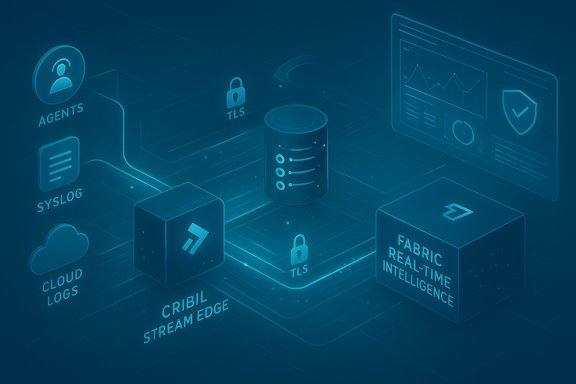
- Cribl collects telemetry from heterogeneous sources (agents, syslog, cloud providers, appliances).
- Cribl Stream or Cribl Edge applies parsing, enrichment, filtering, rate controls, and transformations to convert noisy, high‑volume telemetry into high‑fidelity event records.
- Cribl routes the prepared events to the Fabric Eventstream using a Kafka endpoint provisioned by Fabric.
- Fabric Eventstream receives events and forwards them to downstream Fabric workloads (Real‑Time Intelligence pipelines, Microsoft Sentinel connectors, analytics workloads, AI models).
Why this matters: product and business implications
For security and operations teams
- Faster onboarding of third‑party telemetry — Turning vendor‑specific logs and device telemetry into Fabric‑ready events reduces custom integration work. That can be especially valuable for Security Operations Centers (SOCs) migrating to Microsoft Sentinel or using Fabric RTI for SIEM‑adjacent analytics.
- Event fidelity and cost control — Cribl’s ability to reduce noise (sampling, routing lower‑value data to cheaper storage) means teams can retain what matters in Fabric while keeping costs in check.
- Timely investigations and prioritization — Enriching events at the edge or in the pipeline (e.g., adding asset context, severity scoring) improves detection accuracy and reduces mean time to investigate.
For cloud and platform teams
- Unified procurement and billing — Customers who use MACC can buy Cribl through Azure Marketplace, simplifying procurement and potentially consolidating vendor spend.
- Cleaner architecture for hybrid environments — Organizations operating multi‑cloud, on‑prem, and SaaS sources can centralize pre‑ingestion logic in Cribl and maintain fewer bespoke connectors into Fabric.
For Microsoft and Cribl
- Ecosystem synergy — Microsoft gets a robust third‑party ingestion and processing layer that complements Fabric’s event and analytics capabilities. Cribl gains a first‑class integration route into a growing Fabric ecosystem and broader enterprise reach via Microsoft channels.
Technical mechanics and verified specifics
The integration is implemented as a Kafka‑style endpoint relationship: Fabric creates a Cribl data source that yields bootstrap server values and connection metadata. Cribl Stream and Cribl Edge use those connection values when configuring the Fabric Real‑Time Intelligence Destination.Key technical points verified in vendor documentation and product notes:
- The Fabric destination in Cribl is listed under a Fabric folder in the Destinations catalog and explicitly supports streaming transports with configurable TLS and PQ (partition/queue) support.
- Fabric provisioning supplies the Kafka bootstrap endpoint and Fabric is responsible for load balancing; Cribl’s destination documentation notes there are no load balancing requirements on the Cribl side because Fabric handles load balancing when it receives the data.
- Microsoft’s Fabric documentation provides UI steps for adding Cribl as a source to an Eventstream (currently noted as a preview‑capable source in some workspaces) and documents permissions and prerequisites such as Fabric workspace permissions and a Worker Group in Cribl.
- Region exceptions are documented: some Fabric workspace capacities do not support the Cribl source (examples include specific regions flagged in the product docs), so geography must be validated during planning.
- Cribl product release notes show the Fabric RTI destination appearing in Cribl Stream and Cribl Edge product versions aligned with the November release.
What to expect during implementation
Pre‑deployment checklist
- Ensure you have a Cribl Worker Group with permissions to configure destinations. Worker Groups in Cribl are the execution plane responsible for sending data.
- Validate Fabric workspace permissions — contributor or higher is typically required to edit an Eventstream and add a Cribl source.
- Confirm geographic availability for the Cribl source in your Fabric capacity and that there are no restrictions for your region.
- Plan authentication: Fabric supports OAuthBearer authentication for Cribl connections if you require token‑based connections; the docs show specific permission levels required to configure OAuthBearer.
Step‑by‑step (simplified)
- In Microsoft Fabric, create an Eventstream and add a new Cribl data source to that Eventstream.
- Fabric will provision connection values (bootstrap server details and credentials).
- In Cribl Stream or Cribl Edge, create a Fabric Real‑Time Intelligence Destination, supplying the bootstrap server and credentials provided by Fabric.
- Use Cribl pipelines to parse, enrich, and route events to the Fabric destination. Optionally use QuickConnect in Cribl for streamlined setup.
- Publish the Eventstream in Fabric and monitor data arrival in the Fabric ingestion planes and downstream consumers (Real‑Time Intelligence pipelines, dashboards, Sentinel, etc..
- Validate end‑to‑end telemetry fidelity, observe latency, and tune pipeline rules for sampling or enrichment.
Use cases and practical scenarios
Modern SIEM and security observability
SOCs migrating to Microsoft Sentinel or adopting Fabric RTI for detection can use Cribl to normalize log formats, enrich with asset and vulnerability context, and route only necessary events to expensive real‑time analytics while offloading cold data to cheaper storage targets.Hybrid and legacy device telemetry
Many enterprises run critical infrastructure appliances, network devices, and legacy systems that produce non‑cloud‑native logs. Cribl can collect these sources, perform schema mapping, and transform them into consistent event schemas that Fabric expects.AI and analytics-ready streaming
Pre‑cleaning data before it hits Fabric increases the quality of inputs to AI models, reducing noise and improving model performance. Teams using Fabric for streaming ML, anomaly detection, or real‑time dashboards benefit from Cribl’s enrichment and filtering.Cost optimization and data governance
By centralizing routing logic, organizations can set retention, redaction, and sampling policies consistently—helpful for compliance and cost containment.Strengths: what the integration does well
- Operational simplicity — surfacing Cribl as a Fabric data source removes previously manual steps around Kafka endpoints, custom connectors, and bespoke routing scripts.
- Vendor neutrality retained — Cribl remains vendor‑agnostic, capable of routing to multiple destinations, which reduces lock‑in risk for the ingestion layer when compared to using a single cloud vendor for all telemetry processing.
- Scale and reliability — Kafka‑style transport and partition support, combined with Fabric’s managed ingestion, supports large scale, high‑throughput telemetry use cases.
- Billing convenience — Azure Marketplace procurement and MACC compatibility lower administrative friction for Microsoft‑centric customers.
- Security and configuration options — TLS and OAuthBearer capabilities enable secure, policy‑aligned deployments.
Risks, limitations, and critical considerations
Vendor claims vs. measurable outcomes
Cribl and Microsoft highlight qualitative benefits like “dramatically reducing manual overhead” and “accelerating time‑to‑value.” These are meaningful promises, but they are vendor claims. Organizations should require proof points—benchmarks or pilot results—showing actual onboarding times, bandwidth/latency impacts, and cost savings before committing to large‑scale migrations.Preview status and regional limitations
Microsoft’s documentation indicates the Cribl source exists in a preview capacity in some contexts and explicitly lists region limitations for the preview. Enterprises must verify production readiness for their specific Fabric workspace region.Security and compliance scrutiny
- Data passing through Cribl and Fabric traverses multiple control planes and may be subject to differing compliance certifications. Organizations should validate that both Cribl and Microsoft support required compliance regimes (e.g., FedRAMP, SOC 2, GDPR controls) for the data classes being routed.
- Redaction and PII handling need to be planned at the pipeline level. Cribl provides transformations and masking, but the operational model must include auditing and proof of redaction where required.
Cost visibility and management
Routing large volumes into Fabric without effective pre‑ingestion reduction will increase consumption‑based costs. While Cribl can reduce volume, improper rule configuration can lead to unexpected ingestion and storage costs in Fabric.Latency and SLAs
While Kafka transport is high throughput, additional processing stages (heavy enrichments, complex parsing, or synchronous lookups) can introduce latency. For strict real‑time requirements, validate end‑to‑end latency under production loads.Operational complexity shifted, not eliminated
The integration simplifies certain tasks, but it also introduces new operational responsibilities: managing Cribl worker groups, pipelines, and Fabric Eventstream lifecycle. Teams must either upskill or adopt managed services/consulting to run the combined stack effectively.Comparing alternatives and where Cribl + Fabric fits
There are multiple approaches to ingesting telemetry into Microsoft environments:- Native connectors directly into Fabric/Sentinel: simple for Azure‑native sources but often expensive or limited for third‑party devices.
- Custom Kafka or event hub connectors: flexible but require engineering time to build, secure, and scale.
- Third‑party ingestion and processing platforms (Cribl’s competitors): some offer similar features (parsing, enrichment, routing), but Cribl’s tight integration and marketplace presence make it an attractive choice for Microsoft‑centric shops.
Best practices and recommended rollout strategy
- Start with a focused pilot:
- Select a representative set of high‑value telemetry sources (security devices, cloud audit logs, major application logs).
- Validate schema transformations and enrichment logic in a staging Fabric workspace.
- Measure baseline metrics:
- Capture current ingestion volume, latency, and SOC investigation time, then quantify improvements after Cribl pipeline tuning.
- Tune before sending everything to Fabric:
- Use Cribl’s sampling, piping to cheaper storage, and field‑level redaction to reduce cost and noise.
- Define governance:
- Create a pipeline catalogue and change control for Cribl transformations; log pipeline versions and changes.
- Automate monitoring:
- Monitor Cribl worker health, pipeline throughput, and Fabric Eventstream metrics; set alarms for backpressure or failed deliveries.
- Plan rollouts by region:
- Validate regional availability and compliance requirements before moving production workloads.
- Document cost allocation:
- Leverage MACC compatibility where available and define tagging and chargeback mechanisms for consumption.
Practical checklist for security teams
- Verify that the Cribl destination in Stream/Edge has TLS enabled and certificates validated.
- Confirm that PII redaction and field hashing rules are in place for regulated data.
- Test end‑to‑end alerting paths (Cribl → Fabric RTI → Sentinel / downstream playbooks) in a simulated incident.
- Include Cribl pipeline changes in incident response runbooks, as enrichment logic can affect detection rules.
Strategic considerations for platform leaders
- The integration reduces friction for Microsoft-centric migrations, but platform teams must balance ease of ingestion with long‑term architectural goals. Centralized ingestion in Cribl makes multi‑destination routing easy, but it also places a critical dependency on Cribl’s availability and governance model.
- Consider engaging Microsoft and Cribl professional services for initial architecture and runbook creation to avoid common pitfalls around schema drift, cost spikes, and region limitations.
- Treat Cribl pipelines and Eventstreams as first‑class configuration items that require versioning, testing, and rollback capabilities.
Final assessment: practical, but due diligence required
This integration is a pragmatic and technically mature step toward aligning third‑party telemetry with Microsoft Fabric’s real‑time analytics and AI ambitions. The engineering work—making Cribl a data source inside Fabric and adding a Fabric destination in Cribl Stream/Edge—provides clear operational benefits: simpler onboarding, richer pre‑ingestion processing, and potential cost savings when rules are properly applied.However, the most compelling claims in vendor messaging (e.g., dramatic reductions in manual overhead and accelerated time‑to‑value) should be treated as promises to be validated in pilots. Organizations must perform realistic load and latency tests, verify compliance coverage for their data types, and set up strong governance and monitoring before scaling.
For teams moving telemetry into Fabric for security, observability, or AI use cases, the Cribl + Fabric combination is a practical architecture pattern—one that preserves vendor neutrality at the pipeline layer while giving Microsoft customers a convenient procurement and integration path. The value will be highest for hybrid estates and those with many non‑Azure native sources, provided careful design and operational discipline are applied.
Cribl’s Fabric Real‑Time Intelligence integration is available now; organizations evaluating it should plan a small‑scale pilot, validate regional and compliance constraints, and measure ingestion economics before full production rollout.
Source: IT Brief Asia Cribl integrates stream with dedicated Microsoft Fabric RTI
