

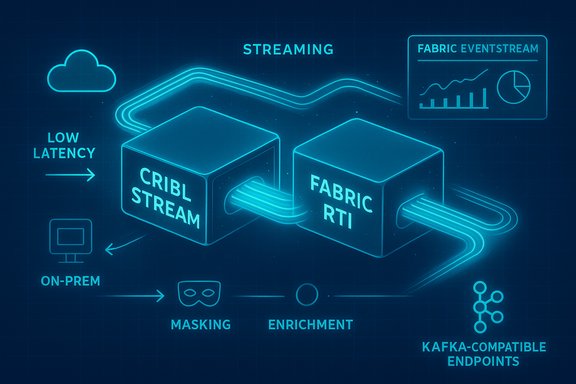
Cribl’s Stream is now a ready-to-use data source inside Microsoft Fabric’s Real‑Time Intelligence, turning what used to be a custom‑built ingestion pipeline into a streamlined, configurable route for high‑volume telemetry destined for Fabric Eventstream.
Background
Microsoft Fabric introduced Real‑Time Intelligence (RTI) as the event‑driven layer of its unified analytics platform, allowing organisations to capture, discover, query, and act on streaming telemetry without requiring data to first land in long‑term storage. Fabric’s RTI includes Eventstreams, Eventhouses, OneLake-backed storage, and a control plane for stream governance and discovery. The platform supports multiple ingestion patterns, including Kafka and other brokered transports, to accommodate both cloud‑native and on‑premises sources. Cribl, long positioned as a vendor-neutral data engine for IT and security telemetry, has formalised and productised a direct integration between Cribl Stream and Fabric RTI. The integration was announced as generally available in mid‑November and listed Cribl as a Data Source inside Fabric, allowing administrators to add Cribl to an Eventstream from Fabric’s portal and to configure a Fabric‑targeting Destination inside Cribl Stream. This reduces custom engineering work and aligns Cribl’s pipeline controls — parsing, enrichment, sampling, deduplication, masking — with Fabric’s ingestion and governance expectations.What the integration actually does
Native data‑source model inside Fabric
Fabric now exposes a Cribl tile in the Eventstream “Add source” catalogue. From the Fabric side, operators can search for and add the Cribl source, review connection settings, and publish the Eventstream to receive the Kafka‑compatible endpoint details that Cribl needs to connect. This is a deliberate shift from the older model where teams either built bespoke connectors or used intermediary brokers with custom mappings. The Microsoft Learn documentation walks through the exact steps to add Cribl as a source, including permission requirements and region caveats.A Fabric Real‑Time Intelligence Destination in Cribl Stream
On the Cribl side, recent Stream releases introduced a Fabric Real‑Time Intelligence Destination that can write directly to Fabric Eventstreams. The destination supports two fundamental modes:- Streaming (low‑latency, single‑event delivery)
- Batching (bulk writes, Parquet landing for high‑volume data)
What moves through the pipeline
The combined solution supports a broad range of telemetry:- Logs (firewalls, proxies, application logs)
- Metrics and traces (application performance and telemetry)
- Security events and alerts (IDS/IPS, EDR/SIEM outputs)
- Network telemetry and custom application events
Why this matters to WindowsForum readers and IT teams
Faster time‑to‑value for streaming analytics
A ready‑made Cribl data source in Fabric changes onboarding from long engineering projects into a configuration exercise. That reduces friction for pilots, accelerates SOC and NOC deployments, and shortens the time between collecting telemetry and surfacing real‑time dashboards or Copilot‑driven insights in Fabric. This is significant for organisations trying to move from batch analytics to operational, event‑driven workflows.Cost and signal quality control
Ingesting raw telemetry at full fidelity into cloud analytics platforms can be expensive. Cribl’s pipeline provides a cost control layer by filtering, sampling, and reshaping data before it hits Fabric storage and query engines. This helps avoid ingesting noise, reduces storage and query costs inside Eventhouses and OneLake, and preserves budget for high‑value events.Procurement and billing alignment
Because Cribl was added to the Microsoft Azure Marketplace in November 2024 and has a commercial agreement with Microsoft dating back to May 2024, customers can procure Cribl via Microsoft billing constructs such as the Azure Consumption Commitment (MACC). This simplifies procurement and can make commercial evaluation and vendor onboarding far easier for Microsoft‑centric enterprises.Technical anatomy — how data flows end‑to‑end
- Source collection: Cribl Stream and Cribl Edge capture telemetry from cloud services, on‑prem devices, SIEMs, or agents. They parse and optionally enrich events with metadata (asset tags, geolocation, vulnerability context).
- In‑pipeline processing: Streams are filtered, sampled, deduped, masked, and reformatted according to pipeline policies. This step is where organisations implement retention, PII redaction, and enrichment for downstream ML consumption.
- Destination export: The Fabric RTI Destination in Cribl writes to the Fabric Eventstream using either the Kafka‑compatible endpoint published by Fabric or the ingestion URI exposed when a Cribl source is added in Fabric.
- Fabric processing and activation: Incoming events land in Eventstreams, can be routed to Eventhouses (time‑partitioned storage), and are made available for low‑latency queries, Real‑Time Dashboards, triggers, and Copilot/AI skills inside Fabric.
Strengths and strategic advantages
- Streamlined onboarding: The integration converts prior custom engineering tasks into standardised configuration steps in both Fabric and Cribl. This reduces implementation risk and lowers the skill barrier for teams adopting streaming analytics.
- Signal optimisation upstream: Cleaning and shaping telemetry before it is stored or queried improves ML/AI signal quality and reduces cost exposure in Fabric analytics layers. This is crucial for SOC workflows and AI copilots that require curated inputs.
- Operational controls: Persistent queues, backpressure, and batching modes give operators predictable behaviors during spikes, network outages, or maintenance windows, which is important for high‑availability telemetry.
- Microsoft ecosystem alignment: Marketplace availability and partner recognition (Cribl was named a finalist in the Microsoft 2025 Americas Partner awards) smooth purchasing and co‑marketing paths for enterprise deployments.
Risks, caveats and practical limitations
Potential vendor coupling and lock‑in
Deep technical integrations reduce operational friction but increase coupling to a vendor stack. Organisations with multi‑cloud or cloud‑agnostic goals should design abstraction layers — for example, using standard Kafka schemas or open storage formats like Parquet, Iceberg, or Delta — so data assets remain portable if strategy changes.Hidden ingestion and downstream costs
Even with upstream reduction, high‑cardinality streams retained in Fabric can still drive storage and query costs. Teams must enforce retention policies and make deliberate decisions about what is retained in Eventhouses and OneLake. Cost modeling is essential before scaling.Performance and SLO variability
Neither vendor publishes universal latency guarantees that apply to every topology. Real‑world latency depends heavily on network path, Kafka configuration (partitions, brokers), Cribl worker sizing, and Fabric workspace capacity. Pilot tests with production‑like volumes and tail‑latency measurements are mandatory for any latency‑sensitive use case.Security and governance complexity
Real‑time dashboards and triggers amplify governance needs: RBAC, data‑source permissions, service‑principal hygiene, and audit trails must be configured and enforced. Fabric supports role‑based data‑source permissions and Cribl provides masking capabilities, but teams must plan and validate these controls as part of deployment.Practical guidance for pilots and PoCs
- Start narrow: choose a single, high‑value telemetry stream (for example, firewall logs or endpoint alerts) and validate ingestion, transformation, and dashboard activation end‑to‑end.
- Measure everything: instrument each hop for throughput, latency, queuing, and error rates. Capture p50/p95/p99 latencies and monitor tail behavior under simulated spikes.
- Codify pipelines: store Cribl pipelines, transformation rules, and Fabric stream definitions in version control and include them in change‑control processes.
- Define SLOs: agree cross‑team delivery SLOs for latency, acceptable loss, and retention, then design persistent queuing and backpressure policies to meet them.
- Cost map: model expected ingestion, storage, and query costs for Eventhouses/OneLake with realistic retention windows and cardinality assumptions. Use Cribl to reduce low‑value noise before it hits Fabric.
Use cases that benefit most
- Security Operations (SOC): Prioritise enriched IDS/EDR alerts and route high‑value signals to Fabric for real‑time investigation and automated triage. The cleaned event streams improve analyst efficiency and MTTD/MTTR.
- Network and Digital Ops (NOC): Enrich telemetry with topology and configuration data in Cribl then stream to Fabric dashboards for low‑latency incident detection and automated remediation triggers.
- Real‑time AI & Copilot experiences: Curated, high‑fidelity event feeds are ideal training and inference inputs for Copilot‑style assistants and AI skills inside Fabric, reducing the risk of poor results caused by noisy data.
Technical verification and cross‑checks
Key integration claims have been validated across vendor documentation and public materials:- Microsoft Learn contains a dedicated guide for adding Cribl as a source to an Eventstream, including prerequisites and configuration steps, confirming Fabric’s first‑class support for Cribl as a source.
- Cribl’s documentation (Stream release notes) formally lists a Fabric Real‑Time Intelligence Destination and explains Kafka‑based export, batching vs streaming modes, and Fabric load balancing semantics.
- Cribl’s press release and corporate blog describe the commercial availability of the integration and position it as an extension of the May 2024 global agreement and November 2024 Microsoft Marketplace listing. These announcements reflect the same capabilities described in technical docs.
Cost, procurement and partner implications
Listing Cribl as a Fabric Data Source, plus the vendor’s presence in the Azure Marketplace, enables enterprises to acquire Cribl via Microsoft procurement channels. That can be particularly helpful for organisations that use MACC or other committed spend vehicles, as it reduces vendor onboarding friction and centralises billing. Procurement teams should still model committed consumption against expected usage to avoid underutilisation of MACC credits. Cribl’s finalist status in Microsoft’s 2025 Americas Partner awards signals strong partner alignment and increases the likelihood of co‑engineering support or prescriptive deployment patterns from Microsoft field teams. However, partner recognition is not a substitute for joint reference checks and pilot validation.What to watch next
- Evolution of Fabric RTI connectors and supported regions. Microsoft Learn currently lists regional caveats for Cribl source support; verify your workspace region compatibility during planning.
- Cribl Stream version updates and destination feature parity. New Stream releases may add more configuration knobs, performance improvements, or security enhancements; keep release‑note monitoring in your release process.
- Cost modelling features inside Fabric (per‑stream pricing, Eventhouse retention tiers) and Cribl (ingestion credits, worker scaling). Both vendors are refining pricing constructs tied to event throughput and storage; revalidate cost assumptions before scaling.
Final assessment
The Cribl — Microsoft Fabric Real‑Time Intelligence integration is a practical, well‑engineered step toward simplifying real‑time telemetry management for Microsoft‑centric enterprises. By making Cribl a first‑class data source and providing a dedicated Fabric Destination inside Cribl Stream, the vendors remove a large portion of engineering friction, improve signal quality for downstream analytics and AI, and offer operational controls needed for production deployments. That said, organisations should approach adoption with discipline: run narrow, well‑instrumented pilots; define SLOs and retention policies; model costs; and plan for portability if multi‑cloud or vendor‑agnostic strategies remain important. Where these precautions are taken, the combined solution can materially speed up time‑to‑value for SOCs, NOCs, and real‑time AI workloads while preserving governance and cost control.In short, for WindowsForum’s audience and enterprise IT teams, this integration represents a meaningful operational advance — one that deserves a place in modern telemetry architectures, provided it’s introduced with appropriate performance validation and governance guardrails.
Source: IT Brief UK Cribl integrates stream with dedicated Microsoft Fabric RTI
