

Crimson Desert is the rare kind of game that arrives already sounding like a contradiction: bloated, overstuffed, occasionally uneven, and yet impossible to ignore. Pearl Abyss has built an open-world action adventure that seems determined to do everything at once, and that excess is precisely what makes it so compelling. In an era where many blockbuster games trim ideas for clarity, Crimson Desert leans into abundance, friction, spectacle, and freedom. The result is a game that may frustrate some players, but is almost certain to become one of 2026’s defining releases.
Pearl Abyss has spent years positioning Crimson Desert as more than just another fantasy action game. It is a successor of sorts to the worldbuilding ambition that made Black Desert notable, but the new project is designed as a single-player open-world adventure rather than a persistent MMO. The official site describes Pywel as a seamless world shaped by war, ruin, and discovery, with Kliff and the Greymanes at the center of the story.
That shift matters because it changes the burden of expectation. In an MMO, the occasional rough edge can be softened by systems, social play, and long-tail progression. In a single-player open world, every system has to justify itself on its own merits, which is why Crimson Desert’s sheer density of activities is so provocative. Pearl Abyss is not simply asking players to visit its world; it is asking them to live inside it.
The launch timing also adds pressure. The game is scheduled for March 19, 2026, and Pearl Abyss has been steadily feeding the market with story videos, combat showcases, and technical details ahead of release. The company has even confirmed a pre-order and cross-game promotion tied to Black Desert, which signals how strongly it wants Crimson Desert to become a flagship property rather than a one-off release.
What makes this launch especially interesting is that Crimson Desert has not tried to win people over by being tidy. Early coverage and the official materials suggest a game full of mounts, trading, investigation, brawling, banking, faction systems, creature harvesting, and puzzle solving. That kind of ambition can look reckless on paper, but when it lands, it can produce the once-in-a-generation feeling that reviewers keep reaching for.
The most striking thing about the design is how much it invites detours. Rather than funneling players through a single intended path, the game seems to reward wandering, experimentation, and mechanical curiosity. That creates a world that feels less like a checklist and more like a machine full of gears, with each gear capable of spinning into something unexpected. That is a very different creative bet from the more curated open-world structure many players have come to expect.
That philosophy can make exploration feel rewarding even before the player understands all the systems in play. The game’s appeal is partly rooted in discovery for its own sake, and that is something many modern open worlds struggle to preserve. Once maps become too efficient, curiosity often dies; Crimson Desert seems determined to keep curiosity alive through mystery, not mere size.
That emphasis is important because complex combat can make or break an ambitious open-world action game. If movement, timing, and enemy behavior fail to cohere, all the surrounding systems become decorative. But if the combat works, it can transform every hill, castle, and camp into a potential battlefield where the player’s improvisation becomes the real entertainment.
This matters for both casual and hardcore players. For newer players, variety can reduce repetition and make experimentation less punishing. For veterans, it creates room for mastery, route optimization, and combat expression that can turn ordinary skirmishes into improvisational set pieces. That is the kind of flexibility that keeps a large game alive long after launch.
That tension may be the key to understanding why people are so divided on it. Some players will see a wide sandbox that keeps offering fresh toys. Others will see a lack of restraint, where every new idea risks undercutting the clarity of the one before it. Both reactions can be true at once.
But abundance is only an advantage if the player’s time feels respected. A shallow activity can still be useful if it serves a broader fantasy or feeds into another system. If it is merely there to pad the map, it becomes noise. Crimson Desert’s challenge is that its ambition is so large that even one weak system can stand out sharply.
This matters because abundance creates administrative friction. If a game gives players dozens of materials, creatures, crafting components, and equipment upgrades, it has to offer a graceful way to store and sort them. Otherwise, the fantasy of being a world-class adventurer collapses into the reality of constantly managing menus. That is not the kind of friction most players want to remember.
This is also where player psychology comes into play. Hoarding is fun when the game gives clear reasons to do it and a safe place to put the results. When it does not, players start making defensive choices instead of expressive ones. That is a subtle but important difference, especially in a game trying to sell freedom.
The risk, of course, is that physics puzzles can become either too obvious or too arbitrary. The strongest puzzle sequences give the player enough information to feel clever once the solution clicks. The weakest ones create confusion, not satisfaction, because the intended logic is hidden behind poorly telegraphed constraints. That is where many ambitious games stumble.
That kind of design can be thrilling when it works, but it also amplifies unevenness. One clever puzzle can feel like an “aha” moment; the next can feel like a collision of arbitrary mechanics. In a game already packed with side systems, the puzzle layer has to be especially disciplined, or it will contribute to the sense that the game is spreading itself too thin.
That kind of transparency is helpful for consumers, especially when a game targets both high-end visual quality and broad platform support. It suggests Pearl Abyss knows performance is part of the selling point, not a post-launch apology. And with the game coming to PC, Xbox Series X|S, and PlayStation 5, the studio has to prove it can scale without collapsing under its own ambition.
There is also a broader market implication here. If Pearl Abyss can deliver a large, system-rich open world with strong performance, it raises the bar for other studios trying to justify similar scope. If it struggles, critics will use Crimson Desert as proof that “more” is not always better. The stakes are bigger than one launch.
The important question is not whether the premise is novel, but whether the game knows how to pace it. Big open-world games often struggle when the central plot is urgent but the player is free to ignore it for dozens of hours. Crimson Desert seems to solve that by making the world itself feel like part of the emotional recovery process rather than a distraction from it.
That is why the game’s narrative may end up being more effective than its premise suggests. The plot does not need to reinvent fantasy storytelling if it can deliver enough emotional charge through pacing, staging, and combat payoff. In a game this large, momentum is the real currency.
The launch strategy reflects that ambition. Pearl Abyss has used official reveals, performance details, platform support, and pre-order promotions to build momentum in the final weeks. This is the kind of campaign that signals confidence, but also urgency; the studio wants players talking now, not months after release.
That tension is why the game’s reception matters beyond its sales chart. It is a test case for whether scope itself can still be a selling point in 2026, or whether only disciplined scope survives. Crimson Desert is not merely competing against other games; it is competing against skepticism.
Post-launch support will matter just as much. If Pearl Abyss patches friction points quickly, clarifies underdeveloped systems, and deepens the mechanics that already work, Crimson Desert could have a long tail. If it does not, players may remember it as a brilliant but overextended experiment. That distinction will define its legacy.
Source: Windows Central https://www.windowscentral.com/gami...ways-and-thats-exactly-why-its-unforgettable/
 Overview
Pearl Abyss has spent years positioning Crimson Desert as more than just another fantasy action game. It is a successor of sorts to the worldbuilding ambition that made Black Desert notable, but the new project is designed as a single-player open-world adventure rather than a persistent MMO. The official site describes Pywel as a seamless world shaped by war, ruin, and discovery, with Kliff and the Greymanes at the center of the story.That shift matters because it changes the burden of expectation. In an MMO, the occasional rough edge can be softened by systems, social play, and long-tail progression. In a single-player open world, every system has to justify itself on its own merits, which is why Crimson Desert’s sheer density of activities is so provocative. Pearl Abyss is not simply asking players to visit its world; it is asking them to live inside it.
The launch timing also adds pressure. The game is scheduled for March 19, 2026, and Pearl Abyss has been steadily feeding the market with story videos, combat showcases, and technical details ahead of release. The company has even confirmed a pre-order and cross-game promotion tied to Black Desert, which signals how strongly it wants Crimson Desert to become a flagship property rather than a one-off release.
What makes this launch especially interesting is that Crimson Desert has not tried to win people over by being tidy. Early coverage and the official materials suggest a game full of mounts, trading, investigation, brawling, banking, faction systems, creature harvesting, and puzzle solving. That kind of ambition can look reckless on paper, but when it lands, it can produce the once-in-a-generation feeling that reviewers keep reaching for.
A World Built for Excess
Crimson Desert’s open world is not trying to be a quiet backdrop. It is built as a playground of systems, where exploration is meant to expose players to one oddity after another. The official descriptions emphasize a living continent filled with conflict, hidden treasures, and adventure, and that framing matches the breadth of activity already documented in previews and launch coverage.The most striking thing about the design is how much it invites detours. Rather than funneling players through a single intended path, the game seems to reward wandering, experimentation, and mechanical curiosity. That creates a world that feels less like a checklist and more like a machine full of gears, with each gear capable of spinning into something unexpected. That is a very different creative bet from the more curated open-world structure many players have come to expect.
Exploration as a Core Verb
The promise here is not simply “big map,” but active geography. Crimson Desert has been described as a world where you can climb, ride, trade, fight, hunt, and investigate, and those verbs matter because they give the terrain purpose. A mountain is not just scenery if it contains a route, a clue, or a hidden challenge.That philosophy can make exploration feel rewarding even before the player understands all the systems in play. The game’s appeal is partly rooted in discovery for its own sake, and that is something many modern open worlds struggle to preserve. Once maps become too efficient, curiosity often dies; Crimson Desert seems determined to keep curiosity alive through mystery, not mere size.
- Exploration is supported by diverse terrain and traversal.
- Hidden activities appear to be scattered broadly, not concentrated in one loop.
- The game encourages players to learn by stumbling into systems organically.
- Discovery seems designed as a long-term motivation, not a tutorial phase.
Combat That Refuses to Stay Simple
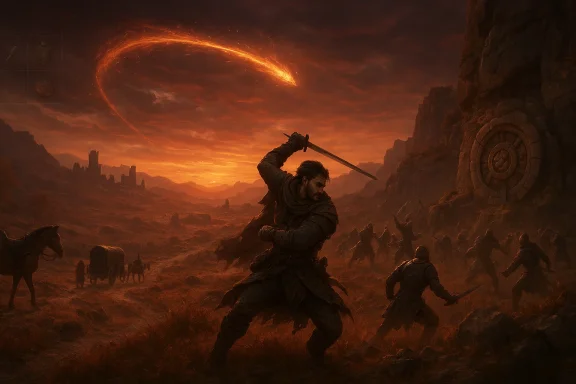
If the open world is the stage, combat is the engine. Pearl Abyss has repeatedly shown that Crimson Desert is built around a high-expression melee-and-ranged combat system with weapon switching, spells, environmental interaction, and large-scale encounters. The developer’s own recent showcases framed combat and progression as central pillars, not side attractions.That emphasis is important because complex combat can make or break an ambitious open-world action game. If movement, timing, and enemy behavior fail to cohere, all the surrounding systems become decorative. But if the combat works, it can transform every hill, castle, and camp into a potential battlefield where the player’s improvisation becomes the real entertainment.
The Value of Mechanical Variety
The best sign for Crimson Desert is that it does not appear to rely on a single combat fantasy. Traditional weapons, guns, bows, magic, and heavy action-movie style throws all seem to coexist in one ecosystem. That variety is not just about spectacle; it gives the game more room to create rhythm, surprise, and tactical identity.This matters for both casual and hardcore players. For newer players, variety can reduce repetition and make experimentation less punishing. For veterans, it creates room for mastery, route optimization, and combat expression that can turn ordinary skirmishes into improvisational set pieces. That is the kind of flexibility that keeps a large game alive long after launch.
- Multiple weapon classes appear to be available.
- Magic and physical attacks are blended into one system.
- The game favors creative combat chaining over one-button repetition.
- Large bosses and mass battles may provide the strongest showcase moments.
Systems, Activities, and the Strange Joy of Overdesign
One of Crimson Desert’s biggest talking points is not a single mechanic but the sheer number of them. Official and preview coverage points to a game stuffed with trading, factions, creature harvesting, mount systems, and a broad array of side activities. That kind of density can be exhilarating because it lets players define their own pace, but it can also make the game feel like a bundle of prototypes stitched together into one release.That tension may be the key to understanding why people are so divided on it. Some players will see a wide sandbox that keeps offering fresh toys. Others will see a lack of restraint, where every new idea risks undercutting the clarity of the one before it. Both reactions can be true at once.
Why “Too Much” Can Be a Feature
In a genre often criticized for repeating the same loops across a huge map, excess can actually feel refreshing. When a game offers archery competitions, brawling pits, trade routes, banking, mounts, and quest-driven side economies, it creates the impression of a world that existed before the player arrived. The point is not that every activity must be deep; the point is that the world must feel inhabited.But abundance is only an advantage if the player’s time feels respected. A shallow activity can still be useful if it serves a broader fantasy or feeds into another system. If it is merely there to pad the map, it becomes noise. Crimson Desert’s challenge is that its ambition is so large that even one weak system can stand out sharply.
- Trading and logistics appear to be more than cosmetic.
- Factions and progression suggest a web of social systems.
- Mini-games and distractions can add texture if they stay meaningful.
- Weak side content risks diluting the strongest mechanics.
Inventory, Storage, and the Pain of Carrying Everything
No matter how exciting a game’s systems are, the boring parts still matter. Crimson Desert appears to have a slot-based inventory model, and early coverage suggests that storage may be more limited than players would like at launch. The Steam listing shows a 150 GB install footprint, which already hints at a game that is asking for significant hard drive real estate before the player even starts hoarding loot.This matters because abundance creates administrative friction. If a game gives players dozens of materials, creatures, crafting components, and equipment upgrades, it has to offer a graceful way to store and sort them. Otherwise, the fantasy of being a world-class adventurer collapses into the reality of constantly managing menus. That is not the kind of friction most players want to remember.
A Design Problem, Not Just an Interface Problem
Inventory design is often treated like a minor usability issue, but in a game like Crimson Desert it becomes a core structural question. If players are expected to gather hides, bones, crafting manuals, creature drops, and trade goods, then storage determines whether the game feels adventurous or tedious. Good inventory design disappears into the background; bad inventory design repeatedly interrupts the mood.This is also where player psychology comes into play. Hoarding is fun when the game gives clear reasons to do it and a safe place to put the results. When it does not, players start making defensive choices instead of expressive ones. That is a subtle but important difference, especially in a game trying to sell freedom.
- Slot pressure can discourage experimentation.
- Collection-heavy games need reliable storage tools.
- Convenience features may matter as much as combat polish.
- Administrative friction can damage long-session pacing.
Puzzles, Physics, and the Zelda Comparison
Crimson Desert also appears eager to borrow from the modern physics-puzzle tradition popularized by games like Zelda. That comparison is not a cheap headline grab; it reflects a real design lineage where players are encouraged to reason through space, objects, and environmental interactions rather than follow rigid scripted solutions. In the best cases, that makes the player feel inventive.The risk, of course, is that physics puzzles can become either too obvious or too arbitrary. The strongest puzzle sequences give the player enough information to feel clever once the solution clicks. The weakest ones create confusion, not satisfaction, because the intended logic is hidden behind poorly telegraphed constraints. That is where many ambitious games stumble.
When Systems Become Storytelling
The most interesting thing about Crimson Desert’s puzzle design is not whether any one challenge is difficult. It is whether the puzzles make the world feel more tactile and interactive. If a player uses physics, stamina, weather, or item interaction to solve problems, then the environment becomes part of the narrative rather than a backdrop behind it.That kind of design can be thrilling when it works, but it also amplifies unevenness. One clever puzzle can feel like an “aha” moment; the next can feel like a collision of arbitrary mechanics. In a game already packed with side systems, the puzzle layer has to be especially disciplined, or it will contribute to the sense that the game is spreading itself too thin.
- Physics interaction can deepen immersion.
- Puzzle clarity is essential when the world is already complex.
- Good puzzles should feel solved, not merely completed.
- Environmental interaction can become a signature feature if balanced well.
Performance, Platforms, and Technical Confidence
Technically, Crimson Desert is arriving under unusually high scrutiny. Pearl Abyss and its partners have spent the final stretch before launch detailing platform performance, and that is a smart move because the game’s visual ambition makes people immediately suspicious of optimization. Recent reporting notes platform modes across PS5, PS5 Pro, Xbox Series X, Xbox Series S, and PC, with a heavy emphasis on resolution and frame-rate tradeoffs.That kind of transparency is helpful for consumers, especially when a game targets both high-end visual quality and broad platform support. It suggests Pearl Abyss knows performance is part of the selling point, not a post-launch apology. And with the game coming to PC, Xbox Series X|S, and PlayStation 5, the studio has to prove it can scale without collapsing under its own ambition.
Why Optimization Is a Marketing Feature Now
For large cross-platform releases, optimization has become part of the preview narrative. Players no longer assume that a visually impressive game will run well, especially if it promises dense open-world systems and complex combat. Crimson Desert’s technical messaging suggests Pearl Abyss understands that modern trust is earned through specifics, not vague reassurance.There is also a broader market implication here. If Pearl Abyss can deliver a large, system-rich open world with strong performance, it raises the bar for other studios trying to justify similar scope. If it struggles, critics will use Crimson Desert as proof that “more” is not always better. The stakes are bigger than one launch.
- Multiple console modes indicate serious optimization effort.
- PC specs and frame-rate targets are part of the launch story.
- Performance transparency can reduce pre-release skepticism.
- Cross-platform parity will shape post-launch perception.
Story, Characters, and the Classic Vengeance Setup
The narrative foundation of Crimson Desert is straightforward on purpose: a devastation, a loss, a scattered group, and a vow to rebuild. Pearl Abyss frames Kliff and the Greymanes around a violent ambush by the Black Bears, turning the story into a journey of reunion, retaliation, and restoration. That kind of setup is familiar, but familiarity is not always a flaw if the execution is confident.The important question is not whether the premise is novel, but whether the game knows how to pace it. Big open-world games often struggle when the central plot is urgent but the player is free to ignore it for dozens of hours. Crimson Desert seems to solve that by making the world itself feel like part of the emotional recovery process rather than a distraction from it.
Set-Pieces as Narrative Payoff
The strongest story moments in games like this are usually not the dialogue scenes. They are the moments where the mechanics, the camera, and the stakes all align into a single surge of momentum. Early Crimson Desert coverage suggests Pearl Abyss understands this well, leaning into dramatic encounters and large-scale spectacle to make the story feel bigger than the familiar revenge framework.That is why the game’s narrative may end up being more effective than its premise suggests. The plot does not need to reinvent fantasy storytelling if it can deliver enough emotional charge through pacing, staging, and combat payoff. In a game this large, momentum is the real currency.
- The core story uses a proven revenge-and-rebuild structure.
- Emotional payoff will depend on pacing, not just plot twists.
- Set-pieces may carry more weight than exposition.
- The Greymanes give the story a team-based identity.
The Business Case for Ambition
Crimson Desert is not just a creative statement; it is a business bet. Pearl Abyss is effectively asking the market to embrace a premium single-player blockbuster from a studio best known globally for an MMO brand. That is a difficult transition, but it also gives the company a chance to expand beyond its established audience and into a larger premium-console conversation.The launch strategy reflects that ambition. Pearl Abyss has used official reveals, performance details, platform support, and pre-order promotions to build momentum in the final weeks. This is the kind of campaign that signals confidence, but also urgency; the studio wants players talking now, not months after release.
Competitive Implications
Crimson Desert lands in a market where open-world fatigue is real, but so is appetite for systems-rich adventures. If the game succeeds, it could pressure rivals to think bigger about combat depth and player freedom in their own large-scale projects. If it falters, it may reinforce the idea that modern players prefer focused design over maximalist spectacle.That tension is why the game’s reception matters beyond its sales chart. It is a test case for whether scope itself can still be a selling point in 2026, or whether only disciplined scope survives. Crimson Desert is not merely competing against other games; it is competing against skepticism.
- Success could elevate Pearl Abyss into a broader premium-console tier.
- Strong sales may encourage other studios to pursue denser open worlds.
- Weak reception could validate restraint as the safer market strategy.
- The game’s launch will shape perceptions of BlackSpace-style ambition.
Strengths and Opportunities
Crimson Desert’s biggest strength is that it dares to be unapologetically big. Even before launch, it has already established itself as a game that wants to combine exploration, combat, puzzles, trading, and set-piece storytelling into one enormous experience. That breadth creates a real opportunity for Pearl Abyss to deliver something that feels fresh in a genre that often mistakes familiarity for polish.- Ambition is visible in every system
- Combat variety appears genuinely expansive
- The world design supports curiosity and discovery
- Technical transparency builds launch confidence
- Cross-platform release broadens audience reach
- Set-piece storytelling can create memorable highs
- Trading and side systems add replay value
Risks and Concerns
The biggest concern is that Crimson Desert may be asking players to love too many moving parts at once. When a game piles on activities, the weakest ones become impossible to ignore, and a few shallow systems can drag down the perception of the whole experience. That risk is especially high in a single-player game where the player cannot rely on social interaction to keep the momentum going.- Inventory and storage may feel cumbersome
- Some mini-games could seem undercooked
- Puzzle design may veer into filler
- Mechanical sprawl can dilute narrative focus
- Performance expectations are extremely high
- Platform parity will be scrutinized closely
- Combat complexity may overwhelm some players
Looking Ahead
The most important thing to watch after launch is whether Crimson Desert’s systems reinforce one another or compete for attention. A game this broad needs harmony between exploration, combat, progression, and administration, because even a stunning world can become exhausting if the player spends too much time wrestling the interface. The real test is not whether Pearl Abyss made a lot of content; it is whether that content feels like one coherent fantasy.Post-launch support will matter just as much. If Pearl Abyss patches friction points quickly, clarifies underdeveloped systems, and deepens the mechanics that already work, Crimson Desert could have a long tail. If it does not, players may remember it as a brilliant but overextended experiment. That distinction will define its legacy.
- Watch how players respond to the inventory and storage model.
- Monitor whether combat depth holds up over many hours.
- See whether puzzle content feels clever or repetitive.
- Track performance on Xbox Series S, PS5, PS5 Pro, and PC.
- Pay attention to post-launch patches and quality-of-life updates.
Source: Windows Central https://www.windowscentral.com/gami...ways-and-thats-exactly-why-its-unforgettable/
Last edited:
