

Pearl Abyss has finally lifted the veil on how Crimson Desert will run across PCs, current-generation consoles, and macOS — and the details matter. The studio published a full set of hardware targets that pair aggressive upscaling strategies with a surprisingly conservative memory and storage baseline, while console owners get explicit, tiered performance modes (including an upgraded PlayStation Spectral Super Resolution on PS5 Pro). These official specifications give the clearest picture yet of what players should expect at launch and how to prioritize upgrades if they want consistent fidelity or frame‑rate targets. .com]())
Crimson Desert is Pearl Abyss’s single‑player open‑world action/adventure built on the studio’s BlackSpace engine. Like many modern AAA releases, the team is leaning on cross‑vendor and platform upscaling, optional frame generation, and platform-specific upscalers to make high resolutions and ray tracing achievable across a wide range of devices. The public specification set is organized around five PC presets (Minimum → Ultra), multiple console performance modes (Performance, Balanced, Quality), and a surprisingly broad macOS target list that includes support for Apple silicon families via MetalFX. These announcements arrive in the run-up to the game’s launch and are intended to help players plan storage, GPU, and CPU upgrades ahead of the release.
Key points for PC players:
Representative pairings (developer‑published examples):
Crimson Desert’s system sheets reveal a pragmatic engineering approach: a single, firm memory and storage baseline; flexible upscaling and frame‑generation options across platforms; and clearly signposted console tradeoffs so players can choose fidelity or framerate. The game’s success in meeting these promises will depend on launch‑day optimization, drivers, and real‑world testing — but Pearl Abyss has done the community a service by publishing concrete, platform‑specific targets ahead of release. Expect lively benchmark coverage once reviewers and players hit the world of Pywel, and plan upgrades around SSD speed and that non‑negotiable 16 GB memory floor.
Source: Wccftech Crimson Desert Gets Detailed PC, Console (PS5 Pro Supports New PSSR & RT), and Mac Specs
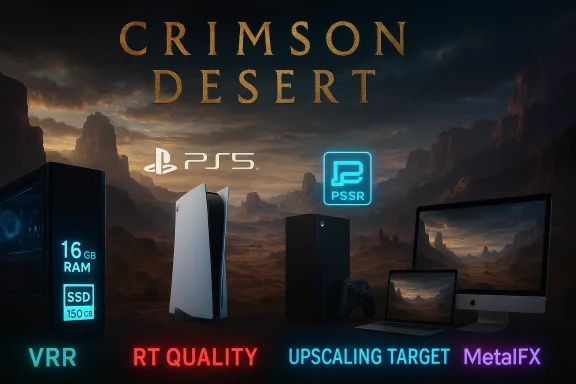 Background / Overview
Crimson Desert is Pearl Abyss’s single‑player open‑world action/adventure built on the studio’s BlackSpace engine. Like many modern AAA releases, the team is leaning on cross‑vendor and platform upscaling, optional frame generation, and platform-specific upscalers to make high resolutions and ray tracing achievable across a wide range of devices. The public specification set is organized around five PC presets (Minimum → Ultra), multiple console performance modes (Performance, Balanced, Quality), and a surprisingly broad macOS target list that includes support for Apple silicon families via MetalFX. These announcements arrive in the run-up to the game’s launch and are intended to help players plan storage, GPU, and CPU upgrades ahead of the release.What Pearl Abyss published — the essentials
PC: a 16 GB memory floor and a mandatory SSD
Pearl Abyss’s PC requirements set a universal RAM baseline of 16 GB and require 150 GB of SSD storage for install size across all presets. The OS requirement is Windows 10 64‑bit (22H2 or newer). The published GPU and CPU pairings define clear targets for each preset, from low/upscaled 1080p 30 FPS to Ultra 4K @ 60 FPS. The developer explicitly lists both AMD and NVIDIA GPU and CPU options for each tier, signaling optimization across vendor stacks.Key points for PC players:
- Memory: 16 GB required at minimum and recommended tiers.
- Storage: 150 GB install, SSD required — streaming and world data depend on fast storage.
- OS: Windows 10 64‑bit 22H2 or later.
- Upscaling: Several presets target upscaled output (for example, 1080p targets achieved via internal upscalers or vendor technologies at lower internal resolutions).
Console: explicit modes and a PS5 Pro upscaling bump
Pearl Abyss provided per‑platform mode breakdowns:- PlayStation 5 / P, Balanced, and Quality modes with differing targets. Notably, the PS5 Pro supports an upgraded PSSR upscaler that Pearl Abyss says can reach 40 FPS when upscaling from 1440p and 60 FPS (and higher with VRR) when upscaling from 1080p — both with Ray Tracing set to High in those upscaling modes. A Quality mode is locked to native 4K with Ray Tracing Ultra at 30 FPS**. These are explicit performance targets offered by the developer.
- Xbox Series X / S: Series X modes include 60 FPS performance targets at upscaled 4K (from 1280p with FSR3), while the Series S is presented as a lower tier (720p @ 40 FPS or 1080p @ 30 FPS) with ray tracing disabled on the S.
- Portable Windows handhelds (ROG Ally series): Pearl Abyss gave explicit targets for ROG Xbox Ally and Alley X variants, including 1080p upscaled modes with FSR3 + frame generation and specific FPS targets for Performance/Balanced/Quality presets.
macOS: day‑one support with MetalFX upscaling and Apple silicon targets
Pearl Abyss confirmed Crimson Desert will launch day‑one on macOS with explicit support for MetalFX upscaling and frame interpolation on newer macOS versions. The mac spec sheet names Apple silicon chips across M2 Pro → M3 Ultra and M4 families as the hardware brackets for the various presets and lists macOS 15.0 or later as the minimum, with macOS 26+ unlocking MetalFX upscale + frame interpolation for smoother targets (i.e., 60 FPS modes on Apple Silicon). This is notable: Crimson Desert is one of the few AAA titles shipping native macOS support at launch.Deep dive: The PC hardware targets explained
Pearl Abyss structures PC specs around five graphic presets and explicit resolution/FPS targets that pair with matched GPU and CPU examples. The pattern is familiar: lower presets use internal upscaling to hit 1080p at 30 FPS or 60 FPS targets, while High/Ultra aim for native 4K experiences.Representative pairings (developer‑published examples):
- Minimum / Low (upscaled 1080p targets) — GPUs: RX 5500 XT / GTX 1060; CPUs: Ryzen 5 2600X / i5‑8500; RAM 16 GB; SSD required.
- Recommended / Medium (1080p 60 FPS target) — GPUs: RX 6500 XT / GTX 1660; CPUs: Ryzen 5 5600 / i5‑11600K.
- High / Ultra (1440p 60 FPS or 4K 60 FPS targets) — GPUs scale to RX 7700 XT / RTX 4070 for 1440p 60, and RX 9070 XT / RTX 5070 Ti for 4K 60; CPUs scale up to Ryzen 7 7700X / i5‑13600K.
- The 16 GB memory floor is the most important baseline requirement. If you’re at 8 GB or edge‑case 12 GB, you should plan to upgrade. The game’s streaming and asset footprint justify the SSD mandate: 150 GB of install plus streaming for an expansive world.
- GPU expectations are moderate for minimum/recommended tiers but scale into current‑generation cards for native 4K60. Players hoping for 4K60 without upscaling should expect high‑end hardware.
- CPU scaling matters for higher CPU targets (open world AI, physics, streaming), so matching GPU upgrades with appropriate CPU generations will matter to avoid CPU‑limited scenarios at high FPS.
Console breakdown — what the modes mean for owners
PlayStation 5 and PS5 Pro: PSSR, VRR and the tradeoffs
Pearl Abyss’s console breakdown places a lot of emphasis on the PS5 Pro’s upgraded PSSR (PlayStation Spectral Super Resolution). The developer’s targets:- PS5 Pro Performance mode: 60 FPS with upscaling (targets 60 VSync, or 60+ FPS with VRR enabled).
- PSSR upscaled modes: 40 FPS when upscaling from 1440p; 60 FPS (and more with VRR) when upscaling from 1080p. keep Ray Tracing set to High.
- PS5 Quality mode: native 4K, Ray Tracing Ultra, 30 FPS.
- The PS5 Pro’s value proposition here is better upscaling + ray tracing enabled at higher frame targets, rather than universally higher native resolution at all modes.
- The PS5 Quality mode is a deliberate fidelity lock — native 4K at 30 FPS with Ultra RT — so performance-minded players will likely prefer Performance/Balanced modes or enable VRR on compatible displays to smooth variable‑rate upscaling.
Xbox Series X / S: scaled targets and ray tracing choices
- Xbox Series X hits the higher end of the console targets with 60 FPS Performance choices and upscaling to 4K (FSR3 from 1280p), with Ray Tracing Low/High choices depending on the preset.
- Xbox Series S owners will see lower native targets: 720p @ 40 FPS or 1080p @ 30 FPS with ray tracing disabled on the Series S. That plainly positions the S as the budget/portable console option for this title.
Handheld/portable: ROG Ally targets
Pearl Abyss also published performance targets for the ROG Xbox Ally family (Ally, Ally X), showing FSR3‑based upscaling and frame generation options to hit 40–60 FPS targets at 720p → upscaled 1080p depending on the mode. These entries indicate explicit handheld tuning and support for modern upscaling stacks in constrained thermal envelopes.macOS support: an uncommon AAA launch on Apple silicon
Crimson Desert is notable for shipping on macOS day‑one with explicit Apple silicon tiering. Pearl Abyss lists:- macOS 15.0 minimum for base support and macOS 26+ for MetalFX upscaling plus frame interpolation to reach 60 FPS targets on M3/M4 chips.
- Chip targets span M2 Pro → M3/M4 variants for mid/high presets and M3 Ultra / M4 Max for the highest modes (4K @ 60 FPS targets when MetalFX + interpolation are available).
- MetalFX upscaling is the macOS path for accelerated upscaling; Pearl Abyss also lists ray tracing as on for the M3/M4 families at higher presets.
- Native macOS AAA releases remain rare. The official decision to target MetalFX explicitly and to show named Apple silicon parts gives Mac gamers a clear upgrade roadmap and confirms the studio invested in platform‑specific optimization. However, real‑world performance will depend on the final macOS version, Apple drivers, and how efficiently the BlackSpace engine maps ray tracing to Apple’s GPU architecture.
Upscaling, frame generation and ray tracing: the technology stack
Crimson Desert’s targets lean heavily on a hybrid of vendor and platform upscalers and optional frame generation:- PC: developer lists cross‑vendor support expectations and mentions support for AMD FSR and NVIDIA DLSS 4 in prior announcements and developer updates. This allows the studio to aim for higher visual targets without forcing native resolution rendering on all hardware.
- PS5 Pro: upgraded PSSR is a platform‑level upscaler (Sony’s spectral super resolution) used here to achieve higher frame targets on the Pro hardware while keeping ray tracing enabled. The PS5 Pro modes specifically call out PSSR upscaling and VRR to hit 60+ FPS in certain modes.
- macOS: MetalFX Upscaling is the macOS path; on macOS 26+ Pearl Abyss lists frame interpolation plus MetalFX as the route to stable 60 FPS on Apple silicon.
Storage, patch sizes and install considerations
Pearl Abyss requires 150 GB of SSD storage for the game install on PC and similarly on other platforms. For PC players, the combination of a mandatory SSD and a 150 GB footprint means:- Plan for at least 200 GB free to accommodate day‑one patches and extra content.
- Use a NVMe SSD where possible for faster streaming and minimal in‑game stuttering in open‑world zones.
- Console installs will also occupy substantial console storage; Xbox and PlayStation users with filled drives should consider external or upgraded internal SSD options.
Practical advice — who needs to upgrade, and what to prioritize
Short version: upgrade the SSD and make sure you have 16 GB of RAM before chasing GPU gains. Here’s an ordered checklist:- Ensure your system has 16 GB of RAM. If not, upgrade first — it’s non‑negotiable for the official minimum.
- Install on a fast SSD (NVMe recommended) and reserve extra headroom for patches (150 GB + cushion).
- Match your GPU to your target preset: aim for mid‑range cards (RTX 20/30/40 series equivalents or AMD RX 6000/7000 equivalents) for 1440p/60; if you want native 4K60, plan for current‑generation high‑end cards.
- Balance CPU/GPU: for higher FPS targets, pair a modern multi‑core CPU (eg. Ryzen 5 5600 or above, Intel i5‑11600K or above per the developer examples). CPU bottlenecks will show in open‑world pathing and physics heavy scenes.
- For console players: enable VRR on compatible displays to smooth upscaled variable FPS on PS5 Pro or Xbox Series X. Quality mode is for fidelity; Performance mode + VRR is for smoother gameplay.
Strengths in Pearl Abyss’s approach
- Clear, platform‑specific guidance. Developers gave explicit GPU/CPU pairings and FPS/resolution targets rather than vague statements, which helps players plan upgrades. The universal 16 GB floor simplifies baseline expectations.
- Cross‑platform upscaling support. The use of vendor‑level upscalers and platform upscalers (PSSR on PS5 Pro, MetalFX on macOS, FSR/DLSS on PC) makes the title accessible across hardware generations while still enabling high fidelity on modern silicon.
- Native macOS release at launch. Shipping day‑one on macOS with MetalFX support signals significant engineering effort and broadens the addressable audience — an uncommon move for AAA Western/Korean titles.
- Explicit console tradeoffs. By clearly separating Performance, Balanced and Quality modes, Pearl Abyss helps console owners choose the experience they prefer (higher fidelity vs higher framerate).
Risks, caveats and things to watch
- Published targets are not immutable. The FPS and RT quality targets are devipping builds; post‑launch patches, driver updates, or even platform firmware can move real performance significantly. Treat numbers as expected targets, not guarantees.
- Upscaling tradeoffs. Relying on upscaling (PSSR, FSR, DLSS, MetalFX) tends to hide native rendering cost but can reduce fine detail, produce shimmering, or create temporal artifacts when combined with frame generation. Players sensitive to microdetail may prefer native modes even if they cost performance.
- Ray tracing performance variability. Even when developers enable RT in higher presets, ray tracing remains hardware‑intensive and often scales poorly on older hardware. For consoles, the PS5 Pro’s PSSR claim is promising — but real experience will depend on how the engine balances RT complexity with upscaling.
- Mac performance is contingent on Apple drivers and OS. The macOS targets depend on MetalFX and the maturity of Apple’s GPU drivers on new macOS releases; performance may improve over time or vary across M2/M3/M4 models.
- Storage + patch bloat. The 150 GB install plus day‑one patches and post‑launch content could balloon download/ install sizes; players on metered or constrained storage should prepare.
Verdict — who should be excited, and who should be cautious
Pearl Abyss is shipping a technically ambitious, cross‑platform open world and has given players the practical data needed to prepare. If you’re a PC player with 16 GB of RAM and a modern SSD, you can reasonably expect playable performance across a wide range of GPUs by using upscaling. Console players on PS5 Pro should be especially interested in the upgraded PSSR modes that promise a better balance of RT and frame‑rate; however, those expecting native 4K60 on consoles without upscaling will be disappointed — Quality modes are locked to 30 FPS in exchange for Ultra RT fidelity. Mac users finally get a first‑class AAA option, but buy‑in should be cautious until real‑world benchmarks arrive for specific M‑chip models.Final recommendations for readers and PC builders
- Prioritize SSD speed and 16 GB RAM above a GPU upgrade unless you’re targeting native 4K.
- If you own a PS5 Pro, enable VRR on your display for the smoothest experience in upscaled Performance modes.
- Mac owners should verify their macOS version aligns with the MetalFX/frame interpolation requirements listed by Pearl Abyss if they expect 60 FPS targets on M3/M4 hardware.
- Factor in an extra storage buffer (200 GB+) for patches and potential future content.
- Watch early launch benchmarks from reputable outlets and independent testers before making last‑minute hardware purchases — developer targets are informative but not definitive.
Crimson Desert’s system sheets reveal a pragmatic engineering approach: a single, firm memory and storage baseline; flexible upscaling and frame‑generation options across platforms; and clearly signposted console tradeoffs so players can choose fidelity or framerate. The game’s success in meeting these promises will depend on launch‑day optimization, drivers, and real‑world testing — but Pearl Abyss has done the community a service by publishing concrete, platform‑specific targets ahead of release. Expect lively benchmark coverage once reviewers and players hit the world of Pywel, and plan upgrades around SSD speed and that non‑negotiable 16 GB memory floor.
Source: Wccftech Crimson Desert Gets Detailed PC, Console (PS5 Pro Supports New PSSR & RT), and Mac Specs
