

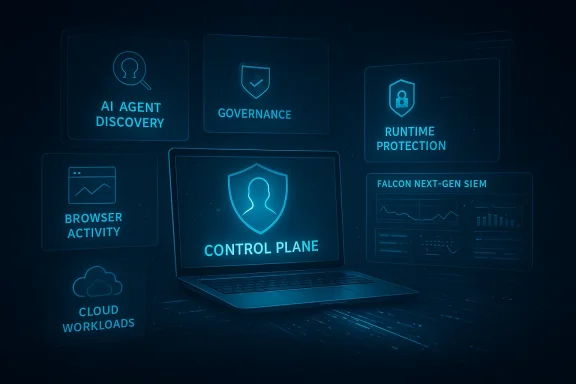
CrowdStrike is pushing Falcon into a broader role than classic endpoint protection, and that shift matters because the company is now treating AI security as an endpoint-first discipline rather than a bolt-on feature. In the materials surfaced from the forum’s current coverage, the company’s newest Falcon innovations are described as extending AI agent discovery, governance, and runtime protection across endpoints, browsers, SaaS, and cloud workloads, while also pulling Microsoft Defender for Endpoint telemetry into Falcon Next-Gen SIEM. That is more than a product tweak; it is a statement about where CrowdStrike thinks the next control plane should live. The endpoint, in other words, is being recast as the place where autonomous activity becomes visible, governable, and actionable.
The timing of this move is no accident. Enterprise security teams are watching a fast expansion of AI agents, copilots, and browser-based workflows that blur the old distinction between human users and machine actions. CrowdStrike’s pitch, as reflected in the current coverage, is that the endpoint remains the most reliable place to observe those behaviors because it sits closest to identity use, application execution, and data movement. That makes Falcon less of a single-purpose EDR product and more of a security operating layer for the AI era.
What makes the story especially interesting is the implicit competitive posture toward Microsoft. Falcon’s latest updates reportedly add support for Microsoft Defender for Endpoint telemetry inside Falcon Next-Gen SIEM, which suggests CrowdStrike is not merely competing with Microsoft at the endpoint level but also trying to absorb Microsoft-generated visibility into its own analytics stack. That is a pragmatic strategy: if customers already run mixed estates, the vendor that can normalize the most telemetry and make it usable fastest often wins the budget conversation.
The broader market context is shifting as well. Security platforms are no longer being judged only on prevention or detection, but on how well they can understand agent behavior, runtime context, and cross-domain activity. The forum’s current coverage frames CrowdStrike’s announcement as part of that wider move from static application security to live control of autonomous systems, which is a useful way to understand why the endpoint is being elevated again after years of cloud-centric hype.
Another important angle is operational consolidation. CrowdStrike’s recent posture appears designed to keep customers inside a single workflow for discovery, governance, threat hunting, and response. That matters because AI-era security problems are rarely isolated to one layer. An agent may begin in a browser, touch SaaS data, pivot through identity, and leave traces in endpoint telemetry before anyone notices. The vendor that can tie those events together has a strong advantage.
That matters because the endpoint is where work actually happens. It is where identities authenticate, where prompts are entered, where files are opened, and where data is copied into tools that may or may not be sanctioned. If AI security is going to be operationalized, CrowdStrike is betting the best place to begin is not the model layer or the cloud control plane, but the device where user intent becomes machine action.
The company’s strategy also reflects a familiar platform pattern. Expand the surface area, then unify the telemetry. Add browser visibility, SaaS insights, and cloud workload controls, then bring them together inside a single control experience. That is not glamorous, but it is often how market share is defended in enterprise security.
That is smart positioning. Many enterprises are already committed to Microsoft 365, Defender, Entra, Purview, and Sentinel, but they still want a vendor that can unify third-party and first-party signals. If CrowdStrike can be the platform that reduces tool sprawl while improving visibility, it can remain relevant even in Microsoft-heavy accounts.
That is a meaningful step because discovery is the prerequisite for governance. Enterprises often think they have an AI policy until they ask where agents are actually running, what data they can touch, and which identities they inherit. Discovery turns those abstract questions into enforceable inventory problems. In security, that shift is usually where spending begins to accelerate.
The challenge is that discovery alone is not enough. A modern agent may appear benign while it is quietly reading internal content, triggering external calls, or moving data into a workflow outside the security team’s immediate view. CrowdStrike’s answer appears to be runtime protection tied to telemetry-rich enforcement, which is where Falcon’s endpoint heritage gives it credibility.
This is where endpoint visibility becomes strategically useful. The endpoint can capture process behavior, browser activity, privilege use, and local data movement in ways cloud-only tools often cannot. For AI workflows that blend local activity with SaaS and browser interactions, that visibility can be the difference between a useful alert and a delayed investigation.
CrowdStrike’s update is therefore best understood as a bet on live control, not just policy enforcement. That is important because AI threats are dynamic. Prompt injection, malicious extensions, shadow AI usage, and unauthorized tool access are all behavior problems as much as configuration problems.
The upside is obvious. Enterprises do not want to duplicate every dataset, rebuild every dashboard, or force every investigation through a single native console if there is already useful data elsewhere. By accepting Microsoft telemetry, CrowdStrike can shorten deployment friction and make Falcon feel less like a rip-and-replace play and more like a consolidation platform.
The downside is also obvious. Interoperability can blur product boundaries and make it harder to explain where one vendor ends and another begins. But in enterprise security, that blur is often acceptable if it saves analysts time and improves the quality of the response.
The strategic implication is bigger than one product feature. CrowdStrike is signaling that the future of security operations is not about owning every sensor, but about owning the intelligence layer that makes disparate sensors useful. That is a subtle but important difference, and it helps explain why the company can compete even in accounts where Microsoft is already deeply embedded.
That is why “endpoint as epicenter” is not just a branding line. It reflects a genuine operational truth: security teams often need to know what happened on the device before they can understand what happened in the cloud. AI may be distributed, but the human experience of AI is still frequently local.
CrowdStrike’s challenge is to make the endpoint feel broad enough to govern the full AI workflow without losing the speed and clarity that made Falcon attractive in the first place. That is a delicate balance, but it is also the reason the company can credibly claim to lead on runtime control.
This is where the category gets interesting. If the browser becomes an execution layer for AI, then endpoint security vendors have a natural advantage over cloud-only players. They already understand device context, local process behavior, and user-session dynamics. The browser is simply another place where those signals can be stitched together.
That also explains why shadow AI has become such a strong theme in the market. The risk is not just unmanaged software, but unmanaged workflows that happen in tools employees already trust. In that sense, CrowdStrike is responding to a problem that is both technical and behavioral.
Microsoft’s advantage is obvious: it controls the productivity layer and much of the identity stack. CrowdStrike’s counterargument is that the device is where incidents become visible and where response can still be decisive. If the endpoint is the most trustworthy source of runtime behavior, then Falcon has a right to lead the workflow.
That creates a classic platform competition. Microsoft wins by embedding security into the work surface. CrowdStrike wins by being the best operational lens into what users and agents are actually doing. For customers, the choice will often come down to which layer they trust more when something goes wrong.
That means rivals will need to show more than feature parity. They will need to show workflow superiority. Can they detect the incident faster? Can they connect the dots across domains? Can they reduce analyst toil while preserving control? CrowdStrike is clearly trying to answer yes to all three.
A likely result is category convergence. Endpoint, browser, SaaS, identity, and SIEM tooling are all drifting toward the same operational question: how do you govern autonomous activity without crippling productivity? Vendors that can answer that question convincingly will win the next budget cycle.
That matters because policy without observability quickly becomes theater. Companies may have acceptable-use rules for AI, but they often lack the operational data needed to enforce them. CrowdStrike’s advantage is that it can attach enforcement to the device and use telemetry to validate whether policy is being followed.
The enterprise opportunity is not just security; it is auditability. The more AI workflows touch sensitive data, the more executives will need defensible records showing what happened, when, and why. That is where endpoint-centric AI security becomes a compliance enabler as much as a threat-defense tool.
CrowdStrike is essentially trying to make that consumer-style flexibility safe enough for enterprise use. The challenge is that security controls which are too visible or restrictive tend to trigger workarounds. So the real product test is whether Falcon can enforce policy without making the experience miserable for the user.
This is why the endpoint remains central. It is the place where consumer expectations meet corporate obligations. Anyone building AI security products for enterprises needs to account for that collision.
In the end, CrowdStrike’s message is not that the endpoint is returning to glory for nostalgic reasons. It is that the endpoint never stopped mattering; the threat model simply changed. As AI becomes embedded in everyday work, the most valuable security layer may be the one that can see intent turn into action in real time, and that is exactly where CrowdStrike wants Falcon to stand.
Source: SDxCentral CrowdStrike agent-proofs endpoints, brings Microsoft to Falcon
Source: 01net CrowdStrike Establishes the Endpoint as the Epicenter for AI Security
 Overview
The timing of this move is no accident. Enterprise security teams are watching a fast expansion of AI agents, copilots, and browser-based workflows that blur the old distinction between human users and machine actions. CrowdStrike’s pitch, as reflected in the current coverage, is that the endpoint remains the most reliable place to observe those behaviors because it sits closest to identity use, application execution, and data movement. That makes Falcon less of a single-purpose EDR product and more of a security operating layer for the AI era.What makes the story especially interesting is the implicit competitive posture toward Microsoft. Falcon’s latest updates reportedly add support for Microsoft Defender for Endpoint telemetry inside Falcon Next-Gen SIEM, which suggests CrowdStrike is not merely competing with Microsoft at the endpoint level but also trying to absorb Microsoft-generated visibility into its own analytics stack. That is a pragmatic strategy: if customers already run mixed estates, the vendor that can normalize the most telemetry and make it usable fastest often wins the budget conversation.
The broader market context is shifting as well. Security platforms are no longer being judged only on prevention or detection, but on how well they can understand agent behavior, runtime context, and cross-domain activity. The forum’s current coverage frames CrowdStrike’s announcement as part of that wider move from static application security to live control of autonomous systems, which is a useful way to understand why the endpoint is being elevated again after years of cloud-centric hype.
Another important angle is operational consolidation. CrowdStrike’s recent posture appears designed to keep customers inside a single workflow for discovery, governance, threat hunting, and response. That matters because AI-era security problems are rarely isolated to one layer. An agent may begin in a browser, touch SaaS data, pivot through identity, and leave traces in endpoint telemetry before anyone notices. The vendor that can tie those events together has a strong advantage.
Background
CrowdStrike has spent years building Falcon into a broad platform rather than a narrow endpoint agent. That evolution started with the idea that modern attackers move laterally across identity, cloud, and endpoint layers, so the defender needs a similarly integrated view. The latest AI-security push continues that logic, but the target has changed: it is no longer just the human attacker, but also the autonomous or semi-autonomous agent that can misuse legitimate access.The shift from EDR to control plane
Traditional endpoint security focused on malware, behavioral detections, and incident response. That still matters, but it is no longer enough when the “user” may be a browser extension, an AI assistant, or an agentic workflow connected to corporate data and tools. CrowdStrike’s current messaging suggests Falcon is being positioned as the layer that can see those interactions in motion and enforce policy around them.That matters because the endpoint is where work actually happens. It is where identities authenticate, where prompts are entered, where files are opened, and where data is copied into tools that may or may not be sanctioned. If AI security is going to be operationalized, CrowdStrike is betting the best place to begin is not the model layer or the cloud control plane, but the device where user intent becomes machine action.
The company’s strategy also reflects a familiar platform pattern. Expand the surface area, then unify the telemetry. Add browser visibility, SaaS insights, and cloud workload controls, then bring them together inside a single control experience. That is not glamorous, but it is often how market share is defended in enterprise security.
Why Microsoft matters here
Microsoft is the obvious reference point because its security stack sits across endpoint, identity, productivity, and cloud. By reportedly enabling Falcon to consume Microsoft Defender for Endpoint telemetry in Next-Gen SIEM, CrowdStrike is signaling that it wants to be the analytics and control layer above mixed-vendor environments, not just the standalone replacement for Microsoft tooling.That is smart positioning. Many enterprises are already committed to Microsoft 365, Defender, Entra, Purview, and Sentinel, but they still want a vendor that can unify third-party and first-party signals. If CrowdStrike can be the platform that reduces tool sprawl while improving visibility, it can remain relevant even in Microsoft-heavy accounts.
- The endpoint still matters because it is the first place autonomous work becomes observable.
- Falcon is being framed as a broader security control plane, not just EDR.
- Microsoft interoperability may be a sales advantage, not a compromise.
- AI security is increasingly about runtime context, not static policy.
- Telemetry fusion is becoming a differentiator in crowded enterprise accounts.
Falcon as the AI Security Hub
CrowdStrike’s core bet is that AI security should be anchored in the same operational environment that already protects user devices. That is why the platform emphasis on endpoints, browsers, SaaS, and cloud workloads is so important. The company is effectively saying that AI risk is not a separate category; it is an extension of existing enterprise exposure, and Falcon can be the place where those risks converge.Discovery before defense
One of the most consequential themes in the current coverage is AI agent discovery. You cannot protect what you cannot see, and that principle becomes much harder to apply once employees begin using sanctioned and unsanctioned AI tools across devices and browsers. CrowdStrike’s pitch is that Falcon can identify these agents and workflows before they become blind spots.That is a meaningful step because discovery is the prerequisite for governance. Enterprises often think they have an AI policy until they ask where agents are actually running, what data they can touch, and which identities they inherit. Discovery turns those abstract questions into enforceable inventory problems. In security, that shift is usually where spending begins to accelerate.
The challenge is that discovery alone is not enough. A modern agent may appear benign while it is quietly reading internal content, triggering external calls, or moving data into a workflow outside the security team’s immediate view. CrowdStrike’s answer appears to be runtime protection tied to telemetry-rich enforcement, which is where Falcon’s endpoint heritage gives it credibility.
Runtime protection is the real battleground
The phrase runtime protection is doing heavy lifting here. It suggests that CrowdStrike is not just cataloging AI tools, but watching how they behave when they are active, connected, and capable of action. That distinction matters because a lot of AI security failures will not happen at install time. They will happen mid-session, when an agent chains actions together faster than human reviewers can intervene.This is where endpoint visibility becomes strategically useful. The endpoint can capture process behavior, browser activity, privilege use, and local data movement in ways cloud-only tools often cannot. For AI workflows that blend local activity with SaaS and browser interactions, that visibility can be the difference between a useful alert and a delayed investigation.
CrowdStrike’s update is therefore best understood as a bet on live control, not just policy enforcement. That is important because AI threats are dynamic. Prompt injection, malicious extensions, shadow AI usage, and unauthorized tool access are all behavior problems as much as configuration problems.
- Discovery identifies the agents and workflows in play.
- Runtime protection measures what those agents do after launch.
- Endpoint telemetry helps connect user intent to machine behavior.
- Browser and SaaS visibility closes gaps that EDR alone cannot handle.
- Policy becomes meaningful only when tied to execution.
Microsoft Telemetry and Platform Pragmatism
One of the most interesting parts of the story is CrowdStrike’s willingness to incorporate Microsoft Defender for Endpoint telemetry into Falcon Next-Gen SIEM. That is not a sign of weakness; it is a recognition that enterprise customers live in hybrid and often messy environments. Security buyers increasingly prefer the platform that can normalize the most data, even if that data originates from a rival’s stack.Interoperability as a growth strategy
CrowdStrike’s interoperability angle can be read as a sales tactic and an architectural statement at the same time. On the sales side, it reduces the friction of adoption in Microsoft-dense shops. On the architectural side, it suggests Falcon wants to be the analytical truth layer where telemetry from different control points is reconciled. That is a strong position if the company can keep the workflow coherent.The upside is obvious. Enterprises do not want to duplicate every dataset, rebuild every dashboard, or force every investigation through a single native console if there is already useful data elsewhere. By accepting Microsoft telemetry, CrowdStrike can shorten deployment friction and make Falcon feel less like a rip-and-replace play and more like a consolidation platform.
The downside is also obvious. Interoperability can blur product boundaries and make it harder to explain where one vendor ends and another begins. But in enterprise security, that blur is often acceptable if it saves analysts time and improves the quality of the response.
Why the SIEM layer matters
Falcon Next-Gen SIEM is the natural place for this kind of consolidation because SIEM is where telemetry becomes operational context. If CrowdStrike can ingest Microsoft Defender for Endpoint data alongside its own signals, it gains a better chance of building richer detections and more actionable investigations. That is especially useful in AI-driven incidents, where the chain of events may span multiple tools and identities.The strategic implication is bigger than one product feature. CrowdStrike is signaling that the future of security operations is not about owning every sensor, but about owning the intelligence layer that makes disparate sensors useful. That is a subtle but important difference, and it helps explain why the company can compete even in accounts where Microsoft is already deeply embedded.
- Microsoft interoperability lowers procurement resistance.
- SIEM is the natural aggregation point for mixed telemetry.
- Platform value increasingly comes from context, not just raw data.
- Hybrid environments reward vendors that reduce fragmentation.
- The analytical layer may matter more than the native sensor.
Endpoint-Centric AI Security
CrowdStrike’s decision to center the endpoint is strategically important because it pushes back against the idea that AI security should live exclusively in cloud or identity tooling. The company is arguing that the endpoint is still the most actionable security domain because it is where users, apps, and data collide in real time. That claim has become more persuasive as AI tools spread into browsers and desktop workflows.Why the endpoint is still the epicenter
The endpoint remains the richest source of behavioral evidence in most enterprises. It sees which applications are opened, which websites are visited, what files are accessed, and how users move between sanctioned and unsanctioned workflows. In the AI era, those signals matter even more because the same device may be used to interact with a corporate copilot, a personal chatbot, and a browser-based agent in the same work session.That is why “endpoint as epicenter” is not just a branding line. It reflects a genuine operational truth: security teams often need to know what happened on the device before they can understand what happened in the cloud. AI may be distributed, but the human experience of AI is still frequently local.
CrowdStrike’s challenge is to make the endpoint feel broad enough to govern the full AI workflow without losing the speed and clarity that made Falcon attractive in the first place. That is a delicate balance, but it is also the reason the company can credibly claim to lead on runtime control.
The browser as a new execution layer
Browser activity deserves its own emphasis because many AI interactions now happen there. Employees increasingly use browser-based copilots, extensions, workflow tools, and SaaS assistants that never touch a traditional server-side security perimeter. CrowdStrike’s expansion into browser visibility therefore looks like a logical extension of endpoint control rather than a side project.This is where the category gets interesting. If the browser becomes an execution layer for AI, then endpoint security vendors have a natural advantage over cloud-only players. They already understand device context, local process behavior, and user-session dynamics. The browser is simply another place where those signals can be stitched together.
That also explains why shadow AI has become such a strong theme in the market. The risk is not just unmanaged software, but unmanaged workflows that happen in tools employees already trust. In that sense, CrowdStrike is responding to a problem that is both technical and behavioral.
- Endpoint telemetry captures local evidence other layers may miss.
- Browsers are becoming primary surfaces for AI execution.
- Shadow AI often begins with ordinary user behavior.
- Runtime context matters more than static app approval.
- Device-level governance scales into browser and SaaS control.
Competitive Implications
The competitive implications of CrowdStrike’s move are substantial because the company is aiming at the same strategic territory that Microsoft, Palo Alto Networks, and other platform vendors want to own: the system of record for AI-era security. The difference is that CrowdStrike is coming at the problem from the endpoint outward, while others are approaching it from identity, cloud, or productivity inward.Platform rivalry is intensifying
CrowdStrike’s Falcon strategy is a direct answer to platform consolidation. Enterprise buyers do not want ten different AI security tools if one stack can provide acceptable coverage and integration. That pressure rewards vendors that can present a coherent narrative across discovery, governance, runtime protection, and response.Microsoft’s advantage is obvious: it controls the productivity layer and much of the identity stack. CrowdStrike’s counterargument is that the device is where incidents become visible and where response can still be decisive. If the endpoint is the most trustworthy source of runtime behavior, then Falcon has a right to lead the workflow.
That creates a classic platform competition. Microsoft wins by embedding security into the work surface. CrowdStrike wins by being the best operational lens into what users and agents are actually doing. For customers, the choice will often come down to which layer they trust more when something goes wrong.
What rivals will have to prove
The bar is getting higher for every security vendor that wants to compete in AI. It is no longer enough to say you protect data, identities, or cloud workloads in isolation. Buyers will ask how a product sees prompts, extensions, browser actions, non-human identities, and downstream tool use. They will also ask whether the same product can help analysts investigate and respond without jumping between consoles.That means rivals will need to show more than feature parity. They will need to show workflow superiority. Can they detect the incident faster? Can they connect the dots across domains? Can they reduce analyst toil while preserving control? CrowdStrike is clearly trying to answer yes to all three.
A likely result is category convergence. Endpoint, browser, SaaS, identity, and SIEM tooling are all drifting toward the same operational question: how do you govern autonomous activity without crippling productivity? Vendors that can answer that question convincingly will win the next budget cycle.
- Microsoft remains the most direct strategic rival.
- CrowdStrike’s endpoint heritage gives it runtime credibility.
- Buyers will favor vendors that unify investigation workflows.
- AI security categories are converging across the stack.
- Workflow quality may matter more than feature checklists.
Enterprise vs. Consumer Impact
Enterprise buyers will feel the effects of CrowdStrike’s shift far more directly than consumers, but the consumer behavior shift is what makes the enterprise problem harder. Employees are bringing personal AI habits into work, and that means consumer-grade expectations are shaping business risk. CrowdStrike’s strategy is aimed at the enterprise response to that reality.Enterprise governance gets more granular
For enterprises, the practical value of Falcon’s AI security posture is governance. Security teams need to know which endpoints are running which tools, whether those tools are approved, what data they can access, and how their actions are logged. The current coverage suggests CrowdStrike is building toward that level of precision, especially by tying discovery to runtime behavior.That matters because policy without observability quickly becomes theater. Companies may have acceptable-use rules for AI, but they often lack the operational data needed to enforce them. CrowdStrike’s advantage is that it can attach enforcement to the device and use telemetry to validate whether policy is being followed.
The enterprise opportunity is not just security; it is auditability. The more AI workflows touch sensitive data, the more executives will need defensible records showing what happened, when, and why. That is where endpoint-centric AI security becomes a compliance enabler as much as a threat-defense tool.
Consumer behavior influences enterprise risk
On the consumer side, the impact is indirect but important. People now expect AI tools to be fast, always available, and easy to use. That expectation bleeds into enterprise behavior, where users often seek workarounds when sanctioned tools feel too restrictive. The result is more shadow AI, more browser-based activity, and more unmanaged data movement.CrowdStrike is essentially trying to make that consumer-style flexibility safe enough for enterprise use. The challenge is that security controls which are too visible or restrictive tend to trigger workarounds. So the real product test is whether Falcon can enforce policy without making the experience miserable for the user.
This is why the endpoint remains central. It is the place where consumer expectations meet corporate obligations. Anyone building AI security products for enterprises needs to account for that collision.
- Enterprises need auditability, not just alerts.
- Consumer expectations are driving shadow AI adoption.
- Policy enforcement must be visible enough to work, but quiet enough to avoid resistance.
- The endpoint is where governance and usability collide.
- Compliance value is becoming a major selling point.
Strengths and Opportunities
CrowdStrike’s current direction has several obvious strengths. It addresses a real and urgent market problem, it plays to the company’s existing endpoint credibility, and it extends Falcon into the broader AI security conversation without abandoning the platform story. The opportunity is to become the vendor that can see AI activity where it happens, not just where it is managed.- Strong endpoint heritage gives Falcon credibility for runtime enforcement.
- AI agent discovery is a timely response to shadow AI and unmanaged workflows.
- Browser and SaaS coverage extends visibility beyond the classic device boundary.
- Microsoft telemetry support improves interoperability in mixed estates.
- Next-Gen SIEM integration helps turn visibility into investigations.
- Platform consolidation may resonate with budget-conscious enterprise buyers.
- Runtime protection aligns well with the dynamic nature of AI risks.
Risks and Concerns
The biggest risk is overextension. The more Falcon tries to become the center of AI governance, browser visibility, SaaS protection, and SIEM analytics, the more it must prove that the platform remains coherent and not just broad. Buyers like consolidation, but they do not like complexity disguised as consolidation. That distinction matters.- Platform sprawl could make the product harder to deploy and tune.
- Telemetry overload may create more noise if correlation is not strong.
- Microsoft dependence could complicate the rivalry narrative.
- Runtime controls may be difficult to explain to non-technical buyers.
- Browser and SaaS visibility gaps could persist if adoption is uneven.
- Category confusion may arise if AI security messages overlap with existing EDR and XDR claims.
- Competitive bundling from Microsoft could pressure pricing and margins.
Looking Ahead
The next stage will likely determine whether CrowdStrike’s latest Falcon expansion becomes a durable category position or just another incremental platform update. The critical test is whether customers can use Falcon to discover AI agents, govern them consistently, and investigate incidents without stitching together too many external systems. If that workflow works, the company will have strengthened its claim that the endpoint is still the epicenter of enterprise security.What to watch next
- Whether CrowdStrike publishes clearer examples of agent discovery in real enterprise deployments.
- How well Microsoft Defender telemetry is normalized inside Falcon Next-Gen SIEM.
- Whether browser and SaaS protections become deep enough to matter operationally.
- How aggressively Microsoft responds with overlapping endpoint and agent-governance messaging.
- Whether customers treat Falcon as a consolidation platform or just another tool in the stack.
In the end, CrowdStrike’s message is not that the endpoint is returning to glory for nostalgic reasons. It is that the endpoint never stopped mattering; the threat model simply changed. As AI becomes embedded in everyday work, the most valuable security layer may be the one that can see intent turn into action in real time, and that is exactly where CrowdStrike wants Falcon to stand.
Source: SDxCentral CrowdStrike agent-proofs endpoints, brings Microsoft to Falcon
Source: 01net CrowdStrike Establishes the Endpoint as the Epicenter for AI Security
