

CrowdStrike is using RSAC 2026 to make a clear strategic argument: AI security has moved from a niche governance issue to a runtime control problem, and the company believes the Falcon platform is the right place to solve it. The new announcements broaden Falcon across endpoints, SaaS, cloud, and desktop AI tools, while also tightening the company’s SIEM story for customers trying to modernize without ripping and replacing existing investments. In practical terms, CrowdStrike is telling enterprises that the rise of autonomous agents has created a security gap older tools were never designed to close. That is a timely message in San Francisco this week, and it also reflects how quickly the market around AI security has hardened into a real buying category.
CrowdStrike has been building toward this moment for more than a year. The company spent 2025 reframing Falcon as an agentic security platform, then moved into AI-specific detection and response with Falcon AIDR in December 2025, which was positioned as protection for the prompt and agent interaction layer across development and workforce usage. The latest RSAC announcements extend that idea outward and downward: outward into SaaS and cloud AI usage, and downward into the endpoint where many AI actions ultimately execute.
That sequencing matters. CrowdStrike is not merely adding another feature to a crowded product line; it is trying to define the control plane for an AI era in which software agents can read data, invoke tools, and trigger workflows with privileges that look more like a human operator than a traditional application. The company’s own messaging has repeatedly stressed that prompt injection, jailbreaks, and unauthorized tool execution are now operational threats rather than theoretical ones. Its recent public materials describe AI adoption as an expanding attack surface that spans employees, agents, models, MCP servers, and cloud workloads.
The timing also aligns with CrowdStrike’s threat narrative for 2026. In its Global Threat Report, the company said AI-enabled adversaries increased operations by 89% year over year, and that attackers had exploited legitimate GenAI tools at more than 90 organizations by injecting malicious prompts. That kind of data gives CrowdStrike a useful sales wedge: the company can argue that AI security is no longer speculative because the adversary has already moved in. The RSAC launch turns that warning into a product roadmap.
Equally important, the announcement lands in a broader market where security vendors are racing to claim the shadow AI and agentic AI categories. Netskope, for example, has already pushed a One AI Security suite, while CrowdStrike itself has spent months adding AI Discovery and AIDR capabilities. The market is converging on a shared premise: enterprises need visibility into where AI is running, what it can access, and whether its actions can be governed in real time. CrowdStrike’s bet is that its endpoint-first architecture can make that visibility operational, not just descriptive.
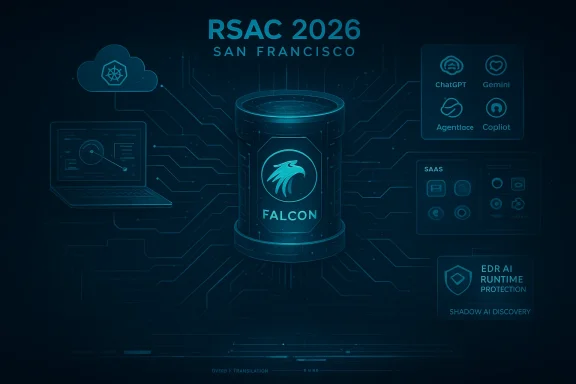
The company is also adding Shadow AI Discovery for Endpoint, which is designed to find AI applications, agents, LLM runtimes, MCP servers, and development tools across devices. In the language of security operations, this is the difference between knowing AI exists somewhere in the environment and knowing exactly where it lives, what it touches, and how far a compromise could spread. CrowdStrike is pairing that visibility with AIDR for Desktop, extending its prompt-layer protection to common desktop AI tools including ChatGPT, Gemini, Claude, DeepSeek, Microsoft Copilot, O365 Copilot, GitHub Copilot, and Cursor.
The broader package also includes Shadow SaaS and AI Agent Discovery for Microsoft Copilot, Salesforce Agentforce, ChatGPT Enterprise, OpenAI Enterprise GPT, and Nexos.ai. That expansion is telling because it recognizes an uncomfortable truth: enterprise AI is already fragmented across vendors and deployment models, which makes policy consistency difficult. CrowdStrike is trying to collapse that fragmentation into one policy and telemetry layer.
From a technical standpoint, the logic is compelling. If an AI agent downloads a file, launches a script, opens a network connection, or accesses local resources, those signals are easier to correlate on the endpoint than in isolated point tools. The challenge is that AI workflows are often distributed across browser sessions, SaaS interfaces, APIs, and cloud workloads, so endpoint telemetry alone may not explain the full chain of custody. CrowdStrike appears aware of that, which is why it is tying endpoint visibility to SaaS and cloud discovery.
This is also where CrowdStrike’s messaging becomes strategically elegant. The company can position Falcon as the platform that sees the full lifecycle: discovery, prompt inspection, runtime enforcement, and incident response. If that vision holds, the endpoint is not just a sensor; it becomes the place where AI policy gets enforced in practice.
That is a useful capability if AI systems are becoming more autonomous. An agent that can read documents, run commands, and make API calls could be perfectly legitimate in one context and dangerous in another. The security question is not simply whether the process exists; it is whether its actions violate policy, exceed permissions, or indicate compromise. That is why runtime traceability matters more than a static inventory.
This also hints at a broader shift in security operations. Analysts are no longer just asking, “What malware ran?” They are asking, “What did the agent try to do, why, and under whose authority?” CrowdStrike is trying to make that question answerable in one platform rather than across several disconnected tools.
By identifying AI apps, agents, LLM runtimes, MCP servers, and development tools, CrowdStrike is trying to give security teams a map of the hidden AI estate. That map is not just about compliance. It helps teams estimate blast radius, determine which systems are exposed, and prioritize controls based on actual deployment rather than policy assumptions.
The emphasis on MCP is also notable. Model Context Protocol has rapidly become an important connector between agents and tools, which makes it a natural place for attackers to abuse trust relationships. CrowdStrike’s focus suggests it sees the protocol not just as an integration standard but as a potential control point. That is a smart read of where the market is heading.
The company’s support for tools like ChatGPT, Gemini, Claude, DeepSeek, Microsoft Copilot, O365 Copilot, GitHub Copilot, and Cursor is especially important because it covers both consumer-style and enterprise-style AI experiences. That breadth suggests CrowdStrike is less concerned with one product category than with the general behavioral pattern of AI-assisted work. If the tool can move data, generate code, or trigger actions, it belongs in the same risk conversation.
This is where enterprise and consumer impact diverge. Consumers mostly care about convenience and local privacy, while enterprises must care about delegated authority, audit trails, and regulatory exposure. CrowdStrike’s product design clearly leans toward the enterprise problem set, even when the underlying tools are widely used by consumers too.
That is a strong acknowledgment that AI security does not stop at the endpoint. In cloud-native environments, malicious activity can spread quickly through ephemeral workloads, automation pipelines, and service accounts. If an AI workload is compromised, defenders need a way to see what it touched, what it accessed, and how it behaved inside the cluster. CrowdStrike is trying to give them that view.
CrowdStrike is also positioning automation as part of the response story, including integration with security orchestration workflows. That suggests the company wants to reduce manual triage and move directly from detection to containment. In a cloud environment, that is not a luxury; it is how you keep small AI incidents from becoming broad service outages.
This is a practical move. Many large enterprises live in mixed environments, and SIEM migration is often slowed by sensor deployment, retraining, and duplicated data costs. CrowdStrike is trying to reduce those barriers by making Falcon less dependent on a complete endpoint rip-and-replace. That could be especially attractive for security teams that already trust Microsoft on the endpoint but want Falcon’s analytics and response layer.
That combination tells a familiar but important story: the company knows buyers do not migrate because a vendor has a better slide deck. They migrate when the new platform is cheaper, easier to operate, and less disruptive to analysts. CrowdStrike is leaning hard into that reality, and it is probably the most commercially grounded part of the RSAC package.
That puts pressure on several fronts. Endpoint rivals will need to explain how they handle AI behavior without full process and device visibility. Cloud security vendors will need to show they can monitor AI workloads without stopping at configuration assessment. SIEM vendors will need to prove they can help customers discover and govern AI systems, not just collect logs about them after the fact. CrowdStrike is intentionally collapsing those category boundaries.
It also helps that CrowdStrike’s own threat report gives urgency to the category. When a vendor can point to active exploitation of AI tools at more than 90 organizations, the market is more likely to treat AI security as budget-worthy. Competitors will have to respond not just with features, but with equally credible evidence that the problem is real and growing.
Another concern is product complexity. AI security is still evolving, standards are in flux, and enterprises are not uniformly mature in how they deploy agents, MCP servers, or AI-connected SaaS tools. A platform that promises too much visibility too early can create implementation headaches, tuning burdens, or alert fatigue if the operational model is not tight enough.
A second thing to watch is whether CrowdStrike can translate its AI security message into measurable operational outcomes: fewer blind spots, faster investigations, lower data-exposure risk, and easier SIEM transitions. That is where the buyer conversation will become more concrete. Security leaders do not buy categories; they buy reduced workload and reduced uncertainty. CrowdStrike seems to understand that, which is why so many of the announcements are tied to runtime, discovery, and migration rather than just branding.
Source: SiliconANGLE CrowdStrike targets AI security gap with Falcon platform expansion at RSAC Conference - SiliconANGLE
 Background
CrowdStrike has been building toward this moment for more than a year. The company spent 2025 reframing Falcon as an agentic security platform, then moved into AI-specific detection and response with Falcon AIDR in December 2025, which was positioned as protection for the prompt and agent interaction layer across development and workforce usage. The latest RSAC announcements extend that idea outward and downward: outward into SaaS and cloud AI usage, and downward into the endpoint where many AI actions ultimately execute.That sequencing matters. CrowdStrike is not merely adding another feature to a crowded product line; it is trying to define the control plane for an AI era in which software agents can read data, invoke tools, and trigger workflows with privileges that look more like a human operator than a traditional application. The company’s own messaging has repeatedly stressed that prompt injection, jailbreaks, and unauthorized tool execution are now operational threats rather than theoretical ones. Its recent public materials describe AI adoption as an expanding attack surface that spans employees, agents, models, MCP servers, and cloud workloads.
The timing also aligns with CrowdStrike’s threat narrative for 2026. In its Global Threat Report, the company said AI-enabled adversaries increased operations by 89% year over year, and that attackers had exploited legitimate GenAI tools at more than 90 organizations by injecting malicious prompts. That kind of data gives CrowdStrike a useful sales wedge: the company can argue that AI security is no longer speculative because the adversary has already moved in. The RSAC launch turns that warning into a product roadmap.
Equally important, the announcement lands in a broader market where security vendors are racing to claim the shadow AI and agentic AI categories. Netskope, for example, has already pushed a One AI Security suite, while CrowdStrike itself has spent months adding AI Discovery and AIDR capabilities. The market is converging on a shared premise: enterprises need visibility into where AI is running, what it can access, and whether its actions can be governed in real time. CrowdStrike’s bet is that its endpoint-first architecture can make that visibility operational, not just descriptive.
What CrowdStrike Announced
The most consequential piece of the RSAC package is EDR AI Runtime Protection. CrowdStrike says it gives defenders runtime visibility into how AI applications and agents behave on a system by tracking commands, scripts, file activity, and network connections. That is a meaningful expansion of classic endpoint detection and response, because it moves the focus from malicious binaries or process trees to the behavior of software entities that may be legitimate but risky in context.The company is also adding Shadow AI Discovery for Endpoint, which is designed to find AI applications, agents, LLM runtimes, MCP servers, and development tools across devices. In the language of security operations, this is the difference between knowing AI exists somewhere in the environment and knowing exactly where it lives, what it touches, and how far a compromise could spread. CrowdStrike is pairing that visibility with AIDR for Desktop, extending its prompt-layer protection to common desktop AI tools including ChatGPT, Gemini, Claude, DeepSeek, Microsoft Copilot, O365 Copilot, GitHub Copilot, and Cursor.
Why this matters
These additions are not just a catalog of features. They reflect a simple thesis: when AI becomes an active participant in business workflows, security can no longer stop at identity or data classification alone. It has to understand runtime behavior, tool use, and implicit trust. CrowdStrike is effectively asking customers to treat AI agents like privileged users with unusual behavior patterns, because that is increasingly what they are.The broader package also includes Shadow SaaS and AI Agent Discovery for Microsoft Copilot, Salesforce Agentforce, ChatGPT Enterprise, OpenAI Enterprise GPT, and Nexos.ai. That expansion is telling because it recognizes an uncomfortable truth: enterprise AI is already fragmented across vendors and deployment models, which makes policy consistency difficult. CrowdStrike is trying to collapse that fragmentation into one policy and telemetry layer.
- Runtime protection targets what AI does, not just what it is.
- Discovery targets hidden adoption and ungoverned deployment.
- Desktop coverage extends security to the tools employees use directly.
- Agent discovery broadens the lens beyond one app or one model.
- Cross-platform support is meant to reduce gaps created by vendor sprawl.
The Endpoint as Control Plane
CrowdStrike’s most opinionated claim is that the endpoint should be the control plane for AI security. The company argues that because many AI actions eventually execute on a device, the endpoint is the best place to observe behavior, enforce policy, and stop malicious activity before it spreads. That is a classic CrowdStrike move: use the endpoint as the central point of truth and then expand outward from there.From a technical standpoint, the logic is compelling. If an AI agent downloads a file, launches a script, opens a network connection, or accesses local resources, those signals are easier to correlate on the endpoint than in isolated point tools. The challenge is that AI workflows are often distributed across browser sessions, SaaS interfaces, APIs, and cloud workloads, so endpoint telemetry alone may not explain the full chain of custody. CrowdStrike appears aware of that, which is why it is tying endpoint visibility to SaaS and cloud discovery.
Runtime signals versus static policy
A traditional security policy can say, this application may not run, or this user may not access that dataset. But AI systems can produce novel outputs, chain tools, and adapt behavior based on prompts. Runtime protection therefore becomes behavioral control, not just allow-listing. That distinction is central to CrowdStrike’s pitch and to the market as a whole.This is also where CrowdStrike’s messaging becomes strategically elegant. The company can position Falcon as the platform that sees the full lifecycle: discovery, prompt inspection, runtime enforcement, and incident response. If that vision holds, the endpoint is not just a sensor; it becomes the place where AI policy gets enforced in practice.
- Endpoint telemetry can reveal script execution and lateral movement.
- Behavioral inspection can catch AI misuse that static controls miss.
- The control-plane model helps unify desktop, cloud, and SaaS response.
- The approach is strongest when paired with identity and data context.
Runtime Protection and Agent Behavior
The new EDR AI Runtime Protection capability is especially important because it addresses a gap many legacy tools leave open. Traditional EDR is strong at identifying suspicious binaries or malicious persistence, but it was never designed to understand whether an AI agent’s chain of actions is appropriate in context. CrowdStrike says it can now trace suspicious behavior back to the originating process and isolate the affected endpoint before activity spreads.That is a useful capability if AI systems are becoming more autonomous. An agent that can read documents, run commands, and make API calls could be perfectly legitimate in one context and dangerous in another. The security question is not simply whether the process exists; it is whether its actions violate policy, exceed permissions, or indicate compromise. That is why runtime traceability matters more than a static inventory.
The prompt-to-process chain
One of the biggest practical problems in AI security is connecting a prompt to a downstream action. If a model is tricked by prompt injection, the malicious instruction may not appear malicious until the model turns it into a command, a file operation, or a network request. CrowdStrike’s runtime framing is designed to make that chain visible, which is exactly where defenders need help.This also hints at a broader shift in security operations. Analysts are no longer just asking, “What malware ran?” They are asking, “What did the agent try to do, why, and under whose authority?” CrowdStrike is trying to make that question answerable in one platform rather than across several disconnected tools.
- Runtime visibility can expose hidden agent misuse.
- Process lineage helps link AI prompts to actions.
- Isolation remains critical when risk turns into active compromise.
- Detection is more useful when it can be translated into response.
Shadow AI Discovery and Governance
The Shadow AI Discovery features matter because they address the governance problem before it becomes a breach problem. Enterprise employees are already using AI tools in ways that IT and security teams may not fully understand, and homegrown AI development is growing just as quickly. CrowdStrike’s message is that you cannot govern what you cannot see.By identifying AI apps, agents, LLM runtimes, MCP servers, and development tools, CrowdStrike is trying to give security teams a map of the hidden AI estate. That map is not just about compliance. It helps teams estimate blast radius, determine which systems are exposed, and prioritize controls based on actual deployment rather than policy assumptions.
Why discovery is the first battleground
Discovery is often the least glamorous part of security, but in AI it may be the most urgent. If teams do not know that a developer has stood up an MCP server, or that a business unit is using an unauthorized desktop assistant, then prompt injection and data leakage controls are only partially effective. CrowdStrike’s discovery tools are meant to close that blind spot.The emphasis on MCP is also notable. Model Context Protocol has rapidly become an important connector between agents and tools, which makes it a natural place for attackers to abuse trust relationships. CrowdStrike’s focus suggests it sees the protocol not just as an integration standard but as a potential control point. That is a smart read of where the market is heading.
- Discovery identifies hidden AI tooling and runtime components.
- Governance depends on visibility into sanctioned and unsanctioned use.
- MCP awareness reflects the rise of tool-connected agents.
- Blast-radius analysis helps prioritize defense investments.
Desktop AI, SaaS, and the Browser Layer
CrowdStrike’s decision to cover desktop AI applications and SaaS-based agent activity shows it understands where modern work actually happens. The browser, the desktop app, and the SaaS console are where users and agents increasingly interact, and that is where prompt injection, data exposure, and unauthorized workflows can take shape. Security that ignores this layer risks being technically correct but operationally irrelevant.The company’s support for tools like ChatGPT, Gemini, Claude, DeepSeek, Microsoft Copilot, O365 Copilot, GitHub Copilot, and Cursor is especially important because it covers both consumer-style and enterprise-style AI experiences. That breadth suggests CrowdStrike is less concerned with one product category than with the general behavioral pattern of AI-assisted work. If the tool can move data, generate code, or trigger actions, it belongs in the same risk conversation.
AI in SaaS workflows
The SaaS announcements, including visibility into Microsoft Copilot, Salesforce Agentforce, ChatGPT Enterprise, OpenAI Enterprise GPT, and Nexos.ai, show that CrowdStrike is also targeting managed enterprise environments where AI is embedded into workflow software. That matters because SaaS deployments often carry implicit trust: once an agent is authorized, it may inherit access to sensitive records, customer data, or internal tickets. CrowdStrike wants to monitor those permissions and data paths continuously.This is where enterprise and consumer impact diverge. Consumers mostly care about convenience and local privacy, while enterprises must care about delegated authority, audit trails, and regulatory exposure. CrowdStrike’s product design clearly leans toward the enterprise problem set, even when the underlying tools are widely used by consumers too.
- Desktop coverage follows the work now being done in AI apps.
- SaaS visibility addresses delegated access and workflow automation.
- Copilot and Agentforce are important because they sit close to business data.
- Consumer-style AI tools can still create enterprise-grade risk.
Cloud, Kubernetes, and AI Data Flow
Cloud security is the other half of the story, because AI systems increasingly run where data, compute, and orchestration already converge. CrowdStrike’s new Shadow AI Discovery for Cloud is aimed at identifying ungoverned AI services, risky LLM connections, and sensitive data exposure across infrastructure and application layers. The company is also introducing AIDR for Cloud and Kubernetes, which brings runtime inspection and enforcement to containerized AI workloads.That is a strong acknowledgment that AI security does not stop at the endpoint. In cloud-native environments, malicious activity can spread quickly through ephemeral workloads, automation pipelines, and service accounts. If an AI workload is compromised, defenders need a way to see what it touched, what it accessed, and how it behaved inside the cluster. CrowdStrike is trying to give them that view.
Data movement is the real asset
The new AI Data Flow Discovery for Cloud may be one of the most important announcements, even if it does not sound flashy. Real-time visibility into how sensitive data moves into and through AI services is a prerequisite for policy enforcement, incident response, and compliance reporting. Without that flow map, teams are guessing where data has gone after an agent or model touches it.CrowdStrike is also positioning automation as part of the response story, including integration with security orchestration workflows. That suggests the company wants to reduce manual triage and move directly from detection to containment. In a cloud environment, that is not a luxury; it is how you keep small AI incidents from becoming broad service outages.
- Cloud discovery helps surface hidden or ungoverned AI services.
- Kubernetes runtime controls address containerized AI workloads.
- Data flow mapping supports both security and compliance.
- Automation shortens the response window in fast-moving environments.
SIEM Migration and Microsoft-Centric Customers
Beyond AI security, CrowdStrike used RSAC to sharpen its Next-Gen SIEM pitch. The most important piece is expanded support for organizations that use Microsoft Defender for Endpoint, allowing Falcon to ingest and correlate Defender telemetry without requiring additional sensors. That lowers friction for Microsoft-centric customers that want to modernize their SOC without immediately standardizing on a single endpoint stack.This is a practical move. Many large enterprises live in mixed environments, and SIEM migration is often slowed by sensor deployment, retraining, and duplicated data costs. CrowdStrike is trying to reduce those barriers by making Falcon less dependent on a complete endpoint rip-and-replace. That could be especially attractive for security teams that already trust Microsoft on the endpoint but want Falcon’s analytics and response layer.
Why migration friction matters
Security vendors often underestimate how much inertia lives in dashboards, search syntax, and analyst habits. CrowdStrike’s new query translation agent, which can convert legacy queries such as Splunk searches into CrowdStrike Query Language, is designed to protect existing workflows during migration. The company is also adding third-party indicator management and native Falcon Onum integration to improve streaming performance and reduce storage overhead.That combination tells a familiar but important story: the company knows buyers do not migrate because a vendor has a better slide deck. They migrate when the new platform is cheaper, easier to operate, and less disruptive to analysts. CrowdStrike is leaning hard into that reality, and it is probably the most commercially grounded part of the RSAC package.
- Defender telemetry support lowers deployment friction.
- Query translation helps preserve analyst productivity.
- Third-party IOC ingestion improves detection enrichment.
- Onum integration addresses data volume and cost concerns.
Competitive Implications
CrowdStrike’s RSAC move is also a competitive land grab. The AI security market is crowded with vendors chasing discovery, governance, and runtime enforcement, but few have CrowdStrike’s combination of endpoint heritage, cloud-native architecture, and SOC platform ambitions. By connecting AI security to Falcon Next-Gen SIEM, CrowdStrike is trying to ensure it owns both the prevention and operations layers.That puts pressure on several fronts. Endpoint rivals will need to explain how they handle AI behavior without full process and device visibility. Cloud security vendors will need to show they can monitor AI workloads without stopping at configuration assessment. SIEM vendors will need to prove they can help customers discover and govern AI systems, not just collect logs about them after the fact. CrowdStrike is intentionally collapsing those category boundaries.
Market positioning
The company’s strongest advantage is narrative coherence. It can tell a story where AI security starts at discovery, continues through prompt and runtime control, and ends in SOC response and migration. That is a more complete story than many point products can offer. Whether buyers believe a single platform should own so much of the stack is another matter, but the pitch is clear.It also helps that CrowdStrike’s own threat report gives urgency to the category. When a vendor can point to active exploitation of AI tools at more than 90 organizations, the market is more likely to treat AI security as budget-worthy. Competitors will have to respond not just with features, but with equally credible evidence that the problem is real and growing.
- CrowdStrike is trying to define the AI security platform category.
- Endpoint, cloud, and SOC buyers are all part of the same sales motion.
- Competitors must prove coverage across runtime, governance, and response.
- Threat intelligence strengthens CrowdStrike’s commercial narrative.
Strengths and Opportunities
CrowdStrike has several advantages here, and they are not just product-level. The company is leveraging a recognizable platform strategy, a strong threat-intelligence narrative, and a timely market shift toward agentic AI governance. If it executes well, this could deepen Falcon’s role as the default control layer for AI-heavy enterprises.- Platform breadth gives CrowdStrike multiple entry points into the same account.
- AI runtime focus meets a real and emerging operational need.
- Endpoint visibility remains a differentiator in behavioral analysis.
- SIEM migration tools can lower adoption friction and accelerate sales.
- Microsoft interoperability may appeal to large hybrid enterprise customers.
- Threat report credibility supports the urgency of the AI security message.
- Cross-domain telemetry can improve detection quality and response speed.
Risks and Concerns
The biggest risk is overreach. CrowdStrike is trying to solve a lot at once: discovery, governance, endpoint runtime, SaaS visibility, cloud inspection, SIEM modernization, and AI workflow protection. That breadth is attractive, but it also raises the familiar platform sprawl concern: customers may question how much of the stack they should consolidate under a single vendor.Another concern is product complexity. AI security is still evolving, standards are in flux, and enterprises are not uniformly mature in how they deploy agents, MCP servers, or AI-connected SaaS tools. A platform that promises too much visibility too early can create implementation headaches, tuning burdens, or alert fatigue if the operational model is not tight enough.
- Category ambiguity could make buyers slow to standardize.
- Implementation complexity may grow as AI estates become more diverse.
- False positives are a risk when monitoring novel AI behaviors.
- Vendor consolidation concerns may limit large-scale replacement deals.
- Protocol churn could outpace policy and detection logic.
- Budget competition remains intense across security and AI infrastructure.
- Proof of efficacy will matter more than feature count.
Looking Ahead
The next test for CrowdStrike is whether customers see these announcements as a coherent operating model or as a fast-moving bundle of adjacent features. If the company can demonstrate that Falcon meaningfully reduces AI risk without slowing adoption, it will have a strong claim to owning the practical layer of AI governance. If not, competitors will frame the market as too dispersed for any single platform to control.A second thing to watch is whether CrowdStrike can translate its AI security message into measurable operational outcomes: fewer blind spots, faster investigations, lower data-exposure risk, and easier SIEM transitions. That is where the buyer conversation will become more concrete. Security leaders do not buy categories; they buy reduced workload and reduced uncertainty. CrowdStrike seems to understand that, which is why so many of the announcements are tied to runtime, discovery, and migration rather than just branding.
- Watch for customer adoption of AIDR for Desktop and Copilot Studio protections.
- Watch for evidence that Shadow AI Discovery finds materially unknown assets.
- Watch for SIEM migration wins tied to query translation and Onum.
- Watch for cloud workload adoption in Kubernetes-heavy environments.
- Watch for competitor responses in endpoint, SSE, and cloud security categories.
Source: SiliconANGLE CrowdStrike targets AI security gap with Falcon platform expansion at RSAC Conference - SiliconANGLE
