
As 2025 winds down, the University of Colorado Anschutz Department of Biomedical Informatics delivered a string of advances that together map a clear trajectory: clinical data, genomics and responsible AI are moving from proof-of-concept into practice-ready tools. This year’s top breakthroughs range from one of the most inclusive human genome assemblies yet to validated instruments that let clinicians and hospitals judge whether AI-generated clinical summaries are safe to use. Each story illustrates a common theme—translation at scale—and shows how multidisciplinary work at CU Anschutz is shaping safer, fairer and more reproducible biomedical science.
The life sciences entered 2025 with two parallel inflections: genome references that better reflect global diversity, and rapid adoption of large language models (LLMs) in clinical workflows. Those inflections collide in practical problems—genetic tests that miss variants found in underrepresented populations, and LLMs that can draft clinical notes quickly but sometimes hallucinate or omit critical facts. CU Anschutz’s 2025 highlights respond to both problems: building inclusive genomic resources, equipping clinicians with validated evaluation tools for AI outputs, and offering reusable software and statistical methods that reduce technical debt in research.
Taken together, these developments reduce three primary translational frictions:
Critical verification: the Nature paper’s abstract and full manuscript confirm the 65-individual / 130-assembly numbers, assembly continuity metrics and the magnitude of structural variation detected. Independent institutional summaries (for example, genomic centers and research portals) echo the claim and detail the DOI and PubMed identifiers tied to the Nature record. Practical implications:
Independent confirmation: the journal article’s validation results (high Cronbach’s alpha and inter-rater agreement across nearly 800 summaries) are reported in the peer-reviewed manuscript and summarized in the University’s press materials. Those independent records corroborate reliability claims and provide the numeric support hospitals need for governance discussions. Operational guidance for clinicians and IT:
What leaders should plan:
Implications:
Operational tips:
Actionable steps:
The path forward is not frictionless: peer-reviewed validation, governance frameworks, and infrastructure planning are essential next steps. For hospitals and research groups, the year’s lessons are concrete: measure rigorously, design for clinicians, and invest in data and software practices that are maintainable. Those who do will find that the tools and standards emerging from 2025 transform one-off research breakthroughs into operational improvements that benefit patients across diverse communities.
Source: CU Anschutz newsroom 2025 in Review: CU Anschutz Breakthroughs Shaping the Future of Health and Science
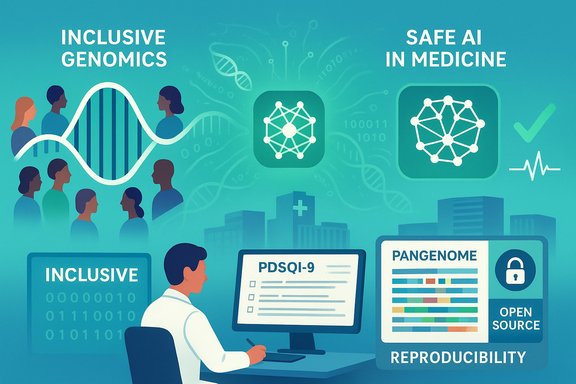 Background: why this cluster of breakthroughs matters now
The life sciences entered 2025 with two parallel inflections: genome references that better reflect global diversity, and rapid adoption of large language models (LLMs) in clinical workflows. Those inflections collide in practical problems—genetic tests that miss variants found in underrepresented populations, and LLMs that can draft clinical notes quickly but sometimes hallucinate or omit critical facts. CU Anschutz’s 2025 highlights respond to both problems: building inclusive genomic resources, equipping clinicians with validated evaluation tools for AI outputs, and offering reusable software and statistical methods that reduce technical debt in research.Taken together, these developments reduce three primary translational frictions:
- Representation gaps in reference datasets that bias diagnosis and research.
- Trust and evaluation deficits that slow safe AI deployment in clinical care.
- Sustainability and reproducibility problems in research software and genetic analyses.
A new, more inclusive human pangenome: 65 people → 130 complete assemblies
One of the year’s most consequential publications assembled genomes from 65 individuals and produced 130 haplotype-resolved assemblies—doubling haplotypes per person—and reached near–telomere-to-telomere continuity for many chromosomes. That pangenome work closed the majority of longstanding assembly gaps and resolved thousands of structural variants previously invisible to short-read analyses. The study’s conclusions: a pangenome built on many diverse genomes substantially improves genotyping accuracy from short reads and unlocks tens of thousands of structural variants per person for downstream disease association. These findings were published in Nature and reported by CU Anschutz. Why this matters: most clinical genetics pipelines still rely on a single linear reference that underrepresents global diversity. A pangenome reference limits false negatives and variant miscalls in populations that were historically under-sampled, improving diagnostic yields and making precision medicine more equitable.Critical verification: the Nature paper’s abstract and full manuscript confirm the 65-individual / 130-assembly numbers, assembly continuity metrics and the magnitude of structural variation detected. Independent institutional summaries (for example, genomic centers and research portals) echo the claim and detail the DOI and PubMed identifiers tied to the Nature record. Practical implications:
- Clinical genetics labs will need to re-benchmark pipelines (alignment, variant calling, annotation) against pangenome-aware tools.
- Hospital IT must plan storage and compute for graph-based references and new genotyping workflows.
- Regulatory and reporting frameworks should anticipate more structural variant findings and their interpretation challenges.
LLMs in clinical practice — validated evaluation with PDSQI‑9
Large language models are now assisting with note drafting, inbox triage and patient messaging. The central barrier to safe use has been evaluation: how do we judge whether an LLM summary is accurate, clear and clinically useful? CU Anschutz researchers led by Yanjun Gao developed and validated the Provider Documentation Summarization Quality Instrument (PDSQI‑9), a nine-item instrument that measures organization, clarity, accuracy and clinical utility for AI-generated clinical summaries. The development and validation appear in a peer-reviewed article describing its psychometric properties and inter-rater reliability, and CU Anschutz issued an accompanying press summary. Why this matters: validated metrics are a prerequisite for clinical deployment of AI summarizers. Hospitals implementing LLM assistants can use PDSQI‑9 to quantify failure modes, measure improvement across models and enforce minimum acceptance thresholds before clinical outputs enter workflows.Independent confirmation: the journal article’s validation results (high Cronbach’s alpha and inter-rater agreement across nearly 800 summaries) are reported in the peer-reviewed manuscript and summarized in the University’s press materials. Those independent records corroborate reliability claims and provide the numeric support hospitals need for governance discussions. Operational guidance for clinicians and IT:
- Pilot LLM summarizers in a non-production environment.
- Use PDSQI‑9 to score outputs across specialties and identify context-specific weaknesses.
- Require a human-in-the-loop approval step for any summary used in clinical decision-making.
- Make quality scores part of procurement contracts with vendors to enforce safety targets.
Cliniciprompt and the practical UX of AI for clinicians
LLMs are powerful but brittle; the right prompt frequently determines clinical utility. CU Anschutz rolled out Cliniciprompt, a clinician-facing prompting framework and toolkit that helps non-technical users craft repeatable, validated prompts and saves successful prompt examples for reuse. CU reports high adoption rates in internal pilots—nurse adoption approximated 90% and physician adoption about 75%—and the tool has been showcased at national informatics meetings. Third‑party analyses and conference coverage described Cliniciprompt as a pragmatic step toward safer LLM use in message triage and decision support. Strengths:- Focuses on human-centered prompt tooling rather than model internals, accelerating clinician uptake.
- Offers retrieval‑augmented generation patterns that reduce hallucination risk by grounding prompts in validated content.
- Adoption figures come from institutional reports and conference coverage; independent peer-reviewed performance benchmarks are still needed.
- Prompting frameworks are helpful but do not substitute for model transparency, audit logs, or governance.
- Integrate Cliniciprompt-style tooling with access-controlled, auditable LLM endpoints.
- Pair prompt automation with PDSQI‑9 evaluation to monitor output quality over time.
New national consensus on the role of critical care pharmacists
CU Anschutz faculty led a national expert panel that produced consensus recommendations to integrate critical care pharmacists (CCPs) into ICU teams. The guidance—endorsed by major organizations such as the Society of Critical Care Medicine and the American Society of Health-System Pharmacists—recommends that every critically ill patient admitted to an ICU should receive care from a CCP and spells out infrastructure, staffing and research priorities. The manuscript reporting these recommendations was published in a peer-reviewed clinical pharmacy journal and summarized by CU Anschutz. Why this is notable: meta-analyses and time-motion studies cited in the recommendations associate pharmacist integration with reduced adverse drug events, lower mortality and shorter ICU stays—effects that translate into hard operational benefits and possible return-on-investment for health systems.What leaders should plan:
- Assess current ICU pharmacist coverage and patient-to-pharmacist ratios; evidence suggests an optimal candidate range to balance workload and burnout risk.
- Budget for weekend/holiday pharmacist coverage—recommendations highlight gaps in continuity as a patient-safety liability.
- Include pharmacists in EHR order‑set stewardship and sepsis/antimicrobial stewardship governance.
NF1 tumor biology: cell imaging + machine learning (press-released discovery)
CU Anschutz announced a study using advanced cellular imaging and machine learning to show that loss of the NF1 gene produces structural changes in nerve-supporting cells that promote tumor growth in Neurofibromatosis type 1 (NF1). CU’s summary frames this as a mechanistic mapping that could enable diagnostics and drug discovery. The CU newsroom provides the details, but a corresponding peer-reviewed publication could not be unambiguously located in major databases at the time of reporting. Because the primary paper was not found in public repositories while preparing this review, the claim should be treated as institutionally reported and promising—but pending verification in a peer-reviewed manuscript. Cautionary note: institutional press releases are essential for rapid communication, but translational claims should be cross-checked against the peer-reviewed record before policy or clinical investments. Until the methods, cohort sizes and ML validation metrics are available in a full manuscript, plan any operational changes cautiously.Asthma genetics in African-ancestry populations: 17 implicated genes
An international study led by CU Anschutz used transcriptome-wide association methods and expression-prediction models trained in African-ancestry cohorts to identify 17 genes associated with asthma risk. The team developed models for nasal epithelium and CD4+ T cells and made resources publicly available, expanding tissue- and ancestry-matched prediction tools. CU’s report frames this as the largest African-ancestry asthma TWAS to date and highlights the importance of matched-ancestry models for accurate inference. Verification: the CU newsroom describes the TWAS, the sample sizes (>9,000 African-ancestry individuals) and the public release of expression models. Those materials provide practical resources researchers can deploy immediately. Independent confirmation from the journal of record (Journal of Allergy and Clinical Immunology or equivalent) should be consulted when interpreting clinical translation claims.Implications:
- Researchers performing cross-ancestry GWAS/TWAS should use ancestry-matched expression models to reduce bias.
- Clinical genetics reporting for asthma risk must be reassessed as tissue-specific regulatory associations are clarified.
Summix2: ancestry-aware tools for summary-level genetic data
CU and collaborators released Summix2, an open-source suite that estimates and adjusts for substructure in genetic summary allele frequency data. Summix2 can estimate reference-group proportions and produce ancestry-adjusted allele frequencies from summary statistics—practical when individual-level data are unavailable. It’s packaged for R/Bioconductor and is actively maintained; the Bioconductor documentation and R manual corroborate functions like summix, adjAF and summix_local. Why this matters: many large consortia and public allele-frequency resources publish summary-level data. Being able to adjust those data for complex ancestry mixtures speeds downstream analyses and reduces bias introduced by mismatched reference populations.Operational tips:
- Use Summix2 to reweight summary statistics before meta-analysis when constituent cohorts have differing ancestries.
- Maintain transparency: report the reference panels used and sensitivity analyses showing the effect of ancestry adjustment.
Software Gardening Almanack: reproducible software checks for research code
Sustainable research software is a silent prerequisite for reproducibility. CU Anschutz engineer Dave Bunten developed the open-source Software Gardening Almanack: a handbook plus a Python package called almanack that performs repository checks, extracts sustainability metrics and supports pre-commit hooks. The project’s website and PyPI listing document the package, its CLI, and example notebooks for analyzing repositories. Why this matters: reproducible pipelines and maintained codebases reduce technical debt and make method replication feasible across labs. The Almanack helps research groups operationalize best practices—documentation, versioning, linting—through automated checks that can be integrated into CI/CD.Actionable steps:
- Add almanack checks to CI pipelines in research repositories.
- Use the Seed Bank notebooks to onboard new team members and standardize repository structure.
- Report Almanack metrics in methods supplements to show software quality.
CU’s first AI conference: practical ethics, bias and clinician-centered deployment
CU Anschutz hosted a major AI conference focused on how to integrate LLMs and multimodal AI into research and care responsibly. Sessions emphasized human-in-the-loop designs, uncertainty estimation, bias auditing, and tools like Cliniciprompt that make LLMs accessible to non-technical users. The conference also highlighted translational projects—AI scribes, retrieval-augmented summarization, and clinician-facing prompt toolkits—that have near-term operational value. CU’s coverage and ancillary reporting summarize the conference themes and practical recommendations for hospitals and vendors. Key takeaways for leaders:- Prioritize governance: model logs, version control, and documented human verification policies.
- Measure outcomes: track time saved, error rates, and any safety incidents attributable to AI assistance.
- Invest in clinician training and change management; adoption depends on perceived reliability and clear workflows.
Open science leadership: Peter DeWitt joins Scientific Data editorial board
CU Anschutz’s Peter DeWitt was appointed to the editorial board of Scientific Data, a Nature portfolio journal focused on FAIR data practices and reusable dataset descriptors. The journal’s public editorial-board listing confirms DeWitt’s membership, and CU’s announcement underscores institutional emphasis on open, reproducible science. This appointment strengthens CU Anschutz’s profile in data standards and curation—areas that underpin trustworthy AI and genomics. Why this is strategically important: institutional leadership on data standards accelerates community adoption of practices—standardized metadata, provenance, and machine-actionable data descriptors—that make downstream reuse and AI applications safer and more reliable.Critical analysis — strengths, risks and what to watch
Strengths- Breadth and balance: CU Anschutz delivered advances across infrastructure (pangenome), evaluation (PDSQI‑9), tooling (Cliniciprompt, Summix2, Almanack) and standards (editorial leadership, pharmacist guidelines). That mix supports both discovery and clinical translation.
- Emphasis on representativeness and fairness: genetic studies and ancestry‑aware tools directly confront historical biases in reference data.
- Pragmatic deployment focus: validated instruments and clinician-facing tooling (Cliniciprompt, almanack checks) reduce the gap between research demos and operational use.
- Publication lag and dependence on press releases: several stories were primarily communicated via institutional releases; peer-reviewed methods, sample sizes and full validation details are still forthcoming in some cases (notably the NF1 imaging/ML study). Treat those claims as promising until underlying manuscripts are available.
- Governance and scale: hospital deployments of LLM-based summarizers demand strong governance—PDSQI‑9 gives a tool to measure quality, but governance must mandate thresholds, logging and incident reporting.
- Infrastructure burden: pangenome adoption and new analytic methods will increase computational and storage demands; health systems need a roadmap to provision graph-aware genomic pipelines.
- Clinical validation studies showing net patient benefit (not just time savings) from LLM summarization workflows.
- Standards bodies or regulatory guidance referencing validated instruments (like PDSQI‑9) in procurement and approval processes.
- Consolidation of pangenome tools into diagnostic-grade pipelines and commercial clinical-lab solutions.
- Uptake of Summix2 and similar ancestry-aware tools in major consortia meta-analyses.
Practical checklist for research and clinical leaders
- Governance: mandate human-in-the-loop verification and logging for any LLM output used in care.
- Evaluation: adopt PDSQI‑9 or equivalent validated instruments during pilots and procurements.
- Equity: require ancestry-aware validation for genetic risk models; adopt Summix2 for summary-level adjustments when appropriate.
- Sustainability: integrate the Software Gardening Almanack checks into CI and pre-commit hooks to reduce technical debt.
- Workforce: budget for critical care pharmacist coverage in ICUs per the new consensus recommendations.
- Verification: treat press-release discoveries as provisional until peer-reviewed manuscripts are examined—especially when those findings would change clinical pathways.
Conclusion
CU Anschutz’s 2025 portfolio illustrates how focused investment in data, methods and human-centered tools accelerates safe translation. The pangenome work, PDSQI‑9 validation, clinician prompt tooling, and ancestry-aware statistical packages combine to reduce bias and raise the bar on safety and reproducibility. At the same time, institutional leadership—editorial roles, consensus clinical guidelines, and software-handbook releases—helps align incentives for open, reliable science.The path forward is not frictionless: peer-reviewed validation, governance frameworks, and infrastructure planning are essential next steps. For hospitals and research groups, the year’s lessons are concrete: measure rigorously, design for clinicians, and invest in data and software practices that are maintainable. Those who do will find that the tools and standards emerging from 2025 transform one-off research breakthroughs into operational improvements that benefit patients across diverse communities.
Source: CU Anschutz newsroom 2025 in Review: CU Anschutz Breakthroughs Shaping the Future of Health and Science
