

OpenPrinting’s CUPS received a security update on November 27–29, 2025 after a stack-based out‑of‑bounds write (CWE‑124 / CWE‑129) was found in the cupsd configuration parser that lets a local lpadmin user inject a malicious IPv6 fragment into cupsd.conf through the web UI — an input‑validation failure that can crash cupsd, and under some conditions may be leveraged toward privilege escalation or code execution. The defect is fixed in CUPS 2.4.15; administrators should treat this as a patch‑now item for any system where untrusted or semi‑trusted users can reach the CUPS web interface.
CUPS (Common UNIX Printing System), maintained by the OpenPrinting project, is the standard printing subsystem on most Linux distributions and many Unix‑like systems. cupsd (the CUPS daemon) runs with elevated privileges and exposes a web administration UI that, by design, can be used to change printing configuration. The vulnerability tracked as CVE‑2025‑61915 arises when the web UI accepts a crafted IPv6 address in a configuration directive such that the parser’s internal index arithmetic becomes negative and leads to writes outside the intended stack buffer. The faulty logic is in get_addr_and_mask and the scheduler/conf.c parsing path; the upstream advisory documents both the root cause and a proof‑of‑concept demonstrating deterministic impact while running cupsd under sanitizer builds. Why this matters operationally:
Allow from [::2:3:6:9:c:::::::::::::4::::::::::::::::::::::3]
which demonstrates how ipval and i can be controlled.
Source: MSRC Security Update Guide - Microsoft Security Response Center
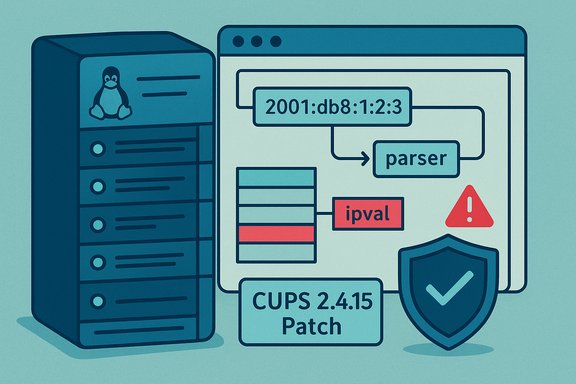 Background / Overview
CUPS (Common UNIX Printing System), maintained by the OpenPrinting project, is the standard printing subsystem on most Linux distributions and many Unix‑like systems. cupsd (the CUPS daemon) runs with elevated privileges and exposes a web administration UI that, by design, can be used to change printing configuration. The vulnerability tracked as CVE‑2025‑61915 arises when the web UI accepts a crafted IPv6 address in a configuration directive such that the parser’s internal index arithmetic becomes negative and leads to writes outside the intended stack buffer. The faulty logic is in get_addr_and_mask and the scheduler/conf.c parsing path; the upstream advisory documents both the root cause and a proof‑of‑concept demonstrating deterministic impact while running cupsd under sanitizer builds. Why this matters operationally:- cupsd runs as root on most systems; a parsing bug in a privileged daemon magnifies risk compared with userland utilities.
- The vector is local — an attacker needs to be able to reach the CUPS web UI and hold the lpadmin group membership or equivalent privileges — but that is a common administration model in many environments.
- The primary immediate consequence is availability (crash / DoS); depending on deployment and configuration management, the bug could be combined with other weaknesses to achieve privilege escalation or remote code execution in some setups. Upstream and downstream advisories list both DoS and potential RCE as realistic outcomes in worst‑case configurations.
Technical anatomy — what the bug is and how it happens
Where the error occurs
The vulnerable code path parses IPv6 textual addresses included in configuration fragments passed through cupsd’s web UI and the server’s configuration updater. The function get_addr_and_mask reads colon‑separated IPv6 segments and accumulates values into a local array; because the parser allowed an arbitrary number of “:” separators and did not bound the index variable before using it as an array subscript, an attacker can force a negative or otherwise out‑of‑range index and then apply ipval writes to ip[i/2] or ip[i/2] |= ipval << 16. Those writes can write before the buffer start on the stack and corrupt adjacent memory. The GitHub advisory reproducer explains the manipulation specifics and provides a PoC using an address such as:Allow from [::2:3:6:9:c:::::::::::::4::::::::::::::::::::::3]
which demonstrates how ipval and i can be controlled.
Consequences of a stack out‑of‑bounds write
A stack out‑of‑bounds write can result in multiple outcomes depending on the exact memory layout and runtime defenses:- Immediate crash (SIGSEGV or sanitizer failure) — the most predictable operational impact (denial of service).
- Corruption of stack‑allocated data (saved registers, return addresses, local variables) — on less hardened systems or with a favorable memory layout, this may allow control‑flow hijack and escalation to code execution.
- Unstable behavior, corrupted configuration, or manipulated privileges inside cupsd that might be used to further escalate or persist an attack.
OpenPrinting’s advisory and the upstream commit label the impact as DoS and potential privilege escalation / RCE in scenarios where cupsd.conf can be controlled remotely or where the environment lacks standard mitigations. Treat the escalation path as plausible but environment‑dependent — modern kernels and toolchains with ASLR, stack canaries, and hardened compilers complicate deterministic exploitation.
Exploitability and attack model
- Attack vector: Local (the web UI or other admin interfaces that accept config edits). CVSS vectors published in community trackers classify this as AV:L (local) with low attack complexity but high privilege required (lpadmin).
- Preconditions: Attacker must be in lpadmin group (or otherwise able to submit a config change through the web UI) or able to trick an lpadmin user into performing the change.
- Delivery: Malicious IPv6 address or crafted configuration line inserted through the cups web UI or via any mechanism that writes cupsd.conf under the cupsd process.
- Outcome: Guaranteed availability impact (crash) and environment‑dependent possibility of privilege escalation or RCE if other conditions permit execution after memory corruption. Upstream PoC (sanitizer‑based) confirms written‑out memory can be controlled and reproducer steps have been published.
Verified facts and cross‑checks
Key claims and corroboration:- Fix availability: OpenPrinting released CUPS v2.4.15 which includes the upstream patch addressing the bug. The fix commit and the release tag are published on the OpenPrinting GitHub project.
- NVD / CVE record: The CVE entry CVE‑2025‑61915 has been added to the NVD and public CVE databases; at initial publication NVD had not yet enriched full CVSS vectors but community trackers show CVSS v3.1 = 6.0 (AV:L/AC:L/PR:H/UI:N/S:C/C:N/I:N/A:H). Cross‑checks with OpenCVE, cvefeed and other aggregators confirm the same description and scoring.
- Distribution advisories and patches: Major Linux distributors published advisories and built packages that include the fixation. Ubuntu posted USN‑7897‑1 and lists fixed package versions for supported releases; Debian’s security tracker maps the vulnerability to package versions and marks stable/unstable status with the fixed version being 2.4.15‑1 in unstable. These distribution notices are primary signals that the patch has been packaged and distribution upgrades should be applied.
- The GitHub advisory includes a step‑by‑step PoC and exact code excerpt showing how a malformed IPv6 address manipulates the index and ipval variables and writes out of bounds. That advisory is the canonical technical reference for root‑cause analysis.
- Public advisories note the possibility of RCE "in some configurations" but there is no broad public telemetry showing reliable, in‑the‑wild RCE exploitation at scale when the CVE was published. Treat escalation claims as plausible only when additional enabling conditions exist (e.g., cupsd.conf editable remotely without authentication, or other local misconfigurations); mark those as environment‑dependent and verify in‑place mitigations before assuming RCE is trivial.
Impact assessment — who should care and why
High‑priority targets:- Multi‑tenant servers and shared hosts where lpadmin membership is not tightly controlled — a single malicious or compromised local account could crash or manipulate a shared printing service and, by extension, affect system availability for many users.
- Systems that expose the CUPS web UI to untrusted networks or where the web UI is reachable from less‑trusted segments — remote reachability turns a local bug into a far more operationally urgent problem. Distribution advisories and security trackers emphasize blocking web UI access from untrusted networks as a compensating control.
- Environments with lax privilege separation on admin accounts, automated configuration agents that accept remote inputs, or where cupsd.conf can be updated by orchestration systems without adequate validation.
- Single‑user desktops where lpadmin membership is limited to known admins and there is little external exposure; these still require patching but may be lower in triage order compared to multi‑tenant or server contexts.
- Community aggregators and OpenCVE reflect a CVSS v3.1 base score near 6.0 (Medium) driven by local attack vector, high privileges required, low attack complexity, and high availability impact. This aligns with the practical model: a local, privileged user can reliably cause a crash; escalation to code execution is possible but not guaranteed.
Immediate mitigation and remediation (24–72 hour playbook)
- Patch immediately where feasible
- Apply the vendor/distribution packages that include CUPS 2.4.15 (or the distro backport containing the upstream commit). Confirm the package version after upgrade.
- Example (Debian/Ubuntu): apt update && apt install --only-upgrade cups cups-daemon (then reboot or restart cupsd as required). Verify package version against the distribution advisory.
- If you cannot patch immediately, apply hardening compensations
- Restrict who can access the CUPS web UI:
- Bind the web UI to localhost (127.0.0.1 / ::1) or firewall the port (default 631) so only trusted admin hosts can reach it.
- Disable remote configuration via the web UI if not required.
- Remove or tightly control lpadmin membership:
- Audit /etc/group and any automation that grants lpadmin rights; remove nonessential accounts from lpadmin.
- Enforce application confinement:
- Use AppArmor/SELinux profiles to constrain cupsd where possible so that a compromised daemon has limited ability to execute arbitrary programs or modify system state.
- Monitor logs and restart policies:
- Ensure cupsd is restarted from a controlled supervisor (systemd) and that crash loops are reported to monitoring systems; configure core dumping policies so crashes do not reveal sensitive information.
- Verify remediation
- After applying updates, validate the cupsd binary and service are the expected versions and that the vulnerable parsing path is no longer present (package changelog or git log should reference the upstream commit). OpenPrinting’s commit db8d560262c22a21ee1e55dfd62fa98d9359bcb0 and release v2.4.15 are the canonical markers.
- Audit and compensation for automated systems
- If you have automated configuration management that pushes cupsd.conf changes, add sanitization and validation steps to prevent malformed IPv6 fragments from being inserted, or temporarily restrict who or what can push changes until the patch is applied.
Detection and monitoring guidance
- Crash and service‑availability indicators:
- Journalctl / systemd logs referencing cupsd crashes or abnormal exits; look for repeated restarts or core dump entries for cupsd.
- Increased crash/restart counts in monitoring dashboards for printing or system services.
- Audit changes to cupsd.conf:
- Monitor filesystem events on /etc/cups/cupsd.conf and the CUPS configuration directories for unexpected modifications (inotify, auditd rules).
- Log and alert on any np‑admin user or non‑standard account that adds or edits configuration remotely.
- Web UI activity:
- Check web server access logs for POSTs/PUTs to admin endpoints and anomalous payloads with repeated colon sequences or very long address fragments.
- Forensic indicators:
- If exploitation is suspected, preserve core dumps, cupsd logs, journalctl output and the exact cups configuration files. These will contain the strings and addresses used in the malicious config and are necessary for incident analysis.
Long‑term mitigation and policy changes
- Minimize administrative privileges: make lpadmin membership an explicit, auditable role and avoid granting it to scripts or service accounts that accept external input.
- Harden admin interfaces: always place service admin interfaces behind VPNs, management networks or jump hosts; do not expose CUPS web UI to public or untrusted networks.
- Test configuration sanitizers: add unit tests or CI gates that validate configuration formats and reject configuration fragments containing invalid IPv6 strings or excessive separators.
- Maintain a patch policy for third‑party open‑source infrastructure components: ensure scheduling and automation for timely package upgrades and distribution of critical upstream fixes.
Timeline and upstream response
- Vulnerability disclosure and advisory: OpenPrinting published an advisory and a fix as part of the v2.4.15 release; the security advisory GHSA‑hxm8‑vfpq‑jrfc documents the bug, reproducer steps and PoC.
- Distribution packaging: Ubuntu issued USN‑7897‑1 and rolled fixes into supported releases; Debian’s tracker lists the package state and maps the fixed version to 2.4.15‑1 in unstable. Administrators should follow their distro advisories for exact package names and backport IDs.
Risk analysis — strengths and weaknesses of the response
What was done well- OpenPrinting issued a focused, surgical fix and published the commit and a release tag so downstream distributions could package and test the change quickly. The GitHub advisory includes a clear technical explanation and a PoC that aids defenders in reproducing the condition in safe test environments.
- Major distributions (Ubuntu, Debian) mapped the CVE into their security trackers and provided package updates, enabling operators to employ standard patch management pipelines.
- Local vector bias: The CVE is scored as local with high privileges required, which can lead some teams to deprioritize patching; that’s risky in shared or multi‑tenant environments where local access may already be reachable by many users or automated services.
- Long tail in embedded and vendor kernels: Systems with vendor‑supplied images or embedded appliances that include CUPS may lag distro patches — these devices will remain exposed unless vendors push updates or administrators rebuild images.
- Potential for chaining: Although the immediate impact is DoS and the RCE path is environment‑dependent, adversaries with local access can chain this bug with other primitives. Treat the presence of a memory corruption in a privileged daemon as high operational risk.
Practical checklist for sysadmins (quick actions)
- Inventory
- Identify hosts running cupsd and record versions: rpm -qa | grep cups or dpkg -l | grep cups; systemctl status cups.
- Patch
- Apply vendor/distro updates that include CUPS 2.4.15 or equivalent backport, then restart/reboot as required. Confirm package change logs reference the upstream commit.
- Lockdown
- Restrict access to CUPS web UI (bind to localhost or firewall port 631).
- Restrict lpadmin membership; remove non‑admins.
- Monitor
- Add alerts for cupsd crashes, unexpected restarts and changes to cupsd.conf.
- Harden
- Implement AppArmor/SELinux confinement for cupsd where feasible.
- Incident readiness
- If an exploit is suspected, preserve logs, core dumps and the malicious cups configuration and isolate the host for forensic analysis.
Conclusion
CVE‑2025‑61915 is a classic example of how parsing errors in privileged daemons present outsized operational risk. The bug allows an lpadmin user to craft IPv6 fragments that force a stack out‑of‑bounds write in cupsd; while the immediate, verifiable impact is a denial‑of‑service (service crash), the presence of a stack corruption in a root‑context daemon makes it a candidate for privilege escalation or RCE in poorly hardened environments. OpenPrinting has released version 2.4.15 to address the issue and major distributions have packaged the fix; administrators should update promptly, restrict access to CUPS administration features, and audit lpadmin privileges to close the practical attack paths. Acknowledgement: The fix, advisory and reproducer are published in OpenPrinting’s security advisory and commit history; distribution advisories from Ubuntu and Debian provide packaged updates and specific version mappings for common deployments.Source: MSRC Security Update Guide - Microsoft Security Response Center
