

Enterprise IT budgets have long treated SAP as both backbone and brake: indispensable for large-scale operations, yet an increasingly heavy and recurring line item that chews into innovation funding. Recent conversations among CIOs and finance leaders describe SAP’s licensing and maintenance model as an “enterprise tax” — a predictable, persistent cost that rarely declines and often grows as systems expand. At the same time, the rise of low-code platforms — led by Microsoft Power Platform — is changing the equation: by enabling rapid, compliant extensions to SAP without multiplying SAP license counts, Power Platform can materially reduce cost-per-user and the total cost of ownership for many routine business applications.
SAP’s dominance in enterprise resource planning is near-universal among the largest companies: the platform underpins critical financials, supply chain, manufacturing, and core transactional processes across industries. That scale, however, comes with an equally large and sometimes opaque pricing and compliance model.
Yet, the path has pitfalls. Indirect access litigation and audit risk remain the existential concerns; a single misclassified integration or unmonitored automation could trigger a retroactive liability. Hidden consumption costs for AI features, data storage, and compute must be actively managed. And governance failures will quickly erode the initial licensing savings.
The pragmatic conclusion: Power Platform is a powerful lever to meaningfully reduce SAP licensing and maintenance burdens, but it must be applied with legal, architectural, and financial rigor.
When pursued with a disciplined program — rightsizing audits, supported integration fabrics, a CoE for governance, and tight consumption monitoring — intelligent automation using Microsoft Power Platform can tilt the cost‑to‑value equation decisively in favor of innovation. The payoff is not only lower software bills but faster time to value, higher user satisfaction, and a freed innovation budget that can be reinvested in strategic modernization rather than merely keeping the lights on.
(Important verification notes: SAP’s annual maintenance percentages (commonly reported around 19–22%) are widely cited in industry audit and advisory sources; the Diageo indirect‑access damages figure has been reported in legal and trade coverage as approximately £54.5M; Microsoft reports roughly 48 million monthly active Power Platform users in recent financial disclosures; Forrester’s TEI study for Power Apps reports a 206% three‑year ROI with payback under six months. These claims were cross‑checked against independent analyst and vendor reports to ensure accuracy. Where vendor‑claimed percentage improvements were cited in customer stories, those are noted as vendor or customer‑reported outcomes and should be validated for budgeting purposes.
Source: nerdbot Lower Your SAP Licensing Costs with Intelligent Power Platform Automation
 Background
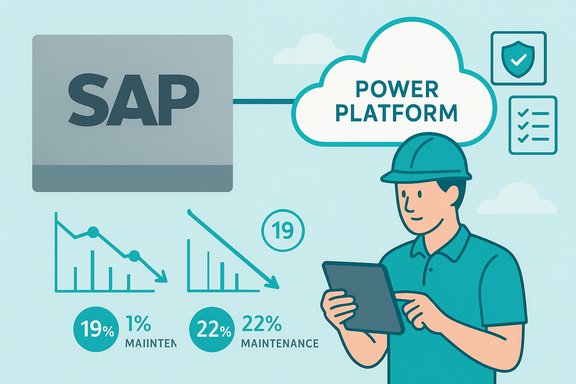
SAP’s dominance in enterprise resource planning is near-universal among the largest companies: the platform underpins critical financials, supply chain, manufacturing, and core transactional processes across industries. That scale, however, comes with an equally large and sometimes opaque pricing and compliance model.- Annual maintenance (support) fees are routinely calculated as a percent of the license value and often fall in the high teens to low twenties percent range (commonly reported around 19–22%).
- Indirect access — when third-party systems or portals read or write to SAP-contained data — has produced unpredictable and substantial additional fees in high-profile cases where license structures didn’t match modern integration patterns. The Diageo–SAP litigation over Salesforce integration famously quantified those risks in the tens of millions of pounds.
- Migration economics to SAP S/4HANA and cloud subscription models (for example, RISE with SAP) have not been a universal cure for cost concerns: negotiations, contract terms, and renewal escalators still create uncertainty and, in some renewals, double-digit percentage increases unless contracts are carefully structured. Analyst commentary indicates many customers remain on legacy ECC for financial reasons, with a large share planning slower or phased migrations.
Overview: Why Power Platform Matters for SAP Cost Optimization
Microsoft’s Power Platform is not a single product but a family of tools — Power Apps, Power Automate, Power BI, Power Virtual Agents, plus newer capabilities (Copilot, Fabric, Syntex) — that accelerate application delivery and automation with low-code approaches. The platform’s reach and metrics are large and growing: Microsoft reports tens of millions of monthly active users across Power Platform, and independent trackers show steep year-over-year growth. Microsoft itself disclosed roughly 48 million monthly active Power Platform users in its 2024 disclosures. For enterprise architects, the attraction is clear and multifaceted:- Lower per-user licensing cost: Entry-level Power Apps per-user prices measured in tens of dollars per month are orders of magnitude lower than typical SAP “professional” named-user license costs, which for many modules and contracts have enterprise-scale price points in the thousands per year. This creates a practical path to extending SAP workflow to large populations (field workers, frontline staff, occasional users) without buying SAP Professional seats for every user.
- Faster time-to-solution: Low-code development reduces delivery cycles dramatically. For many forms, approvals, and workflow automations that previously required months of SAP ABAP development or heavyweight integration projects, Power Platform implementations can deliver usable solutions in days or weeks.
- Governed citizen development: When paired with governance and a Center of Excellence (CoE), low-code empowers business experts to build and own solutions — reducing IT backlog while maintaining security and ALM discipline. This combination scales productivity without proportionally increasing SAP license counts or custom SAP code maintenance burdens. Independent enterprise forums and vendor case studies highlight governance patterns and rapid ROI as repeatable outcomes.
The Economics: Where the Savings Come From
Breaking down the cost drivers makes the case for an intelligent Power Platform-first strategy clearer.1. Cut the recurring “maintenance tax”
SAP’s annual maintenance bill is typically calculated as a percentage of the license value and can approach or exceed 20% per year. Over a typical five-year cycle this recurring fee becomes a substantial portion of total spend — effectively a compound recurring tax unless the organization reduces license counts or renegotiates terms. Independent analyses and SAP-audit guidance commonly quote the 19–22% range for standard vs. enterprise support tiers.- Practical levers: retire unused modules, downgrade mis‑classified users, and shift non‑transactional users to cheaper access methods or to Power Apps front‑ends that consume SAP data but avoid adding named SAP users.
2. Avoid unnecessary “professional” seats
Large organisations frequently discover over‑licensing: users counted as “professional” when they only need occasional, read‑only, or targeted interactions. For example, downgrading or reclassifying user types after a rightsizing audit can save six‑figure sums in enterprises with hundreds of SAP seats.- Practical levers: conduct regular license entitlement audits, integrate usage telemetry in governance, and replace heavy SAP GUI workflows for occasional users with Power Apps or Power Automate flows that preserve compliance while eliminating priced SAP seats.
3. Mitigate the indirect access risk
Indirect access — when external systems or user interfaces interact with SAP data — is the most legally and financially treacherous area. The Diageo ruling demonstrated the exposure: unpaid license/maintenance claims were quantified in the tens of millions because Salesforce integrations produced what the court found to be indirect use.- Practical levers: design integrations using supported SAP connectors, adhere to SAP’s digital access guidance, and where possible methodically control data flows so that high‑volume or high‑risk access uses a small, auditable set of licensed technical users or API‑based consumption models. Re‑architecting integrations using Power Platform with official SAP connectors and carefully designed data planes (Dataverse, filtered APIs) offers a compliant way to provide functionality without spawning new named SAP users.
4. Replace shelfware and small-point solutions
Many enterprises carry dozens of small point solutions — forms, approvals, reports — each with its own maintenance and license cost. Consolidating these into a managed Power Platform portfolio reduces third-party subscription and maintenance fragmentation.- Practical levers: migrate small SaaS apps and Excel-based processes into Power Apps and Power BI reports; centralize automation in Power Automate; and retire redundant tools.
5. Demonstrable ROI from productivity gains
Independent economic studies show rapid payback and strong ROI for Power Platform adoption. Forrester’s Total Economic Impact study of Power Apps found a representative composite organization realized 206% ROI over three years and payback in under six months — driven by faster development, automation of manual work, and reduction in third-party tool sprawl. Microsoft’s own marketing and case studies echo those findings in customer stories.Real-World Proof Points
Several enterprise examples illustrate how the combination of SAP and Power Platform plays out in practice:- Professional services and global compliance use-cases implemented via Power Automate have cut processing times dramatically while avoiding additional SAP seats. Many partner case studies report 50–90% reductions in manual processing for document-based workflows.
- Large consumer goods and manufacturing firms have used Power Apps as front‑end layers over SAP data for high‑volume but low‑complexity interactions (e.g., plant‑floor entry, asset checks, field sales), replacing potential SAP named user growth with inexpensive Power Platform licenses and Dataverse storage. Independent community documentation and practitioner threads show these are repeatable patterns when governance is in place.
- Global consultancies and audit practices emphasize a dual track: keep SAP for mission‑critical core transactionality, and use Power Platform for peripheral processes and worker‑facing apps that scale user counts without bloating SAP license metrics. This pattern reduces shelfware and the recurring maintenance base while delivering a cleaner TCO profile.
Implementation Patterns: How to Do This Right
Using Power Platform to lower SAP licensing costs requires deliberate architecture, governance, and operational recipes. The following patterns and steps reflect what works across multiple enterprises.Step 1 — Inventory and Rightsize (Audit)
- Run a complete inventory of SAP license types, assigned users, modules, and actual usage telemetry.
- Identify candidates for reclassification (e.g., professional → functional, occasional → task user).
- Flag idle or redundant licenses for cancellation and removal before renewal windows.
Step 2 — Prioritize the Low-Risk, High-ROI Workloads
- Target forms, approvals, field workflows, and dashboards that consume SAP data without requiring full SAP transactions.
- Prioritize use cases where the user experience is a thin client over SAP, and where API‑level integration or Dataverse staging is sufficient.
Step 3 — Build a Secure Integration Fabric
- Use supported SAP connectors for Power Platform or official SAP‑provided APIs to ensure requests are auditable and maintain compliance with contract definitions of “access.” Avoid brittle screen‑scraping or ungoverned RPA paths that could be classified as indirect access.
- Centralize heavy writes under a few technical users or service principals where contractually required, and log all activity for traceability.
Step 4 — Create a Power Platform CoE and ALM Pipeline
- Establish a CoE (Center of Excellence) with guardrails: environment strategy, Dataverse canonical schema, ALM flows, approved connectors, and monitoring for flows and apps.
- Instrument flows and apps for usage and cost telemetry — treat Power Platform assets as first‑class IT products.
Step 5 — Run Pilots, Measure, Scale
- Use tight pilot scopes and track KPIs: licensing delta, development hours saved, time-to-deploy, error reduction, and user satisfaction.
- Scale the framework by templating connectors, data models, and reusable components.
Risks, Limitations, and Governance Imperatives
Power Platform is a powerful lever, but it isn’t a magic bullet. Several risks and operational challenges deserve explicit attention.- Indirect access and contractual risk: Replacing SAP GUI interactions with Power Apps that query SAP data does not inherently avoid indirect access claims unless the integration approach aligns with the licensing contract and SAP’s digital access framework. Legal review and a conservative architecture approach are essential. The Diageo case is an instructive warning: courts may find indirect usage based on how integrations operate, and damages can be material.
- Governance and shadow IT: Low-code accelerates delivery, but without a CoE and deployment guards activities proliferate into unmanaged, unsupported apps that create security, compliance, and data quality headaches. Enforce approval gates and runtime monitoring.
- Hidden costs of scale: While per-user Power Platform licenses are low, large-scale automation can increase Azure or Copilot consumption, data egress, storage, and compute costs. Pilot cost‑tracking for AI or heavy data scenarios is mandatory. Vendor metering and consumption models (e.g., Copilot credits) can create surprises if unmonitored.
- Data governance and master data: Many automation failures stem from inconsistent master data rather than tool limitations. Investments in canonical data models, MDM, and retrieval fabrics pay off quickly when scaling automations.
- Vendor and lock‑in considerations: Heavy reliance on Microsoft connectors, Dataverse, and Copilot agents increases platform dependency. Design for portability where possible (clean API boundaries, documented data schemas).
Commercial and Contractual Playbook for CIOs
To capture savings while avoiding compliance regression, CIOs should apply a disciplined contract and financial playbook.- Cap renewal escalators: Negotiate caps on annual maintenance increases and explicitly tie escalation formulas to defined indices where possible. Analyst reports show renewal spikes where caps were not negotiated.
- Use third‑party maintenance strategically: Where appropriate, third‑party support providers can offer maintenance at materially lower rates (often cited around 50% of SAP’s annual fee) as a stopgap while planning migration. This can be controversial but is legitimate and economical for certain portfolios.
- Document digital access and integration patterns: Maintain legal and architecture records that show how external access occurs, the number of technical users/service principals, and the controls in place that limit indirect use exposure. This documentation matters during audits or renegotiations.
- Adopt a measurable migration and modernization road map: For companies planning S/4HANA moves, accept that many migrations take multiple years and significant budgets. Analyst projections suggest substantial portions of the installed base will remain on ECC into the late 2020s and beyond due to cost and complexity. Treat migration as a phased business transformation with clear ROI gates.
Governance Checklist: Security, Compliance, and Cost Control
- Define an enterprise approval gate for any Power Platform app that accesses SAP data.
- Require provenance and audit logs for every automated action that writes back to SAP.
- Instrument environment spend with explicit budgets and alerts (include Copilot credits, Azure compute, and Dataverse storage).
- Enforce role-based connector whitelists and service principal controls.
- Maintain a license entitlement register and schedule quarterly reconciliations before renewal windows.
- Run periodic indirect access risk reviews with legal, procurement, and architecture teams.
The Human Factor: Citizen Developers and Cultural Change
Low-code eliminates technical friction, but the human and operational shifts determine long‑term outcomes.- Empowerment with discipline: Citizen developers accelerate innovation when given templates, training, and a safe sandbox; they become value multipliers, not cost drivers, when CoE guidance and ALM are present.
- Reskilling and new roles: Successful programs create citizen developer tracks, Power Platform product owners, and a small centralized team to manage operational debt and security reviews.
- Change management: Business adoption depends on UX and experience design — cheap apps that frustrate users reduce adoption and hide the real cost of technical debt.
Tactical Roadmap: A 6‑Month Action Plan
- Month 0–1: Conduct a SAP license and usage audit; identify obvious downgrade candidates and shelfware.
- Month 1–2: Stand up a Power Platform CoE with a governance baseline and a prioritized use‑case list.
- Month 2–4: Deliver 2–3 high‑value pilot apps that replace potential SAP seat growth (field access, approvals, reporting). Measure licensing delta and time saved.
- Month 4–6: Formalize integration fabric (supported SAP connectors/service principals), instrument cost telemetry, and begin staged rollout of successful pilots with ALM pipelines.
- Month 6+: Scale while maintaining quarterly license reconciliations and an executive dashboard tying automation outcomes to SAP license headcount and maintenance spend.
Critical Perspective: Strengths and Where to Watch Closely
Power Platform delivers measurable speed, cost reduction, and democratized innovation. For many enterprises, the combined approach — keep SAP where it is best (transactional integrity, complex finance, manufacturing) while letting Power Platform own lightweight UX, forms, and orchestrations — provides the optimal blend of control and agility.Yet, the path has pitfalls. Indirect access litigation and audit risk remain the existential concerns; a single misclassified integration or unmonitored automation could trigger a retroactive liability. Hidden consumption costs for AI features, data storage, and compute must be actively managed. And governance failures will quickly erode the initial licensing savings.
The pragmatic conclusion: Power Platform is a powerful lever to meaningfully reduce SAP licensing and maintenance burdens, but it must be applied with legal, architectural, and financial rigor.
Conclusion
SAP will remain a strategic backbone for large enterprises for the foreseeable future, but the economics around access, support, and cloud transitions have injected urgency into cost-control strategies. Power Platform presents a proven, practical path to reducing the marginal cost of scaling user access and functionality around SAP — shrinking the recurring “maintenance tax”, avoiding unnecessary professional seats, and consolidating legacy point solutions.When pursued with a disciplined program — rightsizing audits, supported integration fabrics, a CoE for governance, and tight consumption monitoring — intelligent automation using Microsoft Power Platform can tilt the cost‑to‑value equation decisively in favor of innovation. The payoff is not only lower software bills but faster time to value, higher user satisfaction, and a freed innovation budget that can be reinvested in strategic modernization rather than merely keeping the lights on.
(Important verification notes: SAP’s annual maintenance percentages (commonly reported around 19–22%) are widely cited in industry audit and advisory sources; the Diageo indirect‑access damages figure has been reported in legal and trade coverage as approximately £54.5M; Microsoft reports roughly 48 million monthly active Power Platform users in recent financial disclosures; Forrester’s TEI study for Power Apps reports a 206% three‑year ROI with payback under six months. These claims were cross‑checked against independent analyst and vendor reports to ensure accuracy. Where vendor‑claimed percentage improvements were cited in customer stories, those are noted as vendor or customer‑reported outcomes and should be validated for budgeting purposes.
Source: nerdbot Lower Your SAP Licensing Costs with Intelligent Power Platform Automation
