

Microsoft’s short MSRC entry — that “Azure Linux includes this open‑source library and is therefore potentially affected” — is accurate, but it is a scoped inventory attestation, not a blanket guarantee that no other Microsoft product carries the same vulnerable Linux code. The vulnerability in question (CVE‑2019‑10638) is an upstream Linux kernel weakness in how the kernel generates IP ID values for connection‑less protocols; it was fixed upstream in the 5.1.7 kernel series by replacing the weak hashing scheme with a stronger SipHash‑based generator. Customers running Azure Linux (the Microsoft‑maintained Linux distribution) should treat the product as confirmed in‑scope and apply the vendor guidance, and security teams should not assume other Microsoft artifacts are out of scope until they’re explicitly inventoried and attested.
CVE‑2019‑10638 was disclosed in mid‑2019 after researchers showed that predictable or insufficiently randomized IP identification (IP ID) values can be abused to track devices and even leak kernel addresses. The authors of the original research demonstrated practical attacks that extract information from the 16‑bit IP ID field used in IPv4 headers; browsers that enable peer‑to‑peer UDP (for example via WebRTC) can be coerced into generating UDP traffic to attacker‑controlled endpoints, making remote fingerprinting and tracking feasible.
Upstream Linux maintainers addressed the issue in the 5.1.7 kernel branch by changing the IP ID generation algorithm to a stronger hash (SipHash) with a larger key, and by backporting fixes into older stable kernels where appropriate. Distributions published security notices and pushed kernel updates accordingly. Microsoft’s MSRC statement naming Azure Linux as a product that “includes this open‑source library and is therefore potentially affected” is an inventory mapping for that product — it does not say Azure Linux is the only Microsoft product that could contain the vulnerable Linux kernel code.
This article explains the vulnerability, how the fix works, how open‑source kernel bugs propagate across supply chains, what Microsoft’s short attestation does — and does not — mean, and what customers should do now.
Attackers exploit that correlation to:
Because the kernel maintained per‑net‑namespace or global counters indexed by hashes of the 5‑tuple (source/destination IP/ports plus protocol), a carefully chosen set of destination addresses could lead to collisions in the counter indices. Those collisions reveal information about the hashing key, and therefore the device’s IP ID sequence for subsequent packets, making device identification and correlation possible.
Distributions patched affected kernels (either by moving to kernel series 5.1.7 or by backporting the relevant commits into their stable kernel trees). Operators running updated kernels no longer expose the original attack surface.
Key points about propagation:
When Microsoft says it will update the CVE/VEX mapping if additional products are identified, it signals that the company is pursuing per‑artifact verification; customers should use Microsoft’s CSAF/VEX manifests (and their own SBOM/inventory processes) to check whether a particular product or image they run is affected.
However, the attestation is limited in scope. It should not be read as an exclusivity guarantee for all Microsoft artifacts. Customers must:
Source: MSRC Security Update Guide - Microsoft Security Response Center
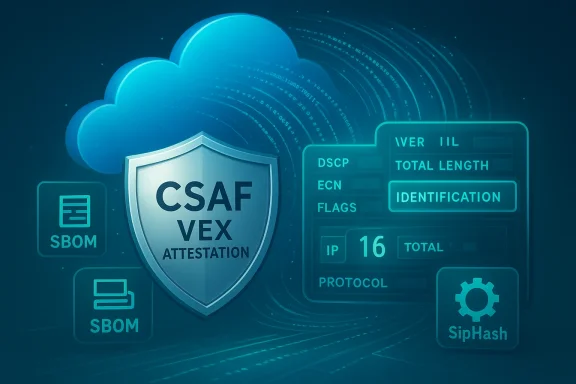 Background / Overview
CVE‑2019‑10638 was disclosed in mid‑2019 after researchers showed that predictable or insufficiently randomized IP identification (IP ID) values can be abused to track devices and even leak kernel addresses. The authors of the original research demonstrated practical attacks that extract information from the 16‑bit IP ID field used in IPv4 headers; browsers that enable peer‑to‑peer UDP (for example via WebRTC) can be coerced into generating UDP traffic to attacker‑controlled endpoints, making remote fingerprinting and tracking feasible.Upstream Linux maintainers addressed the issue in the 5.1.7 kernel branch by changing the IP ID generation algorithm to a stronger hash (SipHash) with a larger key, and by backporting fixes into older stable kernels where appropriate. Distributions published security notices and pushed kernel updates accordingly. Microsoft’s MSRC statement naming Azure Linux as a product that “includes this open‑source library and is therefore potentially affected” is an inventory mapping for that product — it does not say Azure Linux is the only Microsoft product that could contain the vulnerable Linux kernel code.
This article explains the vulnerability, how the fix works, how open‑source kernel bugs propagate across supply chains, what Microsoft’s short attestation does — and does not — mean, and what customers should do now.
The vulnerability: what CVE‑2019‑10638 actually does
The IP ID field and why it matters
Every IPv4 packet carries a 16‑bit IP Identification (IP ID) field used historically for fragment reassembly. For modern systems that rarely fragment, vendors sometimes use the IP ID as an entropy source or counter to help with other internal bookkeeping. If the generator for this 16‑bit value is weak or partially predictable, remote observers can correlate sequences of IP ID values with specific devices.Attackers exploit that correlation to:
- Fingerprint a device across network changes.
- Track device activity across browsing sessions.
- Under certain conditions, glean kernel memory layout information (KASLR bypass) by observing how the generator leaks bits of internal state.
Why the Linux kernel was vulnerable
The Linux kernel’s initial IP ID strategy used comparatively weak mixing functions and a key length that, while operationally convenient, did not provide sufficient cryptographic resistance against focused attacks described by the researchers.Because the kernel maintained per‑net‑namespace or global counters indexed by hashes of the 5‑tuple (source/destination IP/ports plus protocol), a carefully chosen set of destination addresses could lead to collisions in the counter indices. Those collisions reveal information about the hashing key, and therefore the device’s IP ID sequence for subsequent packets, making device identification and correlation possible.
The fix: stronger hashing and backports
Upstream kernel maintainers addressed the problem by switching to a stronger keyed hash (SipHash) for IP ID generation and by ensuring the hashing key is sampled with sufficient entropy and not trivially enumerated. The change reduces information leakage from IP ID sequences and raises the cost of any remote key‑extraction attempt to impractical levels.Distributions patched affected kernels (either by moving to kernel series 5.1.7 or by backporting the relevant commits into their stable kernel trees). Operators running updated kernels no longer expose the original attack surface.
How open‑source kernel bugs propagate into products and why inventory matters
Linux is an upstream project consumed widely across vendors and products. A kernel commit or design decision is included into distribution kernel trees, OEM builds, cloud provider images, container base images, and even vendor‑distributed kernels (for example kernels shipped with WSL2 or with Azure VM images).Key points about propagation:
- The same upstream source file can appear in many different builds and packages; the mere presence of a CVE in upstream code does not automatically mean every downstream artifact is affected — configuration, build options, and backports matter.
- Vendors often ship custom kernel builds, apply backports, or selectively enable/disable kernel features — so the mapping from CVE to product is not necessarily one‑to‑one without an explicit inventory.
- Machine‑readable attestations (CSAF/VEX) and SBOMs are the only reliable way to know whether a named product actually includes a specific upstream component.
What Microsoft’s wording means — legal precision, not exclusivity
Microsoft’s public message is careful and deliberately scoped. The language is an inventory attestation:- “Azure Linux includes this open‑source library” — an assertion about the Azure Linux product family following Microsoft’s internal inventory checks.
- “and is therefore potentially affected” — an operational conclusion: treat the product as in‑scope for mitigation.
- If you run Azure Linux, you should assume the product is in‑scope until Microsoft or your operator confirms otherwise for your exact image/version.
- If you run other Microsoft artifacts that incorporate Linux kernels (for example kernels used in cloud images, WSL2 kernels, marketplace images, OEM images Microsoft distributes, or container base images Microsoft manages), you should not assume they are safe until you verify at the artifact level.
Which Microsoft products could plausibly be affected (and what you must verify)
Any Microsoft artifact that ships a Linux kernel build that includes the affected IP ID code path or an older kernel branch could, in principle, be affected. Possible candidates you should verify include, but are not limited to:- Azure Linux (the product Microsoft has attested).
- Azure Marketplace virtual machine images that include Linux kernels derived from upstream code.
- Microsoft‑distributed kernels used for services that run Linux VMs (for example some images in Platform as a Service contexts).
- The WSL2 kernel distributed by Microsoft (Microsoft supplies and maintains a Linux kernel image for WSL2 on Windows that may contain upstream code).
- Container base images curated by Microsoft that package a Linux userspace — while container images typically reuse distribution kernels, any orchestration that runs Linux kernels on host VMs should be inventoried.
When Microsoft says it will update the CVE/VEX mapping if additional products are identified, it signals that the company is pursuing per‑artifact verification; customers should use Microsoft’s CSAF/VEX manifests (and their own SBOM/inventory processes) to check whether a particular product or image they run is affected.
Practical risk assessment: exploitation feasibility and likelihood
The original research demonstrated remote tracking and, under certain exposures, kernel information leakage. However, assessing operational risk requires context:- Exploit prerequisites: The attacker needs to induce UDP traffic from the target to attacker‑controlled endpoints. That is possible via browser features (WebRTC) or by triggering QUIC/UDP flows from user agents that permit peer‑to‑peer or unrestrained UDP.
- User interaction: Typical attacks rely on a user visiting a malicious website or running a web application that triggers the necessary UDP traffic; many enterprise environments can reduce this risk via browser policies and network controls.
- Remote reachability: The target must permit outbound UDP to the chosen destinations; many corporate networks or cloud environments apply egress filtering that reduces attack surface.
- Mitigations: Updated kernels with SipHash‑based IP ID generation remove the vulnerable leakage channel entirely.
Recommended immediate actions for operators and customers
Follow a prioritized, practical response plan:- Inventory first
- Confirm whether the kernel or image you run includes the upstream code path implicated by CVE‑2019‑10638. Use SBOMs, kernel version checks, and vendor CSAF/VEX attestations.
- If you run Azure Linux (Microsoft’s attested product), treat it as in‑scope immediately.
- Patch where applicable
- For systems running vulnerable kernel versions (anything earlier than 5.1.7 without the backported fixes), apply the vendor‑provided kernel updates or backports as soon as feasible.
- If you rely on vendor images (cloud VM images, WSL2 kernels, marketplace images), follow the vendor’s remediation guidance; Microsoft has indicated it will update CVE mappings if other Microsoft products are affected.
- Mitigate if immediate patching isn’t possible
- Reduce exposure to remote tracking attacks by restricting or auditing outbound UDP egress to untrusted destinations where feasible.
- Implement browser controls or enterprise policies to limit WebRTC or peer‑to‑peer UDP for unmanaged sites.
- Monitor for suspicious web pages or applications that attempt to open peer‑to‑peer channels.
- Monitor and detect
- Watch for signs of unusual or repetitive UDP traffic from endpoints to many distinct recipient IPs — this can be a noisy indicator of attempted device‑fingerprinting campaigns.
- Correlate web logs, proxy logs, and endpoint egress flows to catch suspicious attempts to induce UDP flows.
- Use VEX/CSAF and SBOM data
- Check Microsoft’s machine‑readable CSAF/VEX attestations (the program Microsoft published starting October 2025) for product mappings. Use them to pinpoint which Microsoft artifacts are confirmed affected and which remain under investigation.
Longer term: supply‑chain hygiene and why product‑scoped attestations matter
CVE‑2019‑10638 demonstrates the classic open‑source supply‑chain challenge: a small upstream design choice affects thousands of downstream artifacts. For defenders and product owners, three lessons are clear:- Product‑scoped attestations (CSAF/VEX) and SBOMs are necessary for rapid, correct, and actionable remediation. The binary question “is this company affected?” is meaningless without artifact‑level mapping.
- Starting with a single product (Azure Linux) and expanding attestations gradually is an operationally sensible approach — but customers must treat un‑attested artifacts as unknowns rather than implicitly safe.
- Automated inventory, continuous SBOM verification, and integration with patch management are essential to avoid blind spots when a new upstream CVE is published.
Detection, telemetry and evidence gathering
If you suspect an in‑the‑wild attempt to fingerprint your estate using IP ID techniques, consider these indicators and data sources:- Network egress logs showing rapid UDP connections to many different external IPs from a single host or small subnet.
- Proxy logs showing web pages that request permission to use camera/microphone or initiate WebRTC sessions; these pages could be or host exploit code.
- Endpoint network stack metrics showing abnormal patterning in IP ID fields (network packet captures analyzed for sequence/entropy anomalies can be diagnostic).
Frequently asked operational questions
- Is this vulnerability only an anonymity/tracking problem?
No. While the primary impact is device fingerprinting and tracking, the research also showed potential for leaking kernel address bits (KASLR information), which could in theory amplify other exploit techniques. Treat the vulnerability primarily as privacy and information disclosure risk that can also serve as an exploitation multiplier. - If Microsoft confirms Azure Linux is affected, should I assume my WSL2 kernel is affected?
Not automatically. WSL2 uses a Microsoft‑maintained kernel image; whether it includes the specific affected upstream code depends on the kernel tree and applied patches. You must verify the particular WSL2 kernel build/version in use. Microsoft’s VEX/CSAF attestations and SBOM data are the authoritative way to know. - Can I block the attack by blocking incoming UDP?
The attack relies primarily on inducing outbound UDP from the victim to attacker‑controlled endpoints. Egress filtering that blocks or restricts UDP to arbitrary external hosts substantially reduces risk. Blocking inbound UDP alone does not prevent the attack.
Conclusions and final guidance
CVE‑2019‑10638 is a concrete example of how a modest upstream cryptographic/design weakness can yield practical tracking and privacy risks. The Linux kernel maintainers fixed the problem by hardening the IP ID generator, and distributions issued updates. Microsoft’s public attestation that “Azure Linux includes this open‑source library and is therefore potentially affected” is an authoritative, product‑level inventory statement for Azure Linux — and therefore a call to action for customers running that product.However, the attestation is limited in scope. It should not be read as an exclusivity guarantee for all Microsoft artifacts. Customers must:
- Use SBOMs and Microsoft’s CSAF/VEX files to identify whether their specific Microsoft artifacts are affected.
- Patch promptly when vendor updates are available.
- Apply network and browser mitigations where patching is not immediately possible.
- Treat un‑attested Microsoft artifacts as unknowns and verify them, rather than assuming safety.
Source: MSRC Security Update Guide - Microsoft Security Response Center
