

The libdwarf library contained a small but consequential flaw in dwarf_elf_load_headers.c that, before the upstream fix on July 5, 2019, allowed a crafted ELF file to trigger a division‑by‑zero and crash consumers of DWARF debug data — a vulnerability tracked as CVE‑2019‑14249 and demonstrably exploitable against tools such as dwarfdump.
DWARF is the de facto standard format for debugging information embedded in compiled binaries. Tools and libraries that parse DWARF (for example, libdwarf and the dwarfutils tools such as dwarfdump) are widely used across Linux distributions, build toolchains, debuggers, symbolic analysers, and CI systems. Parsing libraries run inside developer machines, build servers, and any automation that inspects or manipulates binaries; this makes robustness of DWARF parsers an important supply‑chain and availability concern.
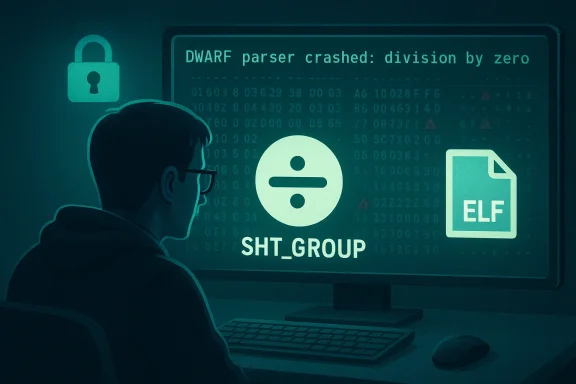
The defect given the CVE identifier CVE‑2019‑14249 was a division‑by‑zero vulnerability triggered when libdwarf processed an ELF section group of size zero (SHT_GROUP). In short, a malformed ELF file containing a zero‑size group section could cause libdwarf to compute a divisor that ends up zero, producing an unhandled runtime error and causing the process to abort — creating a straightforward Denial‑of‑Service (DoS) condition for any tool or service that loads the offending file.
Multiple vulnerability trackers, vendor advisories, and security databases independently record the same root cause and remediation window: the upstream libdwarf project corrected the code on or before 2019‑07‑05, and distributions subsequently issued package updates. The canonical technical summary (as reflected in NVD and distro advisories) matches the original disclosure text: a zero‑size SHT_GROUP in an ELF file leads to a division by zero in dwarf_elf_load_headers.c, allowing a crashed process or persistent service outage.
In the vulnerable libdwarf path, code that loads and iterates ELF section headers computes a value using the section group size without sufficiently guarding against a zero length. That arithmetic then became the denominator in a division operation. When an attacker supplies an ELF file with a crafted SHT_GROUP having size zero, the computation results in a division by zero and a runtime crash. This is a classic robustness bug — not a logic or privilege escalation flaw — but the consequence is total or repeated unavailability for the process performing DWARF parsing. Multiple vulnerability databases summarize the exact trigger and impact.
Source: MSRC Security Update Guide - Microsoft Security Response Center
 Background / Overview
DWARF is the de facto standard format for debugging information embedded in compiled binaries. Tools and libraries that parse DWARF (for example, libdwarf and the dwarfutils tools such as dwarfdump) are widely used across Linux distributions, build toolchains, debuggers, symbolic analysers, and CI systems. Parsing libraries run inside developer machines, build servers, and any automation that inspects or manipulates binaries; this makes robustness of DWARF parsers an important supply‑chain and availability concern.The defect given the CVE identifier CVE‑2019‑14249 was a division‑by‑zero vulnerability triggered when libdwarf processed an ELF section group of size zero (SHT_GROUP). In short, a malformed ELF file containing a zero‑size group section could cause libdwarf to compute a divisor that ends up zero, producing an unhandled runtime error and causing the process to abort — creating a straightforward Denial‑of‑Service (DoS) condition for any tool or service that loads the offending file.
Multiple vulnerability trackers, vendor advisories, and security databases independently record the same root cause and remediation window: the upstream libdwarf project corrected the code on or before 2019‑07‑05, and distributions subsequently issued package updates. The canonical technical summary (as reflected in NVD and distro advisories) matches the original disclosure text: a zero‑size SHT_GROUP in an ELF file leads to a division by zero in dwarf_elf_load_headers.c, allowing a crashed process or persistent service outage.
Technical anatomy: what went wrong and why it matters
ELF section groups (SHT_GROUP) and how a zero size becomes fatal
ELF (Executable and Linkable Format) defines many section types. One of them, SHT_GROUP, is an optional section grouping used to mark sets of sections that should be processed together by linkers or tools. Parsers must check header fields (including sizes) before performing arithmetic that depends on those values.In the vulnerable libdwarf path, code that loads and iterates ELF section headers computes a value using the section group size without sufficiently guarding against a zero length. That arithmetic then became the denominator in a division operation. When an attacker supplies an ELF file with a crafted SHT_GROUP having size zero, the computation results in a division by zero and a runtime crash. This is a classic robustness bug — not a logic or privilege escalation flaw — but the consequence is total or repeated unavailability for the process performing DWARF parsing. Multiple vulnerability databases summarize the exact trigger and impact.
Exploitability and scope: who can be affected?
- Tools operating on untrusted ELF files — e.g., automated scanners, continuous integration (CI) jobs, crash analyzers, and any service that accepts user‑supplied binaries — are primary risk vectors. Because the attack surface is simply "feed this ELF to the tool," exploitation is trivial for attackers who can submit files to a vulnerable parser.
- The flaw is a Denial‑of‑Service only; there is no public evidence that code‑execution is possible from this specific bug. Historical records and the CVE description focus on crash as the impact. That said, any DoS inside critical automation or infrastructure can be escalated into broader operational problems, especially in tightly coupled build/test pipelines.
Severity and scoring
Different trackers assign varying scores, but the generally accepted severity for CVE‑2019‑14249 is Medium with a CVSSv3 base score commonly cited as 6.5, reflecting network or file‑based exposure, no confidentiality or integrity loss, but high availability impact if triggered. Distributions and vendors used this scoring to prioritize fixes and packaging.Timeline and vendor response
- Discovery and disclosure: The issue was publicly documented in July 2019 and recorded in public CVE records as CVE‑2019‑14249, with the canonical description pointing to dwarf_elf_load_headers.c and the zero‑size SHT_GROUP trigger.
- Upstream fix: libdwarf's upstream source tree received changes that addressed the unchecked division condition; the widely cited "before 2019‑07‑05" cutoff indicates the fix was committed by that date. Packaged distributions later incorporated the upstream fix into their libdwarf/dwarfutils packages.
- Distribution patches: Major Linux distributions produced their own updates and advisories (Fedora, Ubuntu, SUSE, openSUSE, Debian derivatives, and others), and vendors such as Snyk and Tenable catalogued the vulnerability in their feeds. Administrators were advised to update dwarfutils/libdwarf packages in affected environments.
Affected products and package status
- Upstream: libdwarf versions earlier than the 2019‑07‑05 fix are vulnerable.
- Downstream / distributions: Many Linux distributions packaged libdwarf inside the dwarfutils package (or similar). Vendors published advisories and fixed package releases at different times. For example, Ubuntu and SUSE track the issue and list the patched or unaffected releases in their security pages; openSUSE lists fixed package versions that incorporate a later upstream release. Administrators should consult their distribution’s package metadata to verify whether their installed libdwarf/dwarfutils versions include the upstream 2019‑07‑05 correction.
Detection, exploitation, and proof‑of‑concept
The original disclosure referenced dwarfdump — the common command‑line tool that ships with dwarfutils — as a demonstration target, which means reproduction is straightforward: a specially crafted ELF file with a zero‑size SHT_GROUP causes dwarfdump (or any binary linking a vulnerable libdwarf) to crash. Public vulnerability databases and advisories reference this demonstrable crash pattern, and community scanners flagged the issue accordingly. There is no known sophisticated exploit chain required to trigger the vulnerability; the main barrier is the ability to feed ELF files to the vulnerable process or service.Detection guidance for operators
- Inventory: locate all hosts that have dwarfutils, libdwarf, or other DWARF‑parsing consumers installed.
- Package inspection:
- Use your distribution package manager to query installed versions: e.g., apt, rpm, dnf, zypper, pacman.
- Compare against vendor advisories; if your package predates the 2019‑07‑05 upstream fix or a vendor backport, treat it as vulnerable. Official vendor pages provide fixed package versions for specific releases.
- Behavioral detection: look for crashes, core dumps, or repeated process restarts associated with dwarfdump, debuggers, symbol servers, or any service that loads ELF files from untrusted sources.
- Threat hunting: review inbound file upload logs, CI artifacts, or user submissions that carry ELF binaries from untrusted origins; prioritize sandboxing or quarantining such inputs until they can be validated.
Mitigation and remediation recommendations
Immediate remediation steps are straightforward and follow standard vulnerability management best practices:- Update packages: install the patched libdwarf/dwarfutils packages provided by your distribution. Upstream fixed the issue on or before 2019‑07‑05; modern distro packages should include that fix. If a vendor has not provided a package for your version, consider upgrading to a supported release or compiling a patched upstream release and staging it through normal deployment channels.
- Minimize exposure: avoid processing untrusted ELF files on shared or long‑running services. If your build or analysis pipelines accept user‑provided binaries, add an explicit quarantine and validation step that runs ELF parsing inside a short‑lived sandbox or container with constrained privileges and resource limits.
- Use process hardening: run debug and analysis tools as unprivileged users, apply seccomp or other syscall filters where feasible, and configure resource limits (ulimit) to reduce the blast radius of crashes caused by malformed inputs.
- Monitor and alert: add detection rules to watch for the specific crash signatures (process name, stack trace, or exit codes) related to libdwarf crashes and configure alerts for unexpected core dumps in tooling infrastructure.
- Vendor coordination: if your organization provides products that bundle libdwarf, ensure your supply‑chain analysis identifies the embedded library and push out vendor updates to downstream customers.
- Query installed package versions for libdwarf/dwarfutils and confirm whether they predate the 2019‑07‑05 upstream fix.
- If vulnerable, apply vendor‑provided updates immediately, or replace with a patched upstream build.
- For services that process untrusted ELF files, implement sandboxing and strict input validation.
- Log and monitor crashes and anomalous process terminations.
Risk analysis: how serious was CVE‑2019‑14249 in practice?
On its face, CVE‑2019‑14249 is a medium‑severity, availability‑only weakness: an attacker can cause processes that parse ELF/DWARF to crash but cannot (based on public reporting) achieve arbitrary code execution from this bug alone. That said, the practical risk depends heavily on the deployment context:- Low to moderate risk in developer workstations and isolated analysis machines: unattended crashes are inconvenient but usually recoverable.
- Higher operational risk in centralized builder, CI, artifact indexing, or symbol‑server services where a single malformed artifact can affect many users or block builds. Attackers who can submit malformed ELF artifacts to shared services can induce repeated outages. This makes the vulnerability more relevant to organizations that accept binaries from external parties (e.g., OSS build sandboxes, bug‑reporting attachments, or third‑party CI tasks).
- Supply‑chain risk: because libdwarf is a widely reused open‑source component, patches needed to propagate through many ecosystems (distributions, containers, appliance images). In some environments, maintainers delay or decline to backport fixes, leaving older systems potentially vulnerable until upgraded. Security scanners have historically flagged unpatched distro packages as “no vendor patch available,” which raises the chance of operational exposure on legacy hosts.
Broader lessons for maintainers and security teams
- Small parser bugs have outsized operational impact. The libdwarf incident demonstrates that a single unchecked arithmetic operation (division) can cascade into service outages when the logic runs in shared or automated contexts.
- Treat parsing of complex binary formats as a high‑risk operation. Any component that consumes untrusted file formats (ELF, PE, Mach‑O, DWARF, or other structured data) should be hardened with:
- Input validation
- Resource limits
- Sandbox/VM isolation
- Fuzz testing during CI to uncover edge cases before they reach production
- Monitor upstream and downstream: upstream fixes (commits in libdwarf) must be tracked by downstream packagers and product teams; vendor advisories and distro trackers (Ubuntu, SUSE, Fedora, etc.) are critical to determine whether a given host is patched. Relying solely on CVE metadata without checking package churn can lead to false confidence.
- Build defense‑in‑depth: even for DoS‑only bugs, the operational impact can be severe when multiple systems depend on a single library. Layered mitigations (sandboxing + package updates + monitoring) contain the risk more reliably than any single control.
Practical remediation playbook for WindowsForum readers (developers and ops)
- For individual developers:
- Update local packages that provide dwarfdump or libdwarf. On Debian/Ubuntu: run package manager update/upgrade and confirm that dwarfutils or libdwarf packages are at a version that includes post‑2019‑07‑05 fixes.
- Avoid running dwarfdump or bulk binary analysis on untrusted files without a disposable environment (container, VM).
- For build/CI/platform engineers:
- Add a preprocessing step that validates ELF headers before invoking DWARF parsers; reject or quarantine malformed artifacts.
- Run the DWARF parser in a restricted container with minimal privileges and resource limits.
- Add monitoring to detect crashes of analysis processes and create automated remediation scripts (restart, quarantining the offending file and reporting the uploader).
- For security and infrastructure teams:
- Inventory all instances where libdwarf or consumer binaries are present: developer workstations, build nodes, artifact indexes, debugging services.
- Use vendor advisories (Ubuntu, SUSE, Fedora, Red Hat) to confirm patched package versions for each distro and epoch; address hosts that cannot be readily upgraded by isolating or hardening services that parse ELF files.
- If you maintain product images or appliances that might include libdwarf statically, verify your image builds and rebuild images to incorporate patched upstream code.
Critical evaluation: strengths and limitations of the public response
Strengths:- The vulnerability was documented publicly with a clear technical cause and a narrow, verifiable reproduction: a zero‑size SHT_GROUP causes division by zero in dwarf_elf_load_headers.c. Multiple independent trackers (NVD, distro advisories, Snyk, and others) recorded the issue and mapped the upstream fix. This clarity made vendor and packager responses straightforward.
- Upstream and many downstream vendors integrated the fix; distributors that maintain dwarfutils provided fixed package versions and communicated status to users, which is the expected producer response model.
- Patch propagation delays: some vulnerability feeds and scanners flagged the issue as unpatched for certain distro versions or for static builds, indicating incomplete propagation of fixes across all packaging ecosystems. That prolongs exposure for hosts that cannot easily be upgraded or where vendors did not backport patches.
- Visibility: because libdwarf is a library primarily used by developer tooling, it might be overlooked by traditional operations‑focused vulnerability triage processes. Organizations that do not inventory developer tooling or that treat developer machines as outside the critical attack surface may miss remediation windows.
- False sense of safety: DoS‑only bugs are sometimes deprioritized, but in the context of automated pipelines and shared services, DoS can be an entry point for broader operational impact (missed builds, delayed releases, or blocked incident response workflows), so teams must evaluate impact in context rather than relying solely on CVSS labels.
- There is no public record of escalations from this specific bug to remote code execution; all authoritative summaries describe only crash/DoS. If other exploit primitives are present in a target environment (e.g., writing to logs that the crashed process later processes unsafely), those chaining possibilities are environment‑specific and not inherent to the reported bug. Treat such chaining as a plausible risk vector but not a proven exploitation path for CVE‑2019‑14249 itself.
Long‑term recommendations for reducing such risks
- Adopt fuzzing for format parsers: sustained fuzzing of DWARF, ELF, and other binary formats in upstream projects and downstream packaging pipelines finds robustness issues before release.
- Expand SBOM coverage: maintain an accurate Software Bill of Materials for developer images and CI pipelines so that libraries like libdwarf are visible in vulnerability scans and patching workflows.
- Harden producer ecosystems: when packaging upstream projects, distributors should consider backporting critical robustness fixes into Long Term Support releases or offering security‑only updates when feasible.
- Include developer tooling in threat modelling: treat shared analysis services, symbol servers, and CI nodes that process untrusted artifacts as production services and apply the same defense‑in‑depth controls used for public‑facing infrastructure.
Conclusion
CVE‑2019‑14249 is a compact, well‑documented example of how a single unchecked arithmetic operation in a widely used parsing routine can produce disruptive availability consequences. The issue — a division by zero triggered by an ELF SHT_GROUP with zero length — was fixed upstream by July 5, 2019, and downstream vendors subsequently shipped patches; operators who process untrusted ELF files should verify that their libdwarf/dwarfutils packages include the upstream fix and apply sandboxing and input‑validation safeguards where binary inputs originate from untrusted sources. The broader lesson remains: robust parsing, timely patching, and treating developer toolchains as part of the critical attack surface are essential defenses against operational outages and supply‑chain shocks.Source: MSRC Security Update Guide - Microsoft Security Response Center
