

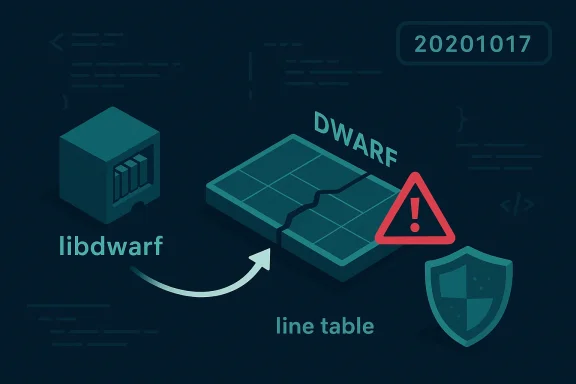
libdwarf — the small, unassuming library that reads DWARF debug data — contains a parsing defect tracked as CVE‑2020‑27545 that, in releases prior to 20201017, can be induced by a crafted object to perform a one‑byte out‑of‑bounds read via an invalid pointer dereference in a malformed line table, producing crashes and denial‑of‑service conditions in calling applications. (prevanders.net)
libdwarf is a compact C library widely used by debugging and binary‑inspection tools (for example, dwarfdump and other DWARF‑aware utilities) to parse DWARF debug sections embedded in ELF, Mach‑O, and other object file formats. The DWARF format describes source‑level mapping, variable types, and stack‑unwinding metadata that debuggers, profilers, and symbol‑processing pipelines rely on. Because DWARF parsing runs inside tools that often accept untrusted or third‑party object files (e.g., CI systems, symbol servers, code analysis services, and developer machines), robustness of the parser is a security priority. (prevanders.net)
The bug tracked as CVE‑2020‑27545 was reported in October 2020 and fixed upstream in the libdwarf release dated 2020‑10‑17 (version string 20201017). The upstream change that marks the fix is captured in the project’s commit history and the version bump to 20201017. (github.com) (prevanders.net)
Vendor advisories and package trackers (SUSE, Ubuntu and others) list the issue and link the fix or patched package updates; SUSE’s security update notes explicitly call out that a corrupted line table could crash the calling app and that the update addresses this problem.
On the other hand, if a server or service is configured to automatically process third‑party artifacts without thorough validation — a common setup in large CI/CD setups or public symbol services — attackers can trigger the condition at scale, causing sustained denial of service across multiple processes or services.
Moreover, the operational cost of an attacker being able to repeatedly crash analysis infrastructure is nontrivial: backlog and delayed pipelines, increased human triage time, potential for follow‑on attack avenues (e.g., distraction while other intrusions are attempted), and reputational damage for public analysis services. The MSRC description the user supplied — which highlights total loss of availability and sustained/persistent denial of service outcomes — is consistent with this operational reality for vulnerable deployments processing untrusted object files. (The downstream security trackers and vendor advisories reflect the same availability‑heavy impact vector.)
Source: MSRC Security Update Guide - Microsoft Security Response Center
 Background / Overview
libdwarf is a compact C library widely used by debugging and binary‑inspection tools (for example, dwarfdump and other DWARF‑aware utilities) to parse DWARF debug sections embedded in ELF, Mach‑O, and other object file formats. The DWARF format describes source‑level mapping, variable types, and stack‑unwinding metadata that debuggers, profilers, and symbol‑processing pipelines rely on. Because DWARF parsing runs inside tools that often accept untrusted or third‑party object files (e.g., CI systems, symbol servers, code analysis services, and developer machines), robustness of the parser is a security priority. (prevanders.net)The bug tracked as CVE‑2020‑27545 was reported in October 2020 and fixed upstream in the libdwarf release dated 2020‑10‑17 (version string 20201017). The upstream change that marks the fix is captured in the project’s commit history and the version bump to 20201017. (github.com) (prevanders.net)
What the vulnerability actually is
The short technical description
- Symptom: A one‑byte out‑of‑bounds read occurring when libdwarf dereferences an invalid pointer while processing a malformed line table in a crafted object file.
- Root cause class: insufficient sanity checks around offsets and line table structures, leading to a release of an invalid pointer or reference (CWE‑763) and an access one byte past an allocated boundary.
How the malformed input triggers the issue
DWARF line tables map instruction addresses to source file lines and include various header fields and internal tables (file name tables, directory entries, column and row information). A crafted object can contain a line‑table header or offsets that produce an incorrect pointer or offset value that libdwarf does not fully validate before dereferencing. That invalid pointer leads to reading one byte beyond a legitimate buffer boundary. While one byte may sound trivial, in practice any out‑of‑bounds read of this type breaks assumptions and can result in crashes, inconsistent behaviour, or repeated faults—enough to create sustained denial of service for tools or services that process such files. Upstream maintainers confirmed the problem and fixed it in the October 17, 2020 release. (prevanders.net)Who and what is affected
Packages and products
The vulnerability is in the upstream libdwarf codebase and therefore affects distributions and packages that include vulnerable libdwarf versions (versions earlier than 20201017). That includes, historically, the libdwarf package and the dwarfutils tools (for example, dwarfdump) that link against it. Linux distributions and appliance vendors that ship older libdwarf releases or embed the code in tooling could be affected until they ship the upstream fix or backport an equivalent patch.Vendor advisories and package trackers (SUSE, Ubuntu and others) list the issue and link the fix or patched package updates; SUSE’s security update notes explicitly call out that a corrupted line table could crash the calling app and that the update addresses this problem.
Likely attack surfaces and real‑world exposure
- Developer and CI systems that automatically analyze third‑party binaries and symbol files (for example, automated artifact analysis in continuous integration, container image scanning that inspects debug sections, or server‑side symbol processing) are a prime concern: they often process untrusted input and may run libdwarf‑based tools as part of pipelines. A malicious artifact could be uploaded by an adversary to cause crashes or to tie up developer resources.
- Public or semi‑public services that accept uploaded binaries for crash analysis, online disassembly, or symbolization are also exposed; an attacker who can submit files can force a crash in the parser and deny service to other users.
- Local developer machines and workstations are affected too, but exploitation there usually requires the victim to open or process the crafted object (user interaction). Because the CVSS vector records User Interaction: Required, remote, unauthenticated spontaneous exploitation is less likely unless upstream services or daemons process file uploads without sanitizing.
Exploitability and impact analysis
How easy is it to exploit?
The technical details indicate the issue is triggered by a crafted object file that contains a malformed line table. For many environments, an attacker needs to get the target to supply or process that file (for example, by uploading an artifact or by tricking a developer into opening the file). That means exploitation generally requires user interaction or some channel that accepts arbitrary object files. The CVSS vector assigned (AV:N/AC:L/PR:N/UI:R/S:U/C:N/I:N/A:H) reflects an attack that can be delivered remotely (network/external delivery of the crafted file) but requires the target to process it.On the other hand, if a server or service is configured to automatically process third‑party artifacts without thorough validation — a common setup in large CI/CD setups or public symbol services — attackers can trigger the condition at scale, causing sustained denial of service across multiple processes or services.
Concrete impact scenarios
- Sustained DoS of CI runners: An attacker pushes a repository with a crafted ELF object to a CI pipeline that runs dwarfdump or similar tools as part of the build/test job. Each job will crash when the parser hits the malicious line table, causing repeated failures and a denial of build/test resources until the pipeline is patched or the artifact removed.
- Service denial for symbolization services: Public symbol servers that automatically process uploaded debug artifacts can be forced offline if each file submitted triggers a crash, and repeated submissions can overload operator response.
- Developer interruption: Receiving a crafted artifact via email, bug tracker attachment, or binary distribution can cause desktop tools to crash, which is disruptive and can slow incident response.
How the problem was fixed (and how to verify your code is patched)
Upstream remediation
The libdwarf project released changes associated with the version bump to 20201017; the commit series and upstream changelog show the release date and updated version string. The actual mitigation approach in the project’s corrections focuses on stricter validation around line table offsets and improved bounds checking before pointer dereferences. The package release (20201017) is the canonical version that contains the fix. (github.com)Vendor and distribution patches
Major distributors and package maintainers incorporated the upstream fix into their security updates. For example:- SUSE released a security update that explicitly states the correction for a corrupted line table that could crash the calling application; vendors provide package update identifiers and installation instructions in their advisories.
- Ubuntu and other Linux distributions have entries in their security trackers and package archives noting that the issue is resolved in newer package versions; Ubuntu’s security record lists CVE‑2020‑27545 with CVSS details and status.
Verifying an installation
- Check the installed libdwarf package version (for distribution packages, query the package manager: dpkg, rpm, zypper, etc.).
- Confirm the installed version is at least 20201017 (or that the distribution’s patch identifier that references the fix is applied).
- If the project code is embedded in a downstream product (embedded appliances, proprietary analysis tools), consult the vendor’s security advisory or rebuild the product after integrating the fixed libdwarf release. (github.com)
Detection and mitigation — practical steps for defenders
Immediate actions (what to do now)
- Patch quickly: Update libdwarf to the patched release or apply your distribution’s security update packages. Prioritize CI/CD runners, public symbolization services, and automated artifact processing hosts.
- Harden ingestion points: Where possible, avoid automatically processing untrusted object files. Introduce manual review gates, restrict who can upload artifacts, or require signed uploads for critical pipelines.
- Sandbox and isolate parsing: Run DWARF‑parsing tools inside constrained sandboxes (unprivileged containers, chroot with restricted capabilities, seccomp filters) and use resource limits to prevent a single malformed input from crashing or consuming the entire host.
- Monitor for repeated crashes: Instrument logging and process monitoring around tools that invoke libdwarf (dwarfdump, symbol servers, etc.). Recurrent segmentation faults or repeated restarts correlated with incoming artifacts are strong indicators of attempted abuse.
Intermediate and longer‑term mitigations
- Rebuild images and artifacts: If you use base images, tool images, or containers that include libdwarf, rebuild them to include the patched version and redeploy.
- Add defensive checks: For teams maintaining code that consumes DWARF directly, add explicit sanity and bounds checks on offsets and header fields before dereferencing. This reduces the likelihood of future one‑byte or small OOB reads.
- Fuzz testing & sanitizers: Integrate fuzzing (e.g., OSS‑Fuzz) and AddressSanitizer/UndefinedBehaviorSanitizer into the testing pipeline for code that parses object file formats. libdwarf has an active history of fuzz‑reported issues; maintaining a fuzzing regimen yields high defensive value. (prevanders.net)
Detection signatures and IOC ideas
- Watch for repeated crash signatures from binaries like dwarfdump and other libdwarf consumers. Distinct crash backtraces referencing line‑table parsing functions are a quick triage path.
- Use process accounting and service supervision alerts for frequent restarts. Correlate these events with incoming file uploads and source repositories to locate malicious artifacts.
Developer guidance — how to fix and harden libdwarf usage
If you maintain tooling that links to libdwarf:- Upgrade the dependency to libdwarf >= 20201017 (or later stable upstream releases that include this patch). (github.com)
- Recompile and statically analyze the toolchain with sanitizers enabled in CI to catch regressions.
- Implement defensive API wrappers that perform high‑level sanity checks before passing data to libdwarf internals. Treat all DWARF offsets and counts as untrusted values and validate ranges and headers up front.
- Isolate parsing work into short‑lived worker processes; a crash will then fail the worker but not bring down a long‑lived supervisor. Use job queuing so failures can be retried with backoff rather than allowing indefinite restart loops.
Why this vulnerability matters beyond a single crash
At first glance, a one‑byte out‑of‑bounds read may sound minor. In practice, parsing logic errors in fundamental file‑format libraries create systemic risk: these libraries are often embedded in multiple tools, run across many hosts, and operate on untrusted data. A small memory safety lapse can therefore be amplified into a wide operational problem — sustained denial of service for build farms, analysis clusters, or any service that incorporates automatic DWARF processing. The libdwarf project’s long history of vulnerability reports — tracked and cataloged across many entries — demonstrates that DWARF parsing tolerates subtle edge cases and benefits from defensive programming and fuzz coverage. (prevanders.net)Moreover, the operational cost of an attacker being able to repeatedly crash analysis infrastructure is nontrivial: backlog and delayed pipelines, increased human triage time, potential for follow‑on attack avenues (e.g., distraction while other intrusions are attempted), and reputational damage for public analysis services. The MSRC description the user supplied — which highlights total loss of availability and sustained/persistent denial of service outcomes — is consistent with this operational reality for vulnerable deployments processing untrusted object files. (The downstream security trackers and vendor advisories reflect the same availability‑heavy impact vector.)
Risk summary and prioritization
- Severity (operational): Medium by CVSS, but high for availability in contexts where untrusted DWARF is processed at scale.
- Exploitability: Requires a crafted object and processing of that object by a vulnerable tool (user interaction or service acceptance). High risk for automated processing pipelines and public upload endpoints.
- Recommended priority: Patch immediately for servers and automated systems that accept third‑party objects; treat local developer machines as medium priority but ensure developer toolchains are updated during regular maintenance windows.
Checklist — immediate action plan for IT teams
- Inventory: identify hosts running libdwarf or tools that statically link / dynamically link against it (dwarfdump, symbolizer binaries).
- Patch: apply distribution updates or upgrade libdwarf to 20201017 or later. For packaged systems, install distribution patches (SUSE, Ubuntu, Debian updates where available).
- Harden: sandbox parsing tools; restrict upload sources and enforce file‑type policies for public services.
- Monitor: enable crash alerts and correlate with incoming artifact uploads.
- Test: add fuzzing or sanitizer runs to CI for components that parse object files. (prevanders.net)
Conclusion
CVE‑2020‑27545 is a compact but practical reminder that even small memory‑safety errors in domain‑specific parsing libraries can translate into meaningful operational risk when those libraries are widely reused. The vulnerability — a one‑byte out‑of‑bounds read caused by an invalid pointer dereference while processing a malformed DWARF line table — was fixed upstream in the libdwarf 20201017 release and has been incorporated into distribution security updates. Organizations that automatically process third‑party object files or run public symbolization services should treat this as a high‑urgency operational patch: update libdwarf, strengthen ingestion controls, and sandbox parsing tasks to reduce the attack surface. For developers, the larger lesson remains the same: rigorous input validation, regular fuzzing, and use of sanitizers materially reduce the likelihood of subtle parsing bugs turning into sustained outages. (github.com)Source: MSRC Security Update Guide - Microsoft Security Response Center
