

Mbed TLS contained a simple but consequential memory-handling bug: plaintext left behind in application buffers after a failed or partial read could remain in process memory because mbedtls_ssl_read did not always zero out unused plaintext, creating a real risk of sensitive-data exposure for affected builds and deployments. This disclosure—tracked as CVE-2020-36476—was fixed upstream in the 2.24.0 line and backported to supported LTS branches, but the operational reality for defenders is more complex: vulnerable code can live in distro packages, vendor appliances, container images, and statically‑linked binaries long after an upstream fix is published, and defenders must both patch and search their artifacts to be sure they truly removed the exposure.
Mbed TLS is an open-source TLS/SSL library widely embedded in embedded devices, appliances, and Linux distributions. CVE-2020-36476 was assigned to a defect in the function mbedtls_ssl_read in Mbed TLS versions prior to 2.24.0 (and prior to the corresponding LTS fixes 2.16.8 and 2.7.17). The technical root cause: missing zeroization of plaintext buffers, meaning that when portions of an application buffer were unused after a read or an error path, that leftover plaintext was not reliably overwritten before being discarded, leaving sensitive bytes discoverable in memory.
This is classed as an information‑exposure weakness (CWE‑212 / CWE‑668). Several well‑regarded vulnerability trackers and vendor pages assigned a high impact rating (CVSSv3.1 base score commonly reported as 7.5) because the defect can expose application-layer plaintext that, if harvested, undermines confidentiality and integrity in subtle ways.
In the case of CVE-2020-36476, certain branches of mbedtls_ssl_read omitted that zeroization. That left leftover plaintext in heap or stack buffers after the API returned. The consequence is straightforward: any process memory exposure mechanism (core dumps, memory single‑process dumps, debugging backtraces, or other in-process reads due to additional bugs) could reveal plaintext that should have been scrubbed. The defect is not an exploitable code‑execution issue by itself, but the confidentiality impact is real and meaningful where secrets (session tokens, credentials, keys, personal data) traverse TLS endpoints built on the vulnerable library.
Special note on Microsoft’s guidance and product attestations: Microsoft’s Security Response Center uses product‑level attestations (CSAF/VEX). In other incidents involving Mbed TLS and other crypto libraries, MSRC has published attestations naming specific Microsoft artifacts (for example, Azure Linux) that were discovered to ship the implicated component. That attestation means those named Microsoft images are authoritatively identified as carriers and should be prioritized for patching, but it does not imply Microsoft has proven that no other Microsoft artifacts ever included the vulnerable library. Operators must therefore perform artifact-level discovery for any Microsoft-provided images or binaries they run. The uploaded advisory notes and operational guidance illustrate how Microsoft’s attestation model is product-scoped and why defenders should not interpret a single-product attestation as an exhaustive inventory.
If you run Mbed TLS in any form—package, static link, container, or embedded firmware—begin triage now: identify where Mbed TLS appears in your estate, apply vendor fixes, rebuild images, and validate that plaintext no longer persists after mbedtls_ssl_read returns. Microsoft’s attestation approach can help prioritize Microsoft-published images (it tells you which Microsoft product images were confirmed to include a component), but it cannot replace artifact-level hygiene: scan, rebuild, validate.
Takeaway: the upstream fix is simple; the operational remediation involves supply‑chain diligence. Patch, but verify—then rebuild and validate.
Source: MSRC Security Update Guide - Microsoft Security Response Center
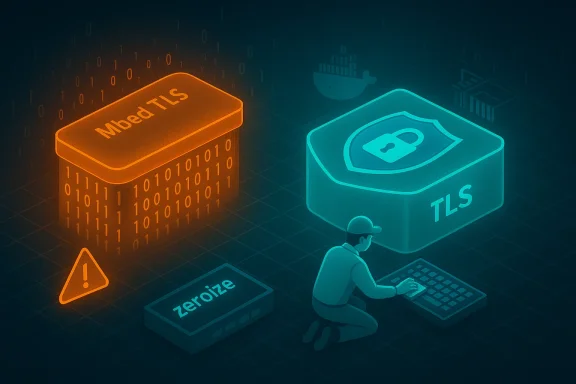 Background / Overview
Mbed TLS is an open-source TLS/SSL library widely embedded in embedded devices, appliances, and Linux distributions. CVE-2020-36476 was assigned to a defect in the function mbedtls_ssl_read in Mbed TLS versions prior to 2.24.0 (and prior to the corresponding LTS fixes 2.16.8 and 2.7.17). The technical root cause: missing zeroization of plaintext buffers, meaning that when portions of an application buffer were unused after a read or an error path, that leftover plaintext was not reliably overwritten before being discarded, leaving sensitive bytes discoverable in memory.This is classed as an information‑exposure weakness (CWE‑212 / CWE‑668). Several well‑regarded vulnerability trackers and vendor pages assigned a high impact rating (CVSSv3.1 base score commonly reported as 7.5) because the defect can expose application-layer plaintext that, if harvested, undermines confidentiality and integrity in subtle ways.
Technical anatomy: what exactly failed
At a high level, TLS libraries must handle buffers that hold decrypted (plaintext) application data. When mbedtls_ssl_read is asked to deliver N bytes to the caller, internal buffers may be larger or reused. On success it returns data properly; on partial reads, error returns, or cleanup paths, code must explicitly overwrite (zeroize) any memory containing now-unused plaintext before the buffer or its lifetime is handed back to other code paths, logged, or freed.In the case of CVE-2020-36476, certain branches of mbedtls_ssl_read omitted that zeroization. That left leftover plaintext in heap or stack buffers after the API returned. The consequence is straightforward: any process memory exposure mechanism (core dumps, memory single‑process dumps, debugging backtraces, or other in-process reads due to additional bugs) could reveal plaintext that should have been scrubbed. The defect is not an exploitable code‑execution issue by itself, but the confidentiality impact is real and meaningful where secrets (session tokens, credentials, keys, personal data) traverse TLS endpoints built on the vulnerable library.
Affected versions and where the fix lives
The canonical affected ranges are:- Mbed TLS versions earlier than 2.24.0 (upstream fixed in 2.24.0).
- Backported fixes were applied to the LTS branches: 2.16.8 LTS and 2.7.17 LTS.
Why this matters in real deployments
Mbed TLS is often used in three dangerous patterns that raise the stakes for this kind of bug:- Embedded devices and appliances: firmware and appliances frequently vendor or statically link libraries. A package update on a host doesn’t fix such binaries in the field. Those devices can retain vulnerable Mbed TLS code until a firmware update is applied.
- Container and image immutability: container images baked with an older Mbed TLS remain vulnerable until the image is rebuilt and redeployed. Host-level patches don’t modify image contents.
- Shared infrastructure: services that handle multiple tenants or run untrusted co‑tenant code increase the attack surface for memory‑disclosure scenarios. Any plaintext leakage there can have high downstream impact.
Impact and exploitability — a practical assessment
- Primary impact: confidentiality—sensitive application data may remain in process memory and be recoverable. Several vendor trackers classify the vulnerability with a high CVSS score reflecting that confidentiality risk.
- Attack vector: network in the sense that remote parties can influence whether plaintext flows through the library (TLS endpoints receive network traffic). However, an attacker does not directly read another process's memory across a network; they must rely on other leakage mechanisms or local access to retrieve the residual bytes.
- Exploit complexity: low-to-moderate for causing states where plaintext lingers (e.g., causing errors or partial reads) but higher for turning that into actionable secret exfiltration without additional local/contextual weaknesses.
- Evidence of public exploitation: public telemetry attributing active exploitation for CVE‑2020‑36476 is limited. Most advisories treat this as a high‑severity disclosure deserving rapid remediation, not because it enables remote code execution, but because of the real risk of data exposure in many realistic environments.
Vendor and distribution response
Upstream Mbed TLS released fixes in the 2.24.0 line and backported to the stated LTS lines. Major Linux distributions subsequently shipped security updates or marked packages as fixed; Ubuntu, Debian, and SUSE trackers catalog the vendor advisories and fixed package versions. Always consult the relevant distro advisory for the exact package name and fixed version in your platform’s package repository.Special note on Microsoft’s guidance and product attestations: Microsoft’s Security Response Center uses product‑level attestations (CSAF/VEX). In other incidents involving Mbed TLS and other crypto libraries, MSRC has published attestations naming specific Microsoft artifacts (for example, Azure Linux) that were discovered to ship the implicated component. That attestation means those named Microsoft images are authoritatively identified as carriers and should be prioritized for patching, but it does not imply Microsoft has proven that no other Microsoft artifacts ever included the vulnerable library. Operators must therefore perform artifact-level discovery for any Microsoft-provided images or binaries they run. The uploaded advisory notes and operational guidance illustrate how Microsoft’s attestation model is product-scoped and why defenders should not interpret a single-product attestation as an exhaustive inventory.
Actionable remediation checklist (priority playbook)
The next steps are practical, prioritized, and assume constrained patch windows. Follow this checklist in order:- Immediate triage (hours)
- Inventory all places Mbed TLS may appear: package lists, container images, firmware images, static binaries, SDKs. Search for package names (mbedtls, libmbedtls), library filenames (libmbedtls*.so, mbedtls.a), and known symbol strings.
- Prioritize externally facing TLS endpoints and appliances that handle sensitive data.
- Apply vendor patches (0–72 hours)
- Upgrade Mbed TLS to 2.24.0 or the corresponding fixed LTS versions (2.16.8, 2.7.17) in build pipelines and package managers where possible. For distro packages, install the vendor-provided security update and restart services where required.
- Rebuild immutable artifacts (24–72 hours)
- Rebuild and redeploy any container images, firmware, or statically linked binaries that vend Mbed TLS. Host package updates do not change statically linked executables or sealed images. Treat every immutable artifact as requiring a fresh build with the fixed library.
- Validate the fix (post-deploy)
- Run integration tests that exercise TLS data paths, intentionally cause partial reads and error paths, and then capture memory artifacts in a controlled staging environment to ensure plaintext is not retained. Use controlled tests rather than public PoCs.
- Short-term mitigations (if patching is delayed)
- Reduce the attack surface: limit network exposure of affected services, place them behind restrictive allow‑lists, isolate them on dedicated hosts, and enforce process-level hardening and supervision.
- Secrets hygiene: if you have reason to believe highly-sensitive keys or secrets were handled by potentially vulnerable processes in exposed contexts, plan for key rotation after you patch and validate. This is especially important in multi-tenant or co‑located hosting where local leakage vectors are realistic.
- Long-term supply-chain changes
- Require SBOMs from vendors and adopt image scanning in CI pipelines so you can detect transitive inclusion of vulnerable library versions earlier in the build process. Microsoft’s use of CSAF/VEX product attestations highlights how machine-readable signals can accelerate triage—but attestations are a complement, not a substitute, for artifact scanning.
Detection and verification: how to prove you’re clean
- Package-based systems (Debian/Ubuntu/RHEL/SUSE): use your OS package manager to check installed mbedtls package versions (for example, dpkg -s mbedtls or rpm -q mbedtls) and confirm vendor advisory versions. Consult distro security pages for fixed package release numbers.
- Containers/images: inspect image layers and package manifests. Tools that list packages inside images (or that extract and scan layers) will show whether a given image contains vulnerable mbedtls packages. Rebuild images that contain the vulnerable code.
- Static binaries and vendor SDKs: run binary scanners that detect embedded Mbed TLS symbols or version strings. Some scanning tools analyze symbol tables or string sections for "mbedtls_version" or other identifiable markers. If you find a statically linked binary that uses a vulnerable Mbed TLS, rebuild or request a rebuild from the vendor.
- Runtime checks in staging: after you patch and rebuild, run negative tests that exercise partial reads and error paths and then verify via memory inspection (in a controlled lab) that plaintext is no longer retained. This test validates that the zeroization paths are effective in your build/configuration.
Operational caution: the supply-chain complication
Two operational facts make CVE-2020-36476 more than a patching exercise:- Vendors, appliances, and embedded devices often vendor library sources or statically link them into binaries. Those artifacts will remain vulnerable unless rebuilt and redeployed. Patching host packages does not remediate those cases.
- Vendor attestation schemes (for example, MSRC’s CSAF/VEX mappings) can speed triage where they exist, but absence of an attestation does not prove absence of the component. Treat attestations as authoritative for what they name, and treat everything else as unverified until you scan and prove otherwise. The uploaded MSRC-focused guidance explains this nuance in operational terms and recommends artifact-level discovery.
Common questions operators ask (short Q&A)
- Q: Is this a remote code execution vulnerability?
- A: No. The bug is a missing zeroization of plaintext buffers; it’s an information exposure issue, not an RCE. However, leaked plaintext can still cause severe breaches (session tokens, credentials, keys).
- Q: If I update my OS package, am I safe?
- A: Maybe. Updating host packages is necessary but not sufficient if you run containers, firmware, or statically‑linked binaries that contain the vulnerable Mbed TLS. You must scan and rebuild immutable artifacts.
- Q: Was there evidence of active exploitation in the wild?
- A: Public exploitation telemetry for this CVE was limited. That does not reduce the need to patch; even a small number of compromised high‑value endpoints can be catastrophic.
Lessons for defenders
- Treat sensitive-memory handling bugs seriously even when they are not memory‑corruption primitives. A missing zeroization can leak high-value secrets as surely as a direct read vulnerability in the right context.
- Inventory immutables. Container images, firmware, and statically linked binaries require rebuilds—not just host package updates. Add automated image scanning and SBOMs to your CI pipeline to detect transitive vulnerable components earlier.
- Demand transparency. Vendor-provided attestations (CSAF/VEX) speed triage when available, but insist on SBOMs and rebuilds or binary attestations for third‑party appliances and SDKs. Microsoft’s product-attestation approach illustrates the power and limitations of attestations—authoritative where they exist, incomplete where they do not.
- Validate fixes in your environment. Library behavior can differ with compiler flags, optimization levels, and platform quirks. Post-patch validation in a staging environment is essential.
Conclusion
CVE‑2020‑36476 is a textbook example of how a small, easily overlooked memory-handling omission can produce outsized operational risk. The fix is straightforward upstream—upgrade Mbed TLS to 2.24.0 (or the fixed LTS releases) and rebuild any artifact that vendors the library—but the defender’s work continues beyond that single update. Effective remediation requires inventorying packages, scanning images and binaries, rebuilding immutable artifacts, validating zeroization in your builds, and, where appropriate, rotating high‑value secrets.If you run Mbed TLS in any form—package, static link, container, or embedded firmware—begin triage now: identify where Mbed TLS appears in your estate, apply vendor fixes, rebuild images, and validate that plaintext no longer persists after mbedtls_ssl_read returns. Microsoft’s attestation approach can help prioritize Microsoft-published images (it tells you which Microsoft product images were confirmed to include a component), but it cannot replace artifact-level hygiene: scan, rebuild, validate.
Takeaway: the upstream fix is simple; the operational remediation involves supply‑chain diligence. Patch, but verify—then rebuild and validate.
Source: MSRC Security Update Guide - Microsoft Security Response Center
