

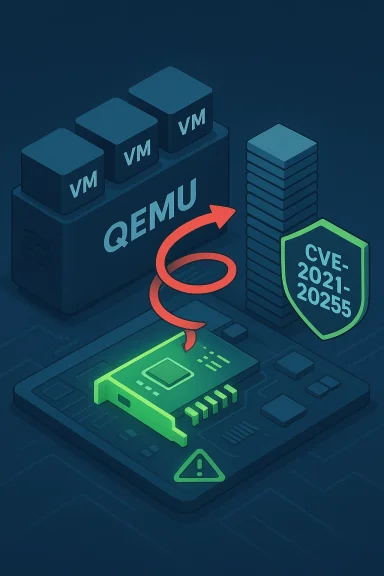
A subtle bug in QEMU’s eepro100 network device emulator — tracked as CVE-2021-20255 — can drive the host-side QEMU process into an infinite recursion and stack overflow when the guest triggers a specific DMA reentry condition, allowing a guest user or process to exhaust CPU cycles or crash the emulator and produce a local denial-of-service against the host and its virtual machines.
QEMU is one of the most widely used open-source machine emulators and virtualizers; it exposes many legacy and modern virtual devices so guests can use familiar hardware interfaces. The eepro100 i8255x device is an emulated Intel EtherExpress PRO/100 NIC commonly exposed for compatibility with older guests or when a particular PCI network device model is requested. The device emulation includes controller command handling, memory-mapped I/O, and DMA-like transfers that simulate the behavior of the physical NIC for the guest.
In early 2021 researchers at Ruhr-Universität Bochum reported an issue in the eepro100 emulation where a specific sequence of controller commands could re-enter DMA handling code in a way that caused unbounded recursion in the controller command path. The recursive path exhausted the stack and either spun the QEMU process consuming CPU or generated a crash on the host — a classic denial-of-service (DoS) outcome. The bug was assigned CVE-2021-20255 and was tracked and discussed on upstream QEMU mailing lists and by downstream distributors.
Two concrete points to highlight:
Why that matters: the fix does not attempt complicated flow rewrites or speculative rewiring of DMA semantics — it enforces a simple invariant that the device command path must not re-enter. The change is surgical, easy to audit, and appropriate for the failure mode (infinite recursion leading to stack exhaustion).
The eepro100 bug is illustrative:
For defenders, the incident is a reminder that device emulation increases attack surface and that layered defenses — device-model selection, resource limits, and minimal privilege — are effective complements to timely patching. If you manage QEMU hosts, treat this CVE as an availability risk with straightforward mitigations: patch, avoid the eepro100 device for untrusted workloads, and apply resource caps on qemu processes.
Acknowledging the specifics of the fix and the distribution advisories, system owners should prioritize updates and hardening based on their threat model; the vulnerability is fixed upstream and in distribution packages, but the host-facing nature of the bug means operational practices (isolation, resource limits, device model choices) remain the first line of defense until every exposed host is patched.
Source: MSRC Security Update Guide - Microsoft Security Response Center
 Background
QEMU is one of the most widely used open-source machine emulators and virtualizers; it exposes many legacy and modern virtual devices so guests can use familiar hardware interfaces. The eepro100 i8255x device is an emulated Intel EtherExpress PRO/100 NIC commonly exposed for compatibility with older guests or when a particular PCI network device model is requested. The device emulation includes controller command handling, memory-mapped I/O, and DMA-like transfers that simulate the behavior of the physical NIC for the guest.In early 2021 researchers at Ruhr-Universität Bochum reported an issue in the eepro100 emulation where a specific sequence of controller commands could re-enter DMA handling code in a way that caused unbounded recursion in the controller command path. The recursive path exhausted the stack and either spun the QEMU process consuming CPU or generated a crash on the host — a classic denial-of-service (DoS) outcome. The bug was assigned CVE-2021-20255 and was tracked and discussed on upstream QEMU mailing lists and by downstream distributors.
What happened: technical root cause, in plain language
At a high level the flaw is an uncontrolled recursion bug in the eepro100 controller command handling. Under a particular sequence of operations the device emulator can re-enter a DMA-handling routine while the original controller code is still on the stack. Instead of returning or deferring, the emulator path calls back into itself repeatedly, creating an effectively infinite recursion. That recursion grows until the host thread’s stack space is exhausted or the host process is overwhelmed by repeated calls — either outcome yields a denial-of-service effect for the QEMU process and any VMs it hosts.Two concrete points to highlight:
- This is not a classic heap overflow or arbitrary memory overwrite — the primary risk is availability (DoS) rather than confidentiality or integrity compromise. Public advisories consistently characterize the impact as denial of service, not remote code execution.
- The defect is triggered by behavior within the guest (a guest user or process sending crafted controller commands) and is therefore local to the VM as an attack vector; however, because QEMU runs on the host, the consequences affect host availability. That coupling (guest-triggered host-impact) is the essential cross-privilege risk for virtualization platforms.
How the fix works (what was changed in QEMU)
Upstream and downstream maintainers addressed the problem by preventing the recursive re-entry from occurring. A representative patch — included in vendor package updates — adds a simple state guard to the eepro100 device state structure and early-return logic to the command handler so that re-entrant entry is detected and rejected rather than recursed into. In other words, the fix introduces a boolean “busy” flag into the device state; when that flag is set, further entries into the command path are logged and dropped instead of recursing. This is a classic, pragmatic mitigation for re-entry-based recursion problems. The patch is displayed in vendor and distribution patch packages and was propagated into QEMU trees and distribution updates.Why that matters: the fix does not attempt complicated flow rewrites or speculative rewiring of DMA semantics — it enforces a simple invariant that the device command path must not re-enter. The change is surgical, easy to audit, and appropriate for the failure mode (infinite recursion leading to stack exhaustion).
Timeline and disclosure
- The issue was publicly discussed on the QEMU developer mailing lists and in open security mailing lists in February–March 2021. The reporting credit goes to researchers at Ruhr‑University Bochum. Red Hat’s product security team and other distributors picked up the report and assigned CVE-2021-20255.
- Downstream distributors (Debian, SUSE, openSUSE and others) created advisories and patches to remediate the issue in their packaged QEMU builds; release notes and security update announcements list the eepro100 stack-overflow fix among the addressed items.
- Upstream QEMU accepted patches and the defense (the busy/reentry guard) was applied in relevant trees and then propagated into distribution package builds. The fix is therefore available through standard updates from most major Linux distributions that ship QEMU.
Severity, scoring, and what “highest threat” means here
Different vendors assigned different CVSS scores. The NVD and multiple distribution trackers show a range of assessments that reflect slightly different viewpoints on exploitability and impact:- The NVD description emphasizes availability as the primary threat and lists the issue as causing a host-side denial of service. The high-level NVD entry is useful as a canonical summary of the technical effect.
- Distribution advisories (for example SUSE’s bulletins) rate the issue at a lower severity when they view the code path as reachable only by privileged guest operations or when mitigations reduce the practical attack surface; these variations explain why you may see CVSS scores differ between NVD and a vendor advisory.
Real-world risk: exploitability and likelihood
As disclosed, CVE-2021-20255 is a local guest-to-host denial-of-service vector. That distinguishes it from remotely exploitable, network-facing bugs. Practical implications:- An unprivileged or low-privileged process inside a VM that can shape controller commands or cause certain device-level behaviors could trigger the recursion; the attacker does not need host privileges but does need meaningful control inside the guest.
- The bug has no publicly documented evidence of privilege escalation to arbitrary code execution; published advisories and tracking entries describe CPU exhaustion or crash as the outcome. If you require certainty, treat this as availability-only until and unless a reliable escalation vector is demonstrated in public.
Who should care most — deployment scenarios and risk tiers
- Cloud providers and multi-tenant hosts: High priority. Any vulnerability that lets a guest disrupt the host process poses outsized operational risk for multi-tenant infrastructure. Providers should treat CVE-2021-20255 as urgent for any systems exposing QEMU to untrusted guests.
- Enterprise virtualization clusters hosting untrusted or semi-trusted workloads: High priority. Operators should patch promptly and consider temporary mitigations (device removal, resource capping) until patches are applied.
- Single‑user desktop or lab environments with fully trusted guests: Lower priority, but patch when convenient. For isolated test VMs run by a single admin who trusts the guest images, the operational impact is smaller but not zero.
Practical remediation and mitigation checklist
Follow these steps to close the window of exposure and reduce attack surface. The list is ordered for immediate triage followed by longer-term hardening.- Install vendor-provided security updates for QEMU as soon as possible. Distribution advisories and package updates include fixes derived from the upstream patch. If you maintain custom QEMU builds, merge upstream fixes that add the re-entrancy guard.
- If you cannot patch immediately, remove or avoid presenting the eepro100 device to untrusted guests. Use alternative virtual NIC models (for example modern virtio-net) where compatible, or explicitly configure your guest definitions to avoid the eepro100 model. This reduces the immediate trigger surface.
- Apply host-side resource limits for QEMU processes so a misbehaving VM cannot exhaust host CPU or destabilize critical host services. Use cgroups (control groups) and systemd slices to cap CPU and memory usage for guest processes. These quotas do not eliminate the bug but limit its blast radius. (Operational best practice; general containment guidance.)
- Run QEMU with least privilege and containment features where possible. Unprivileged QEMU wrappers, seccomp filters, and minimal capabilities reduce the host-level impact if a VM causes a crash. Consider running management software in separate namespaces or under supervisory containers where supported. (General virtualization hardening guidance.)
- Monitor for symptom indicators: abrupt CPU spikes on qemu-system processes, repeated QEMU crashes from device-related log entries, or guest-side attempts to repeatedly reconfigure or restart the network device. These signs suggest attempted exploitation or accidental triggers of the device path.
- Keep an audit trail of patching and configuration changes and apply staged updates with testing for production clusters; while the fix is surgical, regression testing remains important for complex hypervisor stacks.
Detection: how to know if you were affected
There are two practical indicators of this vulnerability being triggered:- Host-side QEMU process crashes with stack traces or crash signatures pointing into eepro100-related code paths. Distribution bug trackers and debug logs from core dumps can show the offending code paths.
- Sustained CPU consumption by specific qemu-system processes when a guest workload runs a sequence of controller operations that repeatedly enters device code. This could look like a runaway single-threaded CPU loop on the host for the QEMU process hosting the affected VM.
Why this class of bug matters: device emulation and attack surface
Device emulation is a perennial security concern because it necessarily implements complex semantics (I/O registers, DMA behavior, interrupts) in software. Device drivers and emulators reorder, buffer, and re-enter code paths in ways that real hardware avoids through electrical constraints; software emulation therefore introduces many additional correctness and reentry classes that are fertile territory for bugs.The eepro100 bug is illustrative:
- It arises from re-entry semantics — the emulator allowed code that pretended to simulate DMA to re-enter the command-processing routine.
- The bug is not an easily visible input-parsing error; it lives in the control flow invariants, which are harder to get right and harder to fuzz comprehensively without hypervisor-style fuzzing tools. That is why seasoned researchers uncovered it using advanced fuzzing techniques.
Developer and operator takeaways
- Maintain discipline around upstream updates: QEMU and its device models evolve, and many subtle vulnerabilities are addressed in downstream distribution updates. Track vendor security announcements and test patches promptly.
- Where possible prefer paravirtualized devices (virtio) for production workloads; they are simpler and designed with virtualization efficiency and safety in mind. When legacy device emulation is required for compatibility, apply stricter isolation and resource controls.
- If you ship VMs to customers or provide guest images, document which virtual devices are exposed and consider shipping images preconfigured to use safer device models for common virtualization stacks. (Operational advice reflecting best practices.)
Open questions and unverifiable points
- Public exploit availability: at the time of vendor advisories and downstream patches there was no widespread, reliable proof-of-concept exploit publicly weaponized for remote attacks; public write-ups and advisories describe DoS/crash potential but do not link a public remote RCE chain for this CVE. That situation can change; absence of a public exploit is not evidence the bug is harmless. Treat the claim “no public exploit” as the best-known state at disclosure and verify again if you find this article weeks or months after publication.
- Scope in appliance stacks: some vendors ship QEMU within appliance bundles where QEMU runs inside other packaging layers. In those cases the distribution and patch cadence matters; always consult the appliance vendor’s security bulletin for the canonical remediation timeline. Distribution advisories show that major vendors included CVE-2021-20255 in security updates, but product-level inventories may vary.
Final assessment
CVE-2021-20255 is an instructive, medium‑risk virtualization vulnerability: the technical mechanism is straightforward — uncontrolled recursion due to DMA reentry — but the operational consequences can be severe for multi-tenant or heavily virtualized environments where host availability is critical. The fix is small and surgical (reentry guard), and most mainstream distributions published updates quickly; the proper remediation is therefore clear and practical: patch promptly and apply containment measures until the patch is deployed.For defenders, the incident is a reminder that device emulation increases attack surface and that layered defenses — device-model selection, resource limits, and minimal privilege — are effective complements to timely patching. If you manage QEMU hosts, treat this CVE as an availability risk with straightforward mitigations: patch, avoid the eepro100 device for untrusted workloads, and apply resource caps on qemu processes.
Acknowledging the specifics of the fix and the distribution advisories, system owners should prioritize updates and hardening based on their threat model; the vulnerability is fixed upstream and in distribution packages, but the host-facing nature of the bug means operational practices (isolation, resource limits, device model choices) remain the first line of defense until every exposed host is patched.
Source: MSRC Security Update Guide - Microsoft Security Response Center
