

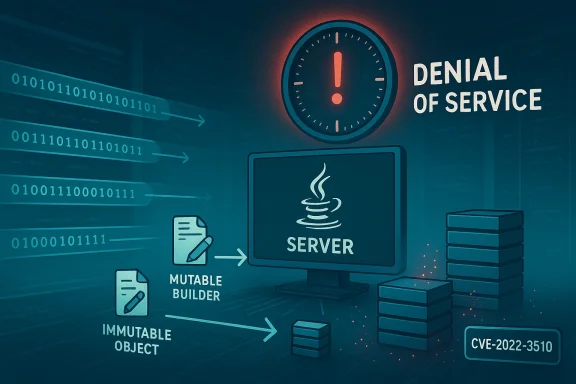
A subtle parsing bug in Google’s Protocol Buffers Java implementation (protobuf‑java and protobuf‑javalite) — tracked as CVE‑2022‑3510 — can be weaponized to produce prolonged garbage collection stalls and a practical denial‑of‑service against Java services that parse crafted messages using message‑type extensions. The flaw is not a remote code execution bug, but its availability impact is significant: malformed inputs that exploit message‑type extension parsing force repeated conversions between mutable and immutable message representations, generating heavy allocation churn and long GC pauses that can render servers unresponsive.
Protocol Buffers (protobuf) is a binary serialization format and a key dependency across countless Java applications, SDKs, clients and server-side services. When a widely used serialization library suffers a parsing inefficiency or correctness issue, the blast radius includes both direct consumers of the library and any product that bundles or shades a copy of it. CVE‑2022‑3510 is a textbook example of this problem: the vulnerability arises in the Java runtime’s handling of message‑type extensions and specific nested message shapes that provoke repeated mutable/immutable conversions and excessive allocations.
The vulnerability was publicly disclosed in December 2022 and has since been documented by standard trackers and vendor advisories. It affects both the full and lite Java runtimes of protobuf prior to patched releases; Google’s upstream fix was merged into the project and distributed in subsequent point releases. (github.com)
CVE‑2022‑3510 appears when an input contains multiple instances of non‑repeated embedded messages that themselves include repeated or unknown fields. Under those specific shapes the runtime may construct instances, merge them, then build again, toggling objects between mutable builder state and immutable message objects repeatedly. Each conversion can allocate new objects and buffers; when repeated at scale, that allocation churn forces the JVM into long garbage‑collection cycles. The result is prolonged stop‑the‑world pauses and drastically reduced throughput — an effective denial‑of‑service.
Vendors and distributions scored the bug as high‑severity for availability (typical CVSS v3.1 vector CVSS:3.1/AV:N/AC:L/PR:N/UI:N/S:U/C:N/I:N/A:H, base score 7.5), reflecting the network attack surface and low attack complexity. The impact classification is availability‑centred: confidentiality and integrity are not affected by the underlying parsing inefficiency.
Important nuance: a product can be vulnerable in two distinct ways.
Concretely, the fix reduces allocation pressure by:
Detection of active exploitation in the wild is hard because the symptom is resource exhaustion and degraded availability — which can have many causes. As of the last consolidated vendor advisories and vulnerability trackers, there are no broadly reported, reliable public proof‑of‑concept exploits weaponizing CVE‑2022‑3510 at scale. But the conceptual exploit is straightforward for any attacker able to reach a parsing endpoint, and therefore the operational risk is real.
A recurring operational challenge is that some vendor packaging decisions make it impractical to backport complex runtime changes into long‑term‑support releases; when the fix requires a refactor in parsing/merging logic, distributors may choose to ship a newer upstream version instead of a risky backport. That means product owners may need to plan version upgrades rather than simple package patching.
Source: MSRC Security Update Guide - Microsoft Security Response Center
 Background / Overview
Protocol Buffers (protobuf) is a binary serialization format and a key dependency across countless Java applications, SDKs, clients and server-side services. When a widely used serialization library suffers a parsing inefficiency or correctness issue, the blast radius includes both direct consumers of the library and any product that bundles or shades a copy of it. CVE‑2022‑3510 is a textbook example of this problem: the vulnerability arises in the Java runtime’s handling of message‑type extensions and specific nested message shapes that provoke repeated mutable/immutable conversions and excessive allocations.The vulnerability was publicly disclosed in December 2022 and has since been documented by standard trackers and vendor advisories. It affects both the full and lite Java runtimes of protobuf prior to patched releases; Google’s upstream fix was merged into the project and distributed in subsequent point releases. (github.com)
What exactly went wrong: a technical explanation
Message‑type extensions and mutable/immutable transitions
Protocol Buffers’ Java runtime historically uses builder patterns and immutable message objects to balance performance and safety. In some parsing paths, the runtime would build transient immutable instances, then merge fields into an existing message object — a pattern that’s normally harmless but becomes costly when repeated many times.CVE‑2022‑3510 appears when an input contains multiple instances of non‑repeated embedded messages that themselves include repeated or unknown fields. Under those specific shapes the runtime may construct instances, merge them, then build again, toggling objects between mutable builder state and immutable message objects repeatedly. Each conversion can allocate new objects and buffers; when repeated at scale, that allocation churn forces the JVM into long garbage‑collection cycles. The result is prolonged stop‑the‑world pauses and drastically reduced throughput — an effective denial‑of‑service.
Similarity to other protobuf parsing bugs
Security trackers explicitly compare this flaw to CVE‑2022‑3171 (another protobuf parsing issue) because both involve parsing logic that leads to pathological memory behavior rather than direct memory corruption. The difference here is the triggering construct: message‑type extensions interacting with repeated/unknown fields. That subtle combinatorial input shape is unlikely to appear in benign traffic but can be deliberately crafted by an attacker who can send arbitrary protobuf payloads.Scope and affected versions
Multiple authoritative trackers and vendor advisories converge on an affected‑version policy: protobuf‑java core and protobuf‑javalite releases prior to 3.21.7, 3.20.3, 3.19.6 and 3.16.3 are vulnerable. That means several minor‑branch ranges used in production may be affected, and embedded/shaded copies of older protobuf versions inside vendor binaries are an important additional risk.Vendors and distributions scored the bug as high‑severity for availability (typical CVSS v3.1 vector CVSS:3.1/AV:N/AC:L/PR:N/UI:N/S:U/C:N/I:N/A:H, base score 7.5), reflecting the network attack surface and low attack complexity. The impact classification is availability‑centred: confidentiality and integrity are not affected by the underlying parsing inefficiency.
Important nuance: a product can be vulnerable in two distinct ways.
- Runtime dependency: If your application or service depends dynamically on a vulnerable protobuf Java runtime, upgrading the library fixes the runtime in place.
- Embedded/shaded static dependency: Many enterprise products (appliances, SDKs, shaded jars inside larger applications) embed a copy of protobuf at build time. In that case, the vulnerable code persists in the shipped artifact until the vendor or integrator rebuilds or replaces the component. Triage therefore must include both package-level and artifact-level inventory.
What was fixed upstream
Google’s protobuf project merged a targeted change that changes how message‑type extensions are handled in the Java runtimes: rather than building up immutable instances and merging afterwards, the code now merges directly from the wire format into mutable message forms (where appropriate), reducing intermediate allocations and avoiding the repeated conversion cycle that caused GC churn. The upstream commit that addresses the issue is included in the project’s change set and mentioned in the release notes for the patched versions. (github.com)Concretely, the fix reduces allocation pressure by:
- Preferring in‑place merging into mutable builders during parsing.
- Avoiding unnecessary construction of temporary immutable objects that would then be copied or merged.
- Making the lite runtime behave in ways that minimize allocations when extensions are present.
Real‑world impact and exploitability
CVE‑2022‑3510 is an availability/Denial‑of‑Service vulnerability with practical exploitability wherever services accept untrusted protobuf binary input and use vulnerable protobuf‑java code to parse it. Exploitation does not require authentication in many scenarios; an attacker only needs the ability to send crafted protobuf messages to the vulnerable endpoint. The attacker must craft messages with the specific nested message shapes described above (non‑repeated embedded messages containing repeated or unknown fields), but once the shape is understood the exploit is relatively low‑complexity.Detection of active exploitation in the wild is hard because the symptom is resource exhaustion and degraded availability — which can have many causes. As of the last consolidated vendor advisories and vulnerability trackers, there are no broadly reported, reliable public proof‑of‑concept exploits weaponizing CVE‑2022‑3510 at scale. But the conceptual exploit is straightforward for any attacker able to reach a parsing endpoint, and therefore the operational risk is real.
Who must act: inventory, triage and prioritization
Prioritize remediation for:- Publicly accessible services that accept protobuf payloads directly (gRPC servers, custom binary RPC endpoints).
- Backend processing systems that deserialize messages from potentially untrusted sources (message queues, ingestion pipelines, API gateways).
- Products and third‑party libraries that embed or shade protobuf jars inside larger distribution artifacts (search thoroughly for bundled protobuf-java/javalite jars in your application images).
- CI/CD build hosts and container images used to build production artifacts: if those images contain an affected protobuf version and are used to produce binaries, downstream builds may carry the vulnerable code.
- Search your artifact repository and application classpaths for com.google.protobuf
 rotobuf‑java or protobuf‑javalite instances and record their versions.
 - Inspect third‑party binary distributions (shaded jars) for embedded protobuf classes. Tools like jar tf, unzip + grep, or automated SBOM scanners help here.
- For containerized workloads, scan base images and layers with up‑to‑date vulnerability scanners that detect protobuf Java vulnerabilities.
- Examine your service logs and JVM telemetry for unexplained or repeated full‑GC pauses and memory spikes during parsing operations; such signals can indicate exploitation or accidental triggers.
Mitigation and remediation: a practical playbook
Apply the following prioritized steps immediately.- Patch the library
- Upgrade protobuf‑java / protobuf‑javalite to one of the fixed releases: at least 3.21.7, 3.20.3, 3.19.6, or 3.16.3, depending on your current branch. These releases include the upstream fix that changes merging behavior to avoid the allocation churn.
- Rebuild shaded/embedded artifacts
- If any third‑party product or internal binary ships a shaded copy of protobuf (common in enterprise Java builds), replace or rebuild those artifacts with the patched version.
- For container images, rebuild images that include vulnerable protobuf jars and redeploy.
- Apply compensating controls while patching
- Limit exposure: restrict network access to protobuf parsing endpoints behind firewalls, rate limit suspicious clients, and require authentication where possible.
- Harden JVM settings: while JVM tuning is not a long‑term fix, enabling aggressive monitoring and bounding memory use (container memory limits, cgroup constraints) can reduce blast radius in emergencies.
- Input validation: implement higher‑level checks that reject unexpected extension‑heavy messages before the protobuf parser runs.
- Scan and verify
- Run binary scanners and SBOM analysis to ensure patched versions are in use across images and artifacts.
- Verify through testing that patched builds no longer exhibit pathological allocation during parsing of crafted test inputs.
- Monitor and harden
- Add alerts for long GC pauses and rapid memory growth on services that parse protobuf messages.
- Consider sandboxing untrusted parsing in a separate process with limited memory and CPU, so a single malicious input cannot crash the main service process.
Detection, hunting and verification guidance
Detecting this class of abuse requires a combination of inventory, telemetry analysis, and targeted tests.- Inventory: locate all places protobuf is used; prioritize endpoints reachable from the public internet or multi‑tenant networks.
- Telemetry signals: look for spikes in GC pause times, increased full‑GC frequency, sudden loss of throughput, or OutOfMemoryError patterns correlated to parsing calls.
- Test harness: write targeted unit/integration tests that feed crafted inputs (multiple non‑repeated embedded messages with repeated or unknown fields) into parsing paths in a controlled environment to confirm whether upgraded versions remove the pathological allocations.
- Static checks: CI pipelines should add dependency checks for protobuf versions and fail builds if a vulnerable version is included. Scanners like OSS‑scanners or SCA tools often flag known CVE‑versions; ensure they are tuned for Java shards and shaded jars.
Why this kind of bug matters: infrastructure and supply‑chain lessons
Parsing bugs that cause resource exhaustion are an insidious class of vulnerability: they do not directly modify memory or leak secrets, but they can render services unavailable and are easy for remote attackers to trigger if parsing endpoints are reachable. The practical lessons from this and similar CVEs are:- Keep dependencies current and treat language runtimes and serialization libraries as critical infrastructure.
- Build reproducible builds and SBOMs so you can trace which versions were used to produce any deployed binary.
- Beware of shaded/embedded third‑party libraries: they can silently carry vulnerable code into otherwise-patched environments.
- Invest in fuzzing and edge‑case testing for parsers: automated fuzzing has repeatedly discovered parsing flaws before they are abused in the wild. (github.com)
Vendor impact and follow‑through
Multiple vendors and distributions published advisories and product‑specific guidance after the disclosure. Some vendors chose to backport fixes into distribution packages; others required users to upgrade to a newer upstream protobuf release. In enterprise contexts where vendor appliances or SDKs embed protobuf, operators should consult vendor security bulletins and apply vendor‑supplied updates or replacement builds. Examples of vendor responses include distribution advisories from SUSE, Debian, and product bulletins that list affected versions and remediation steps.A recurring operational challenge is that some vendor packaging decisions make it impractical to backport complex runtime changes into long‑term‑support releases; when the fix requires a refactor in parsing/merging logic, distributors may choose to ship a newer upstream version instead of a risky backport. That means product owners may need to plan version upgrades rather than simple package patching.
Critical analysis: strengths of the response and remaining risks
Strengths- Upstream fix is focused and code‑level: Google’s merge avoids heuristics and eliminates the pathological allocation pattern rather than masking it. The change is visible in the project’s commit history and release notes. (github.com)
- Distributors and vendors reacted by publishing advisories and packaging updated protobuf releases, enabling standard remediation channels for many operators.
- Because the bug is a resource‑exhaustion class (not memory corruption), exploitation complexity is moderate and the primary mitigation — updating the library — is straightforward conceptually.
- Shaded copies and static linking: a patched system package does not automatically fix binaries that embed vulnerable protobuf versions. Rebuilding or replacing artifacts is operationally costly and easily overlooked, leaving production stacks vulnerable.
- Detection gaps: prolonged GC and service degradation are noisy signals; distinguishing malicious exploitation from accidental workload spikes requires careful telemetry and forensic testing.
- Vendor lag: some vendor products, especially those with long maintenance cycles, may take time to release updated builds. Operators of such products must weigh compensating controls while awaiting vendor updates.
Practical checklist for engineers and security teams
- Immediately identify all Java services that parse raw protobuf input and determine whether they rely on the Java runtime (protobuf‑java, protobuf‑javalite).
- Upgrade library dependencies to patched versions: at minimum 3.21.7, 3.20.3, 3.19.6, or 3.16.3 depending on your branch.
- Search for shaded/embedded protobuf jars in all deployed artifacts and schedule rebuilds where found.
- Add dependency checks to CI: fail builds that include vulnerable protobuf versions, and add SBOM generation to your pipelines.
- Harden parsing endpoints temporarily: rate‑limit, require authentication, and place them behind gateways or firewalls.
- Instrument JVMs for GC pause telemetry and alert on anomalous full‑GC durations correlated with parsing endpoints.
- If you cannot patch immediately, isolate parsing into a sandboxed process with strict memory limits to contain potential DoS attempts.
Conclusion
CVE‑2022‑3510 is a reminder that parser design and allocation strategies matter as much as memory safety. The issue — a parsing inefficiency in protobuf‑java’s message‑type extension handling — does not corrupt memory or expose secrets, but it can degrade availability in a way that is trivial to trigger from the network. The correct remedial action is clear: upgrade to the patched protobuf Java releases and rebuild any artifacts that embed older implementations. Beyond that immediate fix, this incident reinforces longer‑term operational disciplines: robust dependency inventory, reproducible builds, SBOMs, and testing that includes fuzzing and edge‑case inputs for parsers. The upstream fix was made available, vendors issued advisories, and the practical path to remediation is straightforward — the remaining work is execution at scale across supply chains and deployed artifacts.Source: MSRC Security Update Guide - Microsoft Security Response Center
