

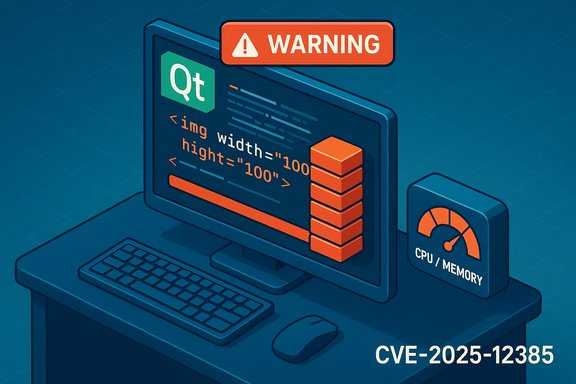
Qt maintainers have assigned CVE‑2025‑12385 to a serious input‑validation bug in the Qt Quick Text component that can be triggered by a crafted <img> tag and lead to excessive memory allocation and application unresponsiveness.
The Qt Quick Text component is the HTML‑style text renderer used widely in QML‑based UIs, and it supports simple inline tags such as <img> to embed images inside text runs. While convenient for developers, that rendering path must validate user‑supplied attributes (for example, width and height) before allocating resources to render an image. In this case, a missing or inadequate check for declared image dimensions in the Text parser means an attacker or malformed content can specify extreme sizes that cause the renderer to allocate vast amounts of memory, stall, or otherwise become unresponsive. CVE‑2025‑12385 was published on December 3, 2025 with a CVSS 4.0 base score assigned by the Qt CNA at 8.7 (high) and is described as an Allocation of Resources Without Limits or Throttling / Improper Validation of Specified Quantity in Input issue that impacts a broad range of Qt releases. Affected series include Qt 5.x and multiple Qt 6 branches up to the specified release points; vendors and integrators must map the specific CPEs for their bundles.
Two practical lessons from those incidents:
This vulnerability highlights a recurring engineering lesson: when UI convenience meets untrusted content, strict validation and defensive resource limits are non‑negotiable. The vendor has provided patches and clear mitigation guidance — the operational task now is rapid inventory, prioritized patching of internet‑facing and server parse paths, and short‑term hardening to buy time while rebuilds and rollouts complete.
Source: MSRC Security Update Guide - Microsoft Security Response Center
 Background / Overview
The Qt Quick Text component is the HTML‑style text renderer used widely in QML‑based UIs, and it supports simple inline tags such as <img> to embed images inside text runs. While convenient for developers, that rendering path must validate user‑supplied attributes (for example, width and height) before allocating resources to render an image. In this case, a missing or inadequate check for declared image dimensions in the Text parser means an attacker or malformed content can specify extreme sizes that cause the renderer to allocate vast amounts of memory, stall, or otherwise become unresponsive. CVE‑2025‑12385 was published on December 3, 2025 with a CVSS 4.0 base score assigned by the Qt CNA at 8.7 (high) and is described as an Allocation of Resources Without Limits or Throttling / Improper Validation of Specified Quantity in Input issue that impacts a broad range of Qt releases. Affected series include Qt 5.x and multiple Qt 6 branches up to the specified release points; vendors and integrators must map the specific CPEs for their bundles. Why this matters to WindowsForum readers
- Many cross‑platform desktop applications on Windows use Qt for their UI layer — from mainstream utilities to industrial software and embedded UIs. When those applications accept or render untrusted text content (chat messages, logs, file previews, auto‑rendered labels), they may invoke the same Text parsing routines that are vulnerable.
- The bug is not a simple typo or format error: it is a resource‑exhaustion and input‑validation problem. That makes it particularly dangerous for server‑side or service components that automatically render user‑supplied content (for example, thumbnailing services, preview generators, or collaborative apps that display remote messages). In those server scenarios, an unauthenticated remote attacker can trigger the condition by submitting crafted content — effectively turning a local UI bug into a network‑triggerable denial‑of‑service (DoS). Open vulnerability trackers explicitly list the attack vector as network with high availability impact.
Technical anatomy — what goes wrong
The vulnerable surface
The problem lives in the Text component parser in Qt Declarative (qtdeclarative). Text in QML can include rich text markup with tags such as <img src="..."> that accept optional width and height attributes. The parser historically trusted or insufficiently constrained these numeric attributes when creating the underlying image object or layout. When width/height values are very large or manipulated in certain ways, the renderer can allocate buffers or compute layout spans that exhaust memory or block the UI thread.Root causes (high level)
- Insufficient numeric validation: the parser failed to enforce sane upper bounds for width and height parsed from the <img> attributes, allowing overly large allocation requests.
- Lack of throttling/limits: there were no defensive allocation limits or fallback behaviors to gracefully refuse or clamp unreasonable resource requests.
- Untrusted input in a trusted path: Text is often treated as low‑risk content, so auto‑rendering paths (e.g., preview panes) may lack the additional sanitization that a network‑facing parser should have.
Observable impact
- Denial‑of‑Service (application unresponsive): The primary impact recorded by the vendor and databases is high availability impact: an app can hang, exhaust memory, or crash when parsing or rendering the crafted tag.
- Potential for larger operational impact: On servers that render images or previews automatically, repeated or large‑scale exploitation can exhaust worker pools and cause cascading service failures. This is the primary operational risk to production systems.
Verified facts and cross‑checks
- The vulnerability description, affected modules, and CWE classifications were published by The Qt Company in their security advisory and announcement for CVE‑2025‑12385. The vendor also lists the recommended mitigations (use trusted text sources or PlainText where rich text isn’t needed) and provides patches and updated releases.
- The NVD and other vulnerability databases index CVE‑2025‑12385 and list the same broad affected versions and the CVSS 4.0 base score of 8.7 contributed by the CNA (Qt). The NVD entry is consistent with the vendor advisory in describing the issue as allocation/excessive resource consumption stemming from missing validation of the <img> tag attributes.
- Third‑party vulnerability trackers (Tenable, OpenCVE, cvefeed and similar observability feeds) independently summarize the impact and reiterate the versions in scope; they also expose the practical attack vector (network, no privileges required) and call out a high availability impact. These independent mirrors corroborate the vendor’s technical classification and severity.
Scope and affected configurations — details defenders need
- Affected code: Qt Declarative (qtdeclarative) — the Text component parser used by Qt Quick.
- Affected versions: Qt from 5.0.0 through 6.5.10; and multiple Qt 6.x maintenance branches as listed by the vendor up to 6.10.0 (see vendor advisory for precise end points). The vendor provides patch diffs for 6.5, 6.8, 6.9 and 6.10 lines, and recommends updates to Qt 6.5.11, 6.8.6, or 6.10.1 where appropriate.
- Common real‑world exposures:
- Desktop apps that render user‑supplied or remote text (chat clients, collaborative document editors).
- Web‑connected apps that automatically render text received from the network.
- Server‑side preview or thumbnail pipelines that use Qt to render inline images or convert rich text to images or PDFs.
- Embedded appliances or commercial software that bundle Qt statically (static linking increases remediation effort because vendors must rebuild).
Attack scenarios and practical risk model
- Low friction DoS against desktop clients: an attacker can deliver a message or file containing a crafted <img> tag. If the victim’s app auto‑renders rich text, the parsing can lock the UI thread or exhaust memory, producing a denial‑of‑service that only requires the user to view or preview the content. No special privileges are required.
- Remote DoS of server processing pipelines: a public upload endpoint (CMS, webmail, containerized thumbnailing service) that automatically renders or sanitizes rich text using Qt can be abused by an unauthenticated attacker to submit a crafted payload, causing worker crash loops, process hangs, or exhaustion of container resources. This is the highest operational risk because it removes the need for human interaction.
- Exploitation beyond DoS: current public descriptions classify the flaw as resource exhaustion; there is no public indication that this specific weakness leads directly to arbitrary code execution. However, resource‑consumption bugs have practical value in multi‑stage attack chains (for example, as a diversion or to collapse telemetry) and can be paired with other vulnerabilities in complex exploit scenarios. Defenders should not assume non‑exploitation of chained attacks.
What’s patched and how to remediate
The Qt project published patches and released fixes for affected branches. The vendor advises upgrading to the earliest patched releases for the line your project uses (examples: Qt 6.10.1, 6.8.6, 6.5.11 — confirm exact subrelease for your distribution). Patch diffs and backports for the various branches are available in the project’s code review and release artifacts. If you cannot immediately upgrade, the vendor suggests configuring Text components to treat untrusted content as PlainText (avoiding rich text parsing) or ensuring that all Text input is from trusted sources. Immediate remediation checklist (recommended order)- Inventory: Identify all applications, services and libraries that embed Qt (statically or dynamically) and record the version of Qt Declarative/qtdeclarative in use.
- Patch: Upgrade to the vendor‑recommended patched versions for your branch, rebuild statically‑linked executables or update packages accordingly.
- Mitigate: Where patching is delayed, enforce conservative input handling: switch Text elements to PlainText for untrusted content, disable automatic rich‑text rendering for external input, and add reject/size‑check logic for any user‑supplied <img> attributes.
- Harden: Add resource limits for renderer subprocesses (memory limits, CPU quotas, timeouts) and isolate untrusted rendering in sandboxed processes or containers.
- Monitor: Watch for crashes or increased OOMs in renderer processes and track incoming content that contains inline HTML/IMG tags. Correlate upload timestamps with crash windows.
Developer guidance — code‑level fixes and hardening
- Validate numeric attributes strictly: clamp width/height attributes to a safe maximum (for example, a few thousand pixels rather than unbounded integers) and reject non‑numeric or pathological values.
- Fail safely: if parsing a tag would require allocations beyond a configured threshold, raise a controlled error and skip rendering rather than attempting the allocation.
- Avoid large synchronous work on UI threads: render heavy or untrusted content in dedicated worker threads or sandboxed renderer processes with resource quotas.
- Sanitize rich text upstream: convert incoming rich content to a sanitized internal representation (stripping or normalizing <img> tags) before handing it to the Text parser.
- Add fuzzing/unit tests for the Text parser input paths to detect regressions and to exercise boundary values for tag attributes.
Operational recommendations — triage and patching at scale
- Prioritize public‑facing services first: any server that accepts file uploads or renders user content should be patched within 24 hours where feasible.
- Staged deployment: rollout patches from canary → internal → external rings and monitor crash/telemetry channels for regressions.
- External vendor tracking: confirm with any third‑party vendors whose products bundle Qt that they have released updates or guidance; many commercial packages embed Qt statically and will require vendor updates or repackaging.
- Container/CI hygiene: rebuild container images and CI base images that include vulnerable Qt binaries; scanning registries for old base images will reduce persistent exposure.
- Detection: log and alert on suspicious inbound payloads that include <img> tags with width/height attributes outside expected ranges; increase logging retention for render process crashes for forensic capture.
Wider context — why image/markup parsers keep being a problem
This vulnerability is part of a recurring pattern: parsers for images, markup and document formats are attractive targets because they often accept complex, structured input and run in privileged or widely deployed contexts. Recent months have seen multiple high‑impact parsing vulnerabilities across image and graphics stacks that demonstrate similar operational consequences (DoS, memory disclosure, or worse) when bounds checks or state assumptions fail. Public incident analyses and vendor advisories repeatedly show that server‑side processing and automated preview pipelines are the most dangerous exposure path because they enable unauthenticated remote triggers.Two practical lessons from those incidents:
- Always treat image/markup parsing as untrusted input; apply the same defenses you would for network payloads.
- Defensive programming must combine input validation, allocation limits, and sandboxing; a single missing bounds check is often sufficient to cascade into widespread outages in modern pipelines.
Evidence of exploitation and PoC status (what we know now)
As of the public advisories and vulnerability mirrors examined at the time of writing, there is no widely published proof‑of‑concept exploit tied to CVE‑2025‑12385. Multiple trackers list exploitability as network and low complexity but do not show public exploit code. That absence does not mean low urgency — resource‑exhaustion primitives are relatively straightforward to weaponize in DoS campaigns, and PoCs typically appear quickly after disclosure. Treat unpatched endpoints as high risk until patched or mitigated. Cautionary note: statements about active exploitation in the wild should be treated conservatively unless confirmed by vendor telemetry, national CERTs, or multiple independent incident reports; the favored operational posture is to patch and harden quickly rather than await such confirmations.Detection and post‑incident steps
- Detection signals to watch for:
- Sudden spikes in renderer process CPU or memory usage after receipt of new inbound text payloads.
- Repeated OOMs or worker crashes correlated to content ingestion timestamps.
- Unusual network traffic patterns from clients repeatedly requesting or loading rich text resources containing <img> tags.
- Post‑incident collection:
- Preserve the exact payload that caused the crash (file, message, or HTTP body) and capture a process core or heap dump for analysis.
- Record environment state: Qt version, application version, OS, and any special render settings (PlainText vs rich text).
- If a service was impacted publicly, check logs for indicators of mass automated uploads and raise the priority for detection/hunting across ingress points.
Strengths, risks and final appraisal
Strengths- The vendor (Qt) published a clear advisory and supplied patch diffs and release guidance across affected branches, giving downstream packagers and integrators the material they need to remediate.
- Public indexing by NVD and major vulnerability trackers means enterprises can map CVE→CPE in their patch management platforms and automate remediation efforts.
- The broad set of affected versions and the prevalence of static linking across commercial apps mean the rollout will not be instantaneous; many applications may remain vulnerable in the long tail.
- Absence of a public PoC today does not reduce operational urgency. DoS attacks leveraging simple numeric constraints are easy to compose and can be weaponized against both desktop and server targets.
- Some vendor and distro feeds may lag in publishing rebuilt packages; teams must track upstream patches and ensure rebuilt artifacts are deployed into production.
- Treat CVE‑2025‑12385 as a high‑priority availability risk for any application or service that uses Qt’s Text parser on untrusted input. Patch promptly, harden rendering paths, and isolate untrusted parsing into constrained processes. The technical fix is straightforward, but the operational work (inventory, rebuilds, staged rollouts) is where most organizations will incur effort.
Practical one‑page action plan (for sysadmins & developers)
- Immediate (0–24 hours)
- Inventory: identify Qt usage and collect versions.
- Apply temporary mitigations: disable rich text rendering for untrusted sources; use PlainText where possible.
- If a public upload/service exists, consider temporarily disabling automatic preview/thumbnailing or rate‑limiting incoming content.
- Near term (24–72 hours)
- Deploy vendor patches or upgrade to the recommended fixed Qt releases.
- Rebuild and redeploy statically linked binaries and container images that include the vulnerable Qt runtime.
- Medium term (1–4 weeks)
- Add input size/clamping checks to any code that forwards <img> attributes to the Text component.
- Add resource quotas and sandboxing for rendering pipelines.
- Add unit/fuzz tests to exercise boundary conditions of the renderer.
- Ongoing
- Monitor crash telemetry and hunting logs for suspicious uploads.
- Maintain an authoritative mapping of CVE→package→build so you can verify remediated status across your fleet.
This vulnerability highlights a recurring engineering lesson: when UI convenience meets untrusted content, strict validation and defensive resource limits are non‑negotiable. The vendor has provided patches and clear mitigation guidance — the operational task now is rapid inventory, prioritized patching of internet‑facing and server parse paths, and short‑term hardening to buy time while rebuilds and rollouts complete.
Source: MSRC Security Update Guide - Microsoft Security Response Center
