

The Go toolchain disclosure CVE-2023-24531 reveals a deceptively simple but important weakness: the go env command prints a shell-script-style representation of environment variables without adequately sanitizing their values. If that output is executed as shell code, specially crafted environment values can cause unexpected behavior — ranging from the insertion of new variables to execution of arbitrary shell commands. The issue was addressed as part of the Go 1.21 milestone, but the practical risk and operational impact depend heavily on how teams use the go tool in scripts, CI pipelines, and container images. This feature explains the bug, demonstrates realistic attack scenarios, analyzes the real-world severity, and gives a prioritized, actionable mitigation plan for developers and operators who rely on Go toolchains.
That convenience is the root of the problem. When a command prints shell code that will later be executed, any value it inserts into that shell code must be correctly quoted and escaped. Failure to do so lets the value break out of the intended assignment and be interpreted as additional commands or as new variable definitions.
The vulnerable implementation emitted environment names and values directly into those assignment lines without ensuring that the value could not break the quoting context. For instance, values containing quotes, command substitutions, newlines, or other shell metacharacters could produce additional tokens when the output is executed.
Two simple demonstration cases illustrate the issue:
Why this matters: many CI pipelines include steps that auto-detect toolchain paths and environment with quick shell snippets. Attackers who can influence a pre-build step or a module used by a pipeline may escalate from code injection into full pipeline compromise.
Why this matters: an infected image can be pushed to a registry and consumed by downstream systems, producing a stealthy supply-chain foothold.
Why this matters: attackers often target developer machines as an entry point into build systems and source code.
Key supply-chain takeaways:
The right way to respond is two-fold. First, address the root: upgrade to a patched Go toolchain so the generator itself performs safe quoting. Second, eliminate the fragile pattern across your automation: stop executing go env output as shell scripts and prefer machine-readable formats or trusted quoting libraries. Together, these steps remove the immediate risk and harden your pipelines against a class of injection vulnerabilities that are otherwise easy to overlook.
This incident is a timely reminder: developer convenience features must be treated as potential security boundaries. Guard those boundaries by treating tool output as data, not executable code, and by applying defense-in-depth to your build and CI environments.
Source: MSRC Security Update Guide - Microsoft Security Response Center
 Background and overview
What go env is and how it's commonly used
The go command exposes go env to inspect the toolchain and environment variables the tool uses. By default, go env prints its output in a shell-friendly format (on POSIX systems that format looks like a series of NAME="value" assignments), and on Windows it prints a batch-file style representation. This behavior is convenient for shell scripting: many developers capture the output of go env, source it into a shell, or use it as a quick way to bootstrap environment variables for build scripts.That convenience is the root of the problem. When a command prints shell code that will later be executed, any value it inserts into that shell code must be correctly quoted and escaped. Failure to do so lets the value break out of the intended assignment and be interpreted as additional commands or as new variable definitions.
The vulnerability in plain language
CVE-2023-24531 is the name given to the problem where go env printed values directly into shell assignment statements without robust quoting and escaping. If a malicious actor can control environment values that go env prints — or a value already contains unexpected characters — then running the output through a shell (for example via piping into source or eval) can result in:- immediate execution of shell commands embedded in values,
- creation of additional environment variables that were not intended,
- injection of shell metacharacters leading to unexpected side effects during script execution.
How the bug works — technical breakdown
Vulnerable pattern
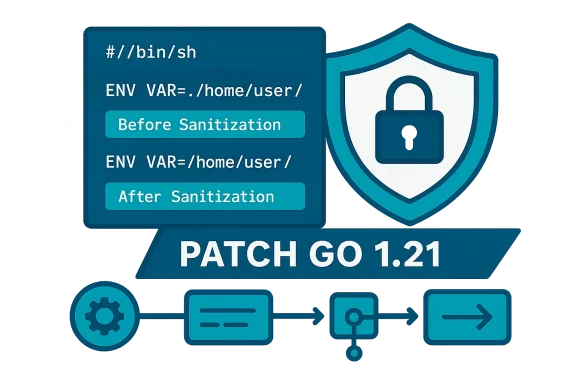
On POSIX systems, the naive output format for an environment assignment looks like:NAME="value"The vulnerable implementation emitted environment names and values directly into those assignment lines without ensuring that the value could not break the quoting context. For instance, values containing quotes, command substitutions, newlines, or other shell metacharacters could produce additional tokens when the output is executed.
Two simple demonstration cases illustrate the issue:
- Command substitution injection:
In this example, the CC value contains a command substitution that, when included in the unsanitized output and executed, runs echo to stderr.Code:$ CC='$(echo shell expansion 1>&2)' go env | source /dev/stdin shell expansion - Assignment-splitting to define new variables:
Here, the crafted CC value includes a quote and an assignment payload that gets interpreted as a separate variable when the output is executed.Code:$ CC=$(echo 'cc"'; echo 'OOPS="oops') go env ... CC="cc" OOPS="oops" ...
Root cause and fix
The root cause is the lack of robust shell escaping when producing a script-like textual representation. The correct fix is to pass every value through a well-tested, platform-aware quoting routine before printing. Quoting is subtle — naive approaches can still be bypassed — so the upstream remedy implemented proper shell quoting for POSIX output and equivalent safe output for Windows batch mode. The patch replaces raw value insertion with a function that escapes and wraps values so they cannot introduce new commands or assignments when the result is executed.Assessing impact and exploitability
When is this a real security problem?
The vulnerability only matters in environments where all three of the following are true:- An attacker can influence one or more environment variables that the local go tool will read (this could be local user-level control or attacker-provided values from a dependent process).
- Scripts or automation execute the output from go env as shell code (via source, eval, or similar), rather than parsing it safely.
- The execution context has privileges or access the attacker wants (for example developer workstations, CI runners, or container build agents).
- CI pipelines that run build steps as part of pull requests and source go env output could be coerced into executing attacker-supplied shell fragments, enabling pipeline-level compromise.
- Container image build steps that export environment variables from untrusted sources and then source go env output during image build could allow supply-chain insertion of commands.
- Local developer scripts that blindly source the output can be abused by a malicious plugin or a compromised tool in the developer workstation environment.
Where the severity is overstated and where it's meaningful
Some public scanners and aggregators have reported a very high severity score for this CVE, while other vendor advisories score it far lower. Both viewpoints can be accurate depending on context:- If an attacker already can set arbitrary environment variables on a target machine, they often have easier and more direct means to achieve compromise — so the marginal value of this vulnerability is limited in those environments.
- Conversely, in modern CI and supply-chain models, build-time inputs and module code may indirectly influence environment values or the way tools run. In those contexts, this vulnerability can materially increase the attack surface, because it converts a tooling convenience into an injection primitive that can jump from a dependency to a build system.
Realistic attack scenarios
1) Malicious module / CI vector
A compromised module or a third-party script used in CI might set or influence environment variables during a CI job (for example, by writing a wrapper or executing commands that set environment variables in the same process). If the job then runs go env and sources its output as part of a scripted environment setup, the module can inject commands that the CI runner will execute.Why this matters: many CI pipelines include steps that auto-detect toolchain paths and environment with quick shell snippets. Attackers who can influence a pre-build step or a module used by a pipeline may escalate from code injection into full pipeline compromise.
2) Container image build-time injection
Container build scripts often set environment variables to configure builds. If a Dockerfile or build script captures environment state and then executes go env output in a RUN or entrypoint script, crafted environment values can execute during image build, embedding malicious behavior in a resulting image.Why this matters: an infected image can be pushed to a registry and consumed by downstream systems, producing a stealthy supply-chain foothold.
3) Local developer toolchain abuse
On a developer workstation, a maliciously-installed tool, plugin, or terminal utility might add crafted environment entries. If the developer uses convenience scripts that source go env's output, the injected commands run in the developer's shell, enabling credential theft, lateral movement, or artifact tampering.Why this matters: attackers often target developer machines as an entry point into build systems and source code.
Detection, indicators, and auditing
What to look for
- Scripts or CI job definitions that pipe the output of go env into source/eval or otherwise execute it directly.
- Unexpected environment variables appearing during builds, especially ones created around the time a module or dependency was updated.
- Shell history, CI logs, or container build logs that show go env output being executed.
- Infected images or build artifacts with modifications that could have resulted from code executed during build.
Practical detection steps
- Search source repositories and CI configs for occurrences of patterns like: piping go env into source, eval, or similar shell execution constructs.
- On build runners and developer machines, audit shell startup files and build wrapper scripts for use of go env output execution.
- Monitor artifact and image provenance for unexpected modification timestamps or extra files created during build steps.
Remediation and mitigation (prioritized)
Immediate mitigations (apply right away)
- Stop executing the raw output of go env. Replace patterns like:
- go env | source /dev/stdin
- eval "$(go env)"
with safer alternatives. - Use JSON output instead: run go env -json and parse the JSON with a language-native parser rather than executing it in a shell. This avoids shell parsing pitfalls entirely.
- If you must produce shell assignments, ensure values are passed through a robust quoting/escaping routine. Prefer library-provided quoting rather than rolling ad-hoc quoting.
Short-term fixes
- Upgrade Go toolchains on build runners, developer images, and developer machines to a patched release (the fix landed as part of the Go 1.21 milestone; upgrade to that release or later where the fix is present).
- For platforms that backport security fixes, apply vendor-supplied patches if you cannot immediately upgrade the toolchain.
- Harden CI job privileges: ensure runners execute under constrained accounts that cannot access sensitive secrets even if a build step is compromised.
Long-term strategies
- Avoid executing generated shell scripts. Prefer structured, machine-parseable data (JSON, YAML) for tooling outputs.
- Put strict controls around what inputs can influence build environments: reduce the set of environment variables that can be set by external code, enforce environment sanitization policies in CI.
- Adopt reproducible-build practices and signed build artifacts where possible to reduce risk from build-time injection.
- Regularly scan all machine images and CI base images for vulnerable Go versions or known vulnerable binaries.
Patching guidance and vendor handling
Which versions are affected
The vulnerability affects cmd/go implementations before the patched release (the correction was included in the 1.21 milestone). The precise affected range is “versions before go1.21.0-0” in official vulnerability listings. Many Linux distribution advisories and OSV records map the issue to packages of golang that are older than that fixed release; vendors may also have backported resolvers for long-term-support releases.How to remediate in practice
- Run go version on build hosts and developer machines. If the version predates the fixed release, schedule upgrades.
- If you rely on distribution packages of golang, check your vendor's security advisories and apply their updates or upgrade to a distribution release that includes the backport.
- For environments where you cannot immediately replace the toolchain, apply the short-term mitigations above: stop sourcing go env output and sanitize inputs.
Why tooling-level bugs like this matter to supply-chain security
This CVE is a reminder that the boundary between convenience and security in developer tooling is thin. Tooling that emits code or configuration intended for execution creates a high-stakes contract: the tool must either produce safe, sanitized code or documentation must explicitly warn against executing the output. Historically, toolchains that print executable fragments introduce fragile expectations that are easily violated in complex, automated pipelines.Key supply-chain takeaways:
- Treat tool outputs as data first; prefer structured formats over “executable-as-text”.
- Assume at-scale automation may inadvertently execute outputs from multiple transient or third-party sources.
- Layer defense: even if upstream tools are patched, ensure CI systems and build images are configured defensively (least privilege, immutable base images, isolated runners).
Risk matrix and recommended timeline for remediation
High priority (apply within hours to days)
- Disable any steps that execute go env output in CI pipelines or automated builds.
- Update build runners to use patched Go tool versions or vendor-provided security updates.
- Replace any eval/source usage with go env -json parsing.
Medium priority (apply in days to weeks)
- Audit developer scripts and onboarding guides for patterns that rely on sourcing go env output; update documentation and templates.
- Harden CI runner privileges, secret access, and artifact push gates to reduce the impact of a compromised pipeline.
Low priority (apply in weeks to months)
- Adopt reproducible builds and pin module versions used by CI pipelines.
- Add automated scans that flag old go versions in images and runners.
Detection hardening and incident response playbook
If you suspect this vulnerability was abused in your environment:- Immediately isolate the affected runner or image build host and preserve logs and filesystem state.
- Identify the build or commit that introduced the change and inspect module updates, pre-build scripts, and environment injection points.
- Rotate keys and secrets accessible on the compromised runner, and invalidate any credentials or tokens that could have been exfiltrated.
- Rebuild artifacts from verified sources using patched toolchains and hardened runners, and validate artifact integrity before publication.
- Conduct a root-cause analysis of how untrusted values reached a step that executed tool-generated code.
Practical developer checklist
- Stop using eval "$(go env)" or piping go env into shell execution.
- Where you need environment values, use go env -json and a proper JSON parser.
- Upgrade to a Go release that includes the fix (Go 1.21 or a vendor-patched package).
- Audit CI, container builds, and local scripts for unsafe use of tool-generated shell fragments.
- Enforce least privilege on build agents; remove unnecessary environment exposure.
- Educate developers: avoid trusting textual outputs from tools as executable scripts.
Conclusion
CVE-2023-24531 is a textbook example of a tooling-level sanitation mistake that can turn convenience into attack surface. On its face the bug is simple: go env produced shell-code-like output without fully escaping values. In isolation, the exposure is limited — an attacker must be able to control environment values and those values must ultimately be executed as shell code — but the reality of modern CI, container builds, and automated toolchains makes that chain of events plausible and dangerous.The right way to respond is two-fold. First, address the root: upgrade to a patched Go toolchain so the generator itself performs safe quoting. Second, eliminate the fragile pattern across your automation: stop executing go env output as shell scripts and prefer machine-readable formats or trusted quoting libraries. Together, these steps remove the immediate risk and harden your pipelines against a class of injection vulnerabilities that are otherwise easy to overlook.
This incident is a timely reminder: developer convenience features must be treated as potential security boundaries. Guard those boundaries by treating tool output as data, not executable code, and by applying defense-in-depth to your build and CI environments.
Source: MSRC Security Update Guide - Microsoft Security Response Center
