

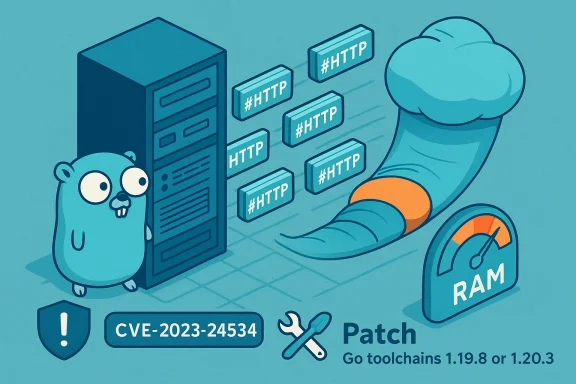
A subtle bug in the Go standard library’s HTTP and MIME header parsing — tracked as CVE-2023-24534 — allows specially crafted requests to force excessive memory allocation inside the net/http and net/textproto packages, producing a practical denial-of-service (DoS) vector that can exhaust process memory and take services offline; operators must treat this as a high-availability risk and apply fixes or mitigations immediately. (go.dev)
The Go programming language’s standard library is ubiquitous across cloud-native stacks, infrastructure tools, proxies, and many end-user services. The net/http and net/textproto packages implement core HTTP and MIME header parsing routines used by both servers and clients. In early April 2023 the Go project assigned CVE‑2023‑24534 to a parsing codepath that, under certain unusual input patterns, allocated substantially more memory than necessary while parsing HTTP or MIME headers. The consequence is that small network requests — crafted to trigger the pathological allocation behavior — can cause a server process to consume large amounts of RAM and either crash or become unresponsive. (go.dev)
The vulnerability is a classical resource exhaustion (CWE‑400) issue: the attacker does not gain code execution or data disclosure but can impact availability by driving memory usage to the point where the process is killed, the host OOMs, or service threads become starved. Several downstream distributors and vendors cataloged the problem and pushed updates, and the Go project issued fixes in later minor releases.
This kind of bug usually arises from logic that attempts to be generous about capacity growth (pre‑allocation or growth-by-factor), but then bases that growth on an attacker‑controlled value (for example, counts of separators, artificially produced header fields, or repeated empty tokens). The result: the server constructs a large internal structure and retains it while processing the request, inflating the process RSS and heap. The fix changes the parsing routine so it measures and bounds allocations more conservatively and only commits memory proportional to the real, parsed header content. (go.dev)
Because Go is commonly statically linked into binaries, many production services that use Go need a two‑step remediation:
Realistic exploitation scenarios:
If you cannot immediately rebuild and redeploy, adopt layered mitigations to reduce exposure:
Large projects that embed Go (for example, proxies, ingress controllers, and infrastructure tooling) often released rebuilds or new minor releases that include the patched runtime; check vendor release notes and upgrade paths for each third‑party component. Community projects such as Traefik, Grafana and others announced builds or guidance for affected versions in the wake of Go fixes.
Note on Microsoft attestation language: some vendors’ public notices (for example, product attestations that a given distribution includes the implicated library) are inventory-level statements and should be read as scoped attestations for the enumerated product; they do not imply exhaustive mapping across all products that might transitively include the same library. Review vendor attestation text to determine whether a given product installation is in scope.
Action now: prioritize inventory, rebuild with the patched toolchain, and apply layered mitigations at the edge and host level until all production artifacts are confirmed rebuilt and redeployed. Keep monitoring for unusual small‑request traffic patterns and watch for vendor advisories that affect third‑party components you run. (go.dev)
Conclusion: Treat this as an urgent availability incident for any internet-facing Go service; patching and rebuild are required to close the exposure permanently, while defensive configuration and network controls can lower the short‑term risk during the remediation window. (go.dev)
Source: MSRC Security Update Guide - Microsoft Security Response Center
 Background / Overview
The Go programming language’s standard library is ubiquitous across cloud-native stacks, infrastructure tools, proxies, and many end-user services. The net/http and net/textproto packages implement core HTTP and MIME header parsing routines used by both servers and clients. In early April 2023 the Go project assigned CVE‑2023‑24534 to a parsing codepath that, under certain unusual input patterns, allocated substantially more memory than necessary while parsing HTTP or MIME headers. The consequence is that small network requests — crafted to trigger the pathological allocation behavior — can cause a server process to consume large amounts of RAM and either crash or become unresponsive. (go.dev)The vulnerability is a classical resource exhaustion (CWE‑400) issue: the attacker does not gain code execution or data disclosure but can impact availability by driving memory usage to the point where the process is killed, the host OOMs, or service threads become starved. Several downstream distributors and vendors cataloged the problem and pushed updates, and the Go project issued fixes in later minor releases.
What exactly is wrong? The technical root cause
At a technical level the bug sits in the parser used for HTTP and MIME header tokens. When the parser encountered certain input sequences it would estimate and allocate a capacity (slice or buffer capacity) that was far larger than the memory needed to hold the actual parsed values. That over‑provisioning happened even for small requests, meaning an attacker could send low‑bandwidth requests that nonetheless forced the server to allocate large heaps per connection.This kind of bug usually arises from logic that attempts to be generous about capacity growth (pre‑allocation or growth-by-factor), but then bases that growth on an attacker‑controlled value (for example, counts of separators, artificially produced header fields, or repeated empty tokens). The result: the server constructs a large internal structure and retains it while processing the request, inflating the process RSS and heap. The fix changes the parsing routine so it measures and bounds allocations more conservatively and only commits memory proportional to the real, parsed header content. (go.dev)
Why this is more dangerous operationally than it looks
- It’s asymmetrical: the attacker sends small network traffic while the victim allocates large RAM, making the attack cheap for the adversary and costly for the target.
- It can be parallelized: multiple simultaneous crafted connections multiply the memory impact.
- It often bypasses simple throughput-based rate limits because each request is small and cheap to send but expensive to process.
Affected versions and vendor responses
The Go project fixed the issue in specific point releases and the vulnerability notice identifies the patched lines. The practical guidance from Go and downstream vendors was:- Upgrade affected Go runtimes and rebuild binaries with fixed releases: Go 1.19.8 or Go 1.20.3 and later contain the fix. (go.dev)
Because Go is commonly statically linked into binaries, many production services that use Go need a two‑step remediation:
- Update the Go toolchain used to build the binary (to a patched release).
- Rebuild and redeploy the service binary so the fixed standard library is embedded.
Exploitation scenarios and practical impact
Attackers can exploit the bug remotely (no authentication required) by sending malformed or unusual header sequences that trigger the pathologic allocation behavior in servers or proxies that parse HTTP/MIME headers via the vulnerable libraries.Realistic exploitation scenarios:
- An internet-facing API or microservice written in Go or using a Go-built reverse proxy can be targeted with thousands of small crafted requests; each request inflates process memory and eventually brings the service down under aggregate pressure.
- Shared hosting or multi‑tenant proxies that maintain many simultaneous connections are especially at risk because a single unpatched proxy process holding many inflated allocations can deplete host memory across tenants.
- Containerized services with low memory limits or strict cgroup quotas can hit their limits quickly and be OOM‑killed.
Detection: how to tell if you’re vulnerable or being targeted
- Inventory: find Go-based binaries and determine the standard library version embedded in them — use the
go version -m <binary>command or thedebug/buildinfofunctions to read embedded build info where available. Note that some binaries built with older toolchains or built withgo buildmay omit detailed module metadata; you may need to consult your build pipeline or CI to know the Go toolchain version used to produce a release. - Monitor memory patterns: sudden, unexplained per‑process RSS or heap increases coincident with inbound HTTP requests — particularly when requests are small in size — are suspicious. Look for:
- Repeated small requests that cause incremental memory growth.
- Elevated numbers of in‑flight connections that correlate with memory pressure.
- OOM killer logs or process termination messages tied to the web server or proxy processes.
- Logging and instrumentation: instrument application handlers and HTTP middleware to log header counts, header sizes, and parse errors. Establish baselines for typical header cardinality and header sizes; deviations often signal probing attempts.
- Network telemetry: WAF logs, reverse proxy access logs and IDS/IPS alerts can show patterns of similarly malformed requests. Because the attack uses small requests, look for repeated hits from the same IPs or IP ranges with unusual header patterns.
Mitigation and remediation — short and long term
The only complete and reliable remediation for CVE‑2023‑24534 is to install patched Go runtime packages and rebuild/redeploy any Go binaries that embed the standard library, or to apply vendor-supplied binary updates where available. That is the immediate, highest‑priority action. (go.dev)If you cannot immediately rebuild and redeploy, adopt layered mitigations to reduce exposure:
- Patch and rebuild as soon as possible (primary fix). Rebuild your Go binaries using Go 1.19.8 or 1.20.3 (or later) and redeploy. (go.dev)
- Apply network controls:
- Rate limit suspicious clients and IP ranges at the edge.
- Block or throttle requests that present extremely unusual header patterns.
- Use a WAF with custom rules to reject malformed headers patterns and limit header counts.
- Limit header processing resource exposure in the application:
- Set Server.MaxHeaderBytes to a conservative value appropriate for your application; this caps the number of bytes read for headers and helps reduce the surface for header‑size-based abuse. Note: MaxHeaderBytes is a defensive control but may not fully eliminate the specific allocation pattern exploited here, so it’s a mitigation not a cure.
- Use http.MaxBytesReader for request bodies to cap body size processing.
- Tune connection and read timeouts (ReadHeaderTimeout, ReadTimeout) to prevent idle or stalled connections from holding inflated structures.
- Host-level resource containment:
- Run services in containers or with cgroups and set sensible memory limits so a single service cannot consume all host RAM.
- Use orchestration health checks and restart policies to recover misbehaving pods/processes automatically.
- Observability and alerting:
- Add alerts for per-process memory increases over short intervals.
- Correlate memory spikes with request patterns to spot targeted probing.
- Vendor patches:
- Apply vendor-supplied OS or package updates for golang or downstream packages as they are released by your distribution. Several distributions and vendors have already issued updates; install them promptly.
Rebuild guidance and supply-chain considerations
Because Go programs are frequently built into statically linked binaries, remediation requires rebuilding — not just updating a system package at runtime. Follow these steps:- Update your build environment to a patched Go toolchain (1.19.8 or 1.20.3+). (go.dev)
- Rebuild all production artifacts that link the standard library. This includes CLI tools, sidecars, proxies, and any custom HTTP servers.
- Run your standard test suite and memory/stress tests to validate that the rebuild does not alter runtime behavior.
- Deploy using your orchestration or release pipeline, using rolling updates to minimize service disruption.
- Confirm the running binary’s build info (where present) using
go version -m <binary>ordebug/buildinfoAPI on the running process; remember that some build methods may not embed module metadata, so keep build logs and CI metadata for verification.
go build may omit module version metadata and show ICODE[/ICODE] for the main module unless built with go install or explicit versioned build steps. If your deployment pipeline does not embed build metadata automatically, maintain build records in your CI to prove which toolchain produced a given artifact.Detection and hunting checklist for incident responders
- Map the inventory: find any services that embed Go or are written in Go.
- Check binary build info when possible:
go version -m /path/to/binaryor usedebug/buildinfofor running processes. - Search logs for suspicious small requests with unusual header counts or characters.
- Look for correlations between inbound HTTP traffic and memory spikes; instrument histograms of headers-per-request and header-size distributions.
- Scan images and images’ layers for Go toolchain presence and the contained Go version. Many registries and container scanners now flag the CVE; use them as an additional signal.
- If you find evidence e affected services and schedule urgent rebuild/deploy with patched runtime.
Vendor and ecosystem impact (what vendors said and did)
Multiple vendors, distributions and security trackers catalogued and distributed fixes after the disclosure. The NVD and distribution advisories document the vulnerability description and list the fixes; SUSE explicitly listed the fix in the Go 1.20.3 update. Many major distributions (Red Hat, Debian, Amazon Linux, Ubuntu derivatives and container images) incorporated patched Go packages and issued security advisories and updates. Operators relying on vendor-supplied packages should apply those OS updates as a priority.Large projects that embed Go (for example, proxies, ingress controllers, and infrastructure tooling) often released rebuilds or new minor releases that include the patched runtime; check vendor release notes and upgrade paths for each third‑party component. Community projects such as Traefik, Grafana and others announced builds or guidance for affected versions in the wake of Go fixes.
Note on Microsoft attestation language: some vendors’ public notices (for example, product attestations that a given distribution includes the implicated library) are inventory-level statements and should be read as scoped attestations for the enumerated product; they do not imply exhaustive mapping across all products that might transitively include the same library. Review vendor attestation text to determine whether a given product installation is in scope.
Strengths and limits of the fix — critical analysis
Strengths- The Go project produced a targeted fix that corrects the allocation logic in the header parser, addressing the root cause rather than merely adding superficial limits. That reduces the chance of false positives or breaking legitimate HTTP usage. (go.dev)
- Vendor updates (OS packages and rebuilt artifacts) allow many operators to remediate without changing application code or runtime configuration in most cases.
- Rebuild requirement: Because many deployments embed the standard library into statically linked binaries, the fix cannot be applied simply by swapping a shared library at runtime — you must rebuild and redeploy, which takes time and coordination. This increases window of exposure. (go.dev)
- Detection gaps: Not all binaries embed build metadata, making it nontrivial to inventory affected artifacts automatically. Build pipelines that do not record toolchain versions add operational risk.
- Workarounds are incomplete: Configuration knobs such as MaxHeaderBytes and timeouts are useful mitigations but may not fully prevent every exploitation pattern; they can also break legitimate clients if set too tight. Treat them as part of layered defense rather than a replacement for the patch.
Practical checklist (what to do now — prioritized)
- Immediately identify all Go-based services and CI pipelines; mark high-exposure internet-facing services for priority remediation.
- Upgrade your build environment to Go 1.19.8 or 1.20.3+ and rebuild artifacts; validate in staging and deploy using rolling updates. (go.dev)
- Apply vendor OS/package updates where your distribution provides patched golang packages or rebuilt application packages.
- Add or tighten edge rate limits and WAF rules to drop clearly malformed header sequences and limit request rates from unknown sources.
- Configure reasonable
MaxHeaderBytesand read/parse timeouts on servers and proxies to reduce exposure while you rebuild. Be cautious with values to avoid breaking legitimate traffic. - Instrument and alert on rapid per-process memory growth correlated with incoming HTTP traffic.
- Retain build provenance: ensure CI pipelines embed and record the Go toolchain version used to produce binaries for post‑incident verification.
Final assessment and closing guidance
CVE‑2023‑24534 is a high‑impact availability vulnerability with straightforward remediation: update to the patched Go releases and rebuild affected binaries. The risk is operational — not an immediate data breach — but it can cause serious, sustained outages if attackers exploit it against high‑traffic endpoints, proxies, or multi‑tenant services. The Go project’s fix addresses the root cause; however, the practical challenge for many organizations is the need to rebuild and redeploy artifacts and to ensure that build metadata is traceable for rapid verification.Action now: prioritize inventory, rebuild with the patched toolchain, and apply layered mitigations at the edge and host level until all production artifacts are confirmed rebuilt and redeployed. Keep monitoring for unusual small‑request traffic patterns and watch for vendor advisories that affect third‑party components you run. (go.dev)
Conclusion: Treat this as an urgent availability incident for any internet-facing Go service; patching and rebuild are required to close the exposure permanently, while defensive configuration and network controls can lower the short‑term risk during the remediation window. (go.dev)
Source: MSRC Security Update Guide - Microsoft Security Response Center
